|
||||||
Access Beginner 1The Absolute Beginners Guide to Microsoft Access Start Here!Access Beginner Level 1 is the perfect starting place for anyone who needs to learn the basics of building databases with Microsoft Access. This class is for the beginner who has little or no experience with Access, however even if you've been working with Access for some time, you may still benefit from these lessons. Consider this the perfect way to learn the fundamentals. Get started by watching the introduction lesson on this page. To continue on with the full class, click on the Watch Now button below. Watch Now for Free!All of my Beginner Level 1 courses are absolutely FREE. Click on the Watch Now button to begin.
What's Next?
Quick Start
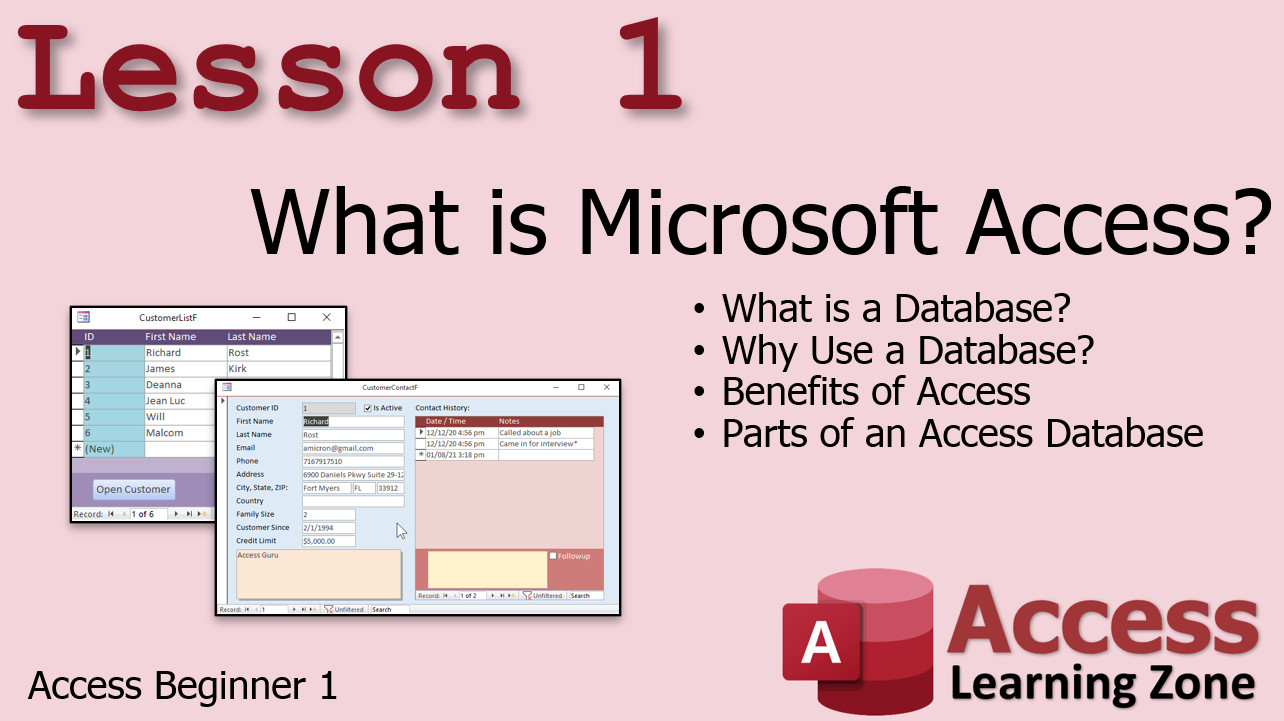
ResourcesTopics CoveredIn Lesson 1, we're going to learn what Microsoft Access is, and what it's used for. You will learn some database terminology. We'll discuss the benefits of a database. We will learn about the parts of a Microsoft Access database including tables, queries, forms, and reports.
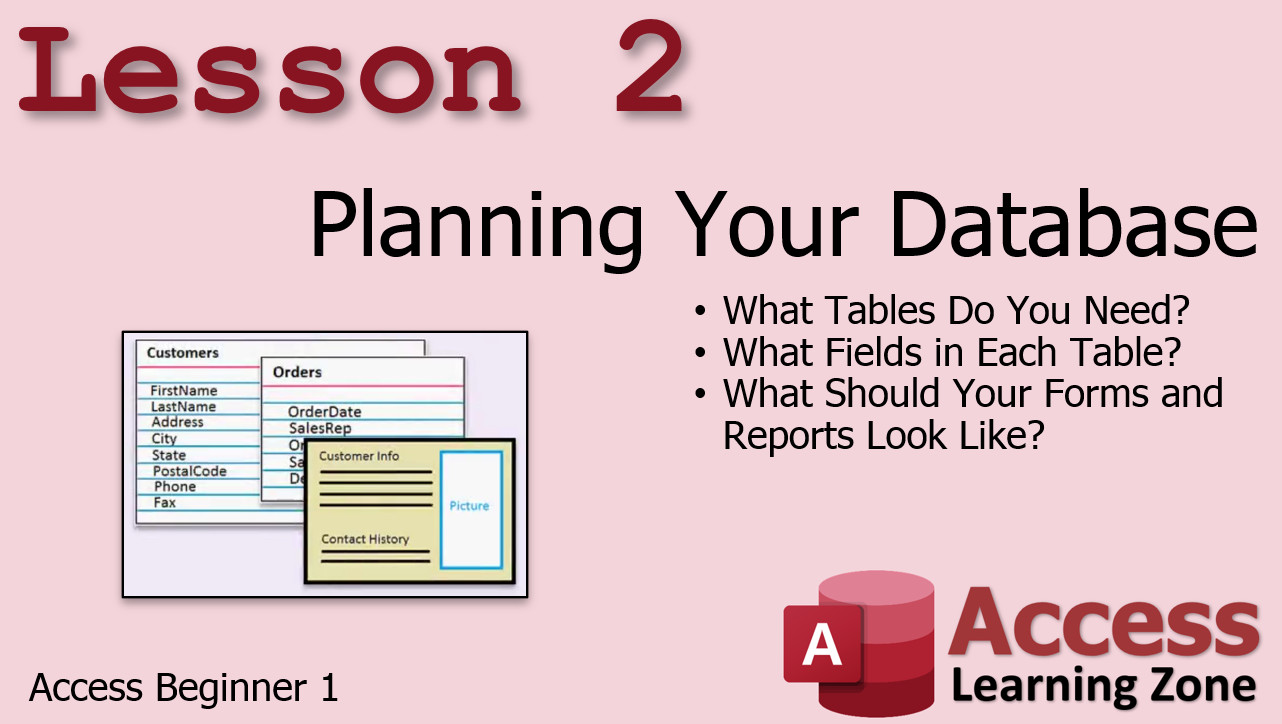
In Lesson 2, we're going to discuss planning your database. What tables do you need? What fields should go in each table What should your forms and printed reports look like?
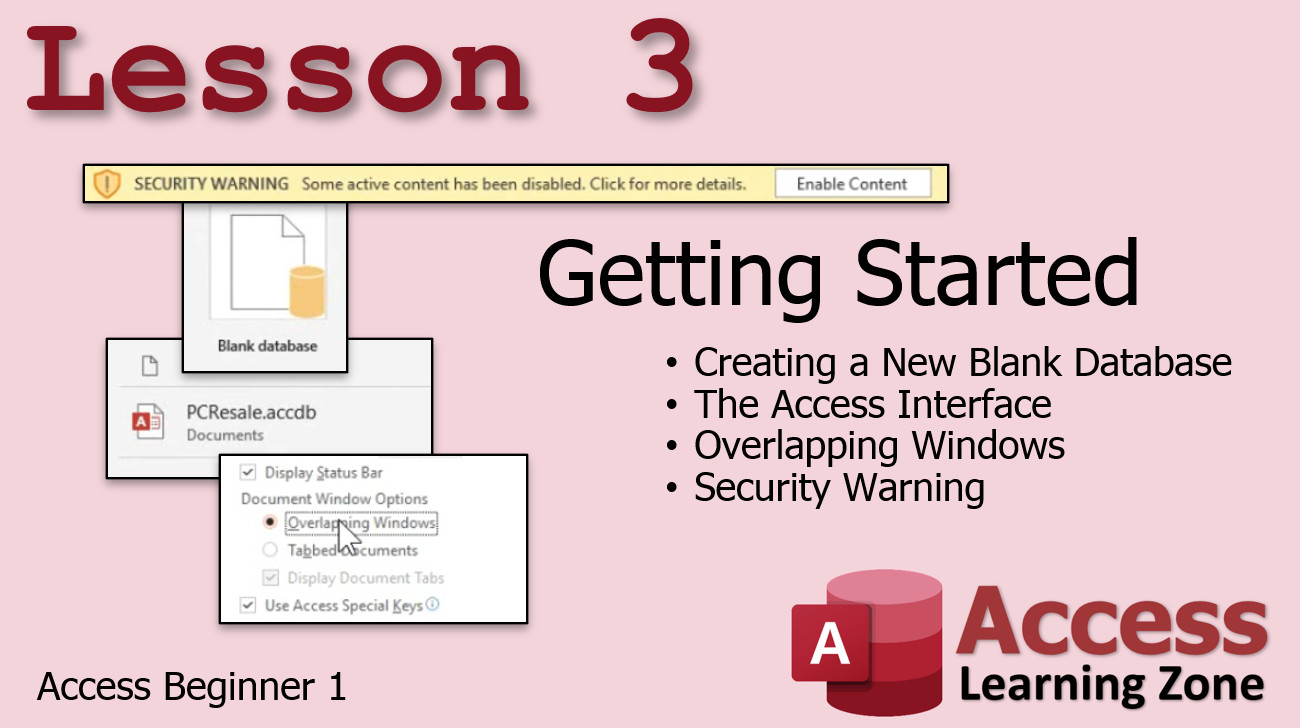
In Lesson 3, we're going to get started creating our first new blank database file. We'll go over the Access Interface, switch the setting from Tabbed Documents to Overlapping Windows, and we'll learn how to handle that security warning that comes up when you open an Untrusted Database.
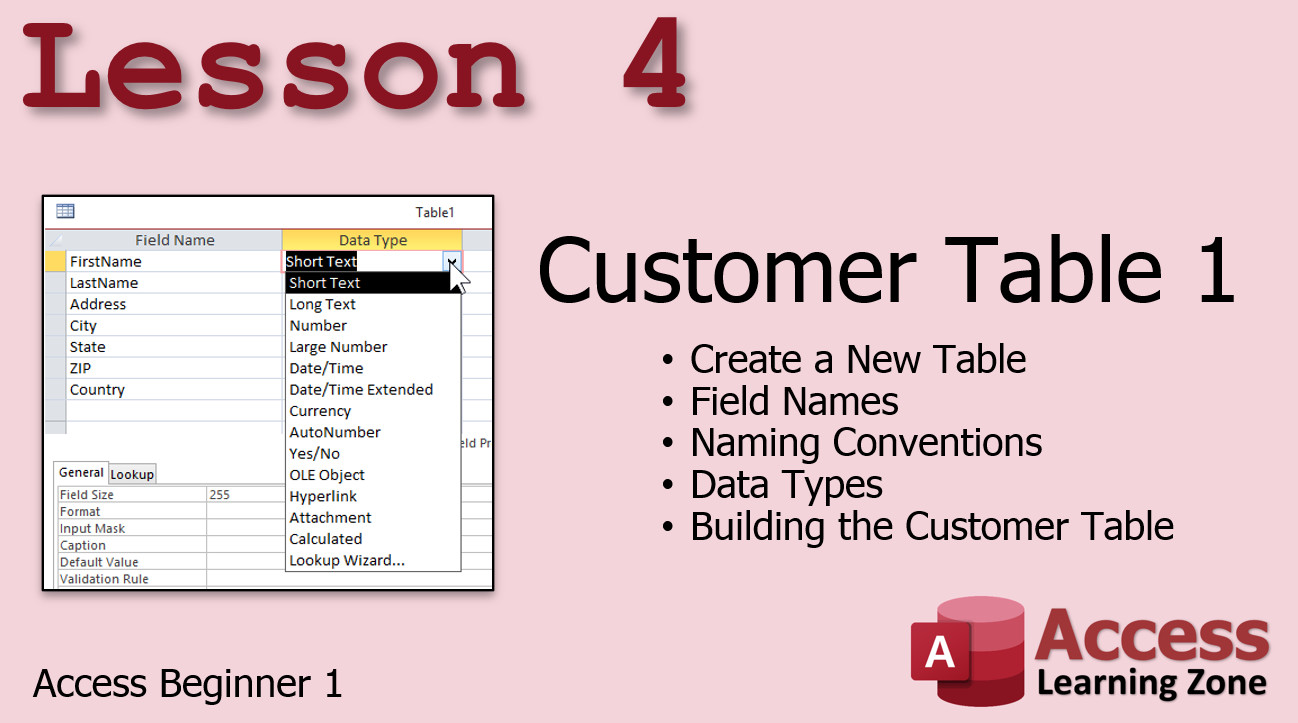
In Lesson 4, we're going to create our first table. We'll learn about field names, naming conventions, data types, and we'll start building the Customer Table.
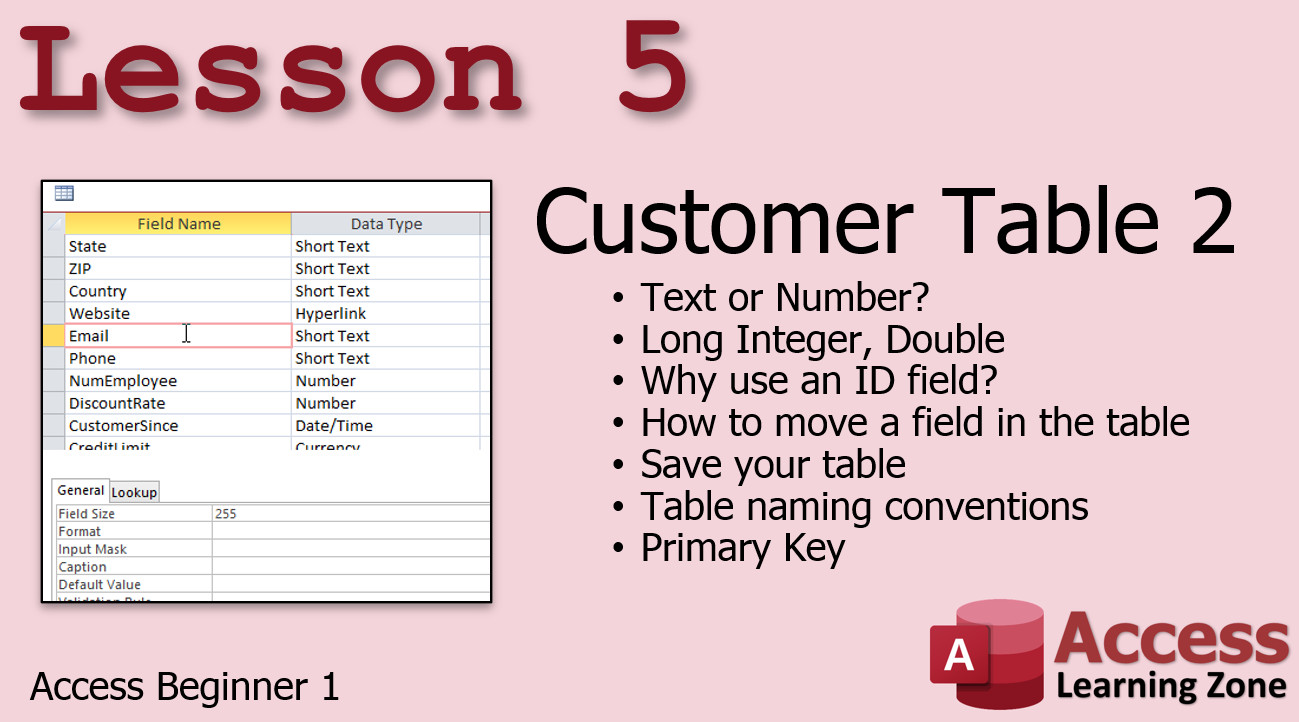
In Lesson 5, we're continuing with building the Customer Table. We're going to decide whether certain fields should be text or number. We'll learn about long integers and doubles. We'll see why you should always include an AutoNumber ID field. You'll see how to move fields around in the table. We'll save our table, and learn about naming conventions. We'll learn about the Primary Key field.
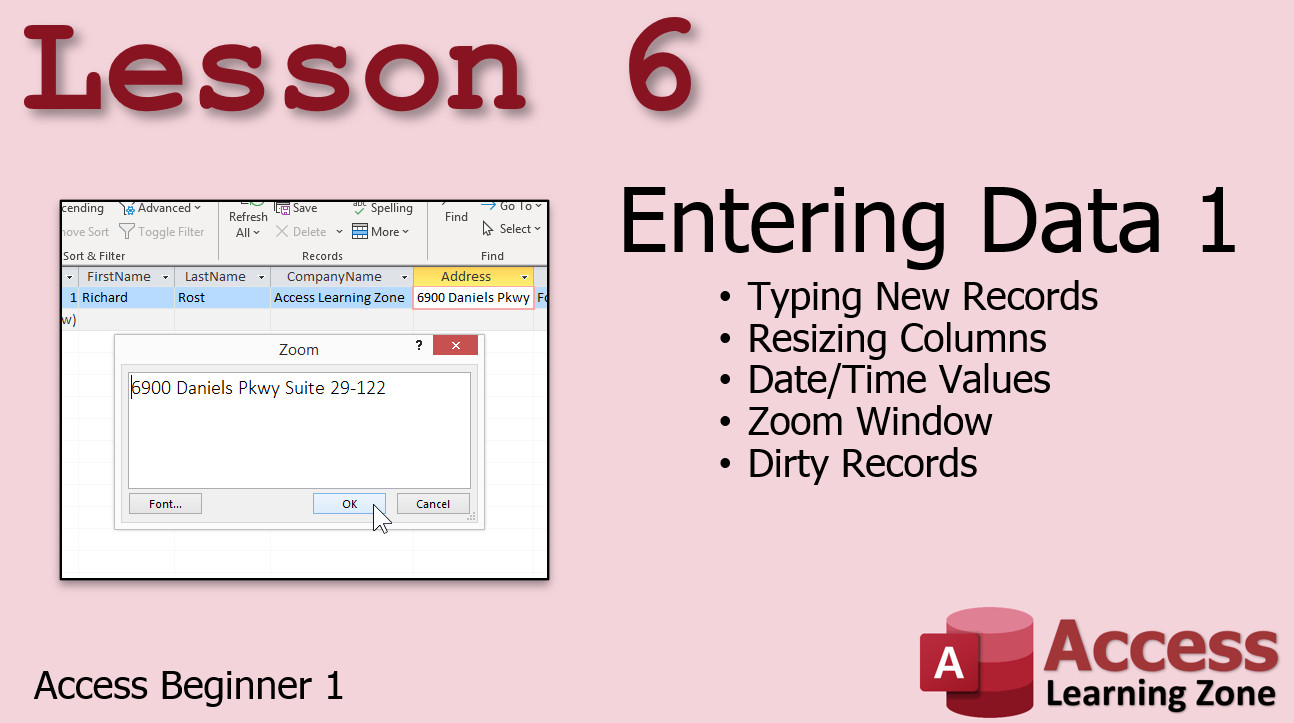
In Lesson 6, we're going to learn how to enter and edit data in our Microsoft Access Tables. We'll see AutoNumbers in action, learn how to resize a column, discuss 2-character state codes, only storing digits in phone number fields, various date/time formats that are allowed, what #### in a field means, see how the Date Picker works, what the 2-digit year cutoff date is, how to toggle a yes/no field with the keyboard, how to open the Zoom window, and learn what Dirty records are.
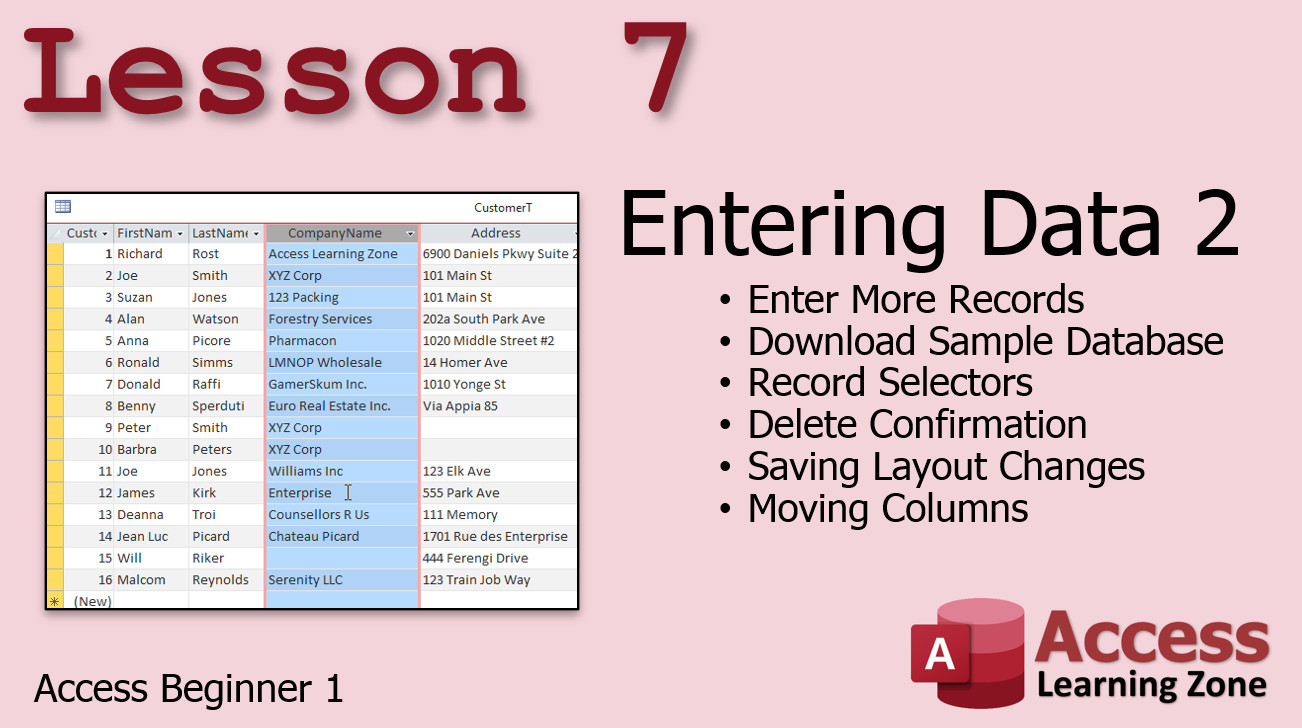
In Lesson 7, we're going to enter more records into our table. I'll show you where and how to download my copy of the database so you don't have to do a lot of typing if you don't want to. We'll learn about record selectors, how to turn off the delete confirmation warning, how to save table layout changes, and how to move columns around. We'll also discuss how AutoNumbers are not reused and why you shouldn't worry about them.
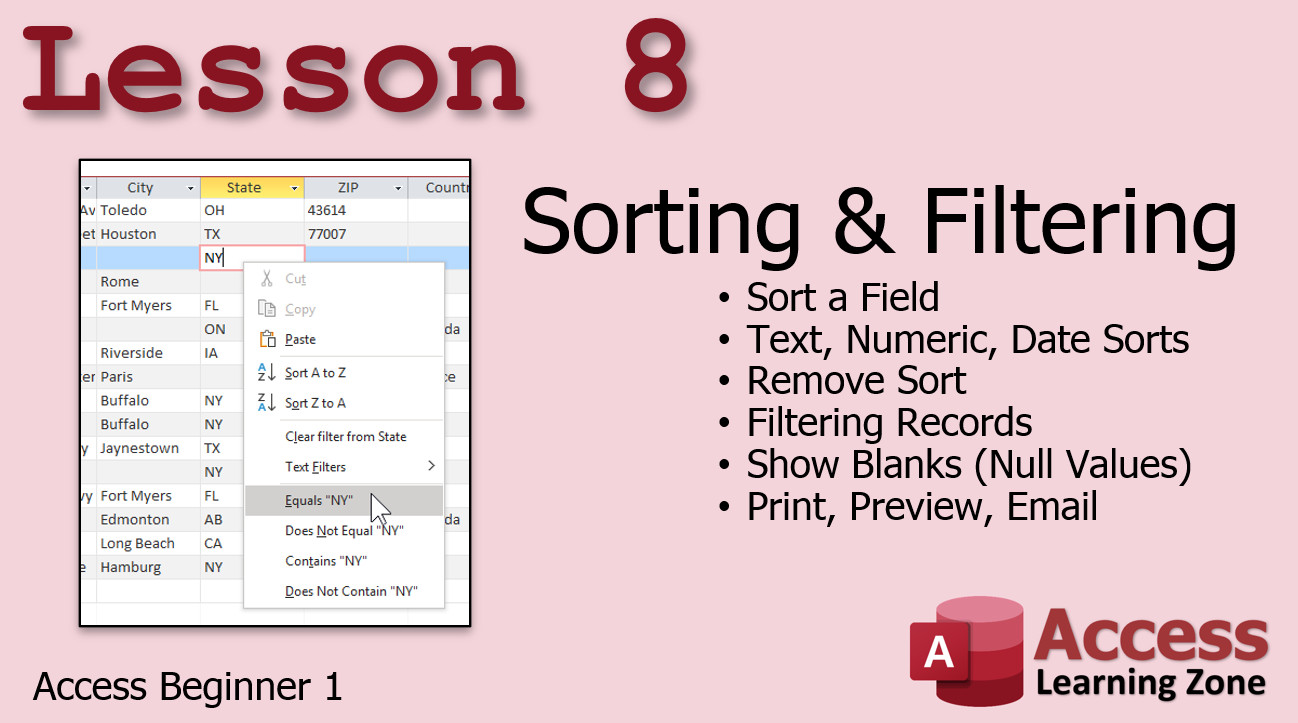
In Lesson 8, we'll learn how to sort and filter our records. You'll see how to perform a single-field sort. You'll learn the difference between text, numeric, alphanumeric, and date sorts. You'll remove the sort. Then, we'll see how to filter records. If the boss only wants to see customers from New York, you'll know how to apply that filter to display the correct records. You'll learn how to print a table or send it as an email attachment.
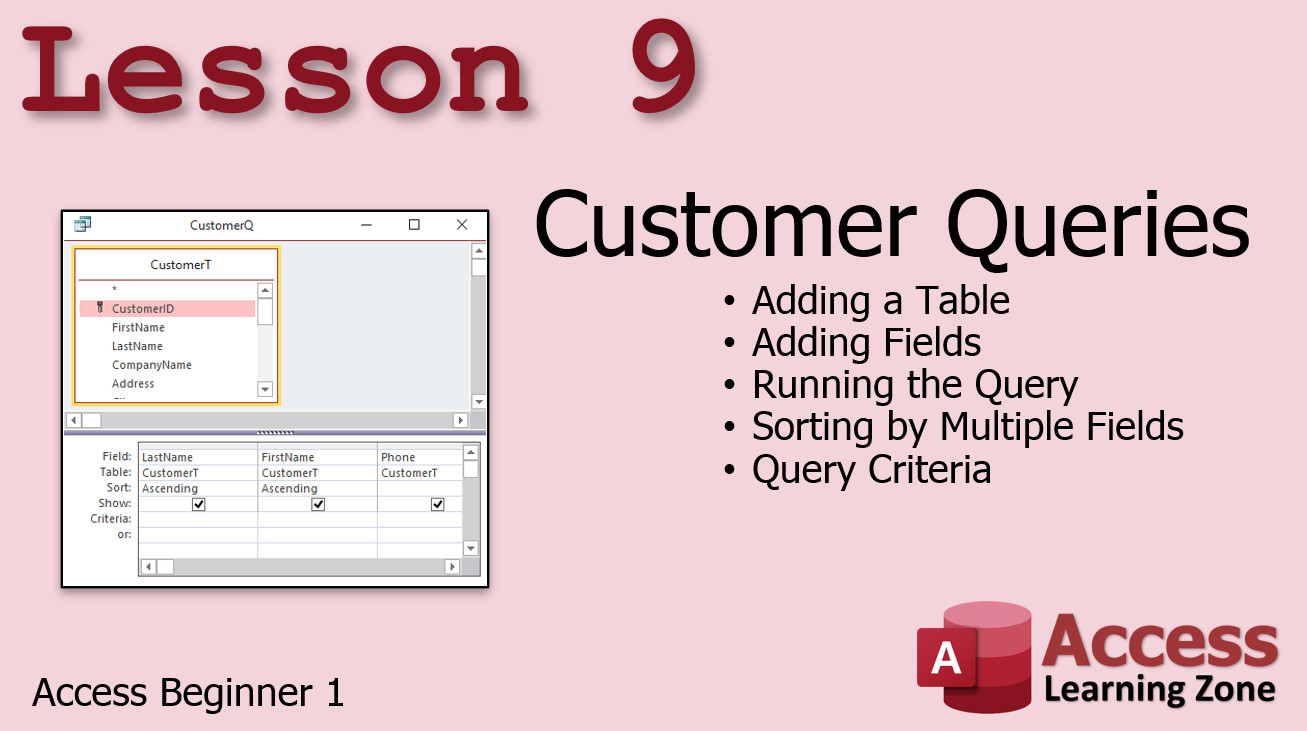
In Lesson 9, we'll learn how to create queries to display our data in different ways. We'll see how to add a table to a query, add fields from the table to the query, and run the query to display results. Then we'll learn how to add sorting to our query using multiple fields, and add criteria.
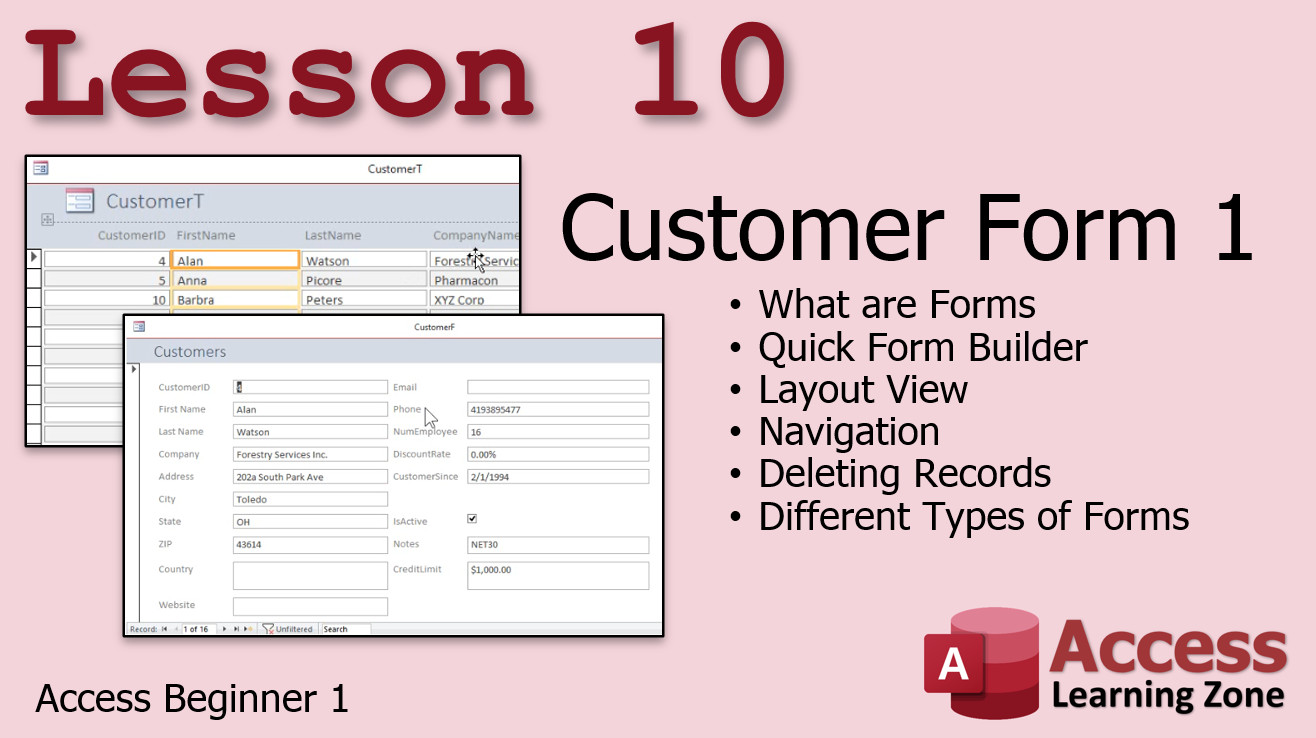
In Lesson 10, we're going to build a customer form to present our user with a nice friendly interface for adding and editing records. We'll see how the quick form builder works. We'll learn about navigation, layout view, deleting records, and the different types of forms in Microsoft Access.
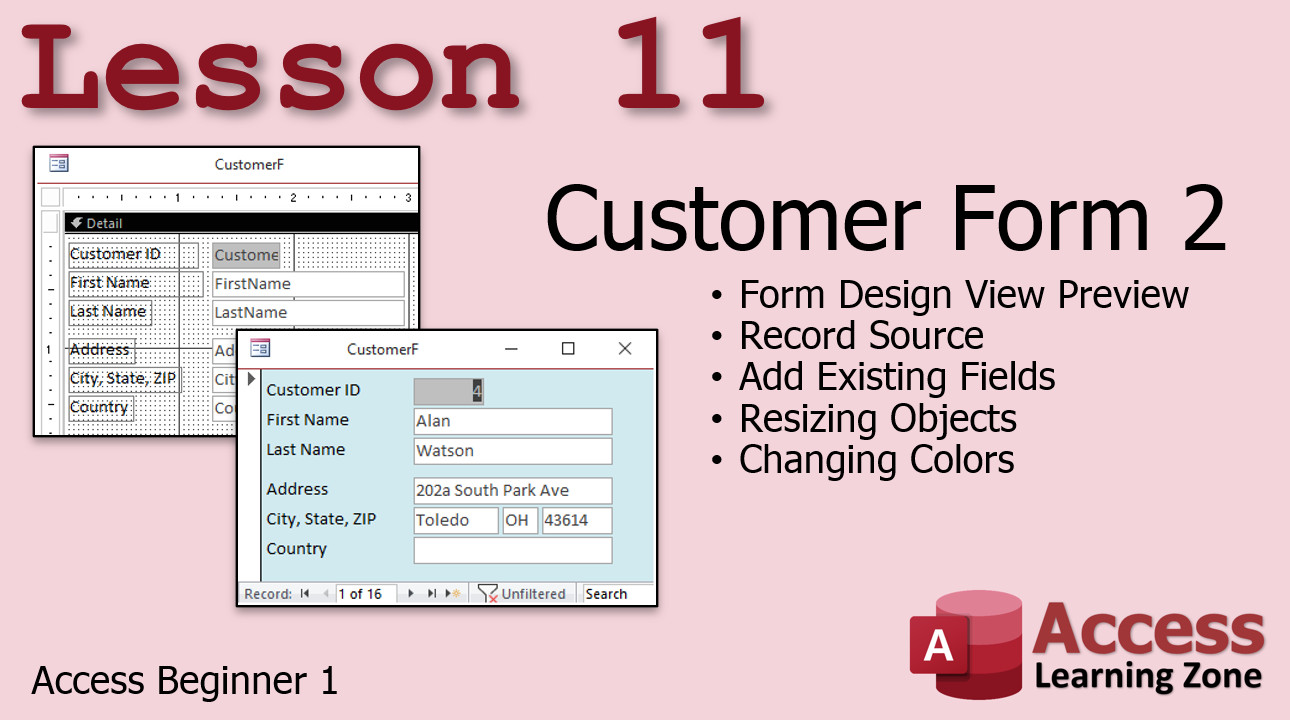
In Lesson 11, we're going to learn the right way to build a form using form Design View. This is a preview of a lesson that I normally used to cover in Level 2. We'll learn about setting the Record Source, adding existing fields from the table to the form, resizing objects - your labels and your text boxes - and changing colors.
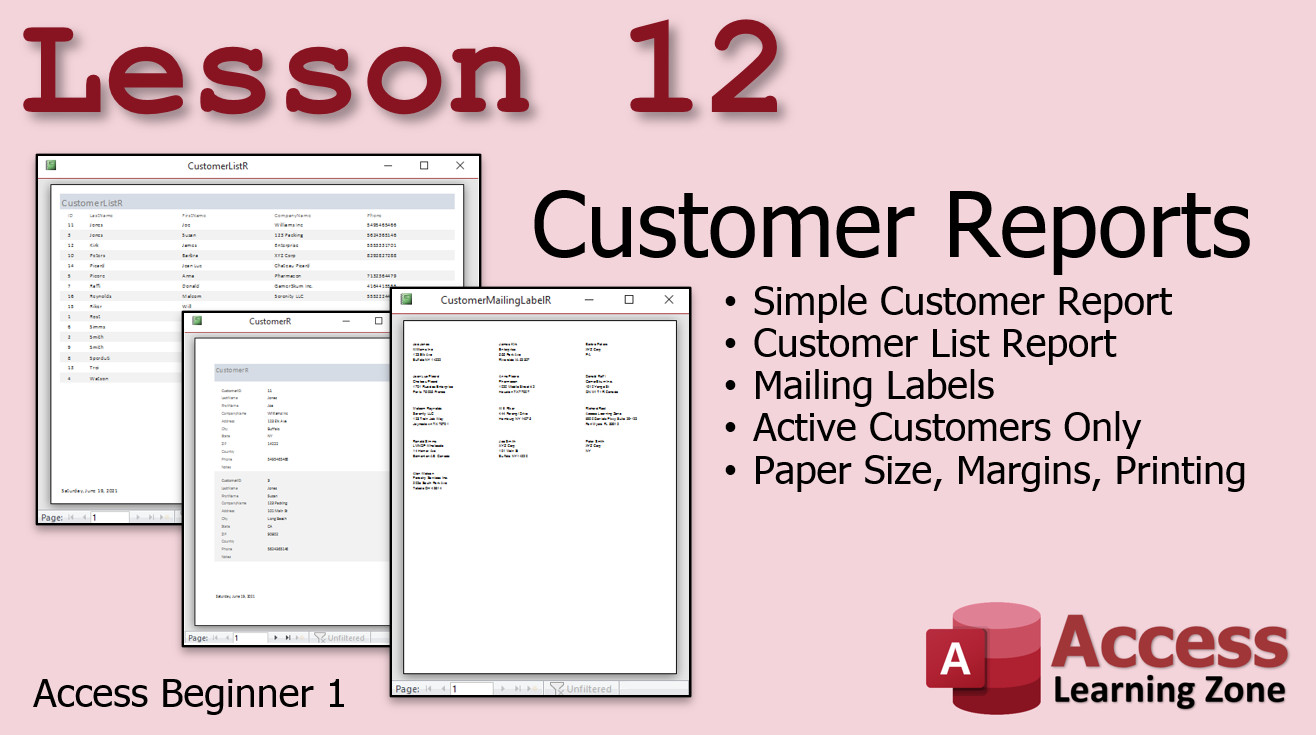
In Lesson 12, we will learn how to make a couple of different customer reports. We will start with a simple customer support, showing one customer at a time. Then we'll make a customer list report so we can see all of our customers listed on a single page. They we will make some mailing labels, and we will only send mailing labels to active customers. We'll also learn about some different concepts like paper size, margins, printing, and so on.
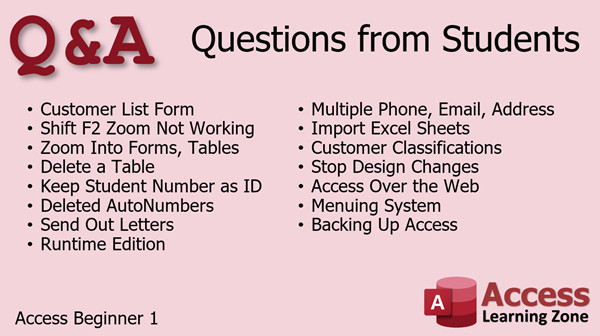
Finally, we'll take some time to go over popular questions that I've been asked over the past 20 years of teaching this course. We'll discuss creating a customer list form, deleting database objects, keeping an existing ID, what happens to deleted AutoNumbers, using Access as a letter writer, the free RunTime edition, how to manage multiple phone numbers, importing data from Excel, customer classifications, stopping users from making design changes, using Access over the Internet, creating a Menu system, backing up your database, and more.
Watch Now for Free!All of my Beginner Level 1 courses are absolutely FREE. Click on the Watch Now button to begin.
Questions?Please feel free to post your questions or comments below. If you are not sure as to whether or not this product will meet your needs, I'd rather help you before you buy it. Remember, all sales are final. Thank you.
More InformationTranscriptWelcome to Microsoft Access Beginner Level 1, a beginner's guide to getting started with Microsoft Access Database Design, brought to you by AccessLearningZone.com. I am your instructor, Richard Rost. This class is for the beginner who has little or no experience building Microsoft Access databases. This is the introductory course in my Microsoft Access Series and is designed to teach you the absolute basics of how to build a database. If you have never used Access before, then you are in the right place - start with this course. However, even if you have been working with Access for a little while, you will still benefit from taking this course. Even expert or advanced users have emailed me and told me they picked up a few tips or tricks from watching my beginner lessons. Consider this a solid foundation for your Microsoft Access education. The goal for today is to get you up and running building your first Microsoft Access database. We will begin by learning some terminology, the benefits of using a database, and we will cover the various components of Microsoft Access. You will learn how to properly plan out your database and determine the different tables, queries, forms, and reports that you will need. We will go over the Microsoft Access Design Interface, see how to create new database files, and I will show you some of the settings that I like to change for my databases. You will learn how to build your very first table to track customers, you will learn about the different types of data that you can store on a table, and you will learn about primary keys. You will learn how to enter data into your table, edit that data, and how to work with records. You will learn about data sorting and filtering. We will see how to use different queries to display information from the tables in different ways. You will construct a form to provide a nice user-friendly interface for working with data on the screen. You will learn how to generate a couple of different printable reports, including a customer list, and you will see how to print mailing labels for all of your active customers only. This class is recorded with Microsoft Access as part of a Microsoft 365 subscription. It is roughly equivalent to Access 2019. However, the lessons in this class are also valid for Access 2016 as well. This is the fourth edition of my Microsoft Access course. If you are using an older version of Access, I have versions available for 2013, 2010 (which also covers 2007), and the older 2003. Feel free to contact me for a free copy if you need one of these older versions. This is an introductory course for Microsoft Access, so you do not need any prior knowledge of Access or even databases in general to benefit from this course. However, you should definitely be familiar with Microsoft Windows basics. You should know how to use the keyboard and mouse, start programs, minimize and maximize windows, use scrollbars, and so on. If not, please go to my website and take my free Windows Beginner Level 1 course before continuing. It would also be beneficial if you know a little Microsoft Excel. While this is not required, I have often found that people who know how to work with spreadsheets have an easier time learning how to build databases with Microsoft Access. If you do not know Excel and you are interested in learning about it, I recommend, again, go to my website and find my free Excel Beginner 1 course. You will benefit more if you know how to use Excel before learning Access. My courses are broken up into four groups: Beginner, Expert, Advanced, and Developer. My beginner courses are for novice users who have little or no experience with Microsoft Access. They are designed to give you an overview of the basic features of Access and to cover just what you need to get up and running. The Expert courses are designed for more experienced users who are already comfortable with Access and have finished the beginner courses. The Expert classes go into a lot more depth about each topic than the beginner classes and cover more functions, features, tips, tricks, and techniques for power users. Once you have mastered the Expert classes, move up to the Advanced series. You will learn how to work with events, macros, automation, and many more advanced features that really add enhanced functionality to your databases. Finally, my Developer level courses are designed to teach you how to program in Visual Basic for Applications. This will allow you to create true professional-quality databases and unlock the full potential of Microsoft Access. Each group is divided into different numbered levels, starting with Level 1, which is the class you are watching now - Beginner, Level 1. Each subsequent level teaches you new and different topics in Microsoft Access, building on the lessons you learned in previous classes. I strongly recommend you do not skip around - watch the classes in order. When you have finished all the beginner classes, move up to the Expert series, then Advanced, and then finally, Developer. Beginner Level 1 is around 4 hours long to give you a good, well-rounded introduction to Access. Levels 2 and beyond are usually between an hour and 90 minutes long each. In addition to my normal Access classes, I also have seminars designed to teach specific topics. Some of my seminars include building a calendar and scheduling database, securing your database from multiple users, working with Access and SQL Server online, working with images, work orders, the SQL language, accounts payable, loan amortization, and lots more. I also have a complete list of all of my seminars and templates; visit my website at accesslearningzone.com. If you have any questions regarding the material covered in today's class, just scroll down to the bottom of the page that you are on and post your questions there. Also, make sure to take a minute to read through any other questions that have been posted as your question may have already been answered. Make sure to click on the subscribe button to get notified by email if any other questions or comments are posted for this class. Also, make sure to visit my Access forum where you can post questions and join conversations with me and my other Access students. Also, be sure to visit my TechHelp page. This is my kind of sort of almost daily video podcast about Microsoft Access where I answer questions sent in to me by my students. To get the most out of this course, I recommend you sit back, relax, and watch each lesson completely through once without trying to do anything on your computer. Then replay the lesson from the beginning and follow along with my examples - actually create the same database that I build in the video, step by step. Do not try to apply what you are learning right now to other projects until you have mastered the sample database from class. If you get stuck or do not understand something, watch the video again from the beginning and start over or check the student forum to see if your issue is listed there. I know sometimes I have to read or see something two or three times myself before that little light bulb turns on over my head. Most importantly, keep an open mind. Access may seem intimidating when you are first learning it, but once you get the hang of it, you will see that it is really easy to use. Also, do not try to take on any other monster projects until you have completed the beginner series and at least the first two classes from the Expert series. I get emails all the time from people who are halfway through the beginner classes and they have already made plans to completely redesign their company database. That is great. I love the enthusiasm. However, I recommend you wait. The beginner classes teach you all of the fundamentals of Access and the first two classes in the Expert series teach you relational database concepts, which is relating multiple tables together. You will need to know that before building any serious real world databases like customer contact managers, accounting systems, or things of that nature. So take my advice. I have been teaching Access for over 25 years. Just be patient. You will get there. For now, if you have a hobby like collecting baseball cards, managing a sports team, or tracking your vehicle maintenance, build a database for that. You will learn more if it is for fun and not for work. You will thank me later. I strongly encourage you to build the database that I build in today's class by following along with the videos. However, if you would like to download a sample copy of my finished database file, you can find it on my website right below the list of video lessons. Sometimes, if you get stuck, the easiest way to learn is to tear apart someone else's database. I know because one of the ways that I taught myself Access years ago was by tearing apart the Northwind Traders database that comes with Microsoft Access. It is a great sample database. While I encourage you to try building the database along with me in the videos, feel free to look over the one that I have built as well. Also, be sure to take a look at my blank database template. That is something that I built for people to use as a starter template for building their own databases. It comes complete with a video explaining how I built it. It is all part of my TechHelp series, which is absolutely free. Below the database files, you will find the links section for other videos and resources. These are optional topics so you can learn more about anything that I happen to mention in class. Since this is the fourth time I am recording Access Beginner 1, I have already got tons of more advanced videos I can point you to if you want to learn about something more specific right now. Now let us take a closer look at exactly what is covered in Access Beginner Level 1. In lesson 1, we are going to learn what Microsoft Access is and what it is used for. You will learn some database terminology. We will discuss the benefits of a database and we will learn about the parts of a Microsoft Access database, including tables, queries, forms, and reports. In lesson 2, we will discuss planning your database, what tables you need, what fields should go in each table, and what you want your forms and reports to look like. In lesson 3, we are going to get started creating a new blank database. We will talk about the Access interface. I will show you how to turn on overlapping windows, which I prefer over the tabbed document interface. I will show you what to do if you get that security warning there. In lesson 4, we are going to begin building our customer table. We will see how to create a new table, learn about field names and naming conventions, learn about the different data types that are available, and start building the customer table. In lesson 5, we are continuing designing the customer table. We are going to decide whether or not certain fields need to be text or number, like phone number for example. We are going to start with text or as number. We will see the difference between long integers and doubles, why we want to use an ID field, an auto number field, how to move fields around inside the table, saving your table of course, table naming conventions, and we will talk about primary keys and indexing. In lesson 6, we are going to learn about entering data into our tables. We will see how to type new records in, talk about resizing columns, look at different date/time values, I will show you the zoom window, and we will discuss what dirty records mean. In lesson 7, we are continuing with entering data. We are going to enter some more records into our table. I will show you how to download a sample database from my website so you do not have to type in all those records if you do not want to. We will talk about the record selectors, how to turn off the delete confirmation warning, saving layout changes, resizing our columns, and moving columns around. In lesson 8, we are going to learn how to sort and filter our data. We will learn how to sort a field, about text, numeric, and date sorts, and the difference between numeric and alphanumeric sorts. We will see how to remove a sort, how to filter our records (both filter by selection and filter with the check boxes), how to show blank records and null values, and how to print, print preview, and send our table as an email. In lesson 9, we are going to learn how to build customer queries. We will see how to add tables to your query, add fields from the table to the query, and how to run the query. Then we will learn how to sort by multiple fields and add query criteria. In lesson 10, we are going to build a customer form to present our user with a nice friendly interface for adding and editing records. We will see how the quick form builder works. We will learn about navigation, layout view, deleting records, and the different types of forms in Microsoft Access. In lesson 11, we are going to learn the right way to build a form using Form Design View. This is a preview of a lesson that I normally used to cover in Level 2. We will learn about creating a blank new form, setting the record source, adding existing fields from the table to the form, resizing objects, your labels and your text boxes, and changing colors. In lesson 12, we are going to learn how to make a couple of different customer reports. We are going to build a simple customer report with one customer at a time, then we will make a customer list report where we can see all of our customers listed one per row. Then we will make some mailing labels, and we will only send mailing labels to active customers. We will learn about different things like paper size, margins, printing, and so on. Now it is time to begin with lesson 1: What is Microsoft Access? Go ahead and click on the link for lesson 1 right now. IntroIn lesson 1 of Microsoft Access Beginner, you will learn the basics of getting started with Microsoft Access, including key terminology, the benefits of using a database, and the main components such as tables, queries, forms, and reports. I will show you how to plan and build your first database, work with customer tables, enter and manage data, sort and filter records, create queries, and generate forms and printable reports. We will also cover essential skills like setting up your workspace, choosing correct data types, using primary keys, and printing mailing labels. This course is designed for absolute beginners. QuizQ1. What is the main purpose of Microsoft Access as described in this course? A. To serve as an email client B. To create and manage databases C. To edit photos and videos D. To write and compile code Q2. Who is this Access Beginner Level 1 class intended for? A. Only advanced database users B. People who have built Access databases for years C. Beginners with little or no experience using Access D. Only Microsoft Certified Professionals Q3. Which of the following is NOT a major component of a Microsoft Access database covered in the introductory lessons? A. Tables B. Queries C. Slides D. Reports Q4. Why does the instructor recommend building a database for a hobby or personal interest when starting out? A. It is more likely to be complex and challenging B. You can make money right away with it C. You will learn more if you enjoy working on it D. You do not need to learn database design for hobbies Q5. In the course structure described, which level comes directly after Beginner? A. Intermediate B. Developer C. Expert D. User Q6. What is a primary key in an Access table? A. The field used to display table data B. The field that uniquely identifies each record C. The password to lock the database D. The largest numerical value in the table Q7. What advice does the instructor give about using course materials? A. Jump around between lessons randomly B. Watch each lesson all the way through once, then follow along step-by-step on replay C. Only read the transcripts and do not watch videos D. Skip directly to the Developer courses Q8. What is recommended if a student has no experience with Microsoft Windows basics? A. Continue with the Access class anyway B. Learn Excel first C. Take the free Windows Beginner Level 1 course D. Only use Mac computers Q9. What is the role of forum and discussion areas in the course? A. For submitting completed assignments B. For chatting about unrelated topics C. For posting and answering questions about Access D. For purchasing extra materials Q10. In which lesson will students learn about filtering and sorting data in Access? A. Lesson 4 B. Lesson 8 C. Lesson 12 D. Lesson 2 Q11. What is the recommended order for progressing through the instructor's Access course series? A. Advanced, Developer, Beginner, Expert B. Expert, Beginner, Developer, Advanced C. Beginner, Expert, Advanced, Developer D. Beginner, Advanced, Expert, Developer Q12. What does the instructor say is beneficial about knowing Excel before learning Access? A. It is required before starting Access B. It makes learning databases easier C. You can copy and paste everything from Excel into Access D. It prevents needing to learn Access forms Q13. Why does the instructor advise students not to take on major work projects until after completing certain classes? A. Because the courses are too short B. To avoid technical problems with large databases C. To ensure a solid foundation and understanding of relational concepts D. Because work projects are less interesting Q14. Which feature is mentioned as providing a user-friendly interface for adding and editing records? A. Tables B. Queries C. Forms D. Reports Q15. What is one way the instructor recommends solving a misunderstanding or problem during the course? A. Send an email to tech support immediately B. Give up and stop watching C. Re-watch the lesson or check the student forum for answers D. Change to a different software program Answers: 1-B; 2-C; 3-C; 4-C; 5-C; 6-B; 7-B; 8-C; 9-C; 10-B; 11-C; 12-B; 13-C; 14-C; 15-C DISCLAIMER: Quiz questions are AI generated. If you find any that are wrong, don't make sense, or aren't related to the video topic at hand, then please post a comment and let me know. Thanks. SummaryToday's video from Access Learning Zone is the first lesson in the Microsoft Access Beginner Level 1 series. This course provides a beginner's guide to getting started with Microsoft Access Database Design. My name is Richard Rost, and I will be your instructor. This class is specifically designed for those who have little or no experience with Microsoft Access databases. If you are entirely new to Access, you are in the right place, as this is the introductory course in my Access series. Even if you already have some experience, you may still find value in this lesson. In fact, many advanced users have told me that they picked up useful tips and tricks from my beginner courses. The aim today is to give you a solid foundation in your Access education and get you building your first database. We will start by going over some essential terminology, understanding the benefits of using a database, and introducing the key components of Microsoft Access. I will show you how to carefully plan your database, figuring out what tables, queries, forms, and reports you will need along the way. We will review the Access design interface, create a new database file, and I will walk you through some settings that I usually change in a brand new database. You will build your first table to track customers, explore the different types of data that can be stored in a table, and learn about primary keys. I will also show you how to enter and edit data, manage records, and use sorting and filtering. You'll see how to use queries to display information from your tables in various ways. We will create a form so you can have a user-friendly interface for data entry and editing. I will demonstrate how to design printable reports, such as a customer list, and show you how to print mailing labels for only active customers. The course features Microsoft Access from a Microsoft 365 subscription, which is very similar to Access 2019. These lessons are also applicable to Access 2016. This is the fourth edition of my course, and if you are using an older version like Access 2013, 2010, or even 2003, I have separate versions available. Just let me know if you need one of those. This is a true beginner course, so you do not need to know anything about databases or Access before starting. However, you should be comfortable with Microsoft Windows basics, such as using the keyboard and mouse, starting programs, and managing windows. If you are not, I recommend my free Windows Beginner Level 1 course, which you can find on my website. It also helps if you are familiar with Microsoft Excel. While not required, experience with Excel will often make learning Access easier. If you are interested, I offer a free Excel Beginner 1 course as well. My curriculum is arranged in four groups: Beginner, Expert, Advanced, and Developer. Beginner courses are for those with little to no experience and focus on the essentials to get you started. Expert courses are for users who are already comfortable with Access and want more in-depth coverage and advanced features. After you complete the Expert classes, the Advanced series teaches you about events, macros, automation, and other features for more complex databases. My Developer courses teach programming with Visual Basic for Applications, which lets you build professional-quality databases and tap into Access's full power. Each level in these groups builds on the previous one, starting with Level 1, which is what you are studying now. The lessons are designed to be taken in order. When you complete all of the beginner material, move on to Expert, then Advanced, and finally Developer. Beginner Level 1 is about four hours long and provides a thorough introduction, while later levels are typically between one hour and 90 minutes each. In addition to my regular courses, I offer seminars that focus on specific topics, like building a calendar, securing databases for multiple users, integrating with SQL Server online, managing images, working with work orders, using the SQL language, setting up accounts payable, loan amortization, and more. You can find a complete list of these seminars, as well as templates, on my website. If you have questions about the material covered, just post them on the page below the lesson. Take time to review other questions as well; your question might already have been answered. You can also subscribe to receive email notifications of new questions or comments. I encourage you to join my Access forum, where you can interact with me and other students, and to visit my TechHelp page. TechHelp is my video podcast where I answer Access questions that come in from students. To get the best results from this course, I recommend watching each lesson once all the way through before you try to follow along. Once you have watched, start the lesson again and build the same sample database with me, step by step. Do not try to apply the concepts to your own projects until you have mastered the sample database. If you get stuck or confused, watch the lesson again from the start or check the student forum to see if anyone else has resolved a similar issue. It is normal to need multiple attempts before concepts click. Keep an open mind. Access might feel intimidating initially, but with practice you will find it is very approachable. Hold off on any large projects until you finish all the beginner and the first two Expert level classes. Many students get excited and jump straight into complex redesigns before they have learned the essential relational database concepts needed for real-world databases. Be patient and follow the course path. In the meantime, I recommend working on a fun project, like tracking a hobby or managing vehicle maintenance, to solidify your skills. You are encouraged to build the same database that I demonstrate in class. If you prefer, you can also download a sample copy of my finished database from my website. Sometimes studying a completed database can help clarify things, just as I learned years ago by exploring the Northwind Traders database included with Access. If you like, also check out my blank database template, which comes with a video tutorial and can save you time starting new projects. On the resources section below the lessons, you will find optional links to further videos and topics for extended learning. Since this is the fourth version of Access Beginner 1, I can refer you to even more advanced material if you want to go further right away. Here is a breakdown of the lessons in Beginner Level 1: Lesson 1: Learn what Access is used for, understand basic database terminology, discuss the reasons for using a database, and review the main Access components: tables, queries, forms, and reports. Lesson 2: Discover how to plan your database, decide which tables and fields you need, and consider what your forms and reports should look like. Lesson 3: Create a new blank database, get familiar with the Access interface, switch to overlapping windows, and handle initial security warnings. Lesson 4: Begin constructing your customer table: create the table, settle on field names and naming conventions, explore data types, and start building your table. Lesson 5: Continue designing the customer table, deciding on appropriate field data types (like whether a phone number should be text or numeric), discuss long integers versus doubles, understand the importance of an ID field and auto number, organize fields, save your work, and learn about primary keys and indexing. Lesson 6: Enter data into your table, learn to add new records, resize columns, work with date and time values, see the zoom window, and understand what makes a record 'dirty.' Lesson 7: Continue data entry, including adding more records, utilizing the sample database if you want to avoid typing, understand record selectors, turn off delete warnings, save layout changes, resize columns, and move columns around. Lesson 8: Learn to sort and filter data, conduct text, numeric, and date sorts, differentiate between numeric and alphanumeric sorts, remove sorts, apply filters by selection or checkbox, display blank and null values, and handle printing or emailing tables. Lesson 9: Build customer queries, add tables and fields to queries, run them, sort by multiple fields, and introduce criteria for queries. Lesson 10: Design a customer form that offers a user-friendly interface for editing and entering records, use the quick form builder, explore navigation, layout view, manage record deletion, and examine various types of forms. Lesson 11: Learn to create forms using Form Design View, which sets you up for more customizable forms. You will make a blank form, set the record source, add fields, adjust objects, and modify labels and text boxes for appearance. Lesson 12: Make customer reports, starting with a simple individual customer report, then a customer list report, followed by custom mailing labels for active customers, focusing on paper size, margins, and printing. With all that outlined, you are ready to begin lesson 1 to learn what Microsoft Access is all about. A complete video tutorial with step-by-step instructions on everything discussed here is available on my website at the link below. Live long and prosper, my friends. Topic ListIntroduction to Microsoft Access and its purpose Database terminology overview Benefits of using a database Components of an Access database: tables, queries, forms, reports Planning a database and designing tables, fields, forms, and reports Creating a new blank database file Navigating the Access design interface Adjusting interface settings (overlapping windows, security warnings) Creating a customer table Field names and naming conventions Understanding Access data types Designing the customer table Choosing field data types (text vs number) Long integers, doubles, and field type choices Using ID and autonumber fields Moving and arranging table fields Saving tables and table naming conventions Primary keys and indexing in tables Entering and editing data in tables Working with date and time values Using the zoom window Understanding "dirty" records Entering multiple records in a table Using the record selector Turning off delete confirmation warnings Saving layout and resizing/moving columns Sorting data in tables Sorting by text, numbers, and dates Understanding numeric vs alphanumeric sorting Removing sorts Filtering records by selection and check boxes Showing blank records and null values Printing, print preview, and emailing tables Building customer queries Adding tables and fields to queries Running queries and sorting by multiple fields Adding query criteria Creating a customer form with the quick form builder Navigating and using layout view in forms Deleting records through forms Types of forms in Access Designing a form with Form Design View Setting form record sources Adding existing fields to a form Resizing form objects, labels, and text boxes Customizing form appearance (colors, arrangement) Building a simple customer report Creating a customer list report Making mailing labels for active customers Adjusting report paper size and margins Printing reports and labels Primary TopicsMicrosoft Access basics, database terminology, Access interface, table creation, data entry, sorting and filtering, building queries, creating forms, generating reports, getting started with Access Secondary Topicsplanning databases, primary keys, data types, naming conventions, printing, report layout, using templates, accessing sample databases |
||
|
| |||
| Keywords: Database progression Benefits of Access Parts of Access database Fields Records Queries Forms Reports Macros Modules Planning Database Table fields Design View Data Types Naming Conventions AutoNumber Calculated Field Lookup Wizard Entering Data Resize Co Page Tag: whatsnew PermaLink Microsoft Access Beginner 1 |