Help System
By Richard Rost

 5 years ago
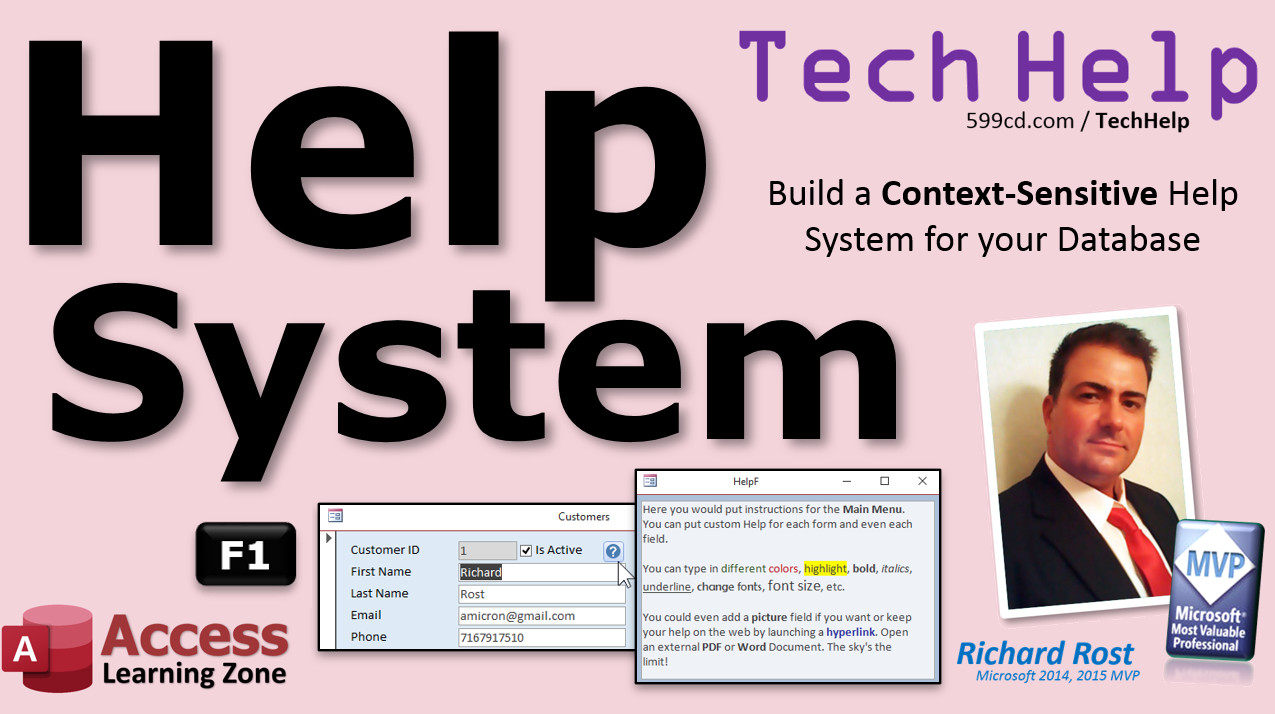
Build a Context-Sensitive Help System for Access
In this video, I will show you how to create a context-sensitive help system for your Microsoft Access database. No messing around with HLP files. You can build the whole thing right inside your database using a table and a form. Or, if you prefer, I'll show you how to launch a web page so you can keep your help files online.
Rick from Houston, Texas (a Platinum Member) asks: Can you create context sensitive help in Microsoft Access forms and/or reports? Something like clicking a field and hitting F1 to get a description or use for field.
Members
I will show you how to trap the F1 key so that you can utilize that keyboard event. Then I'll show you how to determine what the active form and active control are so you don't have to include an ID each time you open the Help form.
Silver Members and up get access to view Extended Cut videos, when available. Gold Members can download the files from class plus get access to the Code Vault. If you're not a member, Join Today!
 Links Links
Microsoft's Guidelines for Help: https://tinyurl.com/y3phvbgt
Forms Keep Their Size: https://599cd.com/AutoResize
Intro to VBA: https://599cd.com/IntroVBA
Key Down Event: https://599cd.com/TechHelpMoveKeys
DLookup: https://599cd.com/DLookup
NZ Function: https://599cd.com/NZ
Double Double Quotes: https://599cd.com/DoubleDouble
 Subscribe to Help System
Get notifications when this page is updated
More InformationTranscript Welcome to another TechHelp video brought to you by AccessLearningZone.com. I am your instructor, Richard Rost.
In today's video, I'm going to show you how to build a context-sensitive help system for your Microsoft Access Database. We're not going to mess around with HLP files and all kinds of that crazy stuff. If you've ever done custom help systems before, they're a bit of a pain. So in this lesson, I'm going to show you how to put the whole thing right inside your database, or if you prefer, I'll show you how you can launch a web page if you want to keep your help system online so it's constantly updated.
Today's question comes from Rick from Houston, Texas, one of my platinum members. Rick asks, can you create a context-sensitive help system to use in Microsoft Access forms, something like clicking on a field and hitting F1 to get help on what that field is for? Someone else actually asked me this question a couple of days ago, but Rick's a platinum member, so he goes first.
Yes, Rick, it definitely is possible. You can create F1 context-sensitive help in Microsoft Access, but there are some better alternatives that I like, and I'm going to show you a couple different things that you might like better than the F1. I will show the F1 alternative in the extended cut, which you're a platinum member so you get access, but I think that there's a better way. Let me show you some other stuff.
Here I am in my TechHelp free template. This is a free download from my website. If you want to grab it, I'll put a link down below. Now, if you hit F1 pretty much at any point in Access, you'll get this help system up. This is for general help on Microsoft Access.
You can create customized help systems. Personally, I think the way that Microsoft does it is a lot of work and I've got a better solution. You may remember from back in the old days, and the old days mean like Windows XP, Vista, that era, Windows 2000, help files looked like this and they were created with what are called HLP or CHM files, and you have to put together this big conglomeration of different stuff and compile it. It's just a lot of work. The modern-day help system isn't much better. There's the help system out of Microsoft Word, like I just showed you in Access.
If you really want to build a help system the way Microsoft recommends, I'll give you a link to their instructions, the guidelines for creating a context-sensitive help file. I'll put it down in the link section below. But what I'm going to show you is going to be actually easier.
So first off, if you want to put a help system in a database, I like to make it plainly visible for the user. Now, F1 involves some training to hit the F1 key. You have to teach the person if you need help, hit F1. I like putting a little button or a little link right on the form if they need help, a little question mark.
If you want your help to be constantly updated, I'd suggest putting it on the web somewhere, make a web page. If you have the ability to do that, it can be any web page you want. For example, in my template, I've got this guy right here that takes you right to my website. If I click on this, boom, it takes you right to this page. I can direct that to any page on the web that I want. If that's an option for you, I'd suggest just do that. That's great. Then you can constantly update your help file too without having to redistribute it to all your users.
Instructions for how to create this are in the video where I create the blank template. Again, I'll put links to the blank templates down below. Go watch that if you want to see how I created this button. You can just put a button like this on any form that you want to. You can also use that hyperlink property. This is basically an image that has a hyperlink property. It's right here, hyperlink address. Instead of a web address, you can put a file in here too. So if you want to make a detailed PDF or a detailed Microsoft Word document, and put it in the database folder or somewhere on your network, you can make a custom one for each form too. Just change that to a file somewhere. It doesn't have to be a web page.
I like using web pages though because the user gets constantly updated help information for my app. But let's say you don't want to go through all that. Let's say you want to keep the help system in your database. Why not? You could put a help system right inside your database, in a table with a form, and then just pop up the appropriate record. It's that easy. Watch.
Here we go. Create, table design. This will be my help system. ID, every record will get its own help ID, and you can have for each form, you can have for each field, whatever you want to do, however many you want to create. Maybe a description. Oh, there we go. That's one of my server alarms I've got in my office. My server is getting ready to reboot. Then of course the notes, and that can be long text and I'd suggest make that rich text. Come down here and make that rich text so you can put colors and bold and stuff like that in there.
If you want to include a picture, you can. I'm not going to bother, but you can easily add a picture if you want to put a small picture of the form or whatever that they're on. However you want to make this up, but I'm just going to do description and notes. Let's save this as my help table, primary key. I'll just put a couple of records in here.
I'll say one for the main menu, and then in the notes I'll say, these are instructions for the main menu. Blah blah blah blah blah. Customer form. This is how to use the customer form. If you want to put a custom, you know, on the customer form, put a little help icon next to something that's like is active, for example. This field means that the user is on our mailing list. So maybe they don't know what is active means.
There's other stuff too you can use like the control tip text. I'll show you how that works in a second. With control tip text, you can give the user a little hint when you hover over a field. I'll show you that in a second.
Save this. That will be my help T. Let's make a form to go with it. So create. Actually, I've got a form down here, my single F. Let's use this guy. Copy, paste. This will be my help F. The reason why I created this template in the first place is so I don't have to create stuff from scratch.
So the help F, let's right click design view. This will be my help form. Let's come up here, and let's go to the record source property. We'll make that the help T, so now this form is bound to the help T. Let's set up some fields in here.
Add existing fields. I don't need to see the help ID. It might be helpful for you so you know what it is, because you need to know that number to pop it up in a minute. We're going to leave one line of code, and I'll show you how one line of code to put in our button to open up the appropriate record.
Let's just change. This will be the help ID. We'll leave it on there. The description, and then the notes. We just need to bring notes in, and we can change this guy here to the ID. So the control source is going to be the help ID. Copy and paste that up under the name.
We're just going to be the description. Copy and paste that up there. Notes is already set, so we're just going to format paint with this so that gets the same color. Slide them up next to each other like that. Make sure that under format, this guy is set to rich text. Sorry, it's under data. I don't know why they don't put it under format. Text format is rich text, which it should be because that's how we set it in the table.
You can make this as big as you want. This is what the user is going to see when the help system pops up. I'm going to left-align all that stuff right there. Let's save it. Let's take a peek at it. Open it up. Looks pretty good.
Now you probably don't want your user messing with this stuff. So design view. I'm going to turn off the record selectors. Let's go here. Allow additions. Now, you want to be able to add stuff yourself. You can go back into the table level if you want to, but if the user accidentally adds one, no big deal. Let's turn off deletions. Let's turn off edits. That way, actually, let's leave edits on. You can have two different versions of this, one for you and one for them, by the way. So let's pretend this is the one for you, but it'll be the same, by the way. It doesn't matter.
You could turn things off like the record selectors under format, for example, where we're at here. No navigation buttons, no. So you want to make it look like it's going to be a valid help system here. Turn the scroll bars off, maybe. Scroll bars, neither.
If you really want to, you could do something where you take it over here and size it in this corner like that, however you want it to appear. I just did a video yesterday on having Access save the size of a form, however you leave it. I'll put a link to that down below too. It'll keep its position wherever you save it, but it'll resize automatically.
Save that. Actually, let's set this to auto center. There's a format setting in here called auto center, right there. It's normally off; turn it on. It'll center itself when you open it, right in the middle of the Access window right there.
So our help system is built right into our database. Now, how do I get it to open up that help thing, that help form? Well, we're going to use a button with one line of code in it.
So on our main menu, right click, design. Let's create a button. Go to this button guy and then the command button wizard. Drop it there. Cancel the wizard. Why are we canceling the wizard? Because what we want to do is not in the wizard.
We're going to open a form, but we have to open a specific record. And yeah, you can open a specific record, but only if it's bound to something on that form, which we're not going to do. We're going to give it a number. Remember, we gave them numbers before. Main menu is number one. Customer form is number two. So we need just one line of code.
I'm just going to put the word help in here for now. I'll show you how to put a picture in it in a minute. Right click, build event. It may ask what builder you want; pick the code builder.
Yeah, I forgot the name and it's 11, Command11. Let's just do this again here. Come back in here. Let's give it a name. Let's call this help button, helpBTN. Let's try that again. Right click, build event. Now I'm in the help button click. If you're asked what builder you want, pick code builder.
If you've never done VBA before, go watch my intro to VBA video. It's free and it'll teach you what this is all about. So go watch that, pause this, come back.
Now in here, all we need is one line of code to open up the right form.
DoCmd.OpenForm "HelpF", , , "HelpID=1"
Usually if you want to have it like a field on the form, you do it like this. Or CustomerID or whatever it is. I'm so used to doing it that way; 99% of the time that's what you do. But this way we're literally just sending it the number 1.
Save it. Now on my main menu, here I am. I want help, I click the help button. Boom. There's help for the main menu. See how easy that is?
Now let's turn this guy into a question mark. Go to design view. Go to its properties and there's a picture property right there. It says none. Click the dot-dot-dot button there and pick a picture. Use your own if you want to. You can click browse. The one here is pretty good though. It's called question mark help, right there. Look at that. It's your standard question mark button. Resize it, and then stick it anywhere you want to stick it. I like to stick it right there. Need some help? Click that button. No training involved.
I'm not against training. I love training. That's what I do for a living, but that's the simplest solution for your users. You'll be surprised, a lot of people don't know that F1 means help. That's a throwback. That goes way back. It's perfect, if memory serves. Back in the 1980s, they started with help as F1. I was so close. I thought it was WordPerfect. It's Lotus123. 1983. I knew if I googled it, I'd find it. I'm pretty sure WordPerfect also. After that point, every application turned F1 into help.
I started teaching Windows and stuff in the classroom mid-1990s, probably about 95, 96, or 97 in there. You'd be surprised how many people at that point even didn't know F1 was help. Even today, people I talk to.
So there's our little help guy. Click it. There's my help. Main menu, these are instructions for the main menu. You can make this pretty. This is a different color. Just simply highlight it. Give it some color. Make something bold if you want to because it's rich text. If you want to put a picture in here, you can. Or even a hyperlink, make a hyperlink field. For more information down here, for more information, go to this. That'll take them out to the web. You can put as much information there as you want to. This can be like the quick stuff.
Let's go to the customer form. Customer form is number two. Let's say they need some help on this stuff.
Now I mentioned earlier a control tip text. Let me show you that. Let's say, what is this 'is active' thing? What does that mean? Right click, design view. Click on this guy. Find control tip text. It's under other, control tip text. This means the customer is on our mailing list or whatever you want it to be.
There's also a status bar text. I'll show you that in a second. Close this. Open up the customer form again. Hover your mouse right over that. There it is. See, this means the customer is on our mailing list. I think it's on the label too, let's see. Yeah, if the label is attached to the control, it'll also pop up. So that's another way of giving some help.
The status bar text is better for stuff you tab to. So, design view, let's say first name field here. Open up the first name field. Go to the status bar text. This is the user's first name. This stuff also comes in if you put it in the table level in here, in this description, this will pop up in the status bar text. I don't like using this though. It closes up your tables. If you really want it on a form, put it in a form.
Open that up, and as you can see right down here, this is the user's first name. That's the status bar text.
But what about our help button? Let's go grab it. Design view, grab this guy, copy, come over here, design view, and paste. There it is. Just stick it wherever you think the user will find it. I like to keep them all kind of in the same spot, like from form to form, so that they know when they're up in the right corner there's a help button.
If you want to make this for each field, there's a field that's crazy, like we did before. What do we do? I think 'is active' we put in the help table. You could stick it next to it here if you want to. If you want to put it next to a field, like they don't know what this field is, you could do this and then make a custom button just for that. Copy, paste, like that. Right click, build event, same thing.
DoCmd.OpenForm "HelpF", , , "HelpID=2"
Yeah, I didn't name the button. This thing here, right click, build event.
DoCmd.OpenForm "HelpF", , , "HelpID=3"
See, I think this is so much easier and better than doing what Microsoft recommends with those HLP files. My personal opinion, but that's what you're watching my video for.
Right click, boom. This is how to use the customer form. I made it for 'is active.' Click, boom. This is how this is for the email. So let's change it. Email, make sure you get the customer's real email address and not a fake one. I don't know, whatever. Boom. There you go.
Of course, you can make yourself your own editor for this, or you can lock all the fields and stuff so they can't make changes. You can pretty this up. I've done a million other videos on how to pretty up your forms and how to lock the different fields you don't want the users editing, all that stuff. I'm just showing you the help system stuff in this lesson. I have tons of other videos on the aesthetics of building forms.
So there you go. That's my recommendation for making a help system in Access. Put it right in Access if you want this to be distributed with the database or if you don't want to go online, because you can go online with these guys too. Instead of little buttons here, make those images. Or you can actually launch a web page from in the button too. Here, let me show you.
Let's take this button here, and instead of opening up the help system, you can launch a web page in here. Here's the code:
Application.FollowHyperlink "https://www.yourwebpage.com"
So, mine, for example. Let's go to my, I don't know, relationships. You could put whatever page you designed for your help system in here. Save it. That's just one line of code again to launch a web page.
Go to the customer form, click that button, and a second later, my web browser opens and goes right to my relationships page. See how easy that is? So you can use a button, or you can use an image like I showed you on the main menu. Either one.
I think that's so much better than using F1. But if you really want to learn how to do F1, I'm not going to show you the Microsoft way, but I'll show you my way how to use F1 to open up the help form to a specific record when the user's tabbing through the control. You can have it so that if they're on this field and they hit F1, they'll get the help for that instead of putting a button next to it. I'll do that in the extended cut for the members, because trapping that F1 key involves a little more programming, and it's a lot more advanced. But if you want to learn that, that's in the extended cut. Silver members and up get access to all the extended cut videos.
Want to learn more? In the extended cut for members, 26 minutes long, I'll show you how to trap that F1 key using the KeyDown event and the KeyPreview property. Then I'll show you how to grab with code the active form and the active control, so you'll know which form and which control on that form the user is sitting on. You don't have to pass a custom ID to a function every time, "ID=1", "ID=2". It'll just know which form and control you're on, and that's covered in the extended cut for members only.
Silver members and up get access to all of my extended cut videos.
How do you become a member? Click the Join button below the video. After you click the Join button, you'll see a list of all the different types of membership levels that are available.
Silver members and up will get access to all of the extended cut TechHelp videos, live video and chat sessions and more. Gold members get access to a download folder containing all the sample databases that I build in my TechHelp videos, plus my Code Vault where I keep tons of different functions that I use. Platinum members get all the previous perks, plus access to my full beginner courses and some of my expert courses. These are the full-length courses found on my website and not just for Access. I also teach Word, Excel, Visual Basic, ASP, and lots more.
Don't worry, these free TechHelp videos are going to keep coming. As long as you keep watching them, I'll keep making more. If you liked this video, please give me a thumbs up and feel free to post any comments that you have. I do read them all. Make sure you subscribe to my channel, which is completely free, and click the bell icon and select all to receive notifications when new videos are posted.
Click on the Show More link below the video to find additional resources and links. You'll see a list of other videos, additional information related to the current topic, free lessons, and lots more. YouTube no longer sends out email notifications when new videos are posted, so if you'd like to get an email every time I post a new video, click on the link to join my mailing list.
If you have not yet tried my free Access Level 1 course, check it out now. It covers all the basics of building databases with Access. It's over three hours long, you can find it on my website or on my YouTube channel. If you like Level 1, Level 2 is just $1, and it's also free for all members of my YouTube channel at any level.
Want to have your question answered in a video just like this one? Visit my TechHelp page and you can send me your question there.
Click here to watch my free Access Beginner Level 1 course, more of my TechHelp videos, or to subscribe to my channel.
Thanks for watching this video from AccessLearningZone.com. Intro In this video, I will show you how to create a context-sensitive help system for your Microsoft Access database without having to work with complicated HLP or CHM files. We will cover options for embedding the help system directly inside your database using tables and forms, as well as ways to link to web-based or local help documents using buttons and hyperlinks. You'll learn how to add help buttons and tooltips to forms and fields, design a simple help table and form, and provide users with practical, easy-to-access instructions and tips right from within your Access application. Quiz Q1. What is the main topic of the video tutorial?
A. Creating advanced reports in Microsoft Access
B. Building a context-sensitive help system for Microsoft Access
C. Designing tables and relationships in Access
D. Migrating data from Excel to Access
Q2. According to Richard, what is a downside of using traditional HLP or CHM help files in Access?
A. They are not compatible with Windows 10
B. They are simple but lack functionality
C. They require compiling and are complicated to manage
D. They only work with web-based databases
Q3. What is one recommended method for providing up-to-date help content to database users?
A. Embedding help text directly in table descriptions
B. Distributing new help files with every database update
C. Hosting the help content on a web page
D. Using only the F1 key for all help needs
Q4. What is the main advantage of using a help button on a form instead of relying on the F1 key?
A. It requires additional programming
B. Users need to be trained to use the F1 key, while a button is intuitive
C. The button only works in design view
D. The button is only for advanced users
Q5. In the example, what does the help system table typically contain?
A. Only field names and data types
B. IDs, descriptions, and notes about the help topic
C. User login credentials
D. A complete backup of all Access forms
Q6. What data type is suggested for the 'notes' field in the help table?
A. Short text
B. Currency
C. Rich text (long text)
D. Number
Q7. What Access object is used to display the help information to users?
A. Query
B. Report
C. Form
D. Macro
Q8. How can you make the help form open to a specific help topic using VBA?
A. By using a macro with no arguments
B. By filtering the form with the appropriate HelpID in DoCmd.OpenForm
C. By opening the table directly
D. By using the SendKeys function
Q9. When adding a help button next to a specific field, what is a recommended practice?
A. Use the default button wizard behavior
B. Assign a custom event that opens the help form to that specific topic
C. Link it to a random record
D. Do not name the button
Q10. What is the purpose of Control Tip Text in Access forms?
A. To create hyperlinks to web pages
B. To display a hint when the user hovers over a field
C. To enforce data validation
D. To change the background color of a field
Q11. How can you easily provide help for each form or field without modifying the database each time you want to update?
A. By embedding the help in a web page and linking to it from the button
B. By using custom HLP files
C. By adding a new table for each help topic
D. By distributing the database via email weekly
Q12. What property helps auto-center the help form when it opens?
A. Auto Size
B. Format Painter
C. Auto Center
D. Record Source
Q13. Which feature in Access makes it easy to provide rich formatting (like bold or colors) in help text?
A. Setting the notes field as Rich Text
B. Using the Caption property
C. Using a macro
D. The Linked Table Manager
Q14. According to the video, what is required to trap the F1 key and provide context-sensitive help using it?
A. Changing only form properties
B. Setting up the KeyDown event and KeyPreview property
C. Adding a module to the database
D. Using the built-in help wizard only
Q15. Which VBA line is used to launch a help page as a web page using a button?
A. DoCmd.RunMacro "WebHelp"
B. Application.FollowHyperlink "https: www.yourwebpage.com"
C. MsgBox "www.yourwebpage.com"
D. LaunchWebPage ("www.yourwebpage.com")
Q16. What is a benefit of building your own help system entirely within Access, as described in the video?
A. Users must be online to access help
B. It works offline and is distributed with the database file
C. It automatically translates help content to multiple languages
D. Every user has to install additional software
Q17. What access do Gold members receive, as mentioned at the end of the video?
A. Only basic TechHelp video access
B. Sample databases, Code Vault, live sessions, and extended cut videos
C. Access to all beginner and expert courses
D. Free Access database hosting
Answers: 1-B; 2-C; 3-C; 4-B; 5-B; 6-C; 7-C; 8-B; 9-B; 10-B; 11-A; 12-C; 13-A; 14-B; 15-B; 16-B; 17-B.
DISCLAIMER: Quiz questions are AI generated. If you find any that are wrong, don't make sense, or aren't related to the video topic at hand, then please post a comment and let me know. Thanks. Summary Today's video from Access Learning Zone covers how to build a context-sensitive help system for your Microsoft Access database. Traditional help systems for Access, such as HLP or CHM files, are outdated and often cumbersome to implement. Microsoft still recommends using these systems or complicated instructions that involve significant setup, but I have a much simpler method that works entirely within your own database. You also have the option to host your help system online, making updates much easier and more accessible to all your users.
This subject came up in response to a member's question about whether it is possible to create a context-sensitive help system for Access forms, similar to the familiar F1 key function that brings up help for a particular field. While it certainly is possible to implement F1-based help, there are more user-friendly solutions. I will show you both options, but personally, I recommend a visible button or link on your forms so that users do not need to know about the F1 key or receive training about its function.
In Access, hitting F1 by default brings up Microsoft Access's general help window, which usually is not specific to your application or form. Creating a targeted, custom help system has long been complicated, especially if you use Microsoft's recommended methods. In older versions of Windows, help files were built and compiled using separate programs and required dealing with multiple formats and distribution headaches. Modern methods are not much better.
To make things easier, I prefer to build a help system directly inside the Access database. One option is to place a visible help button or a question mark image on each form so users instantly know where to get help. If you can publish a help web page, I suggest doing that, because you can update your help content at any time without having to replace the database for your users. Buttons in the database can easily launch these web pages.
If you would rather keep your help system contained within the database itself, you can simply create a table to store help topics, along with a form to display the specific help information associated with each form or even each field. For example, you can have records in your help table for the main menu, customer form, or individual fields such as "is active." Use rich text formatting for your help notes so you can highlight, bold, or use different colors, making the help content easier to read and more attractive.
To display this help information, create a form bound to your help table. This form can be set up so that users cannot edit, delete, or add records unless you allow it for yourself as the administrator. Customize its appearance, disable navigation buttons, and set proper formatting to provide a clean interface. Set the form to auto center so it always opens in the same spot.
To connect your help system to your main forms, just add a button. All you need is a single line of VBA code in the button's click event to open your help form and display the correct record based on its ID. You can use the default button image, like the standard question mark, or any image you prefer. Place these buttons consistently in your forms, such as in a top corner, so users always know where to click for help. If a user needs help with a very specific field, you can add additional help buttons right next to that control.
Beyond these custom help buttons, you can also use Control Tip Text and Status Bar Text properties built into Access controls. The Control Tip Text property lets you provide a pop-up hint when the user hovers over a field, while the Status Bar Text displays information in the status bar when a user tabs into a field. These are great for providing simple hints or reminders, but are limited in space and formatting.
You can also create help buttons that launch web pages instead of opening a form. This is particularly useful if you want your help documentation to be updated frequently or shared among different users; just use a single line of code to open a web page. Either use an actual button, as described above, or create a hyperlink-enabled image.
If you prefer the F1 key approach, I discuss this method in the Extended Cut for members. It involves using the KeyDown event and KeyPreview property to capture when the F1 key is pressed. With some programming, you can detect the active form and control so the help system knows exactly where the user needs help. This method is more advanced but provides that classic Windows-like help experience. Details on how to set this up are available in the Extended Cut, which is available for Silver members and above.
Members at different levels receive varying benefits. Silver members and up get access to all Extended Cut videos, live sessions, and more. Gold members can also download all sample databases and access the Code Vault. Platinum members enjoy all of these perks plus full access to beginner and some expert courses, not just for Access but also for Word, Excel, Visual Basic, ASP, and more.
Regardless of membership, free TechHelp videos like this one will continue to be released. If you enjoy these lessons, feel free to leave comments, subscribe to my channel, and enable notifications to keep up with new releases. Additional resources, related videos, and free lessons are linked below. Email notifications for new videos are only available if you join my email list because YouTube no longer supports them.
If you have not yet taken my free Access Level 1 course, I recommend checking it out. It covers all the basics and runs over three hours long. If you find it helpful, Level 2 is available for a small fee or free to all channel members.
You can submit your own questions on my TechHelp page, and yours may be featured in a future video.
You can find a complete video tutorial with step-by-step instructions on everything discussed here on my website at the link below.
Live long and prosper, my friends. Topic List Building a context-sensitive help system in Access
Adding a visible help button to Access forms
Using images with hyperlink properties for help
Linking help buttons to web pages for online help
Storing help content in a local Access table
Designing a help table with rich text formatting
Creating and formatting a help form bound to a table
Using VBA to open specific help form records
Setting form properties for a user-friendly help popup
Adding question mark icons for help buttons
Utilizing Control Tip Text for field-specific help
Utilizing Status Bar Text for additional field hints
Copying help buttons across multiple forms
Customizing help buttons for individual fields
Launching web pages using VBA from a button
Formatting and protecting help forms from user edits
Incorporating hyperlinks and images in help content Primary Topics context-sensitive help, Microsoft Access, forms, custom help system, VBA, hyperlinks, help tables, user interface design
Secondary Topics control tip text, status bar text, form aesthetics, user training, help button placement
|




