|
||||||
Database PasswordBy Richard Rost
 5 years ago
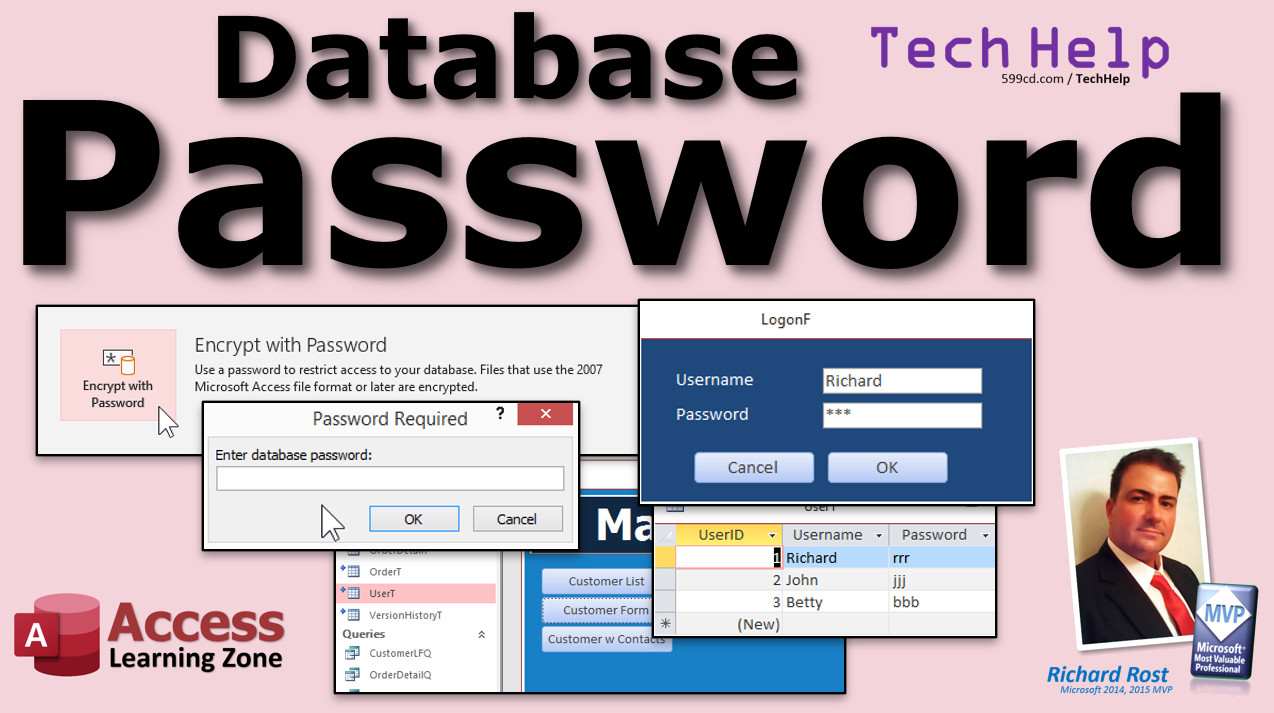
Set and Remove a Database Password in Access In this Microsoft Access tutorial, I will show you how you can protect your database by adding a password. I will also show you how to remove a password if you decide you no longer want one. Nelson from Lincoln, Nebraska (a Platinum Member) asks: I'm an attorney, and I have some sensitive information in my database. Is there any way that I can put a password on it like with Word and Excel to prevent people from opening it? MembersMembers will learn how to split their database and have the frontend connect to the password-protected backend. Then we'll create a user table with usernames and passwords. We'll make a logon form to process the user logon. I'll show you how to use TempVars to store the name of the currently logged on user.
Silver Members and up get access to view Extended Cut videos, when available. Gold Members can download the files from class plus get access to the Code Vault. If you're not a member, Join Today!
Links
Keywordsset database password, create a password, securing, encrypt database, unlock, set password, remove password, password protect,logon form, username, user level security, split database, hide, tempvars, login form, audit, open exclusive, encrypting with a block cipher is incompatible with row level locking. Row level locking will be ignored
More InformationTranscriptWelcome to another TechHelp video brought to you by AccessLearningZone.com. I am your instructor, Richard Rost. In today's video, I am going to show you how to set and remove a password from your Microsoft Access databases. Setting a database password is a great way to prevent unauthorized use of your database. Today's question comes from Nelson from Lincoln, Nebraska, one of my platinum members. Nelson says, I am an attorney and I have some sensitive information in my database. Is there any way that I can put a password on it, like with Word and Excel, to prevent people from opening it? Yes, of course, Nelson. You can apply a database password. Without the password, people cannot even open the database. I am actually surprised at myself that I never covered this in any of my beginner or even expert classes. I did not cover this until my developer lessons. I guess my train of thought was that usually, when you build a database in Access, you want other people to use it. The security measures that I taught, for example in my simple security video, are designed to keep people who you want to be able to use the database from being able to change things or modify the structure of the database, but you still want them to get in there and use it and look up records and add data and stuff like that. If you want to prevent people from even getting in the database at all, all you have to do is set up a database password. Let me show you how that is done. Here, sitting on my desk, I have a file called MyDatabase.accdb. Now I can just double-click on this and it will open. There it is. This is the TechHelp Free Template that you can download from my website if you would like to. It is free of charge. Now you can find the database password settings under File, then Info. That is right here in Encrypt with Password, but if you try this, you get yelled at. It says you must have the database open for exclusive use in order to set or remove the password. How do you do that? Well, you have to open the database exclusively. Shut it down. You cannot open Access by double-clicking on a shortcut to the database. You have to go find Access on your Start Menu. I just made a shortcut to it right there. Just go find it on your Start Menu, or if it is on your taskbar, you can click on it there, but you cannot open it up from the database shortcut. Open up the Access application. You get this screen. Now go to Open, pick Browse. If you see your database here in the recently used or pinned items, do not open it from over here. You need to go to Browse. Browse to wherever your database is - mine is on my desktop - and then find it in here. There is my database. Now, do not hit Open. Drop this down and pick Open Exclusive. You have to open the database exclusively. This just means it is a special mode where only you can make changes to it. No one else can be in it if it is on a network. Now that I have got the database open exclusively, now I can set that password. Go to File, Info, Encrypt with Password. All right, time for your password. Do not forget the password. In fact, I strongly suggest you back up the database before you do this. Make sure you have got a good backup copy. Let me say this one more time for the people in the back row - back up your database before you apply a password. I get emails from people all the time that say, hey, I have got a database with a password on it. I forgot the password. Can you help me get in? No, I cannot, sorry. I do not know if it is your database and it would be unethical for me to help you crack a database that is not yours, if not illegal. I refuse to do that. I have seen some apps on the market that claim to be able to do that, but I have never used them. I will not use them. I have all my databases backed up every night in multiple locations. Offsite. I have got a whole video on backing up your data. Go watch those. Back up your database before you put a password on it. Do not come to me and say you forgot your password. Sorry, I cannot help you. It is just like people that come to me asking for help with databases that have pirated or cracked versions of Office. No, pay for your software, people. So now that I have made sure that I have got a good backup of my database saved somewhere else, I am going to put a password on here. 599CD. All right, 599CD, type in the same password twice. Hit OK. You might get this message. It says encrypting with a block cipher is incompatible with row-level locking. Row-level locking will be ignored. What does that mean? Do not worry about it. Basically, you are turning on advanced encryption and you cannot use row-level locking. I am not going into row-level versus page-level locking right now. Essentially, it does not really matter. Unless you have got a multi-user database with lots and lots of people working on it. If you have enough people using your database where you cannot use row-level locking, you really should be using SQL Server anyway. So do not worry about this error message, just hit OK. Maybe I will make another video someday in the future that talks about row-level locking. Now your database is password protected. Close it. Now you can reopen it just from your shortcut, and when you do, enter database password. If I type in anything but the right password, it does not let you in. Not a valid password. You can sit here until you are blue in the face trying to figure out that password. If you type in the right password, then you are in. Now you have got a password on your database and you realize you no longer want it. How do you remove it? Well, again, you cannot just come in through here once the database is open and go to File, Info, Decrypt. You have to have it open exclusively. So again, shut down the database. Go back in through the Access application. Open, Browse. Mine is on my desktop. Find yours. My database. Drop this down. Open Exclusive. It is going to ask you for the password. Now, File, Info, Decrypt Database. Enter the password again. Do not forget that password. Now I can close the database and reopen it without the password. So that is how you set the password and then remove it if you do not want it. And again, make sure you back everything up. Now, if you are dealing with a multi-user database and you want to link to a password-protected back end, you will need that password when you create the link. When you link to it, if you are splitting your database - I have got another whole video on splitting your database - you will just need that password when you connect to it. That is a good way to put your tables up on the network and have that file protected with a password. But the password is saved in the front end, so if they have access to the front end, they can get right into the back end. So there are a lot of different things you want to consider. Now the password will keep everyone out of the database. If you give someone the password, that is assuming they have the rights to do whatever they want in that database, work with the data, and modify it. If you want to put some simple security on it as far as the design goes, go watch my free simple security video. It is on my website. It is on YouTube. I will put a link down below. You can click on it. I show you how to hide the tables. Even if they are linked, you can hide them so they cannot see them if they are poking around. I will show you how to hide the navigation pane. I will show you how to disable most of the ribbon - all those sensitive commands. I will show you how to encrypt it into an ACCDE file so they cannot modify any of the structure of the database, the forms, the reports, that kind of stuff. If you really want to lock down your database with professional level security, I have got a whole security seminar on my website that covers everything you could possibly want to do: setting up login pages, tracking which users do things, audit trails, and more. Everything you could possibly want to know about securing your Access database is included in my security seminar. Again, I will put a link to that down below. Want to learn more about password protecting your database? A simple database password keeps everybody out. But if you have got a database that you want to share, like on a network, for example, you are going to want to set up a split database. I have got other videos on splitting your database. Go watch those. Watch the simple security video that I mentioned earlier - that also helps you to hide some of the objects in the database and to prevent the user from seeing the navigation pane. In the extended cut for this video, I am going to show you how to split this database but connect to the tables using that password. Then we will create a user logon form. We will make a user table that has the username and password for all of your users in it. Now we know how to store that in a password protected backend file, so that is safe. They cannot just open up that table or database and look at the usernames and passwords. We will set up the logon form so they can either log on or cancel to exit the database. That is all covered in the extended cut. It is security that is perfect for about 99 percent of the users that are out there. If you have some Access experts working for you, like my developer students for example, yes, they can get around this. It is not perfect, but it is good enough for the vast majority of offices. That is all covered in the extended cut. Silver members and up get access to all my extended cut videos, and there are well over 100 of them now, so there is plenty to watch. How do you become a member? Click the Join button below the video. After you click the Join button, you will see a list of all the different types of membership levels that are available. Silver members and up will get access to all of the extended cut TechHelp videos, live video and chat sessions, and more. Gold members get access to a download folder containing all the sample databases that I build in my TechHelp videos, plus my code vault, where I keep tons of different functions that I use. Platinum members get all the previous perks, plus access to my full beginner courses and some of my expert courses. These are the full-length courses found on my website and not just for Access. I also teach Word, Excel, Visual Basic, ASP, and lots more. But do not worry, these free TechHelp videos are going to keep coming. As long as you keep watching them, I will keep making more. If you liked this video, please give me a thumbs up and feel free to post any comments that you have. I do read them all. Make sure you subscribe to my channel, which is completely free, and click the bell icon and select All to receive notifications when new videos are posted. Click on the Show More link below the video to find additional resources and links. You will see a list of other videos, additional information related to the current topic, free lessons, and lots more. YouTube no longer sends out email notifications when new videos are posted, so if you would like to get an email every time I post a new video, click on the link to join my mailing list. If you have not yet tried my free Access Level 1 course, check it out now. It covers all the basics of building databases with Access. It is over three hours long. You can find it on my website or on my YouTube channel. If you like Level 1, Level 2 is just one dollar, and it is also free for all members of my YouTube channel at any level. Want to have your question answered in a video just like this one? Visit my TechHelp page and you can send me your question there. Click here to watch my free Access Beginner Level 1 course, more of my TechHelp videos, or to subscribe to my channel. Thanks for watching this video from AccessLearningZone.com. IntroIn this video, I will show you how to set and remove a password on your Microsoft Access database to help protect sensitive information from unauthorized users. We will talk about why database passwords are useful, the steps you need to open your database in exclusive mode, and how to apply and remove a password securely. I will also discuss important tips like backing up your database before setting a password and what to do if you forget it, as well as briefly mention simple security options to further control access. QuizQ1. What is the purpose of setting a password on a Microsoft Access database? A. It prevents unauthorized users from opening the database. B. It allows multiple users to log in at the same time. C. It automatically encrypts all data fields. D. It makes backup copies of the database. Q2. Where can you find the option to set a database password in Access? A. Under Tools, Security B. Under File, Info, Encrypt with Password C. Under Edit, Preferences D. Under View, Properties Q3. What must you do before you can set or remove a database password in Access? A. Open the database in read-only mode B. Open the database exclusively C. Open the database using a guest account D. Open the database from a backup copy Q4. What does "open database exclusively" mean in Microsoft Access? A. Only the database owner can edit data B. The database opens with all tables locked C. Only one person can access it at a time for making changes D. You must use an administrator account Q5. What should you do before applying a password to your Access database? A. Compact and repair the database B. Set up user accounts C. Make a backup of the database D. Remove all linked tables Q6. If you forget your database password, what does the instructor recommend? A. Contact Microsoft Support for a reset B. Download a password breaker tool C. Use your backup to restore the database D. Ask a developer to crack it for you Q7. What is the message about block cipher encryption and row-level locking warning you about? A. You need to convert to SQL Server B. Advanced encryption disables row-level locking C. Your database is too large for encryption D. You must upgrade Access Q8. How do you remove a password from a Microsoft Access database? A. Go to File and delete the password entry B. Open the database exclusively, go to Info, and use Decrypt Database C. Right-click on the database file and select Remove Password D. Use the Access Recovery tool Q9. When linking a frontend database to a password-protected backend, what do you need? A. The password for the backend B. Admin rights on your computer C. An SQL Server connection D. A VPN connection Q10. What kind of security does a simple database password provide? A. It allows users to edit the structure but not data B. It prevents everyone from opening the database without the password C. It only hides tables but does not block access D. It creates user-level permissions for all objects Q11. For advanced security features like audit trails and tracking user actions, what does the instructor recommend? A. Downloading third-party add-ons B. Taking the security seminar on his website C. Using Excel instead of Access D. Enabling macros in Access Q12. What is suggested if you want to further hide tables or the navigation pane in Access? A. Use the simple security video tutorial provided B. Remove user logins C. Delete all forms and reports D. Set a 256-character password Q13. What is the instructor's advice regarding software authenticity? A. Use trial versions of Office B. Use pirated or cracked software for practice C. Always pay for your software D. Avoid updating Office Q14. Which membership level grants access to all extended cut TechHelp videos and live video and chat sessions? A. Bronze B. Silver and up C. Gold only D. Basic Answers: 1-A; 2-B; 3-B; 4-C; 5-C; 6-C; 7-B; 8-B; 9-A; 10-B; 11-B; 12-A; 13-C; 14-B DISCLAIMER: Quiz questions are AI generated. If you find any that are wrong, don't make sense, or aren't related to the video topic at hand, then please post a comment and let me know. Thanks. SummaryToday's video from Access Learning Zone is all about setting and removing a password on your Microsoft Access databases. I want to address a question about database security, specifically how to restrict access entirely so nobody can even open the file without a password. Setting up a database password is an excellent way to protect sensitive information and prevent unauthorized use of your Access database. To start, if you want to add a password to your database in a way that keeps everyone out unless they know the password, Microsoft Access provides a built-in password feature. Without this password, users cannot even open your database file. Surprisingly, I have not included this feature in any of my beginner or expert courses, mostly because Access databases are often designed for sharing and collaboration, so most of my previous security lessons focused on limiting design changes and preventing unauthorized editing, not stopping people from opening the database entirely. If your goal is absolute access control, you simply need to set a database password. Here are the steps for doing that. First, consider a database file you have on your computer, such as MyDatabase.accdb. Normally, you can open this file just by launching it as usual. However, to put a password on it, you have to use a special mode called "open exclusive." This requirement exists so that only one person can make significant changes at a time, and no one else on a network can be in the file while you set or remove the password. To open the database exclusively, you must start Microsoft Access from your Start Menu or Taskbar rather than double-clicking the database file. Once Access is open, use the Open command, select Browse, and navigate to your database. When you see your file, use the drop-down arrow next to the Open button and select Open Exclusive. After opening the database in exclusive mode, go to File, then Info, and choose Encrypt with Password. You will be prompted to enter a password twice. It is essential to remember your password, and I strongly recommend making a backup before you set one. If you forget your password, there is no simple or ethical way to recover the data. I receive messages all the time from people who have locked themselves out and unfortunately, I cannot help retrieve those passwords. It is very important to keep your data backed up and your password stored somewhere safe. Sometimes, when setting the password, Access may warn you that encrypting with a block cipher is incompatible with row-level locking. In most cases, you can simply ignore this message. Unless your database is used by a large number of users simultaneously, this warning is not something you need to worry about. Really, if you have a setup that large, you should be using SQL Server anyway. Once you have set the password, close the database. From now on, when you or anyone else attempts to open the file, Access will prompt you for the password. Entering an incorrect password will not let you open the database at all. If you later decide that you want to remove the password, you will again need to open the database in exclusive mode. As before, open Access first, go to Open, use Browse, select the database, and choose Open Exclusive. After entering your password to access the file, go to File, then Info, and select Decrypt Database. After entering your password one more time, the password protection will be removed, and you can open the database normally without further prompts. If you maintain a multi-user database system and have a password-protected back end (meaning the file where all the tables reside), you will need to provide that password when linking tables. However, if users have full access to the front end, they technically have access to the back end as well, so you will want to consider more advanced security features depending on your needs. The password feature keeps unauthorized users out completely, but anyone with the password can do anything in the database. If your concern involves restricting design changes or access to certain objects within the database, I suggest checking out my simple security video which demonstrates how to hide tables, remove the navigation pane, and disable certain parts of the ribbon. Converting your database to an ACCDE format also helps prevent users from modifying your forms, reports, or the database structure. If you need professional-grade security, I have a complete security seminar available that covers everything from login forms to auditing user actions. This is ideal if you want to seriously lock down your system or track what different users are doing. Beyond database passwords, if you want to share your database across a network, you should look into splitting your database design into a front end and back end. I have several videos covering this, as well as additional topics like hiding objects and controlling user permissions. In the extended cut of today's video, I will demonstrate how to split a database and connect to a back-end file using a password. I will also show how to create a user logon form, build a user table for managing user accounts and passwords, and ensure that these are securely stored in the protected back-end file. The logon form will allow users either to sign in or exit the database, providing a good balance of user management and security. This approach covers the security needs of the vast majority of small and medium businesses. While it is not impossible for a determined expert to bypass, for almost all regular offices, this setup is more than sufficient. Silver members and higher have access to all of my extended cut videos, and there are now well over a hundred to choose from. Gold and Platinum members unlock even more content, including full course downloads, exclusive code reference material, and my full-length beginner and expert courses across Access, Word, Excel, Visual Basic, ASP, and more. Regardless of which membership level you choose, all my TechHelp videos remain free, and I plan to keep offering new content as long as there is interest. Remember to subscribe on YouTube for quick access to new videos, and consider joining my mailing list to receive notifications since YouTube no longer sends out emails automatically. If you would like to have your question answered in an upcoming video, you can find the form on my TechHelp page. For anyone new to Microsoft Access, I highly recommend starting with my free Access Level 1 course, which covers all the basics and is available on both my website and YouTube channel. A full video tutorial with step-by-step instructions on setting and removing passwords in Microsoft Access is available on my website at the link below. Live long and prosper, my friends. Topic ListSetting a database password in Microsoft Access Opening a database in exclusive mode Navigating to the Encrypt with Password feature Applying a password to a database Understanding the password encryption warning Testing password protection by reopening the database Removing a database password Opening a password-protected database in exclusive mode for removal Decrypting the Access database Backing up the database before applying a password Considerations for multi-user and split databases with passwords Primary TopicsAccess database password protection, opening databases exclusively, encrypting with password, removing password, basic database security Secondary Topicsmulti-user databases, splitting databases, ACCDE conversion, backing up databases, navigating Access interface, security seminars |
||||||||||||||||||||||||||||
|
| |||
| Keywords: TechHelp Access set database password, encrypt database, unlock, set password, remove password, password protect, logon form, username, user level security, split, hide, tempvars, login form, logon, audit, open exclusive, block cipher, row level locking PermaLink Database Password in Microsoft Access |