|
||||||

|
|
||||||
|
Access Survey SeminarSurveys in Google Forms. Collect, Analyze in Access. WelcomeWelcome to the Microsoft Access Survey Seminar. This seminar is 4 hours, 6 minutes long. You will learn how to build surveys & questionnaires in Google Forms for anyone to fill out. You will then see how to collect the responses using Microsoft Excel and directly into Microsoft Access. We will then build lots of queries, forms, and reports to analyze and summarize that data. ResourcesSeminar Goals
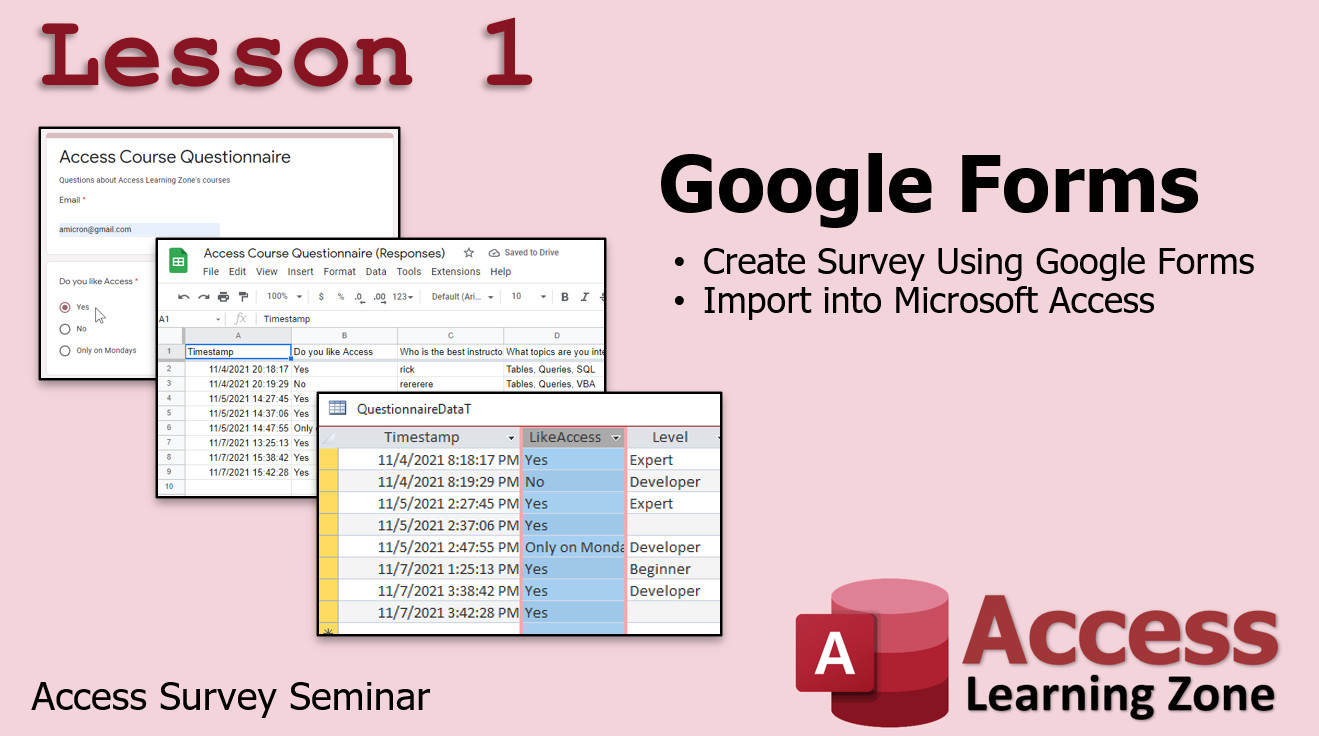
Topics CoveredIn Lesson 1 we will learn how to create surveys and questionnaires in Google Forms. We will learn how to import the response data into Access.
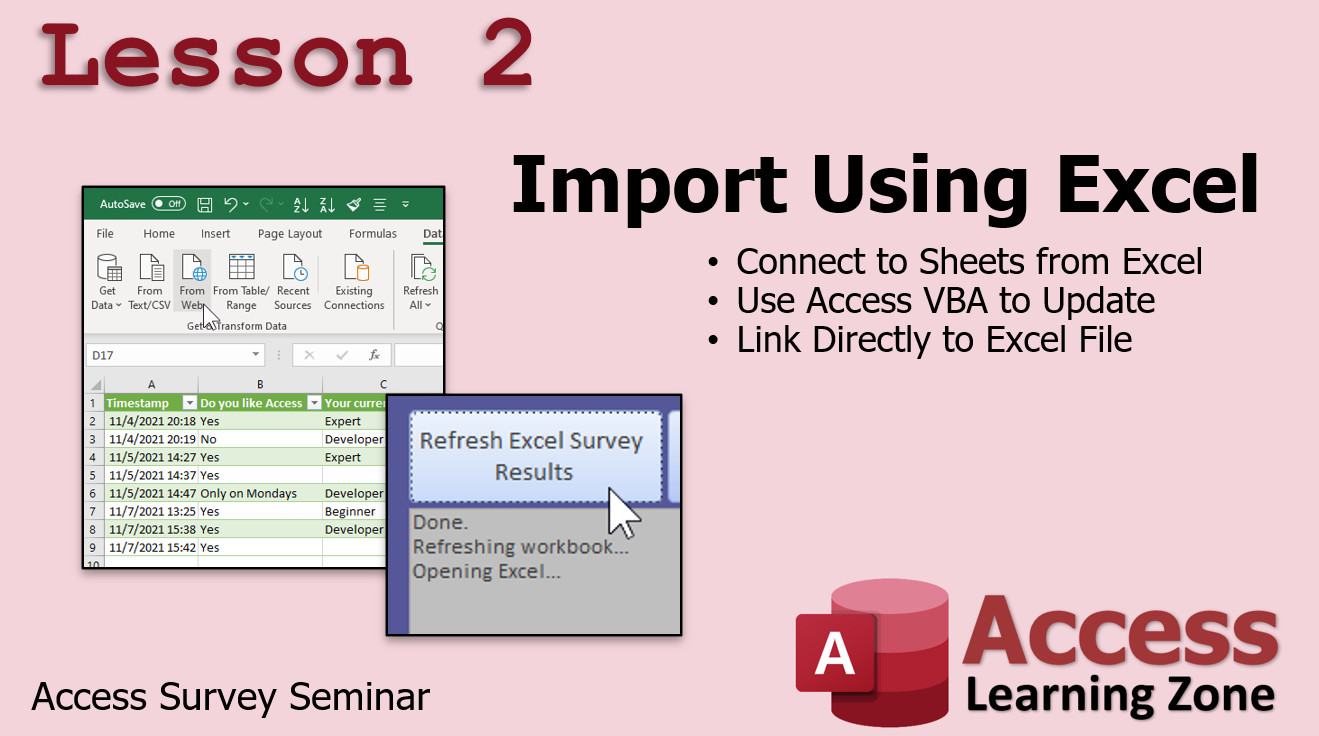
In Lesson 2 we will learn how to connect to Google Sheets from Excel. Then we will use a little VBA Automation to make Access tell Excel to update the data in the background, which we can then get into Access via a linked table.
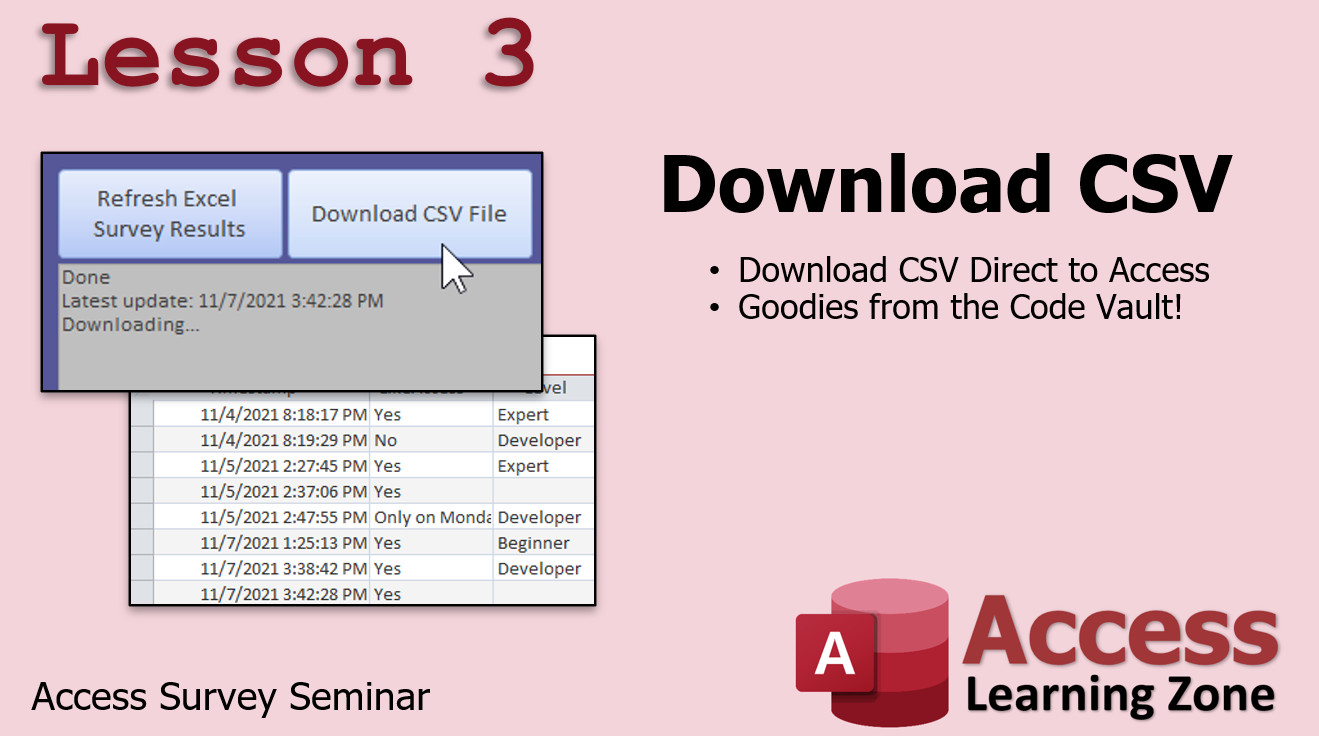
In Lesson 3 we will skip Excel entirely and learn how to download a CSV text file from the web automatically with Access and a single click. Goodies from the Code Vault.
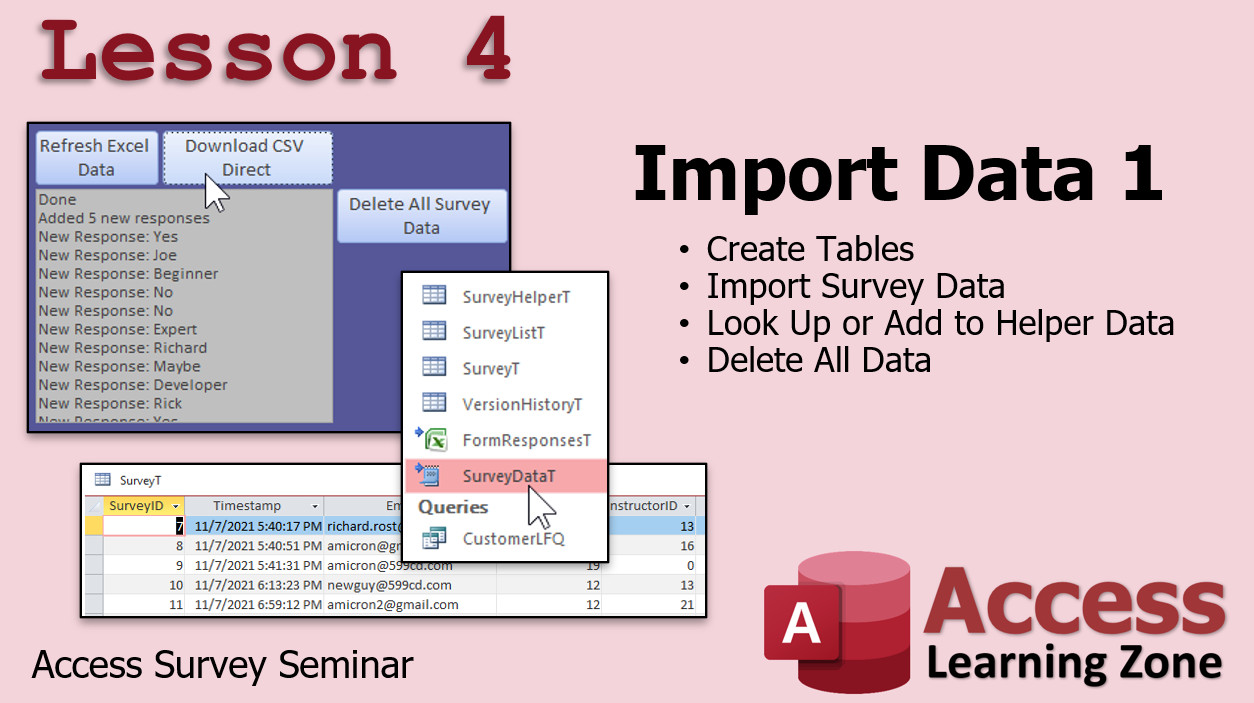
In Lesson 4 we will create tables to import the data from the CSV file directly into Access instead of using a linked table. We'll create helper data tables to store all of the different types of survey responses.
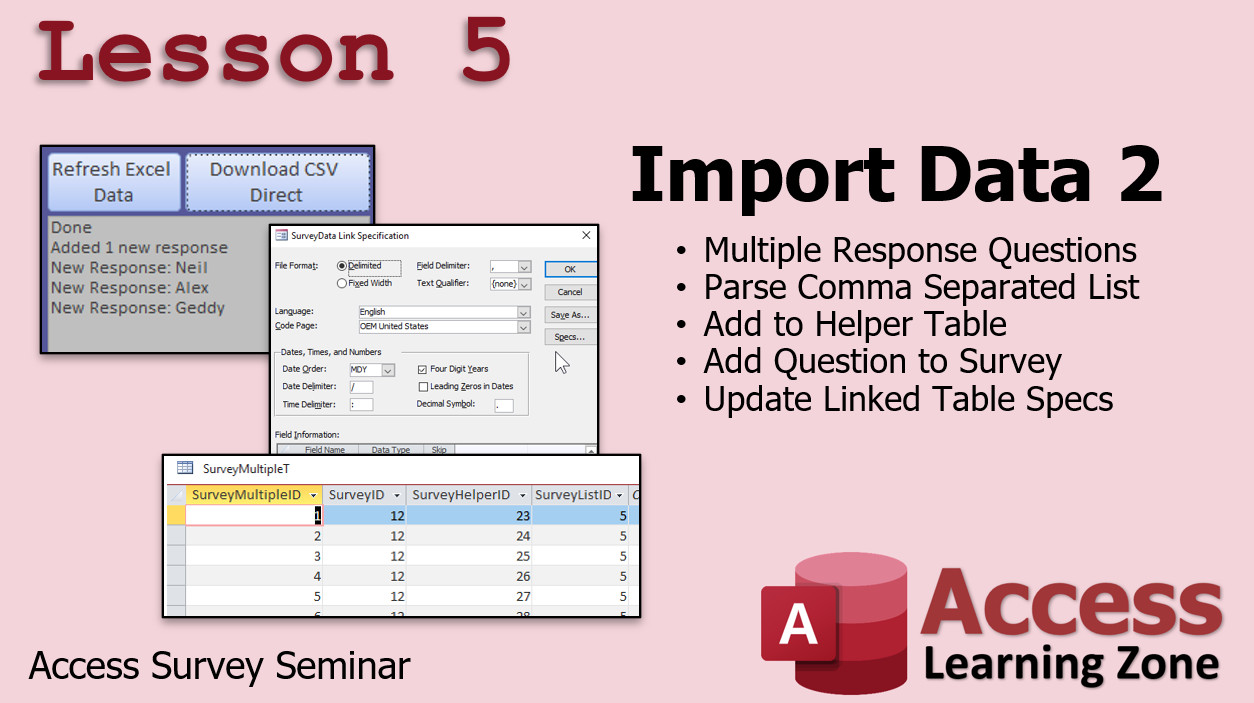
In Lesson 5 we will learn how to import the multiple-item responses into a related helper data table. This way a response such as "queries, forms, reports" will be split up into 3 properly relational records.
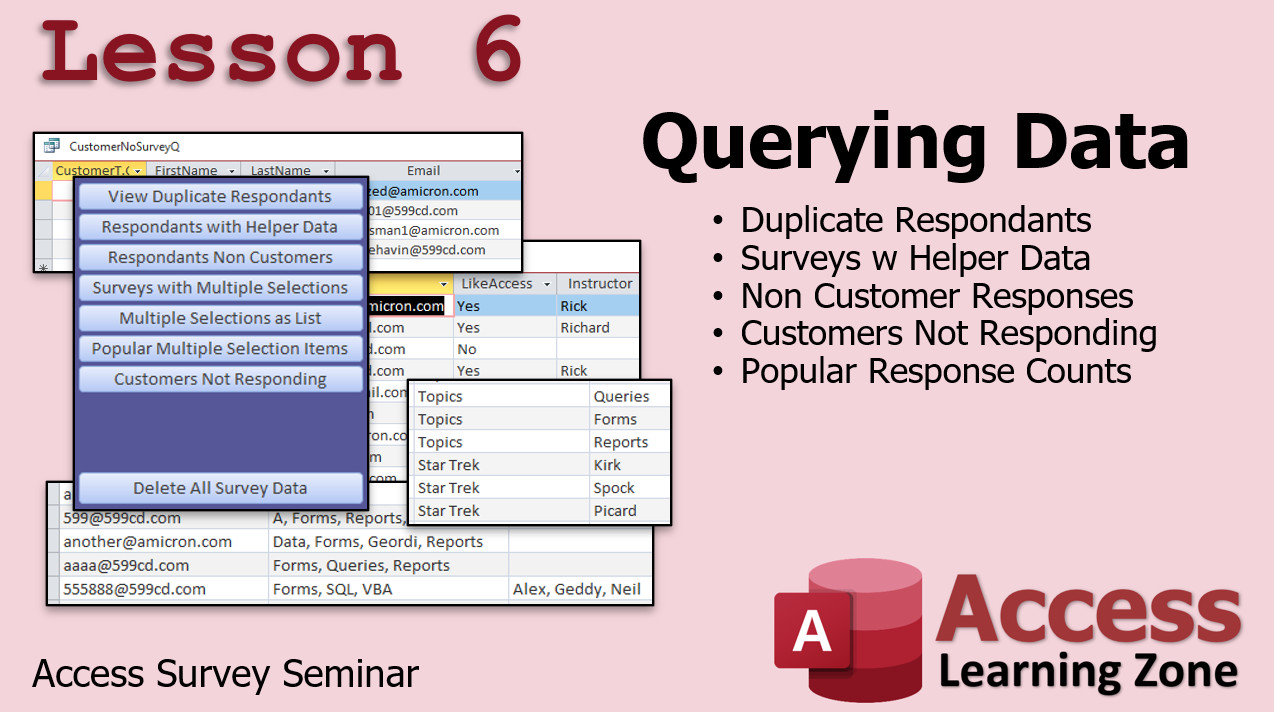
In Lesson 6 we will make a whole bunch of different queries to analyze the response data: are there any duplicate respondents, are there non-customer responses, show the surveys with all the helper data, what are the popular responses, and lots more.
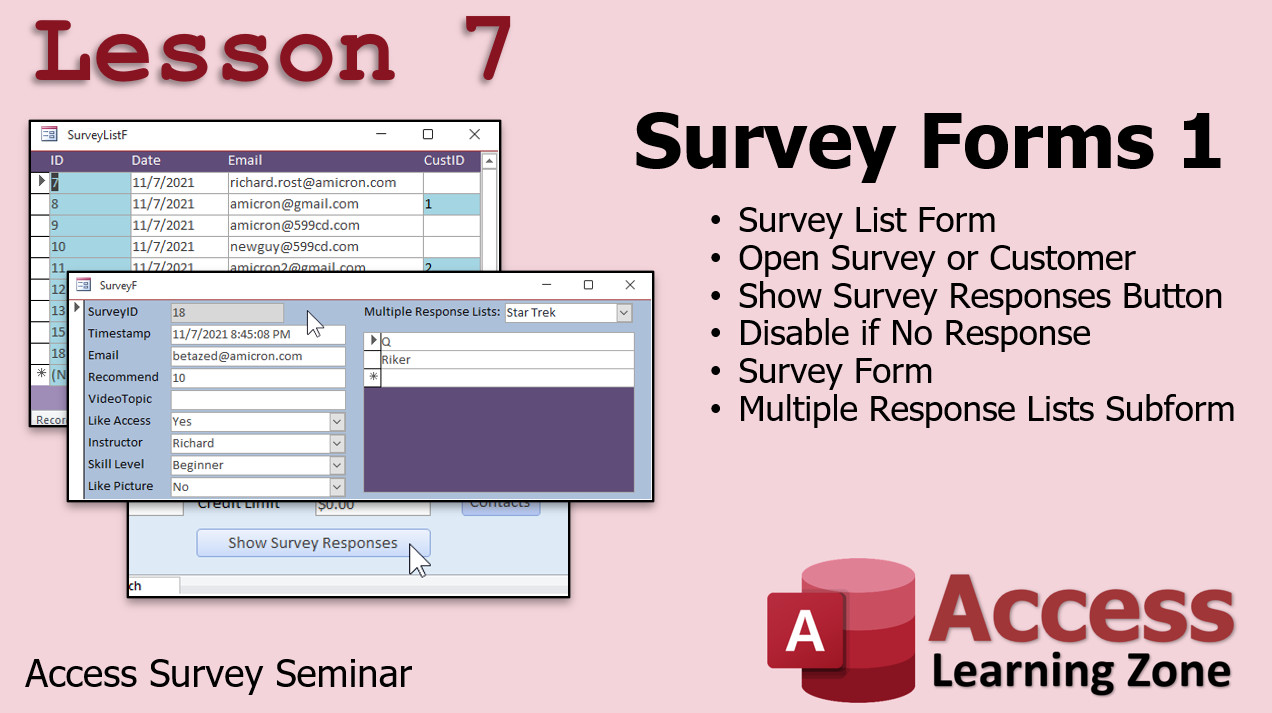
In Lesson 7 we will build a survey form to show all of the results along with the helper data info, and a subform to show the multiple response answers. We will be able to link the surveys to existing customers. On the survey list form we can open the survey response form or the customer form. We can open the survey data directly from the customer form.
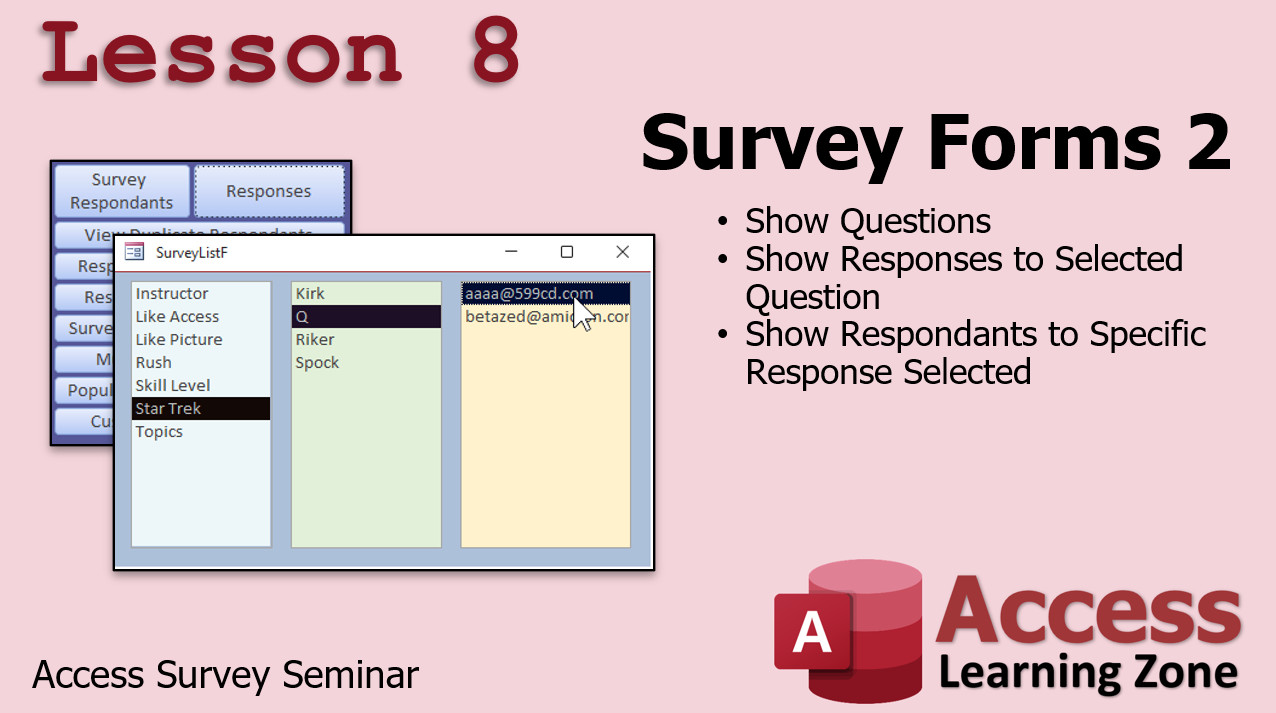
In Lesson 8 we will go in the opposite direction. Whereas in Lesson 7 we wanted to see the response data from a specific customer, in Lesson 8 we want to pick a specific survey response and then see all of the customers who responded with that answer. This would be handy to show, for example, "which customers said they wanted to refinance their mortgage within the next 5 years."
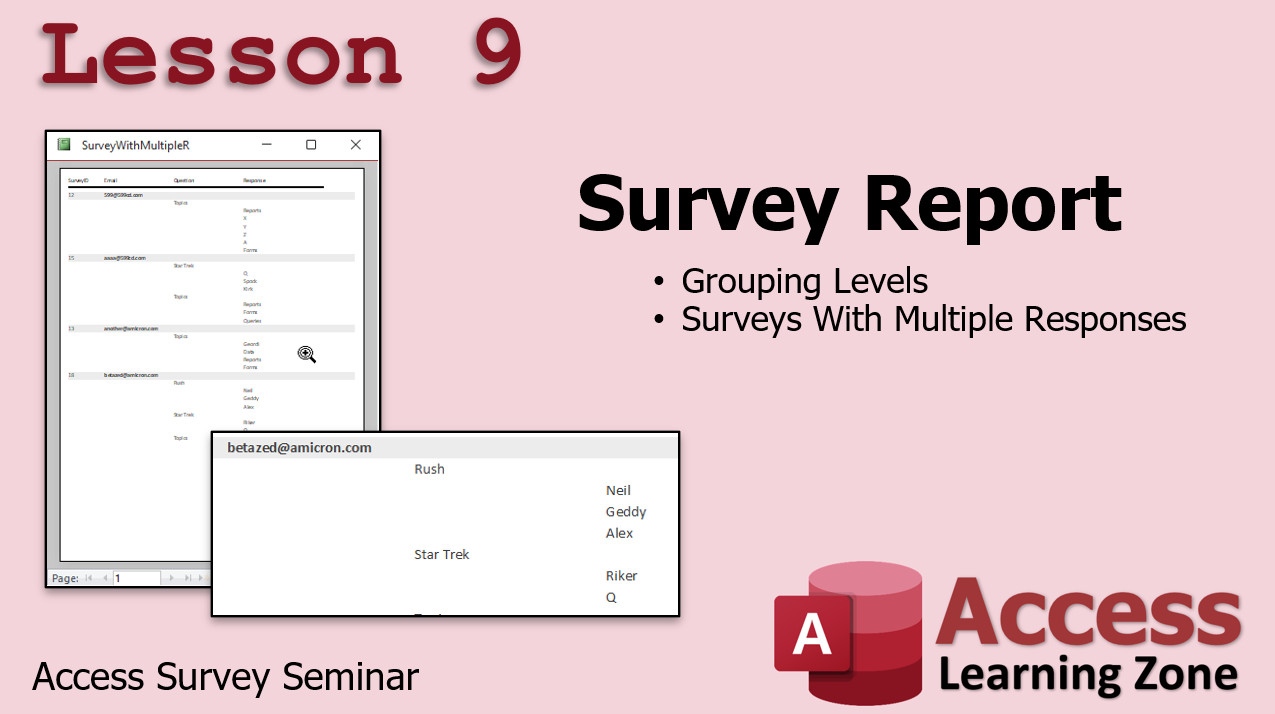
Finally, in Lesson 9 we will do some reporting. We'll see how to create a report with sorting and grouping levels to display each survey response with the multiple-answer questions and their responses grouped.
Pre-RequisitesThis is a Developer-Level Seminar. There will be a lot of VBA and SQL. It is strongly recommended that you have completed my entire Access Beginner and Expert series. My Developer 1 class is highly recommended so you understand the basics of programming in VBA. If not, at least watch my free Intro to VBA video. Developer 16 is recommended if you want to learn about Recordsets. I strongly recommend these lessons before you watch this Seminar. I also recommend my Access SQL Seminars which will teach you how to work with the SQL language. VersionI am using Microsoft 365, roughly the equivalent of Access 2016 or 2019. Everything in this seminar should work with every version of Access back to 2007. NotesPlease note that this seminar is NOT downloadable. You must watch it online. Enroll TodayEnroll now so that you can watch these lessons, learn with us, post questions, and more.
Questions?Please feel free to post your questions or comments below. If you are not sure as to whether or not this product will meet your needs, I'd rather help you before you buy it. Remember, all sales are final. Thank you. KeywordsSurveys, Questionnaires, Polls, Quizes, Multiple Choice, Header Image, Duplicate, Required, Delete, Sections, Shuffle Option Order, Short Answer, Paragraph, Allow Other, Dropdown, Linear Scale, Add Picture, Add Video, Get Link, Shorten Link, Import to Access, Link to Excel File as Table, Publish to Web, Get & Transform Data, From Web, Enable Background Refresh, Excel.Application, File Download from Web, vba automation, google sheets
More InformationTranscriptWelcome to the Microsoft Access Survey Seminar brought to you by AccessLearningZone.com. I am your instructor, Richard Rost. In this seminar, I will teach you how to create surveys and collect data from multiple respondents using Google Forms, a free online service. Once the information has been collected, I'll show you how to get it using Microsoft Excel, automated from Access. Then I'll also show you how to grab it as a CSV file directly from Access without using Excel. There are two different options you can use to get the data into Access. Next, we'll make all kinds of different queries to do all kinds of different reporting, and then we'll make a couple of different forms so you can see each respondent and their responses, or the other way - see all the responses and who responded that way. We'll do grouping reports and lots more. Now, like it shows right here, this is a developer level seminar. Access is not for beginners, so you should definitely know your way around Access. I strongly suggest you take my beginner and expert series before this class, and I highly recommend Developer 1, which teaches you VBA, and Developer 16, which covers record sets. I will use a lot of record sets in today's class. At a bare minimum, you should have at least watched my Intro to VBA free video on my website. I will be using Microsoft 365. It is currently November of 2021, so this is roughly equivalent to Access 2019. Most of what I'm going to show you in this video should be valid going all the way back to Access 2007 or later. If you have questions about the material covered in today's class, you can post them in the comments or questions section down at the bottom of the page that you're on right now. If you have unrelated questions regarding Access in general, you can post them in the Access forum. Let's take a closer look at exactly what we're going to cover in today's class. In lesson one, we'll see how to create a survey using Google Forms, a free service online. We'll learn how to collect the responses in a spreadsheet and then import that information into Microsoft Access. Lesson two is taken from the extended cut from my TechHelp for silver members. So if you're already a silver member and you've watched this already, you can skip lesson two. In lesson three, we're going to learn how to bypass Excel completely and use just Microsoft Access VBA to download our survey data direct from the web as a CSV file, a text file. Then we'll import that information directly into Access with a linked table - all goodies from the Code Vault coming up in lesson three. In lesson four, we're going to work on importing the data that we downloaded in the last lesson into our database. This way we can set it up properly, make it relational, and add the supporting data to a helper data table, which I'll talk about in a few minutes. We'll make a button to delete the data. Lots more is covered in lesson four. In lesson five, we're going to continue with importing data. We're going to tackle the multiple response questions - those check boxes. We're going to parse the comma separated lists that Google gives us and put each one of those items in its own record in the table. We'll add them to the helper table if needed. Then we'll add another question or two to the survey and see how we have to update the linked table specifications every time we add a question. That's all covered in lesson five. In lesson six, we're going to work on querying our data. We'll put a bunch of different queries together to deal with the data that we've just imported into the database. We'll see a list of duplicate respondents if someone responded more than once to the survey, and surveys with the helper data attached so you can see not just the ID, but the information as well. We'll also check for non-customer responses, so who responded to the survey that is not a customer, and of course, customers not responding the other way around. You can send it out to a bunch of customers to see who has not responded yet. Then we'll do popular response counts. In lesson seven, we're going to make some forms so we can view this data in the database. We're going to make a survey list form. You can see a list of all the surveys sent in with the date and the email, whether or not that person was a customer, and you can double click on the customer ID to open up the customer form, or you can double click on the survey ID to open up the survey form. We'll put a Show Survey Responses button on the customer form. If they do not have any survey responses, we'll disable that button. Then we'll make the survey form, show the combo boxes for each response that are single responses, and make a multiple response list so you can pick what list you want to see, like the Star Trek list or whatever, and it will show you their responses in a subform. There is a lot to do in this lesson. Lesson eight continues with survey forms. This one is a little tricky, but I think you will like the results in the end. What we're going to do is go backwards. I do not want to open up the respondent, the person, and see their responses. I want to go the other way - I want to say, show me a list of all the questions and the responses to that question, and then I want to see all the people who responded to that. For example, here I did Star Trek - who is your favorite Star Trek person? Q, these people responded to that one. The benefit of this is that you might want to do marketing to a specific response from a specific question. For example, are you planning on mortgaging your house in the next five years? Show the mortgage or house question, who answered five years, and show me those people. We're going to do that in this lesson. In lesson nine, I'm going to show you how to make a report with sorting and grouping levels for our surveys with multiple responses. A lot of the reports that you can build are simply just building the right query and then turning the query into a nicely formatted printable report, which we've done with a lot of the queries that I can think of generating for this type of survey data. But one thing I have not shown you in this seminar, at least, is how to make a report that will show the multiple responses. So in this lesson, I'll show you how to do that. IntroIn this seminar, you'll learn how to create and manage online surveys using Google Forms, collect responses, and import that data into Microsoft Access with multiple techniques including Microsoft Excel and direct CSV downloads. I will show you how to parse and organize survey data, handle multiple-choice responses, build queries for data analysis, and create forms and reports to review respondent answers and question-based summaries. This class is aimed at advanced users and covers the use of VBA, linked tables, and strategies for handling and reporting survey results in Microsoft Access. QuizQ1. What is the main purpose of this seminar? A. To teach how to create surveys and manage response data with Microsoft Access using Google Forms B. To introduce basic database concepts for beginners C. To discuss the history of Microsoft Access D. To sell products related to Access Q2. Which tool is used to create the survey in this seminar? A. Microsoft Access Forms B. Google Forms C. Microsoft Word D. SurveyMonkey Q3. Once responses are collected from Google Forms, what is one of the methods shown to get data into Access? A. Manually typing responses into Access B. Importing using Microsoft Excel as an intermediary C. Emailing responses to Access users D. Printing and scanning survey forms Q4. What is emphasized as a prerequisite for taking this seminar? A. A basic understanding of Microsoft Word B. Advanced knowledge of SQL Server C. Solid foundation in Microsoft Access, VBA, and working with record sets D. Certification in Google Forms Q5. What does lesson three demonstrate? A. How to graph survey results in Access B. How to download survey data directly as a CSV file using Access VBA C. How to share Access databases online D. How to protect Access forms with passwords Q6. What is unique about the method shown in lesson five for handling multiple response questions? A. Each possible response is stored in a single text field B. All responses are discarded except for the first C. Each checkbox answer is parsed and stored in its own record in the table D. Multiple response questions are ignored entirely Q7. In lesson six, what kind of data analysis is NOT mentioned? A. Counting popular survey responses B. Identifying duplicate respondents C. Checking for non-customer responses D. Charting the results in PowerPoint Q8. Lesson eight focuses on viewing survey data in which special way? A. By email address only B. By showing all questions and then listing all respondents for each response C. Only by customer ID D. By exporting all data to Excel Q9. Which lesson covers creating printable reports with sorting and grouping on multiple responses? A. Lesson five B. Lesson seven C. Lesson nine D. Lesson three Q10. How should general Access questions unrelated to the seminar be handled? A. By contacting Microsoft Support B. By posting in the Access forum C. By emailing the instructor directly D. By submitting them in the comments section of the lesson Answers: 1-A; 2-B; 3-B; 4-C; 5-B; 6-C; 7-D; 8-B; 9-C; 10-B DISCLAIMER: Quiz questions are AI generated. If you find any that are wrong, don't make sense, or aren't related to the video topic at hand, then please post a comment and let me know. Thanks. SummaryToday's video from Access Learning Zone focuses on teaching you how to create surveys and collect data using Microsoft Access and Google Forms. My goal is to guide you step by step through building a robust process to gather responses from multiple users, bring those replies seamlessly into Access, and then create meaningful reports and forms to analyze your data. First, I will introduce how to set up a survey using Google Forms. This tool is free and operates online, making it easy for anyone to participate. After participants have submitted their answers, I will explain how you can retrieve their responses and import them into Microsoft Access. There are two approaches: first, by using Microsoft Excel as an intermediate step with automation from Access, and second, by downloading the data as a CSV file directly from within Access without Excel. After pulling in the survey data, I will show you how to design queries that let you report on the data in different ways. You will learn how to build forms that let you view each individual respondent with their answers, or flip that around to see each answer choice and all respondents who picked it. We will also cover how to group survey results in reports and handle many other common reporting tasks. It is important to note that this seminar is aimed at developers—you should already be comfortable working with Access. If you have not yet completed my beginner or expert series, I strongly advise you do so first. In particular, my Developer 1 course (covering VBA) and Developer 16 (focusing on recordsets) will be especially useful, as recordsets are a major part of what I will demonstrate today. At a minimum, be sure to check out my free Intro to VBA video. For software, I will be using Microsoft 365 in this seminar, which is very similar to Access 2019. Nearly everything I teach today will work in Access versions from 2007 onward. Throughout the seminar, if you have specific questions about what we cover, you can use the comments or questions area at the bottom of the page. For more general Access topics, use the forum. Here is an overview of what you will learn lesson by lesson: Lesson one concentrates on designing a survey with Google Forms. You will see how to collect responses into a spreadsheet and then move that data into Access. Lesson two is drawn directly from the extended cut of my TechHelp series for Silver members. If you have already watched this as a Silver member, you may wish to skip this portion. Lesson three shows you how to bypass Excel altogether and use VBA inside Access to grab survey results as a CSV file from the internet. You will see how to attach this flat file as a linked table in your database. In lesson four, I will teach you how to properly import survey results into your Access database, restructure this data to make it relational, and add extra information to a helper table. I will also explain how to build a button to delete imported data when necessary. Lesson five focuses on dealing with questions that allow multiple selections, such as checkboxes. I will help you break down the comma-separated lists provided by Google Forms so that each individual response becomes its own record in the database. You will also see how to modify the linked table each time you add a new survey question. Lesson six is dedicated to querying your data. You will learn to design queries for a range of scenarios: identifying duplicate respondents, linking surveys with helper data, isolating non-customer responses, and checking for customers who have not replied. You will also learn how to count how many times each response was picked. In lesson seven, I will explain how to create forms that make it easy to browse and review survey data. You will see how to build a survey list form, drill down to see customer details, or view individual survey entries. I will discuss adding buttons that help navigate related records, including disabling the survey response button for customers who have not yet submitted a reply. You will also see how to display responses using combo boxes or a multiple response list through a subform. Lesson eight approaches survey data from another angle. Instead of starting with a respondent and reviewing their answers, here you will begin with a specific question and look at all the people who selected a certain response. This approach is handy for targeting specific population segments, for example, if you want to find all customers who answered a certain way for targeted marketing. Lesson nine wraps up the seminar by showing you how to build Access reports with sorting and grouping features, especially for presenting survey questions that allowed multiple answers. You will learn how to take your queries and turn them into polished, printable reports that properly organize all your survey data, even when responses span multiple selections. You can find a complete video tutorial with step-by-step instructions on everything discussed here on my website at the link below. Live long and prosper, my friends. Topic ListCreating a survey using Google Forms Collecting responses in a spreadsheet Importing Google Forms data into Microsoft Access Downloading survey data as CSV using Access VBA Linking CSV data to Access via linked table Importing and normalizing survey data in Access Using helper tables for relational setup Creating a button to delete survey data Parsing multiple response questions from CSV Storing individual responses from comma-separated lists Updating linked table specs for survey changes Building queries to analyze imported survey data Identifying duplicate survey respondents Querying customer and non-customer responses Finding customers without survey responses Counting popular survey responses Designing a survey list form in Access Linking survey forms to related customer records Enabling and disabling form buttons based on data Displaying single and multiple survey responses in forms Creating forms to view responses by question Querying respondents for specific answers Generating reports with sorting and grouping levels Printing reports showing multiple survey responses Primary TopicsGoogle Forms survey creation, exporting data to Excel and CSV, importing survey data into Access, VBA automation for data importing, parsing multiple response data, relational database design for survey data, complex queries for duplicate/non-customer res Secondary TopicsAccess Developer skills (record sets, VBA), linked table specifications, updating forms and reports for new survey questions. |
||||||||||||||
|
| |||
| Keywords: access seminar Surveys, Questionnaires, Polls, Quizes, Multiple Choice, Header Image, Duplicate, Required, Delete, Sections, Shuffle Option Order, Short Answer, Paragraph, Allow Other, Dropdown, Linear Scale, Add Picture, Add Video, Get Link, Shorten Link Page Tag: whatsnew PermaLink Microsoft Access Survey Seminar |