Check Spelling
By Richard Rost

 4 years ago
Check Spelling in Microsoft Access Forms
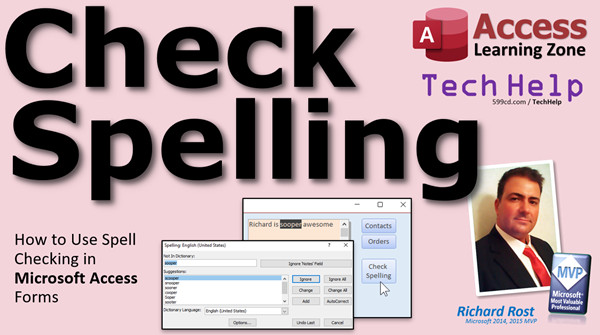
In this Microsoft Access tutorial, I'll show you how to use the Microsoft Office Spell Checking feature in your Access forms. You'll learn how to check all fields in all records, all fields in the current record, and just a single field.
Tania from Seattle, Washington (a Silver Member) asks: Is there any way I can get the spell checker from Word to run in Access?
Members
Members will learn how to check only specific fields.
Silver Members and up get access to view Extended Cut videos, when available. Gold Members can download the files from class plus get access to the Code Vault. If you're not a member, Join Today!
Links
Commands Used
- DoCmd.RunCommand acCmdSpelling
- DoCmd.RunCommand acCmdSelectRecord
 Keywords Keywords
access 2016, access 2019, access 2021, access 365, microsoft access, ms access, ms access tutorial, #msaccess, #microsoftaccess, #help, #howto, #tutorial, #learn, #lesson, #training, #database, ms access vba spell check, Spell Checking in an Access Form, Run Spell Check In Access On One Field In A Form, How To Use Spellchecker On A MS Access Form, How To Add A Spellchecker To A Form, acCmdSpelling, acCmdSelectRecord
 Subscribe to Check Spelling
Get notifications when this page is updated
More InformationTranscript Welcome to another TechHelp video brought to you by AccessLearningZone.com. I am your instructor Richard Rost.
In today's video, I am going to show you how to check spelling in Microsoft Access. Now, I know what you are thinking. Anybody who knows how to use Microsoft Word knows how to run the spell checker. Sure, but I promise I am going to show you some cool tricks that work in your Access database, so just bear with me.
Today's question comes from Tanya in Seattle, Washington, one of my Silver members. Tanya asked, "Is there any way I can get the spell checker from Word to run in Access?"
Well, yeah, Tanya. If you have the full version of Microsoft Office installed and you have the spell checker and it works in Word, it will work in Access too, just the same way.
The one downside is if you do not have Office, for example, if you are running the Microsoft Access runtime (the free version), then no, you will not have the spell checker available as of the last time I checked, which is now. If you are watching this in the future, that might be different, but as of right now, you have to have the full version of Access installed and yes, you get the spell checker. Let me show you how to use it.
Here is my TechHelp free template. It is a free database you can download from my website if you want to, but this will work in any database you choose.
I am not going to spend a ton of time showing you the spell checker features. I am sure most of you know how to use spell check in Word, but there are a couple of quirks in Access.
Let's open up my customer form. To launch the spell checker, we hit F7 on the keyboard. That is going to launch the spell checker. I am going to move it off to the side here and you can see it starts going down the fields in the form and it finds "super" spelled wrong. You can either ignore it, ignore all those words, change it, change all of those words (that is dangerous, be careful), or you can add it to your personal spell checker so it does not catch it in the future. That is great for names, addresses, company names, and so on.
You can ignore the notes field in the future if you want to. That is good with email addresses and such.
I will just hit ignore. There is no one, now it goes to the next record. Ignore, ignore, and it is going to go through every record in your form.
You might not want to do that. You might want to spell check only the current record. Let me close this.
There are a couple ways you can get to this point. If you have, like I have here, a customer list form, when I open this up, let's say I open up just my record here. Notice on the bottom when I double click there, it only has one record in here. So if I run the spell check now with F7, ignore that, and it is done. It is not going to run through every single record in the form or in the table. It depends on how many records you have here.
If you do open up a form that has all of the records in it, for example, 29 records in this case, and if you only want to select just this record to spell check, click on the record selector and only select that record. Now if I hit F7, it will find "super" again, if I ignore that, it is done. See that? I selected the record and it will spell check just that record.
Likewise, if you only want to spell check a certain field, then you can select just the text in that field. Let me spell something wrong over here. I will put a "U" in there for "Parkway." Now if I select the whole record and hit F7, it finds that first, ignore it, then finds "super" in the notes field.
But if I only want to, let's say, check the notes field, and I do not care about all this stuff out here, I do not want to check names and so on, if I select this text and hit F7, now it only goes to "super," ignore, and it will not jump to the rest of the fields. If you select a notes field, it will only spell check the text you select.
What if you do not want to have to remember that F7 is spell check? It is on the ribbon. If you go to the Home tab, in the record section, that guy right there is Spelling, and if you hold your mouse over, it says F7.
My users do not always want to have to run through the menu to find stuff, and I like to leave those off myself most of the time. So, how about we make a little button right here?
To do this, you are going to need one line of VBA code, just one line. Do not be scared if you have never done any VBA programming before. Go watch this video; I will put a link down below you can click on. It is about 20 minutes long and teaches you everything you need to know to get started with VBA. It is really simple and easy to do. Watch, I am going to show you how easy it is.
We are going to go to design view. You can grab a new button up here, right out of the command toolbox. That is your command button, click it, drop it, and the wizard starts up. There are a lot of cool stuff in the wizard that you can use, but what we want is not in here. You get print table, auto dial is still in there, you can quit application, there are all kinds of cool buttons you can make, but there is no spell checker option in here.
Note to Microsoft: add that. Cancel. We are going to do it ourselves. Put in the caption "Spell Check." You can make your button as big as you want, do whatever you want.
Let's open up the properties for this button, double click on it so the property sheet opens. I do not like "Command31." Let's give it a good name, let's call this "SpellCheckBTN" for spell check button.
Now, what do we want to happen when I click on that button? That is going to be its On Click event. Right click, go to Build Event. That is going to bring up this scary looking thing. There is another menu up before that that says what builder do we want; pick the Code Builder. I cover that in my intro to VBA.
You do not need this, do not worry about that. You can close that so it is not so scary.
Right here, notice I am in the Private Sub SpellCheckBTN_Click, this is what is going to happen when I click on that button.
Notice I have got two other buttons here. I have got a contact button and an order button, and those just open other forms: "DoCmd.OpenForm" contact, "DoCmd.OpenForm" order, and some criteria. I cover those in other videos.
What we want to do is, when we click on this Spell Check button, I want to launch the spell checker. Here is the command you need: "DoCmd.RunCommand". It is basically "run" something off one of the ribbon menus. There is a big long list of stuff in here you can do, and I will cover most of this eventually in different videos and in my full developer classes.
But the one we are looking for is "acCmdSpelling" (AC CMD spelling). There it is right there: "acCmdSpelling" - Access Command Spelling. In other words, run the spell checker. That is it. This says run the command from the ribbon spelling checker. That is all. So, you need one line. See how easy this stuff is? You just have to know the keys, someone has to show you what the command is. Now you know it.
That is my job, to teach you how to do this stuff. It is real simple.
Save this. Back over here, close everything down. Whenever you do any programming, always shut the form down and restart it. Trust me. Open it up, click, and there you go, it starts the spell checker.
But again, now it is going through every single record. You might not want that. If you select the record ahead of time and spell check, wait, it is still going to go through them all. That command is going to run through all the records regardless, because when you click on this and then you click on the button, it takes the focus away from that record selection.
What you need to do in your code is you need to tell Visual Basic, "Hey, select the current record that I am on before you run the spell checker." Guess what, one more line of code for you. Ready?
DoCmd.RunCommand acCmdSelectRecord. That says "select the current record first, then run the spell checker."
Come back over here. Close it down, save changes, yes, run it, and spell check. Ignore, ignore, and we are done.
There you go. Now you have a button, you can spell check just the current record, or, if you want, you can spell check the whole thing, whatever you prefer. I like to do just the current record.
What if you only want to spell check certain fields, like last names, for example? I do not want to bother spell checking those. As you can probably imagine, I have added "Rost" to my spell check dictionary. But what if I typed in here "Rostac" like that, and then I hit spell check and it is going to stop on "Rostac"?
What if I want to tell Access I only want to spell check certain fields? Ignore the names, ignore email, I only want to spell check address, maybe city, that is up to you. The notes field, obviously, just those three fields, for example.
How do you do that? That is a little bit more involved. That is about six lines of code, and I will cover how to do that in the extended cut for the members.
In the extended cut for Silver members and up, I will show you how to only spell check specific fields. You can say, "Check this field, this field, that field, do not check the rest of them." A few more lines of code, like six lines total.
As a reminder, Silver members and up get access to all of my extended cut videos, not just this one, all of them. There are 300 and some plus of them now. There is lots and lots and lots of stuff to watch and your membership is definitely well worth the investment.
That is about it. I am Richard Rost, and this has been your TechHelp for today. I will see you next time. Intro In this video, I will show you how to use the spell checker in Microsoft Access, including how to run it from your forms, check individual records or specific fields, and even add a custom spell check button with just a little VBA code. We will look at how Access uses the same spell check feature as Microsoft Word, discuss limitations for runtime users, and cover some handy tips for checking only select records or fields in your database. Quiz Q1. What is required to use the spell checker in Microsoft Access?
A. The full version of Microsoft Office must be installed.
B. Only Microsoft Access needs to be installed.
C. It works with the free Access Runtime version.
D. Windows Spell Checker must be enabled.
Q2. Which keyboard shortcut runs the spell checker in Microsoft Access?
A. F5
B. F7
C. Ctrl+S
D. Ctrl+F
Q3. What happens when you run the spell checker on a form with multiple records?
A. It spell checks only the currently selected field.
B. It spell checks all records by default.
C. It does not run at all.
D. It only checks the notes field.
Q4. How can you spell check only the current record in a form?
A. There is no way to do this.
B. Select the form header and run spell check.
C. Select the record using the record selector, then run spell check.
D. Close and reopen the form before clicking spell check.
Q5. What is the function of the DoCmd.RunCommand acCmdSpelling line in VBA?
A. Opens a new form.
B. Saves the current record.
C. Launches the spell checker.
D. Closes the current form.
Q6. Why does clicking a command button to spell check always check all records by default?
A. Because buttons are disabled on forms.
B. Because clicking the button removes the focus from the selected record.
C. Because spell check in Access cannot be customized.
D. Because all fields are locked in record mode.
Q7. What additional line of code is needed to ensure only the current record is spell checked from a button?
A. DoCmd.OpenForm "CurrentRecord"
B. DoCmd.RunCommand acCmdSelectRecord
C. DoCmd.SaveRecord
D. DoCmd.Close
Q8. Where is the spell check command also available besides using the F7 key?
A. File tab in the ribbon
B. Home tab in the ribbon, Record section
C. Database Tools tab
D. Context menu on the table
Q9. If you want to spell check only a certain field in a form, what should you do?
A. Select the field's label
B. Select the text in that field before running spell check
C. Select the record selector
D. Filter the form for that field
Q10. Can you create a command button for spell check using the built-in button wizard?
A. Yes, there is a spell checker option built in.
B. No, you have to add spell check functionality manually with VBA.
C. Yes, but only for Silver members.
D. Only the report wizard has this feature.
Q11. What should you always do after making programming changes to a form?
A. Compact and repair the database
B. Close and reopen the form
C. Save the table structure
D. Print the form
Q12. How can you configure spell checker to check only specific fields (e.g., exclude last names)?
A. Use a special form property
B. Define fields in the form wizard
C. Write additional VBA code to specify the fields
D. Disable the spell checker entirely
Answers: 1-A; 2-B; 3-B; 4-C; 5-C; 6-B; 7-B; 8-B; 9-B; 10-B; 11-B; 12-C
DISCLAIMER: Quiz questions are AI generated. If you find any that are wrong, don't make sense, or aren't related to the video topic at hand, then please post a comment and let me know. Thanks. Summary Today's video from Access Learning Zone focuses on how to check spelling in Microsoft Access. While most people are already familiar with spell check from using Microsoft Word, there are a few unique points and extra features to be aware of in Access, and that is what I cover here.
The question I am answering today comes from a student asking whether it is possible to use Word's spell checker functionality inside an Access database. The answer is yes, as long as you have the full version of Microsoft Office installed. Access uses the same core spell checking as Word, so you will have this feature available. However, if you are running only the Access runtime (the free version), then the spell checker feature is not included. If you have the full Access package, you can use spell check just like in Word.
To demonstrate, I use my free TechHelp template database, available for download from my website, although you can use any database for these steps. While I do not review every aspect of the spell checker, since most people are already familiar with it, I focus on some Access-specific quirks and tips.
When working with a form, you can launch the spell checker by pressing F7 on your keyboard. Spell check will begin scanning text in your form's fields, and if it detects what it thinks is a mistake, such as a misspelling, you are given options to ignore, change, change all, or add the word to your dictionary. This is particularly convenient for company names and proper names that come up often. For things like notes or email address fields, you can just hit ignore or ignore all.
By default, when you run the spell checker on a form, it moves through every record in the dataset. This might not always be what you want. Sometimes you only want to spell check the current record, not the entire table or form. To accomplish this, you can open a filtered form that shows only the specific record, or manually select just one record in your form before pressing F7. The spell checker will then scan just the record you have selected.
If your interest is only in a specific field, such as the notes or address field, you can select just that text before launching spell check, and it will only scan the highlighted area, rather than every field in the record.
If you do not want to remember that F7 is the shortcut key for spell checking, there is also a way to trigger spell check from the Access ribbon. On the Home tab, you will find a Spelling option. However, many users prefer a button directly on the form itself for easier access.
To add a spell check button, you need only one simple line of VBA code. Do not worry if you are new to VBA; I have an introductory video on my website that shows you how to get started with basic programming. To add the button, you would insert a command button on your form, adjust its properties, and give it a suitable name (such as SpellCheckBTN). Then assign a single command to the button's On Click event that tells Access to run the spell checker. This is done using the proper Access command, which is specialized for launching spell check from code.
Once you have done that, you can close and reopen your form, and clicking the button will trigger the spell checker in the same way as pressing F7. Keep in mind, though, that running spell check this way will check all records by default, because clicking the button removes record highlighting that you might have selected.
To ensure that your button only checks the current record, you need to add one more line of VBA code. This tells Access to first select the current record before running spell check. When you include this, clicking your button will spell check only the active record.
If you want to further limit spell check to certain fields and skip others, that does require a bit more coding, although it is not very complex. I demonstrate in the Extended Cut how to spell check only specific fields you choose, such as address or notes, while ignoring fields like name or email. This is accomplished with just a few additional lines of code.
Silver members and higher get access to all my Extended Cut videos (now numbering over 300), where I cover advanced and custom topics like this in much more detail. Membership definitely offers a substantial learning value.
You can find a complete video tutorial with step-by-step instructions on everything discussed here on my website at the link below.
Live long and prosper, my friends. Topic List Overview of spell checking in Microsoft Access
Launching the spell checker using F7
Spell checking all records in an Access form
Spell checking only the current record
Spell checking a specific field in a form
Using the Spell Check button on the Access ribbon
Adding a custom Spell Check button to a form
Naming and configuring command buttons
Writing VBA code to run the spell checker
Using DoCmd.RunCommand acCmdSpelling in VBA
Selecting the current record with acCmdSelectRecord before spell check Primary Topics Microsoft Access spell checker, Access forms, VBA automation, spell check scope, Access runtime limitations Secondary Topics user interface customization, command buttons, Focus control in VBA, Access ribbon navigation |




