Auto Logon
By Richard Rost

 4 years ago
Automatically Logon to Windows 10, 11 on Startup
In this Microsoft Windows tutorial, I will show you how to set your system up to automatically log on when the computer boots. This is useful if you have applications that you want to make sure are always running, even if the system restarts. I personally use this to run my Microsoft Access database "server" PC. I'll also show you how to then lock the PC once the system does boot, and the startup applications have run.
Issac from Lansing, Michigan (a Gold Member) asks: I use Microsoft Access as an email server. I took your Access Email Seminar, and my database sends emails throughout the day, pulls data from my website, etc. It needs to be running 24/7. When my PC restarts, for any reason, the server will be sitting at the logon screen and doesn't run its processes. How can I have Windows automatically logon by itself and start my database?
Important Notice
- I want to be explicitly clear: do NOT do this on a sensitive computer that has secure business information on it. I'm not telling people to do this with their Windows Server that runs the whole business. I'm saying if you have a machine acting like a "server" running some non-secure tasks like sending emails, and you want to make sure it boots on logon, this is one possible solution. I believe I made this explicitly clear in the video. I trust that people know enough to NOT bypass the Windows password and other security if that machine has vital and sensitive information on it. At the very least, make sure the PC is locked in a secure room or cabinet if you do bypass the password.
Windows 10
- Win+R (Run)
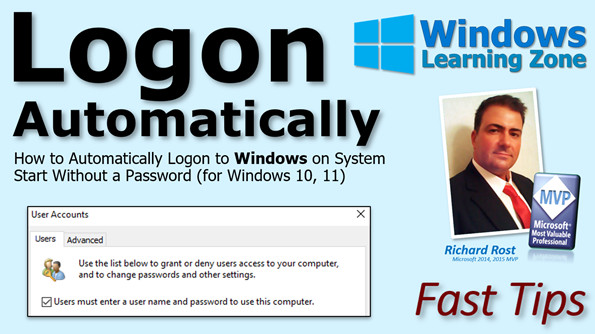
- Uncheck the box says "Users must enter a user name and password to use this computer"
- Enter your username and password again
- Restart
Windows 11
- Start - Settings - Accounts - Sign-in Options
- Turn OFF "For improved security only allow Windows Hello sign-in for Microsoft accounts on this device"
Lock Windows on Startup
- Create Shortcut
- C:\Windows\System32\rundll32.exe user32.dll, LockWorkStation
- Put shortcut in your Startup folder
Shutdown PC From Access
Links
Free Courses
 Keywords Keywords
windows 10, windows 11, microsoft windows, ms windows, ms windows tutorial, #windows10, #windows11, #mswindows, #microsoftwindows, #help, #howto, #tutorial, #learn, #lesson, #training, #database, #fasttips, Turn on Auto Login Windows, Users must enter a user name and password to use this computer, netplwiz, Turn on automatic logon in Windows, How do I make Windows auto login automatically, login without password, How to Enable Auto Login in Windows, LockWorkStation, lock pc, lock workstation
 Subscribe to Auto Logon
Get notifications when this page is updated
More InformationTranscript Welcome to another fast tip video brought to you by WindowsLearningZone.com. I am your instructor Richard Rost.
In today's video, I'm going to show you how you can have your computer automatically log into Windows when the system starts without a password. I am going to show you how to do this for Windows 10 and 11.
Why would you possibly want to do this? I'll explain why in a minute. Today's question comes from Isaac in Lansing, Michigan, one of my gold members.
Isaac says: I use Microsoft Access as an email server. I took your Access Email Seminar and my database sends emails throughout the day, pulls data from my website, and so on. It needs to be running 24-7. When my PC restarts for any reason, the server will be sitting at the log-on screen and doesn't run its processes. How can I have Windows automatically log on by itself and start my database?
For those of you who don't know me well, most of what I do is Microsoft Access Training. Access is a database application. It's very powerful. It's like Excel on steroids. You can use it for all kinds of things. One of those things is you can use it to send email. So you have a whole bunch of emails you want to send out to all your customers. You can have your Access database sit there running on a loop. You have 30,000 emails to send out. It will send out one every minute or two, and then it runs through the entire list, and it runs constantly.
That's what I have in my office. I've been using it for years, and I love it. Now the issue here is that PC has to be running all the time. If the power goes out, or if Windows installs an update and reboots, it's going to be sitting at the log-on prompt.
In my office, I have a version of Access running on a Windows 10 PC sitting on a laptop in the corner. It just handles all those server functions like sending out email, pulling down email signouts from my website, all that stuff. I've got mine programmed so that when it reboots, which I have it do once an hour to keep things running well, it automatically logs into Windows and then locks itself. I'm going to show you how to do all that right now.
A little bit of a warning: if you do this, anyone who has physical access to your computer will be able to get into anything on it. So whatever files are on that computer, if someone gets behind that keyboard, they'll have access to it. Make sure your PC is kept in a secured location.
I run my business from home, so it's just me, my fiance, and my dogs. I trust my fiance. My dogs haven't learned how to use a computer yet, so I'm not worried about it. If someone physically breaks into my house and takes my laptop, they will be able to get into it. Just make sure everything is backed up and you should be okay.
If you have sensitive data on your computer, you might want to consider using a database server, for example, because Access by itself is not 100 percent secure. Make sure you keep your computer in a locked location, an office, or a locked cabinet or something.
If you've got Windows 10, these are the steps that you have to do to set up the automatic log-on. If you have Windows 11, there's one more thing you have to do first, and then after you do this, you can do the Windows 10 stuff. I'm going to show you the Windows 11 step first, and then we'll walk through the Windows 10 stuff, because at that point it's the same for everybody.
If you have Windows 11, they added one more step of security before you can do this stuff that you could do directly in Windows 10. Let me show you that.
First, you go to Start, Settings, Accounts, Sign-in options. You have to turn off this option that says, for improved security, only allow Windows Hello sign-in for Microsoft accounts on this device. Just turn that off.
What is Windows Hello? Well, it's a new log-on technology that you get in Windows 11 that allows you to log on with your face, your fingerprint, or a pin. But you want this computer to log on without a password anyway, so you don't need Windows Hello.
Now, we can do the same things that Windows 10 users can do.
We're going to run NetPLWiz, which is the user account manager. We're going to uncheck the box that says users must enter a username and password to use this computer. It's then going to ask us for our username and password, type it in, and you're done.
It's Start > Run, or you can press Windows key + R to run something. Type in NetPLWiz, hit OK. This window pops up, the user accounts manager, and all you have to do is uncheck that box: Users must enter a username and password to use this computer.
Now you are saying you do not need a password to get in. Hit OK. It's going to want your username and password again, type that in. I'm just going to hit cancel. When you do that, reboot the computer, and you'll see it'll start up without making you log on.
It's that simple. The only trick for a lot of people is that Windows 11 extra step. You have to turn that Windows Hello option off.
Now, your computer will just automatically boot and log itself in. Now you have to put your database in your startup folder, which you probably already know how to do if you're running it as a server. You can also put a shortcut in your startup folder to lock the computer manually.
Basically, the server is going to reboot, start up Windows, log you in, run your Access database or whatever other programs you want, and then lock itself. It's the same as if you hit Control + Alt + Delete and then space to lock it, which I do when I'm leaving.
Yes, your computer will lock itself on startup. But anyone that knows the trick that you can hold down the shift key to bypass the startup folder can still get in. So even though it's locked, it's really just a precaution against your casual everyday users who aren't necessarily computer experts.
When the computer boots, there will be a few seconds where you'll see some stuff happening and then it'll just lock. To the average observer, they'll see it as a locked computer. If someone even takes the computer and boots it, unless they catch it in that window and know the shift key trick, they still won't be able to get in.
It's one more little step. If someone comes in your office and sees a locked computer, they might not think twice that they can just reboot it and hold down the shift key and get in because usually you can't do that.
I'm just a single guy in a home office. I'm not too worried about it. If you have a locked office where you work, great. If security is a big deal for you, you shouldn't be doing this. You can go get SQL Server and your data will be locked.
How do you create that shortcut to lock your system on startup? There it is right there. I'll show you how to do it.
First, yes, this is PowerPoint. I'm going to copy this to my clipboard. I don't want to type it in again. I'll put this text down in the description below the video so you can go copy it. Copy and paste it too.
Now on your Windows desktop, right-click and then go to New and then Shortcut. What item would you like to create a shortcut for? Paste in what I just gave you. It's C Windows System32, which is for most systems. If you installed Windows in a different folder, you have to change that accordingly.
It's rundll32.exe. It's user32.dll, comma, space, LockWorkStation.
Hit next, give it a name, Lock Workstation or whatever you want to call it. Now you have a nice little shortcut. If you double-click on that, it will lock your computer.
That's handy. You can launch this thing anytime you want.
Where's the best place to put this? In your startup folder.
How do you find your startup folder? It used to be nice and simple. They used to give you a link to it right in My Computer. Back in Windows NT and stuff like that. Now you have to dig for it. They've moved it all around.
But there's a command right here: shell:startup that you can use to find your startup folder. Again, Windows key + R to run, shell:startup, press Enter.
A folder for your startup folder is going to open. Mine is under Richard. Let's see, Users, Amicron, AppData, Roaming, Microsoft, Windows, Start Menu, Programs, Startup. See, they buried it. It used to be nice and easy to get to. Now just take this shortcut and drop it in there.
When your computer runs, you can put your Access database in here too, or you'll just shortcut to your database. Then the lock workstation shortcut runs, so it'll run whatever's in here and lock your computer real quick. Like I said, the average observer will just see a locked computer if they walk into your office.
Before I get a ton of emails and people posting all kinds of comments, yes, I know you can run applications as a service in Windows. A service will basically start when the computer starts, when Windows boots, and you don't have to be logged in for it to be running.
The downside is you can't see it running. It's running in the background. If you log on, you still won't see it. With a program like Microsoft Access, you could just run another copy of the database and you'll still be able to see what's going on in the tables and such, but you'll have to program your interface accordingly.
Personally, I like having it running where I can see it. If I'm in my office and I'm working, I like to look at it. I unlock that computer when I sit down to work for the day and I want to be able to see the status, what's going on, how many emails have come in, daily sales, that kind of stuff. So I like to be able to interact with the programs. I like the method I just showed you.
If you're in a more secure environment, yes, there are options available. There's a link to Microsoft's website where they've got instructions on how to create a user-defined service. If you want to see me walk through that, you can post a comment below and if enough people are interested, I'll make a video about it.
This also makes you wonder how do you get Access to reboot the computer?
In VBA, just issue a shell command and tell it shutdown /r and that'll make Windows reboot. I have my computer reboot once a day just to keep things running smoothly, restart it, and get all that memory fresh. I think I reboot my system every morning at like 5am. That's not very hard to do and I cover this in my Access classes.
One other thing I wanted to make absolutely clear: I know I said that I have my database on a machine that automatically logs in and doesn't require a password and all that. I also want to make it clear that my database that does all that is literally just for sending emails. It pulls down email signouts from my website and does some other minor housekeeping tasks.
That database doesn't have any secured information in it such as customer information, credit card data, that kind of stuff. That's all in my SQL Server database, which is tightly secured. You cannot get into that database without my username and password and I'm the only one with the username and password. No one could get into my stuff.
If there is ever a data breach, if someone steals my laptop, all they're going to get is your email addresses and maybe a list of what customers have what classes. Again, not secured information. If you are worried about security, SQL Server is the way to go. I have classes on that too. I'll put a link down below to everything I mentioned in today's video.
There you go. There's your fast tip for today. That's how to get Windows to automatically log in and lock itself. I hope this helps someone. I hope you learned something. I'll see you next time.
If you want me to post more videos about Microsoft Windows, be sure to like this video, subscribe to my channel, and post a comment down below. Let me know that you want more Windows videos.
About 90 percent of what I teach is Microsoft Access database design. But I love teaching Windows, Word, Excel, and lots of other topics too. Of course, the squeaky wheel gets the grease, so if you want more Windows training, make some noise. Intro In this video, I will show you how to set up your PC to automatically log in to Microsoft Windows 10 or 11 without needing to enter a password each time the system restarts. We'll cover situations where this setup is useful, especially for running applications like Microsoft Access that need to operate continuously, and discuss important security considerations. You'll learn the specific steps required for both Windows 10 and 11, how to disable Windows Hello sign-in if needed, use NetPLWiz, and how to create a shortcut to lock your workstation automatically after startup. Quiz Q1. Why might someone want their Windows PC to log in automatically without a password?
A. To allow a server process to run continuously after restarts
B. To make it easier for anyone to use their computer
C. To improve computer security
D. To avoid using Microsoft accounts
Q2. What is the risk associated with enabling automatic login in Windows?
A. Your operating system may get corrupted
B. Anyone with physical access can access your files
C. You may be unable to update your system
D. Your files will automatically back up
Q3. Before setting up automatic login in Windows 11, what security feature needs to be turned off?
A. Windows Defender
B. Windows Hello login requirement for Microsoft accounts
C. BitLocker encryption
D. File History
Q4. Which tool is used to configure automatic login in both Windows 10 and Windows 11?
A. Task Manager
B. NetPLWiz
C. Registry Editor
D. Control Panel
Q5. After unchecking the "Users must enter a username and password to use this computer" box, what must you do?
A. Restart Windows in Safe Mode
B. Enter your username and password
C. Log out and log back in as Administrator
D. Update your drivers
Q6. Where should you place shortcuts (such as to lock the workstation or start a database) to have them run on Windows login?
A. Desktop
B. System32 folder
C. Startup folder
D. Documents folder
Q7. What command can you use in "Run" to quickly access your startup folder?
A. cmd:startup
B. runstartup
C. shell:startup
D. startupfolder
Q8. What does the Lock Workstation shortcut do when run?
A. Reboots the computer
B. Logs you off
C. Shuts the computer down
D. Locks the current user session
Q9. What is a limitation of running applications as a service in Windows, according to the video?
A. They only run when logged in
B. You cannot see the application UI while it runs
C. Services cannot access the internet
D. Services require special hardware
Q10. If you want to run programs visibly and interact with them on reboot, what method does the instructor recommend?
A. Running as a background service
B. Using automatic login and startup folder shortcuts
C. Using Task Scheduler exclusively
D. Creating a batch file in System32
Q11. According to the instructor, when is using SQL Server recommended for data security?
A. Only when working offline
B. Whenever you have sensitive data needing better security
C. For all types of databases
D. Only on older versions of Windows
Q12. What is the main security precaution recommended when enabling automatic login?
A. Regularly update Windows
B. Keep the computer in a secure, locked location
C. Use a VPN
D. Turn off Windows Firewall
Q13. What Windows command can you use in VBA to reboot the computer?
A. reboot now
B. shutdown -r
C. refresh -restart
D. logoff -reboot
Answers: 1-A; 2-B; 3-B; 4-B; 5-B; 6-C; 7-C; 8-D; 9-B; 10-B; 11-B; 12-B; 13-B
DISCLAIMER: Quiz questions are AI generated. If you find any that are wrong, don't make sense, or aren't related to the video topic at hand, then please post a comment and let me know. Thanks. Summary Today's video from Windows Learning Zone focuses on how to set up Windows 10 or 11 to automatically log in when your computer starts, bypassing the need to enter a password each time. This can be extremely useful for those who run essential applications that need to be up and running at all times, such as using Microsoft Access as a server to send and process emails continuously.
One common scenario, and the basis for today's discussion, comes from a question regarding a database that automates email sending. Many users run Access databases that perform regular background tasks, like sending out emails or pulling data from a website. In such cases, the system must remain operational around the clock, and if Windows restarts for reasons such as updates or power failures, the computer halting at the login screen can bring the whole process to a standstill until someone manually logs back in. Automating the login process eliminates this bottleneck.
Let me talk briefly about Microsoft Access for those who might not be familiar. Access is a powerful database application, much more versatile than Excel, and it can be programmed to automate large-scale operations, including emailing massive lists of recipients. For setup like mine, a dedicated PC runs the Access database almost non-stop, handling automated tasks. To maintain smooth operations, I even schedule that computer to reboot periodically and have it automatically log back in and relaunch its tasks.
However, a word of caution is necessary here. If you turn off the Windows login password, anyone with access to your machine can get into your files and programs. Physical security becomes critical. Only use this approach in environments you trust, like a home office secured from unauthorized visitors. In business settings or where confidential data is present, extra care or other solutions, like a dedicated database server, should be considered.
Moving on to the actual steps, the automatic login process differs slightly between Windows 10 and Windows 11. Windows 11 adds another security step before you can proceed with the traditional setup used in Windows 10.
For Windows 11 users, begin in the Settings under Accounts and then Sign-in options. Here, you'll need to disable the option labeled "for improved security, only allow Windows Hello sign-in for Microsoft accounts on this device." Windows Hello allows sign-in with biometrics or a PIN, so turning this off is necessary since the goal is to bypass any interactive sign-in altogether.
Once that is done, you can use the classic user account management tool found in both Windows 10 and 11. Use the Run command (Windows key + R) and enter "NetPLWiz." This opens the user accounts window, where you simply uncheck the box that requires users to enter a username and password. You'll be prompted to confirm your login details, and after that, the computer will log in automatically at startup.
Once this automatic login is set, you should place your mission-critical applications, like your Access database, in the Windows startup folder so they launch as soon as the system starts. If you also want your computer to immediately lock itself after logging in, a shortcut can be created to perform that action. This adds a basic layer of security for casual passersby, though it does not stop someone who knows certain workarounds.
To create such a shortcut, you prepare a link that triggers the lock function and place it in your startup folder alongside your other shortcut(s). The startup folder can be accessed using the "shell:startup" command in Run. Once there, just add your shortcuts. This way, your applications launch and the system quickly locks itself, presenting the appearance of a locked computer to anyone who approaches after boot.
It's important to realize that this approach is meant for convenience and basic security, but not for situations where strong data protection is mandatory. More advanced users may point out that Windows applications can be run as services, meaning they launch in the background regardless of login status. However, service-mode applications do not provide a visible interface, so you won't be able to interact with them in the usual way. Personally, I prefer to have access to my running applications so I can monitor their status directly.
If you need even more reliability or security, you might consider running production databases through robust platforms like SQL Server instead of Microsoft Access, especially for handling sensitive or secure data. My setup only uses automated Access databases for routine notification tasks, never for storing critical information like customer data or payment information. Any sensitive data is handled with properly secured systems.
Should you ever want to have your Access database reboot your PC on a schedule, this can be achieved with a simple command issued from VBA, and I discuss this in my other Access courses.
In conclusion, for users running continuous background tasks on their PC, setting up Windows to automatically log in can keep things moving after a reboot. Just remember the risks and take steps to secure your setup appropriately. If you need help with other methods, such as configuring applications to run as services, feel free to reach out and suggest it as a topic.
You can find a complete video tutorial with step-by-step instructions on everything discussed here on my website at the link below. Live long and prosper, my friends. Topic List Why use automatic Windows login for server processes
Security considerations for automatic login
Steps to disable Windows Hello sign-in in Windows 11
Accessing Sign-in options in Windows 11 Settings
Running NetPLWiz to configure auto login
Unchecking user password requirement in NetPLWiz
Entering username and password for auto login setup
Testing automatic login after restart
Creating a desktop shortcut to lock the workstation
Command syntax for the Lock Workstation shortcut
Locating the Windows startup folder using shell:startup
Adding shortcuts and applications to the startup folder
How the lock shortcut works at startup
Limitations and risks of using startup folder for security
Difference between running an app as a service vs. interactive login
How to reboot Windows from VBA using shell commands Primary Topics automatic Windows login, disabling password on startup, Windows 10 setup, Windows 11 setup, startup folder, auto-lock workstation, Microsoft Access server usage, basic security warnings
Secondary Topics Windows Hello explanation, Access email automation, running Windows applications as a service, data security considerations, controlled reboots with VBA
|