Remove RE
By Richard Rost

 4 years ago
Remove RE and FW From Replies in Microsoft Outlook
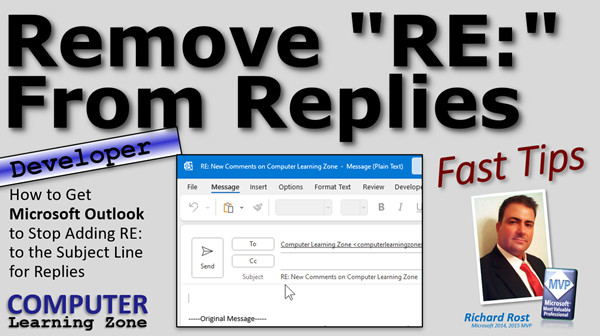
Are you annoyed by Outlook always adding "RE:" to the beginning of replies, or "FW:" to forwards? I personally hate that. You'd think there would be an option somewhere in the settings to get rid of that. Well, there ain't! In this video, I'll show you how you can disable that with one line of VBA code... in the right place, of course.
John from Bloomington, Illinois (a Gold Member) asks: Replying all, Outlook imposes "RE:" in the subject line. So annoying! How can I get rid of that?
Links
Steps
- Developer Tab
- Visual Basic
- View - Project Explorer
- ThisOutlookSession
- Application_ItemSend
If Left(Item.Subject, 4) = "RE: " Then Item.Subject = Right(Item.Subject, Len(Item.Subject) - 4)
 Keywords Keywords
#help, #howto, #tutorial, #learn, #lesson, #training, #fasttips, #outlook, #microsoftoutlook, #msoutlook, microsoft outlook, How to Remove the Prefix RE or FW in Subject, How do I change the Re in Outlook, Removing FW: and RE: from Outlook email Subject field, prevent Outlook from adding RE, Stripping RE: FW: from the Subject Line
 Subscribe to Remove RE
Get notifications when this page is updated
More InformationTranscript Welcome to another FAST tips video brought to you by computerlearningzone.com. I am your instructor Richard Rost.
In today's video, I am going to show you how to get rid of that annoying little RE that Outlook puts at the beginning of any replies in the subject line, anytime you send a reply, or an FW if you forward something.
Now, I have this video marked as a developer video because you would think there would be an option for this somewhere in the menus in Outlook, but there is not. However, we can do it with just one line of VBA code, one for RE and one for forward, if you want to get rid of that too. I will show you exactly where to put it in this video.
Today's question comes from John in Bloomington, Illinois, one of my Gold members. John posted this question in my Outlook forum on my website. He says, "Replying, all Outlook imposes RE in the subject line. So annoying." It is, I agree. How can I get rid of that? Well, John, it is not just a reply all. It is for any reply.
Now, full disclosure, John, I haven't used Outlook for my personal mail in years. I prefer Gmail. That is just me. Outlook is a great program. I honestly still use it for my server. I collect emails with it and I feed them into my Access database from Outlook. But here is a message. The subject was "nightly event completed." If I hit just a regular reply, look at Outlook, it puts that little RE right there.
Now, yes, you can come up here and delete it like that, but that is annoying to do every time you reply to an email. You would think if you poked up in the file options under mail, there would be something in here. Now, I looked through all of these and I spent some time on Google looking for some options and I could not find anything. So, if one of you knows of something that I missed, let me know, send me an email, post a comment. But I do not see any way in here to turn that off.
So, we are going to head over into our Developer tab. Now, if you do not have the Developer tab turned on, first I am going to warn you: back up your data, back up your Outlook PST file, whatever you have to do. Because if you start poking around in the Developer tab and you are not sure what you are doing, you could cause problems. So make sure you get a full backup of your system before you do any of this. Do not come yelling at me if you mess up Outlook.
But if you do not have the Developer tab turned on, you can just simply right-click anywhere on this menu, go to Customize the Ribbon. Over here, you will see the Developer. Normally, that is checked off. You are just going to check that on and then hit OK. Now you should see Developer, and then come over here and click on Visual Basic. That will load up this guy. This is your Visual Basic Editor. Do not be scared of it. It is not hard.
What you are going to do is you are going to go to View and then you are going to go to Project Explorer. If you do not see this tab over here, this pane, we need this guy to get into the Project Explorer. You are going to make sure you double-click on this Outlook Session, which should show up here, this Outlook Session. You are going to drop this box down right here and pick Application, and the default is Application Item Send.
This is code and it goes between that Private Sub and the End Sub. This is what is going to happen when you send an email. Now, this is the easiest way to tackle this problem.
What we are going to do is look at your subject line when you send an email. So yes, you are still going to see the RE - just ignore it. When you send the email, it will get changed. It is the easiest way to fix this problem.
We are going to use a couple of little string functions here in an if-then statement. If the left of item.subject (that is the subject line of the item that you are sending), comma four. So if the left four characters of your subject equals "RE: " (quote, R E colon space), because you do not just want to look for an RE anywhere in the subject line, since you could have the word actual, like, regarding or return on the or something in there.
So if the left four characters are RE: , then we are going to do something. What are we going to do? We are going to chop those characters off. item.subject equals the right of item.subject, comma, how many characters? Well, it is the length of the entire subject line minus four. So it is going to be the length of item.subject minus four.
Let me resize this so you can see the whole thing. Like I said, it is really easy. It is one line of code. That is it. That is all you need.
If the left four characters of your subject line are "RE: ", then set that subject line equal to the right, however long that string is, minus four characters, and this will happen when you send your email.
Let us go back over to Outlook. Save this first - Control S, save it just to make sure. I am going to discard this one that I started.
So, this guy's subject line is "nightly event completed." I am going to hit reply. Now I see it here. Like I said, you are going to still see it because this event does not run until you actually send the email. So, here, "testing new email send," I am going to hit send.
Give it a second. It will show up in your sent mail. Hold on as it processes and goes through. And there it is. Look at that. Testing new email send. What is this? What is the subject line? Testing new email send. See that?
Let us try it again. Reply all. Another test. Send. Give it a second. Here it is. She popped in. Another test. See? And there is no RE in front of it.
If you want to do that for forwards as well, just copy this whole thing, paste it down below, and change this to FW. We can get rid of those extra blank lines. Save it. I can close this now. Now if you forward something, that will happen as well.
That is that. See, it is one line of code. This is why I always say if you learn just a little tiny bit of Visual Basic, you are going to make everything you do, whether it is Outlook or Excel or Word or Access, a whole lot better and easier.
Normally, 90 percent of what I do is Microsoft Access. But Microsoft Office all pretty much uses the same core Visual Basic language. Word, Excel, Outlook, Access - they all share the same basic core of a language.
If you want to learn more VBA, go watch my Intro to VBA video. This one is specifically for Microsoft Access. If you are interested in learning VBA that is generic to all of Office, I have been thinking about putting something like that together, like an intro to VBA for every Office application. Post a comment down below and let me know.
I have also got another video that teaches those string functions: Right, Left, Mid, Length. Again, the same functions work the same, whether it is Outlook or Excel or Access or whatever. Same thing with if-then statements; they work the same.
But if you like this stuff and you want more Outlook-specific training, I need to hear from you. The squeaky wheel gets the grease. The more people I hear that want more stuff, I will make that stuff.
I know Excel and Word and PowerPoint and all that stuff. I mean, Access is my passion. That is what I do mostly, but I do a lot of Outlook programming for my own needs. I am going to share some more—just let me know. Say, "I want to see more Outlook training," and I will make some.
I hope you learned something. I hope this was helpful, and I will see you next time. Thanks for watching.
I hope you enjoyed this video. If you are watching on YouTube, make sure you subscribe to my channel and click the little bell icon so you get notified anytime I release a new video. Make sure you like and share this video with your friends, and make sure you stop by my website for lots of free lessons on all kinds of different topics: Microsoft Access, Excel, Word, Windows, and lots more. It is computerlearningzone.com.
I have also got a shorter URL, 599cd.com. That is a long story, but stop by anyway. We hope to see you soon. Intro In this video, I will show you how to automatically remove the "RE:" and "FW:" prefixes that Microsoft Outlook adds to the subject lines of replies and forwarded emails. We'll talk about why there is no built-in menu option to turn this off and then use a simple line of VBA code in the Visual Basic Editor to strip these from your messages. I'll walk you through enabling the Developer tab, accessing the correct place to enter your code, and explain exactly how the code works to clean up your email subjects. Quiz Q1. What is the main purpose of the VBA code shown in the video?
A. To remove "RE: " from the beginning of a subject line when replying to emails in Outlook
B. To automatically archive emails older than a certain date
C. To block incoming emails marked as spam
D. To help filter emails into customized folders
Q2. Why does the instructor advise users to back up their data before using the Developer tab in Outlook?
A. Making changes can potentially cause problems with Outlook if not done correctly
B. It will delete all old emails automatically
C. The Developer tab will overwrite the Outlook installation files
D. Because Outlook requires a backup to enable advanced features
Q3. How do you enable the Developer tab in Outlook, according to the video?
A. File > Options > Trust Center
B. Right-click on the menu, choose "Customize the Ribbon," then check "Developer"
C. Click on Tools > Add-ins > Enable Developer Tab
D. Insert a new add-in from the Office Store
Q4. Where do you place the VBA code in Outlook to modify the subject line upon sending?
A. In the ThisOutlookSession module in the Visual Basic Editor
B. In a separate new module file
C. In the Word VBA Editor
D. In the email Options menu
Q5. What string function is used to check if the subject line starts with "RE: "?
A. Left
B. Mid
C. Right
D. Length
Q6. What must you do after inserting the VBA code to ensure it works?
A. Save the code with Control S
B. Restart the computer
C. Send a test email from a different account
D. Disable all Outlook add-ins
Q7. When does the removal of "RE: " from the subject line actually occur?
A. When you click Send
B. When you press Reply
C. As soon as you open the email
D. When you read your sent messages
Q8. If you want to modify the code to remove "FW: " from forwarded emails, what should you do?
A. Copy the code and change "RE: " to "FW: "
B. Change "RE: " to "FWD: "
C. Delete the code and start over
D. Add a separate add-in for forwards
Q9. The instructor mentions that Microsoft Office applications share which common feature?
A. Core Visual Basic language for Applications (VBA)
B. Cloud file storage system
C. Chart customization tools
D. Advanced drawing capabilities
Q10. Why does the instructor emphasize learning a little Visual Basic for Applications (VBA)?
A. It can make working in Outlook, Excel, Word, or Access easier and more powerful
B. It helps you design graphics
C. It enables web browsing within Outlook
D. It automatically installs updates for you
Answers: 1-A; 2-A; 3-B; 4-A; 5-A; 6-A; 7-A; 8-A; 9-A; 10-A
DISCLAIMER: Quiz questions are AI generated. If you find any that are wrong, don't make sense, or aren't related to the video topic at hand, then please post a comment and let me know. Thanks. Summary Today's video from Computer Learning Zone focuses on a quick method for removing the RE and FW prefixes that Microsoft Outlook automatically adds to the beginning of your email subject lines when replying to or forwarding messages. Many users find these prefixes unnecessary and would prefer not to have to manually delete them every time.
This tip is labeled as a developer-level solution because, surprisingly, Outlook does not provide a built-in option in the settings menus to control these subject line prefixes. After checking thoroughly through the Outlook options and researching online, there does not appear to be a native way to disable these features. If you do know of an option that I missed, please let me know.
Since Outlook does not make it easy, the solution involves using a little bit of Visual Basic for Applications (VBA) code. If you've never used the Developer tab in Outlook before, make sure to back up your data, especially your Outlook PST files, before making changes. Tampering with the Developer tab can cause issues if you're not careful, so take precautions to protect your information first.
To enable the Developer tab, you can customize your Ribbon and select the Developer option. Once it's enabled, open the Visual Basic editor. You'll need to access the Project Explorer and open the "ThisOutlookSession" module. Select "Application" from the dropdown, then choose the "ItemSend" event, which allows you to run code every time you send an email.
The logic behind the code is straightforward. When you compose a reply, you'll still see RE or FW in the subject line, but the code will automatically remove these prefixes as soon as you send the message. This saves you from having to delete them manually each time.
The technique uses simple string functions. It checks if the first four characters in your subject line are "RE: " (including the colon and space). If they are, it removes these four characters before sending the message. This way, if your subject has RE at the start as part of the standard reply prefix, it will be trimmed away when the email is sent. The same approach works for forwarded emails with the "FW: " prefix; you can adapt the code to handle both.
After saving your changes in the VBA editor, return to Outlook and test by replying to or forwarding emails. Even though you will see the prefix as you're composing, once the message is sent and appears in your Sent Items folder, you'll notice that the RE or FW has been removed from the subject.
This is a simple example of how knowing even a little bit of Visual Basic can make working with Microsoft Office applications much more efficient. The VBA language used in Outlook is virtually the same as it is in Access, Excel, and Word, so the techniques you learn here can apply across the entire suite.
If you're interested in learning more about VBA, including an introduction specific to Microsoft Access, be sure to check out my other tutorials. I also have videos focused on essential string functions like Right, Left, Mid, and Length, as well as the basics of if-then statements. These concepts are consistent throughout different Office programs.
If you'd like to see more Outlook training content, let me know. While Access is my main passion, I use Outlook programming regularly and am happy to share more tips and solutions if there's interest.
You can find a complete video tutorial with step-by-step instructions on everything discussed here on my website at the link below. Live long and prosper, my friends. Topic List Removing RE from Outlook reply subject lines using VBA
Removing FW from Outlook forward subject lines using VBA
Enabling the Developer tab in Outlook
Accessing the Visual Basic Editor in Outlook
Navigating to Project Explorer and Outlook Session
Adding code to the Application ItemSend event
Using string functions to modify email subject lines
Testing and validating the VBA solution in Outlook
Saving and securing VBA changes in Outlook Primary Topics Outlook VBA, subject line modification, reply/forward prefixes, Developer tab setup, event handling, string functions Secondary Topics data backup before VBA editing, cross-Office VBA applicability, learning VBA basics |