|
||||||

|
|
||||||
|
Access Compactor TemplateAutomatically Compact & Repair Access Databases This Microsoft Access template will automatically compact and repair your databases on a regular schedule. You can use it as part of a nightly or weekly event, or you can run it manually whenever you want. The template will also create backup copies of your original databases to avoid corruption. In the videos that accompany the template, I will teach you how to integrate this database into your existing Access applications. Videos
Full Developer DatabaseOnce you have purchased the full developer database template, come back to this page and download the full template. This will give you access to the ZIP file containing the Template ACCDB file. The full version will run on 32-bit or 64-bit Access 2007 or higher. Be sure to watch the User Guide video (above). You can use the template standalone as it is or if you watch the Developer Guide video I will show you how to integrate it into your existing Microsoft Access database applications including a nightly event.
Purchase TemplatePlease be sure to read the Before You Purchase section below before buying this template.
Features
UsageThe Access Compactor template can be used in three ways:
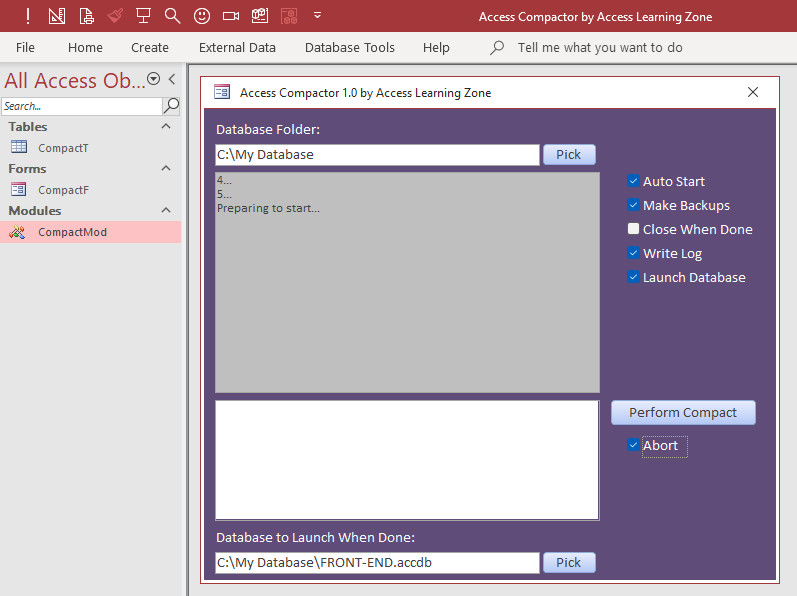
FeaturesThe Compactor can be programmed to auto start when the database opens. Compactor can make backups of your files before compacting them. These will be date/time stamped, so make sure you clean them out occasionally. It will optionally create a log file every use. Then when it is finished compacting you can optionally relaunch your original database.
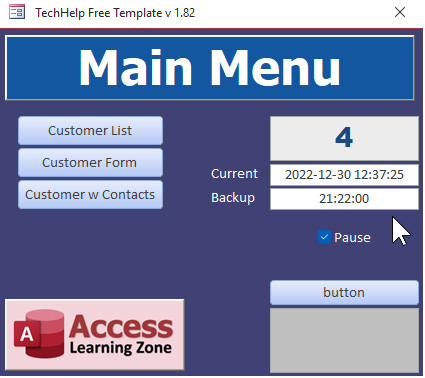
In the Developer Guide video I will show you all the VBA that you need in order to launch the Compactor as part of a nightly event loop in your Access database, complete with a countdown timer.
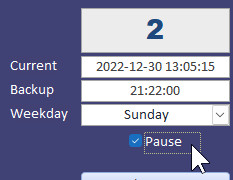
In the Addendum video I show you how to make the compactor only run one day per week which I forgot to do in the Developer Guide.
Before You PurchaseA few important notes before you purchase this template:
Links
Possible Future Upgrade Ideas
LicenseFor internal use only. This template does NOT come with a royalty-free license. You may only customize the template for your business needs and for use within your organization at one location ONLY. You may not resell or distribute any form of this template to others without express written permission. Contact me for additional information on obtaining a license to distribute if you plan on including this template in a product you are reselling. Additional licenses are required if you plan on using this template with more than ten (10) employees or in multiple locations within your organization. Not a Finished ProductPlease keep in mind that most of my template databases are not designed to be finished products that are ready to go in a working environment. My templates are meant as starting points for you to customize for yourself so you don't have to reinvent the wheel. This requires that you have a basic understanding of Microsoft Access development. To work on most of my databases you should have completed my Access Beginner series and the first couple levels of my Expert series at a minimum. Most of my databases require knowledge of SQL and VBA as well. Keep in mind that most of my templates are not like off-the-shelf software. They're starting points for developers to be able to modify and use as their own. It really is going to be in your benefit to watch all of the prerequisite videos so you understand the database and how it works moving forward. This is not like QuickBooks where you just install it and use it. My templates are mostly designed for people who already have an understanding of how Microsoft Access works. Customize For Your NeedsIf you would like to discuss customizing this template for your needs, and integrating it into your current setup, please see my consulting page for details. While I no longer accept custom jobs that are specific to a single user, I may include your features in a future version of this template if they have mass appeal. If you are looking for custom enhancements made to this template just for you, visit my Developer Network. Technical SupportPlease note that technical support is NOT guaranteed for any of my courses, seminars, or templates. If you require help with modifying this template, you may post a question in the Forums, however an answer to your question is not guaranteed. If this template comes with an accompanying Seminar, then you should purchase that Seminar to see how the database was constructed. If not, then you should have taken the suggested courses. Most of my templates are designed on a Developer level and you should have a thorough understanding of SQL and VBA before attempting to modify them. If you have a problem with one of my databases, I will only support the unmodified database exactly as it's downloaded from my site. If you have modified it in any way, it may not be something I can help you with. You can post in the Forums, and I may be able to help you, but if the issue doesn't exist in my unmodified database, it's not something I can support. Questions?Got sales or customer service questions about this template? Feel free to contact me. If you have technical "how do I" questions about this template, you discover a bug, or want to suggest a new feature, then please post your comments below. Keywordsmicrosoft access, ms access, ms access tutorial, #msaccess, #microsoftaccess, #help, #howto, #tutorial, #learn, #lesson, #training, #database, #template, Access Database Compact Tool, Automated Compact and Repair of Access, Automatically Compact and Repair, nightly event, weekly event
More InformationTranscriptDo you want to make sure that your database is properly compacted and repaired on a regular basis? Hi, this is Richard Rost with accesslearningzone.com. I just released my new Access Compactor Template. This is itself a standalone Access database that you can either incorporate into your existing database projects, or you can run it as a standalone. I like to run it once a week to compact all of my backend database files. I have a lot of them. You just put this guy in your nightly event or your weekly event, or whatever you have, and I will show you how to set one of those up when you purchase the template. The compactor will back up your files first if you want. Then it will compact and repair them, create a log file, and then it will exit and relaunch your original database, if you have a database that runs constantly like I do. Here is the compactor. It is pretty straightforward to use. You pick your database folder. In my case, I have my database temporary folder set up here in my database. I have my front end file and then four backend files. There is an option to have this auto start. When this database runs, it automatically begins the compact. Do that if you are going to be including this in some kind of a nightly or weekly backup. The compactor can back up the backend files before it actually compacts them, which is a good idea. You can select "close when done," which means when the compactor is done with its job, it will just shut down. You can have it write out text logs so you can check that and make sure everything is working. You can have it optionally relaunch your database. If you are going to close your original database so the compactor can compact it too, then you can have it relaunch that database and specify it down here. Of course, you can always run the job manually by clicking on "perform compact." There it goes. It is relaunching my front end database. I front end my TechHelp free template. You can see it created a compact log right there, a text file. It notes everything that it backed up and how much space you saved. These files have already been through this compactor about ten times, so they did not compact anymore. Here is a backup folder. The backups will be automatically named for you based on the date that they were compacted and backed up. That is it. That is the Access Compactor. Very simple utility. It is an Access database. There are no other components to use or install. Like I said, just run it as part of your nightly or your weekly backup routine and it will make sure all your backend databases stay nice and compacted. If you have any questions, contact me or post them down below. For more information, visit my website at 599c.com/compactor. I will put a link down below you can click on. Thanks for watching. See you next time. IntroIn this video, I will show you how to use my Access Compactor Template, a standalone Microsoft Access database designed to help you automate the compact and repair process for your backend database files. We will cover how to set up and use the template to back up your files, create logs, compact and repair databases, and optionally relaunch your original database. You will also see how to configure options like auto start, closing on completion, and managing backup folders to keep your database files running smoothly. QuizQ1. What is the main purpose of the Access Compactor Template? A. To automate data entry in Access databases B. To backup and compact Access database files regularly C. To convert Access files to another format D. To import Excel sheets into Access Q2. How can the Access Compactor be used in your workflow? A. Only as a manual tool B. Only with cloud databases C. As a standalone tool or incorporated into existing projects D. Only for Access front end files Q3. What feature does the compactor offer before compacting files? A. Deleting old records B. Backing up backend files C. Sending emails to users D. Encrypting database files Q4. What option can you enable if you want the compactor to start when the database runs? A. Manual start B. Auto backup C. Auto start D. Scheduled task Q5. What does "close when done" mean in the compactor settings? A. It closes your computer when finished B. It shuts down the compactor after finishing its job C. It closes all open applications D. It deletes temporary files Q6. What type of file does the compactor optionally create as a record of its operations? A. An Excel log file B. An Access report C. A text log file D. A PDF summary Q7. What does the compactor do if you want to compact the original database and then keep working in it? A. Leaves it closed B. Deletes the database C. Relaunches the original database D. Archives the database Q8. How are backups named when using the Access Compactor? A. By the user name B. By the database size C. Automatically based on the date compacted and backed up D. Sequential numbers only Q9. How often does the video creator recommend running the Access Compactor? A. Every hour B. Once a day C. Once a week D. Once a month Q10. What needs to be installed or configured before using the Access Compactor? A. Additional external components B. Risk assessment tools C. Nothing; it is a standalone Access database D. A separate server license Answers: 1-B; 2-C; 3-B; 4-C; 5-B; 6-C; 7-C; 8-C; 9-C; 10-C DISCLAIMER: Quiz questions are AI generated. If you find any that are wrong, don't make sense, or aren't related to the video topic at hand, then please post a comment and let me know. Thanks. SummaryToday's video from Access Learning Zone introduces my new Access Compactor Template, a helpful tool designed to keep your Access databases compacted and repaired on a regular schedule. This template is a standalone Access database file. You can use it on its own or incorporate its features into your existing database projects, depending on your needs. Personally, I prefer to run this utility weekly on all of my backend database files. Since I manage quite a few databases, this approach saves time and helps maintain performance. You can schedule the compactor to run as part of a nightly or weekly maintenance routine. When you purchase the template, I will show you how to set up such automated events. One of the template's main features is its backup function. Before performing the compact and repair process, it backs up your files if you choose that option. Afterward, it compacts and repairs the databases, creates a detailed log file recording all activity, and will even exit and relaunch your original database, which is especially useful if you run a database continuously. Using the compactor is fairly straightforward. You simply specify your database folder. In my example, I demonstrated this using my own database setup, which includes a front-end file and four separate backend data files. The template provides an option to start the compact process automatically whenever the database opens. This is ideal for any automated maintenance schedule that you may want to implement. You can also set the compactor to perform backups before compacting, which is strongly recommended. There is an option to have the tool close itself when finished, and you can also enable text log creation. This makes it easy to review the process and ensure everything ran smoothly. If your workflow requires it, the compactor can even relaunch your primary database after finishing its work. This is handy if you close your main database to allow the compactor to process the frontend as well as the backends. All you have to do is specify the database file to relaunch. Manual operation is also possible at any time. You just tell it to perform the compact process, and it will handle the entire sequence for you. For example, in my demonstration, you can see the utility automatically relaunching my TechHelp Free Template front end and generating a compact log file that details what backups were made, which files were compacted, and what space savings were achieved. Since these test files had already been compacted several times, there was no further reduction in size for this demonstration. Backup files are organized into a designated folder, and each backup is automatically named based on the date it was created, making it easy to manage and locate previous versions. Overall, the Access Compactor is a straightforward utility. Since it is built using Access itself, you do not need to install any extra components or worry about compatibility. Just include it in your periodic maintenance schedule, and it will help your backend databases remain optimized and trouble-free. If you have questions, please feel free to reach out or leave a comment. You can find a complete video tutorial with step-by-step instructions on everything discussed here on my website at the link below. Live long and prosper, my friends. Topic ListCompacting and repairing Access databases on a schedule Setting up the Compactor Template as a standalone tool Integrating the compactor into nightly or weekly events Selecting and configuring database folders for compaction Automatically starting the compactor process Backing up database files before compaction Enabling auto-close after compaction completes Writing and reviewing compaction log files Optionally relaunching the database after compaction Manual operation of the compactor tool Automatically naming backup folders by date Primary TopicsAccess Compactor Template, compact and repair automation, backup of backend files, logging processes, database relaunch, Access database maintenance Secondary Topicsscheduled routines, manual job execution, file naming conventions |
||||||||||||||||||||||||||||||
|
| |||
| Keywords: templates access Access Database Compact Tool, Automated Compact and Repair of Access, Automatically Compact and Repair, nightly event, weekly event Page Tag: whatsnew PermaLink Microsoft Access Compactor Template |