|
||||||

|
|
||||||
|
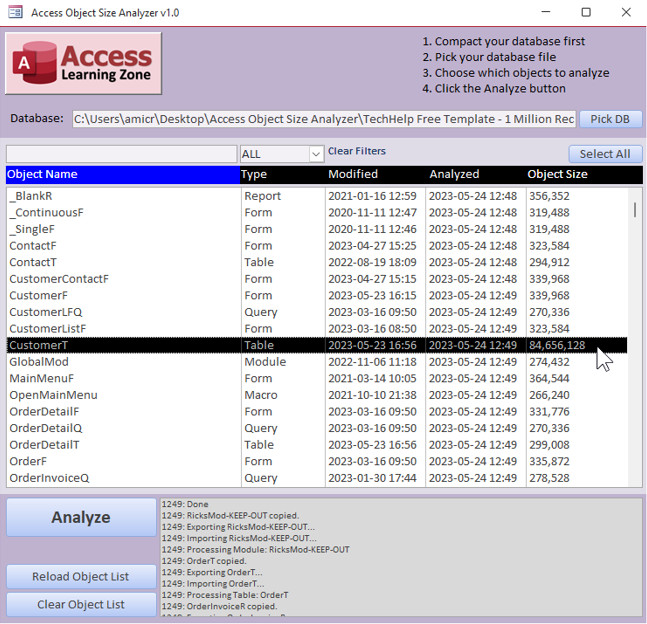
Object Size AnalyzerSee the Sizes of the Objects in your Databases Do you have a database that is unusually large and you can't figure out why? The Microsoft Access Object Size Analyzer by Access Learning Zone will allow you to quickly and easily see the sizes of all of the individual objects (tables, forms, reports, queries, macros, and modules) in your Microsoft Access database files. Videos
Sample DatabaseIf you'd like to download a sample copy of the database template, you can do so here. This is a non-editable ACCDE version of the template which will let you see it work in action. You will be able to analyze the size of the tables and queries in your database, however you will require the paid version in order to analyze the size of the forms, reports, macros, and modules.
The sample database requires 64-bit Access 2013 or higher. If you're still using 32-bit Office, read this. Full Developer DatabaseOnce you have purchased the full developer database template, come back to this page and download the full template. This will give you access to the ZIP file containing the Template ACCDB file. The full version will run on 32-bit or 64-bit Access 2007 or higher. Be sure to watch the User Guide video (above).
Purchase TemplatePlease be sure to read the Before You Purchase section below before buying this template.
Features
Lots of people have asked me over the years if there is a way to determine the size of each of the objects in your database. If you have a very large set of tables or forms they could be taking up lots of space and you don't even know it. Big objects like images and also make your database bloated. So that's where this database analyzer comes in handy. It will scan each of the objects in your database and tell you the exact size is taking up on the disk.
Now that you know which objects are the biggest you can go and optimize them.
Before You PurchaseA few important notes before you purchase this template:
Possible Future Upgrade IdeasIf you are interested in any of these, please post a comment below. As I mentioned the coding in this database is pretty complex - like upper level Developer stuff - so I really don't have any plans on making a video that explains how everything was programmed, but if you are interested, and enough other people are interested in seeing this I will make a tutorial for it and include it as a Developer lesson or separate add-on. Post a comment down below if that's the case. For internal use only. This template does NOT come with a royalty-free license. You may only customize the template for your business needs and for use within your organization at one location ONLY. You may not resell or distribute any form of this template to others without express written permission. Contact me for additional information on obtaining a license to distribute if you plan on including this template in a product you are reselling. Additional licenses are required if you plan on using this template with more than ten (10) employees or in multiple locations within your organization. Please keep in mind that most of my template databases are not designed to be finished products that are ready to go in a working environment. My templates are meant as starting points for you to customize for yourself so you don't have to reinvent the wheel. This requires that you have a basic understanding of Microsoft Access development. To work on most of my databases you should have completed my Access Beginner series and the first couple levels of my Expert series at a minimum. Most of my databases require knowledge of SQL and VBA as well. Keep in mind that most of my templates are not like off-the-shelf software. They're starting points for developers to be able to modify and use as their own. It really is going to be in your benefit to watch all of the prerequisite videos so you understand the database and how it works moving forward. This is not like QuickBooks where you just install it and use it. My templates are mostly designed for people who already have an understanding of how Microsoft Access works. If you would like to discuss customizing this template for your needs, and integrating it into your current setup, please see my consulting page for details. While I no longer accept custom jobs that are specific to a single user, I may include your features in a future version of this template if they have mass appeal. If you are looking for custom enhancements made to this template just for you, visit my Developer Network. Please note that technical support is NOT guaranteed for any of my courses, seminars, or templates. If you require help with modifying this template, you may post a question in the Forums, however an answer to your question is not guaranteed. If this template comes with an accompanying Seminar, then you should purchase that Seminar to see how the database was constructed. If not, then you should have taken the suggested courses. Most of my templates are designed on a Developer level and you should have a thorough understanding of SQL and VBA before attempting to modify them. If you have a problem with one of my databases, I will only support the unmodified database exactly as it's downloaded from my site. If you have modified it in any way, it may not be something I can help you with. You can post in the Forums, and I may be able to help you, but if the issue doesn't exist in my unmodified database, it's not something I can support. Got sales or customer service questions about this template? Feel free to contact me. If you have technical "how do I" questions about this template, you discover a bug, or want to suggest a new feature, then please post your comments below. Keywordsmicrosoft access, ms access, ms access tutorial, #msaccess, #microsoftaccess, #help, #howto, #tutorial, #learn, #lesson, #training, #database, #template, Microsoft Access object size analyzer template
More InformationTranscriptIntroducing the Access Object Size Analyzer, brought to you by AccessLearningZone.com and me, Richard Rost. Have you ever had a database that was really big and you really weren't sure why? You try going through it and you try to figure out what forms have lots of stuff in them, what tables are full of records, and it's just hard to do. There is no easy way to get a file size of how large each object in your Access database is. Unless you manually export each of these objects to a separate database file, you really can't tell. So that's what this template does for you. You load it up, you pick your database, and it will analyze all of the objects in that database: the tables, the forms, the queries, and whatever else, and it will show you the sizes of each of those objects in terms of how much hard drive space they are taking up. As we all know, a big database is a slow database. It's a pretty straightforward process. You get a single database file here, you open it up, and you don't have to incorporate any components in the existing databases. You simply pick the file that you want to analyze. I include a copy of my TechHelp Free template, it's okay. It will read all of the objects that are in that database, and then you select the components that you want to analyze. Like that form, for example - hit analyze. It will pull that object in, take a look at it, and see how big it is, then report the size there. If you want to check multiple objects, just select multiple objects, or you can hit select all up there. It might take a few minutes depending on how many objects are in your database and how big they are. Let's select these objects right here and I'll hit analyze. Now, that customer table right there, I put a million records in it just so you can see how big it is. I'll let it run here. Depending on the size of that object, it might take a minute. There we go, we're done. You can see that single table is 84 megabytes in size. Now you can maybe go optimize that table, get rid of some records you don't need, that kind of stuff. It's also handy for noticing if you have a really large form or report. Maybe you've got some graphics or some images that you put in there. You might put a high resolution graphic in the back of a report; it could be some real megabytes. Maybe go and optimize that, compress the JPEG or something. But that's what this template does. Lots and lots of people have asked me over the years how to check and see what stuff is what size inside their database. Really, the only way to do it is to create a blank database file and a copy of that object, and then see how big it is. That's what this utility will do for you. If you're interested, you can find more information on my website. There is the link right there, "object size." I'll put a link below in the description you can click on. There is a free version that will analyze just your tables and queries. Then, of course, there is a paid version which will do all the rest of the objects: the forms, reports, macros, and modules in your database. Usually, it's only forms and reports you have to worry about. If you have any questions, feel free to post them below. Thanks for watching. See you next time. Live long and prosper. IntroIn this video, I introduce the Access Object Size Analyzer for Microsoft Access and show you how to use this tool to determine the storage size of various database objects, including tables, forms, queries, and more. You will learn how to select and analyze different components in your database to identify which objects are taking up the most space, making it easier to optimize and clean up your Access files. I demonstrate the process step by step, highlight common storage issues you might encounter, and explain how this utility can save you time when managing large databases. QuizQ1. What is the main purpose of the Access Object Size Analyzer? A. To measure internet bandwidth usage B. To analyze the sizes of objects in an Access database C. To generate reports from an Access database D. To backup Access database files Q2. Why might a user want to know the size of database objects in Access? A. To determine the age of the database B. To figure out which objects make the database file large and may cause slow performance C. To export them to Excel D. To improve the security of the database Q3. How does the template analyze the size of Access database objects? A. By exporting each object to a separate file and measuring their sizes B. By running a VBA script that outputs text logs C. By connecting to a SQL Server database for size information D. By generating a random list of objects Q4. What kinds of database objects can the paid version of the Analyzer check? A. Only tables and queries B. Only macros and modules C. Forms, reports, macros, and modules D. Only external linked tables Q5. What might cause a form or report in Access to be unusually large in size? A. Too many table relationships B. High-resolution graphics or images C. Excessive indexing D. Large numbers of users connected Q6. What is the benefit of optimizing a large table identified by the Analyzer? A. It makes queries more visually appealing B. It reduces the risk of data corruption C. It can help improve database speed and reduce file size D. It enables better security settings Q7. How does the user select objects to analyze in the template? A. By manual typing only B. By selecting objects from a list, individually or by selecting all C. By importing an external list of objects D. By running a search query Q8. What is a limitation of the free version of the Object Size Analyzer? A. It can only be used once B. It only analyzes tables and queries C. It requires an internet connection for each use D. It cannot open large databases Answers: 1-B; 2-B; 3-A; 4-C; 5-B; 6-C; 7-B; 8-B DISCLAIMER: Quiz questions are AI generated. If you find any that are wrong, don't make sense, or aren't related to the video topic at hand, then please post a comment and let me know. Thanks. SummaryToday's video from Access Learning Zone introduces the Access Object Size Analyzer, a tool I created to help you figure out why your Access database might be larger than expected by measuring the size of each object within it. Many of us have run into situations where a database file balloons in size, but it's hard to tell which tables, forms, or other items are to blame. There isn't a built-in way in Access to see the individual file size of each object unless you go through the time-consuming process of exporting each one separately to new files and checking their sizes. This can be tedious and is not an efficient solution. The Access Object Size Analyzer streamlines this process. You simply open the analyzer tool, choose the database you want to inspect, and let the program analyze all of the objects inside: tables, forms, queries, and more. It then reports back the size of each object, displaying how much space they take up on your hard drive. This is important because a bloated database often leads to slow performance. Using the analyzer is straightforward. This template is a single Access database file, and you do not need to add any components to your existing databases. Once you open the analyzer, just select the database you want to review. A copy of my TechHelp free template is included. The analyzer will read all the objects in the chosen database, and you can pick which ones you want to examine. After selecting, simply analyze them. The analyzer will process each item and show how big each object is. You can check one object at a time, multiple objects, or select all if you want a broad overview. Just be aware analyzing large objects or many items may take a few minutes. For example, I demonstrated this using a customer table that contained a million records, which resulted in a table size of 84 megabytes. This information is helpful if you want to optimize a large table by deleting unnecessary records. The tool is also useful for spotting oversized forms or reports, which may include large images or high-resolution graphics that take up a lot of space. If you find such objects, you might want to optimize the graphics or compress images to reduce their size. Over the years, I've received many questions about how to determine the space used by individual objects within an Access database. Until now, the only real way was to copy objects into blank databases and check their file sizes after the fact. This utility automates that whole process for you. If you're interested in learning more, visit my website using the link below. There's a free version of the tool that analyzes tables and queries, and a paid version that expands functionality to look at forms, reports, macros, and modules as well. Most of the time, it is the forms and reports that require the most attention. If you have any questions, feel free to reach out and ask. For a complete video tutorial with step-by-step instructions, visit my website at the link below. Live long and prosper, my friends. Topic ListThis is an overview introduction to the Access Object Size Analyzer tool, describing its purpose, features, and benefits. Primary TopicsAccess object size analysis, database optimization, template utility usage, identifying large objects, differentiating free and paid versions Secondary Topicsdatabase performance, object export methods, none |
||||||||||||||||||||||||||
|
| |||
| Keywords: templates access object size analyzer template object analyzer Page Tag: whatsnew PermaLink Microsoft Access Object Size Analyzer Template |