|
||||||
Account Balances TemplateTrack Account Balances & Recurring Expenses The Microsoft Access Account Balances and Recurring Expenses template allows you to track your daily account balances for all of your accounts, including checking accounts, credit card accounts, asset accounts, and so on. You can also track pending transactions and create saved transactions for those activities that you regularly perform manually, such as making credit card payments. Furthermore, you can keep track of recurring transactions so you have a list of all your monthly, quarterly, and annual bills, among others. With just one click of a button, these transactions will be added to your accounts, saving you a significant amount of work and time. If you load up all the information from all your accounts, you can also use this to track your net worth. This template incorporates many extra features, drawing from many of my other templates. Videos
PrerequisitesIf you're primarily interested in just using this template, that's perfectly fine. However, if you're intrigued about how it was constructed and want to modify it to suit your specific needs, I have a series of TechHelp videos that explain the design process.
LinksHere are some links to additional videos and templates that have features I included in this template. While these are entirely optional, if you're interested in understanding how some components of this database were constructed, these videos provide detailed explanations.
Sample DatabaseIf you'd like to download a sample copy of the database template, you can do so here. This is a non-editable ACCDE version of the template which will let you see it work in action. The sample database will allow you to add, edit, and delete data for your own company or personal expenses. The full version, of course, is completely unlocked, offering you full access to the editable ACCDB database and source code. This locked sample database only functions for one company or personal profile. However, with the paid version, you can use it with an unlimited number of companies or personal profiles as you have the capability to switch the backend database files.
The sample database requires 64-bit Access 2013 or higher. If you're still using 32-bit Office, read this. Full Developer DatabaseOnce you have purchased the full developer database template, come back to this page and download the full template. This will give you access to the ZIP file containing the Template ACCDB file. The full version will run on 32-bit or 64-bit Access 2007 or higher. Be sure to watch the Explainer Video (above).
Important NoteThe full developer database (purchased version) is a split database. This means there is a separate front-end and back-end file. The first thing you will have to do is tell the front-end where the back-end is. You can set this in the CompanyT table. This is explained in Account Balances Part 3. Another reason why I strongly recommend you watch all of the videos before trying to setup and use this database. Purchase TemplatePlease be sure to read the Before You Purchase section below before buying this template.
Features
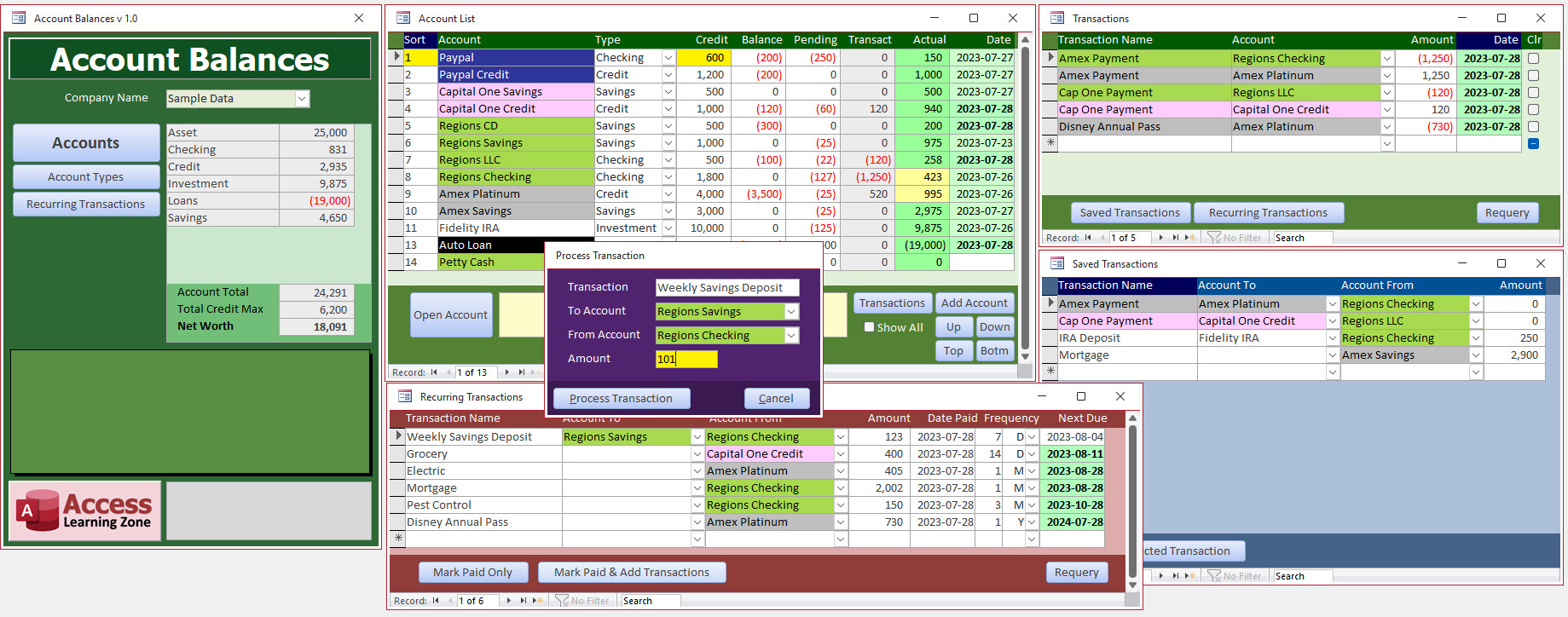
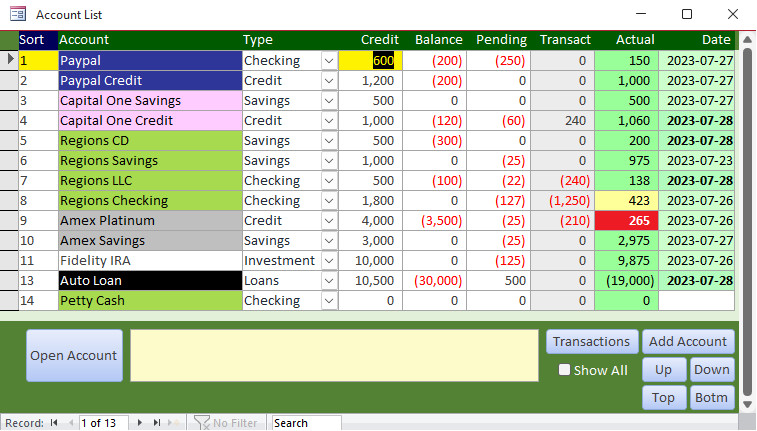
You have the ability to track each of your different accounts, whether they're checking accounts, savings accounts, credit cards, loans, investments, assets, or anything else you'd like to add. You have full control over the list of account types. You can also assign a color scheme to each account; for example, I prefer to color-code each bank or credit card company for easy identification. The system allows you to keep track of your maximum balance, pending transactions, and other related information. It will calculate your actual balance after all pending transactions have been processed. Moreover, you can set warning levels to indicate which accounts urgently need a deposit. The last date each account was updated will be displayed, and if an account hasn't been checked online in a while, you'll receive a visual notification.
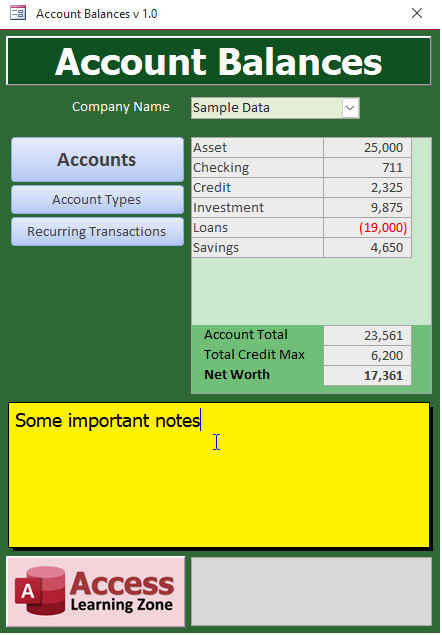
There's a status screen on the main menu that displays the actual balances of all your various account types. Moreover, it can calculate your net worth. An additional feature is the ability to jot down important notes on the main menu, ensuring you'll see them the next time you open the database.
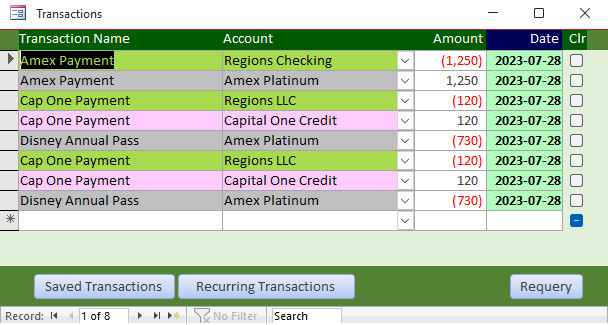
On the transactions form, you'll find a list of all your pending transactions. For each transaction, you can provide a name, specify which account the money is being transferred to or from, indicate the transaction's amount, and set the transaction's date. Once a transaction is cleared, all you need to do is check the "Clear" checkbox; the transaction will then be archived and stored for future reference.
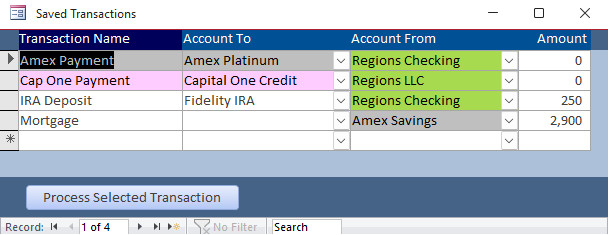
If you frequently carry out certain transactions, like deposits into your savings account or settling a credit card bill, you can list them on the "Saved Transactions" form. When it's time to execute one of these transactions, you simply select it and click the "Process Transaction" button. This feature saves you the effort of inputting the same transaction details over and over again, which can be quite time-saving.
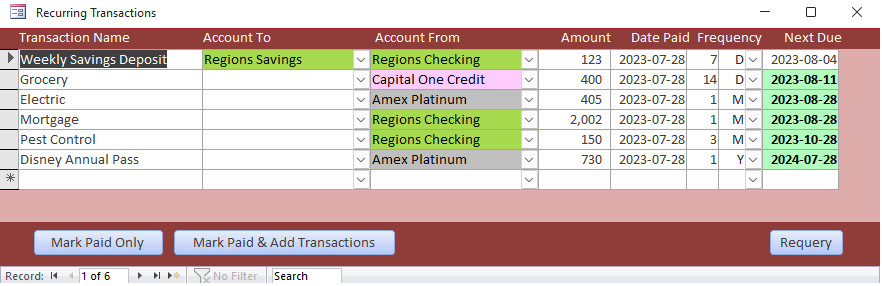
Alongside the Saved Transactions, which are manually processed by you at irregular intervals, there's also the Recurring Transactions form. This form is used to manage regular transactions that occur on a set schedule, such as weekly, monthly, quarterly, or yearly. Typical examples of these would be utility bills, quarterly pest control fees, annual season passes, and other such regularly occurring expenses. When you click on the "Mark Paid and Add Transactions" button, the respective amounts will be appended to your transactions list. The Recurring Transactions form will then update the date paid and automatically adjust the next due date according to the frequency you specified.
These are the main features of the Account Balances template. I initially developed this in Excel many years ago to manage my own personal finances and I've wanted to upgrade it to Access for quite some time. Finally, I've done it. If you want to understand this database more thoroughly before purchasing it, I highly recommend you watch the TechHelp videos to gain a good understanding of how it was constructed.
Features Added to TemplateHere is the list of added features for Gold or Platinum members who have been following along with the extended cuts or downloaded the database after the Account Balances Video Part 9. These features were not included in the TechHelp videos:
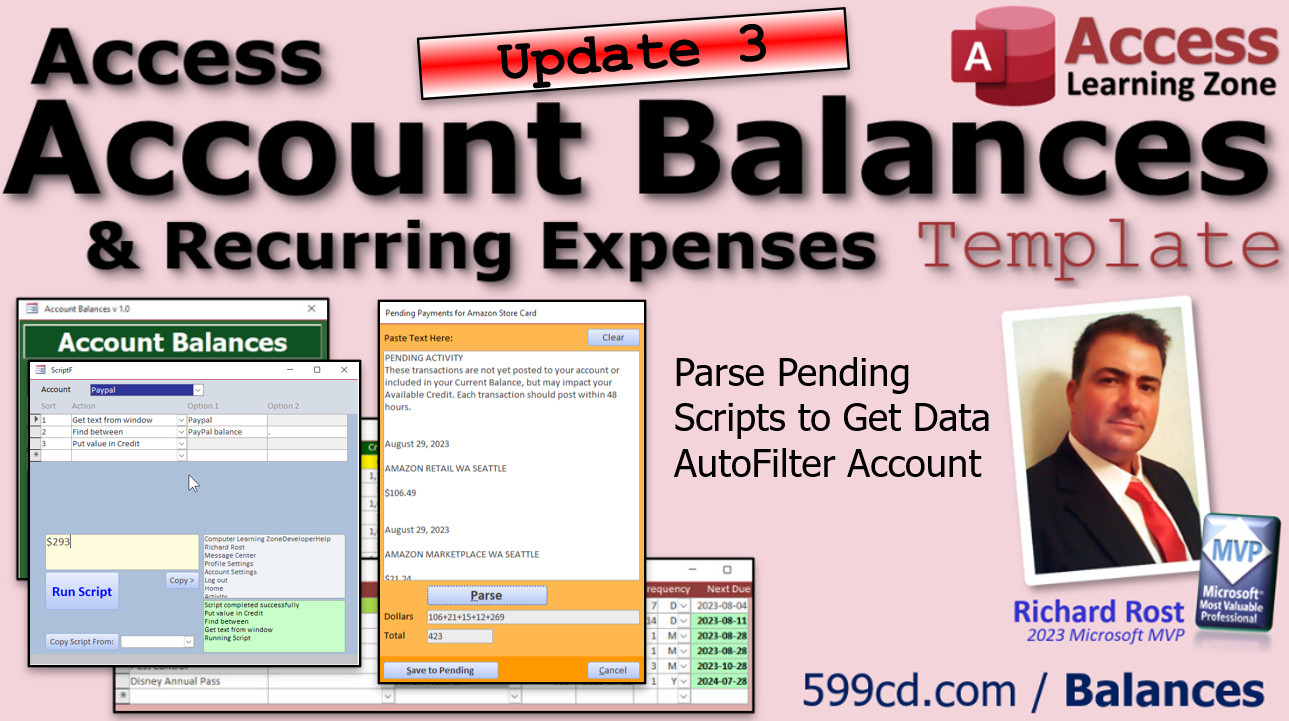
Features Added to Updates 1 & 2Updates 1 & 2 were mostly minor changes and fixes - things that I discovered I wanted to add or modify over the past month or so that I've been working with my personal data. The more you work with software, the more you realize how you want it to work. The videos above explain the changes, but it's nothing major. Features Added to Update 3These are features added to Update 3 of the template. There were three really big features added, so I put together a video explaining those, and then a second explainer video covering them in more detail, plus the other minor additions and modifications I've made since update 2. The big new features are:
Other minor changes include:
Before You PurchaseA few important notes before you purchase this template:
Possible Future Upgrade IdeasIf you have ideas on things you'd like to see added to this database, please post a comment below. If a particular feature garners enough interest or if I consider it to be a particularly good idea, then I will definitely consider adding it. For internal use only. This template does NOT come with a royalty-free license. You may only customize the template for your business needs and for use within your organization at one location ONLY. You may not resell or distribute any form of this template to others without express written permission. Contact me for additional information on obtaining a license to distribute if you plan on including this template in a product you are reselling. Additional licenses are required if you plan on using this template with more than ten (10) employees or in multiple locations within your organization. Please keep in mind that most of my template databases are not designed to be finished products that are ready to go in a working environment. My templates are meant as starting points for you to customize for yourself so you don't have to reinvent the wheel. This requires that you have a basic understanding of Microsoft Access development. To work on most of my databases you should have completed my Access Beginner series and the first couple levels of my Expert series at a minimum. Most of my databases require knowledge of SQL and VBA as well. Keep in mind that most of my templates are not like off-the-shelf software. They're starting points for developers to be able to modify and use as their own. It really is going to be in your benefit to watch all of the prerequisite videos so you understand the database and how it works moving forward. This is not like QuickBooks where you just install it and use it. My templates are mostly designed for people who already have an understanding of how Microsoft Access works. If you would like to discuss customizing this template for your needs, and integrating it into your current setup, please see my consulting page for details. While I no longer accept custom jobs that are specific to a single user, I may include your features in a future version of this template if they have mass appeal. If you are looking for custom enhancements made to this template just for you, visit my Developer Network. Please note that technical support is NOT guaranteed for any of my courses, seminars, or templates. If you require help with modifying this template, you may post a question in the Forums, however an answer to your question is not guaranteed. If this template comes with an accompanying Seminar, then you should purchase that Seminar to see how the database was constructed. If not, then you should have taken the suggested courses. Most of my templates are designed on a Developer level and you should have a thorough understanding of SQL and VBA before attempting to modify them. If you have a problem with one of my databases, I will only support the unmodified database exactly as it's downloaded from my site. If you have modified it in any way, it may not be something I can help you with. You can post in the Forums, and I may be able to help you, but if the issue doesn't exist in my unmodified database, it's not something I can support. Got sales or customer service questions about this template? Feel free to contact me. If you have technical "how do I" questions about this template, you discover a bug, or want to suggest a new feature, then please post your comments below. Keywordsmicrosoft access, ms access, ms access tutorial, #msaccess, #microsoftaccess, #help, #howto, #tutorial, #learn, #lesson, #training, #database, #template, Microsoft Access account balances template, track account balances, expense tracker, recurring transactions, recurring expenses,
More InformationTranscriptIntroducing the Microsoft Access Account Balances and Recurring Expenses Template, brought to you by AccessLearningZone.com. My name is Richard Rost. The purpose of this database is so you can track your daily account balances, whether it's credit cards, checking accounts, loans, or whatever. You can track multiple companies or people if you want. You can track multiple different account types: checking, credit, investments, that kind of stuff. Now, this isn't one of those databases where I have you download your transactions every week or whatever. I don't do that myself. Maybe once a quarter I'll do that. But on a daily basis, I like to just log on to the important accounts - my savings account, my credit card accounts - check what the balances are, and keep track of any pending transactions. This way, I can keep a general eye on what my finances are doing. You can keep track of the transactions that are pending for each account on your transactions form over here. This will show you what transactions are still waiting. You have your MX payment coming out of your checking account and so on. Those are going to add up over here. You can have saved transactions. So if it's something you do all the time, like paying your Capital One bill, you click on this. You go to process selected transaction. You have your to account, your from account, it grabs the balance from over here so it knows how much. Hit process transaction and it puts it up here for you and adds it to your transaction total. In addition to saved transactions, which are ones that you just do whenever, you can also have recurring transactions. These are like bills or things that you do on a regular basis, like you want to make a weekly savings deposit into your savings account, or you have your electric bill every month or your mortgage, that kind of stuff. You can track over here how often it occurs - like every month, every week, every three months, every year. When you're ready to process it, just click on it. Then, down here, click mark paid and add transactions, and it will add the transactions up into your transaction table for you. There you go. It will mark right here that it's paid today and it's not due for another year. There are all kinds of extra added benefits I threw into this database too. You can sort on your columns by clicking on them. You click on a field and it selects the text in there automatically so you don't have to click again and select it. Just little enhancements like that that I like. You can also have accounts that don't always show up on the account list. You can click on show all over here. For example, my asset accounts, I check those maybe every couple months. I'll say, what's my car worth right now? What's the value of my home? If you open up that account, you'll see the option right here to show on list. You can have warning levels and critical levels. Those are generally for your credit card accounts or your bank accounts. This one got low, so it's showing up as a red. This one got really low. I'm explaining, for example, open that up. You can set what your levels are here. You can set the color scheme for each of these. So this thing is packed full of features if you're interested in tracking your daily account balances and your recurring transactions. Now, this full template is available for purchase on my website. Here's the link down here. I'll put it down below in the description and you can click on it as well. I also have a whole series of videos where I covered how I built this thing. This started off as a project in Excel where I show you how to track your account balances in Microsoft Excel. So if you want to get the theory behind why I do a lot of what I do in this database, start here. I have been tracking my personal finances like this in Excel for years. I have been wanting to switch it over to Access because obviously I'm an Access nerd. So I started off in Excel to show you how I did this in Excel. There are two of these. Then I moved it over to Microsoft Access. There are nine of these videos you can watch and some extended cut videos for the members that go over some of the more advanced features. Obviously, if you want to learn all of this, it helps to be a member, at least a Silver member. There is one video on the expense tracker and an extended cut that covers building the recurring transactions. You can watch those videos if you want or not. That's just if you want to learn how the database was built. You can just get the database and use it if you don't care how it was built. That's fine too. That's what the template is for. I've also added a bunch of new features since I recorded those videos that I added to the template. Those are included in an explainer video for people who purchased the template. If you want to learn more, visit my website right here. I'll put a link down below and you can check it out. There's also a free version you can download if you just want to play with it. If you have any questions, feel free to contact me or post a comment down below. Thanks for watching. IntroIn this video, I introduce the Microsoft Access Account Balances and Recurring Expenses Template, which helps you track your daily account balances across multiple accounts and types including checking, credit cards, and loans. I will show how to monitor pending transactions, use saved and recurring transactions for regular expenses, customize alerts for low balances, and make use of convenient interface enhancements. Whether you want to keep a closer eye on your finances or streamline your regular payments, this template is packed with useful features for effective personal account management. QuizQ1. What is the primary purpose of the Microsoft Access Account Balances and Recurring Expenses Template? A. To predict future expenses automatically B. To track daily account balances and recurring transactions C. To manage payroll systems D. To organize personal photo libraries Q2. Which type of accounts can you track using this database? A. Only checking accounts B. Only credit card accounts C. Multiple types like checking, credit, investments, and more D. Only loans Q3. What feature allows you to quickly process transactions you do regularly? A. Transaction exporter B. Saved transactions C. Manual entry only D. Budget forecaster Q4. What is the difference between saved transactions and recurring transactions in this database? A. There is no difference B. Saved transactions are for manual entry once, recurring are for regular automatic entries C. Saved transactions are only for bills, recurring are for one-time payments D. Recurring transactions can only be used for investments Q5. How does the template let you track the payment frequency of regular bills? A. By exporting to Excel B. By logging into each account individually C. By letting you set frequencies like every week, every month, or every year D. Only by marking manually in a list Q6. What does the database allow you to do with columns in forms? A. Change their color only B. Sort them by clicking on the column header C. Lock them from editing D. Hide them permanently Q7. How does the template help you keep track of less frequently checked assets like a car or home? A. By deleting them from the main list B. By always displaying them by default C. By letting you choose to show or hide them from the main account list D. By only exporting them to another program Q8. What are warning and critical levels used for in this template? A. To set up reminders for birthdays B. To color-code accounts based on their balance level C. To hide unused accounts D. To automatically pay bills Q9. Where did the project for this database originally start? A. As a web application B. In Microsoft Word templates C. In Microsoft Excel for tracking account balances D. As a mobile app Q10. What benefit does becoming a member (at least Silver) provide according to the video? A. Access to free smartphones B. Extended cut videos with advanced feature explanations C. Regular mail newsletters only D. Free Microsoft Access upgrades Q11. What can you do if you just want to use the database without learning how it was built? A. Buy individual lessons separately B. Download only the source code C. Purchase and use the template directly D. Register for a mandatory training course Q12. Where can you find additional resources or a free version to try the template? A. By subscribing to a cable service B. By visiting the presenter's website C. By contacting Microsoft directly D. By searching on third-party forums Answers: 1-B; 2-C; 3-B; 4-B; 5-C; 6-B; 7-C; 8-B; 9-C; 10-B; 11-C; 12-B DISCLAIMER: Quiz questions are AI generated. If you find any that are wrong, don't make sense, or aren't related to the video topic at hand, then please post a comment and let me know. Thanks. SummaryToday's video from Access Learning Zone introduces the Microsoft Access Account Balances and Recurring Expenses Template. My goal with this database is to help you keep track of your daily account balances, whether it be for credit cards, checking accounts, loans, or any other financial accounts. You can easily manage multiple companies or people, and track various account types, including checking, credit, and investment accounts. This template is designed for users who do not want to download transactions frequently. Personally, I rarely download my transactions, maybe once per quarter. On a daily basis, I prefer logging in to my key accounts like savings and credit cards, noting their current balances, and keeping an eye on any pending transactions. This approach allows me to stay in tune with my finances without the hassle of sorting through downloaded statements all the time. Within this template, you can see all pending transactions for each account using the transactions form. This gives you a quick overview of which payments are still processing, such as scheduled withdrawals from your checking account. These pending items are automatically totaled on your dashboard. There are options for saved transactions as well. If you routinely pay a particular bill, such as your Capital One credit card, you can save this transaction. When it is time to make the payment, select it, process the transaction, and the template will automatically transfer funds between the designated accounts and update your transaction records accordingly. In addition to saved transactions that you use as needed, the template also supports recurring transactions. These are regular payments like monthly electric bills, weekly savings deposits, or annual insurance premiums. You specify how often these transactions occur—monthly, weekly, quarterly, or yearly. When you are ready to process a recurring transaction, simply select it and mark it as paid, and it will be recorded in your transactions table, updating its next due date as well. I have included several enhancements to make the database easier to use. For example, you can sort data by clicking on column headers, and clicking on any field will automatically select its content for quick editing. Little touches like this make the whole experience smoother. You can also control which accounts appear on your main account list. Some accounts, such as assets like your home or car, may not need daily attention. You can choose to hide them from the default view, and review them only when desired. When you open up these accounts, you have the option to display them in your main list if needed. Warning and critical levels can be set for your accounts, especially useful for keeping an eye on your bank or credit card balances. If an account falls below your set thresholds, the template will highlight it with colors to alert you. You can customize these warning levels and their corresponding colors to suit your preferences. This template is packed with features for anyone interested in monitoring daily account balances and managing recurring expenses. If you are interested, the full template is available for purchase on my website. There is a link in the description below this article. For those who want to learn how the template was constructed, I have produced an entire video series documenting its development. It actually began as an Excel project, so you can start with those videos to see how to manage account balances in Microsoft Excel. I have used this method to track my personal finances in Excel for years but decided to migrate it to Access. The first two videos cover the process in Excel, followed by nine videos in which I build the system in Access. Extended cut videos for members go into more advanced features, so if you want a comprehensive understanding, I recommend at least joining as a Silver member. For those particularly interested in the recurring transactions feature, there is a video focused on the expense tracker and an extended cut covering its construction. You are welcome to watch these to understand the underlying processes, but you can always use the template on its own if you prefer not to build it yourself. Since recording those lessons, I have added several new features to the template. If you purchase the template, you will find an explainer video outlining these latest additions. If you want more information, I encourage you to visit my website. There is also a free version available if you want to try it out before making a purchase. If you have questions, do not hesitate to reach out or leave a comment below. You can find a complete video tutorial with step-by-step instructions on everything discussed here on my website at the link below. Live long and prosper, my friends. Topic ListThis is a video introducing a Microsoft Access template for tracking account balances and recurring expenses, explaining its features and how it can help users manage finances. Primary TopicsMicrosoft Access template, account balance tracking, recurring expenses, saved transactions, financial account types, transaction processing Secondary Topicsaccount visibility settings, warning/critical levels, template enhancements, Excel migration, membership content |
||||||||||||||||||||||||||||||||||||||||||||||||||||||||||||||||||||||||||||||||||
|
| |||
| Keywords: templates access Microsoft Access account balances template, track account balances, expense tracker, recurring transactions, recurring expenses,ÃÆâ€â„à Page Tag: whatsnew PermaLink Microsoft Access Account Balances Template |