File In Use
By Richard Rost

 3 years ago
File Already in Use and Already Opened Errors
In this Microsoft Access tutorial, we're going to learn how to deal with experiencing the "File already in use" error message when you try compacting your database. You may also get the error message saying, "You attempted to open a database that's already opened by another user. Try again when the database is available." We'll talk about both of these issues today.
Kieran from Miami, Florida (a Platinum Member) asks: I try to compact my database at least once a week, like you told me in your compacting video. But it seems most of the time when I do, I get an error message saying that the database is already in use. I do have a few other people on my network, but I always make sure that everyone's logged out. In fact, no one else is here in the office and all the computers are off, but I still get the error message. What gives?
Prerequisites
Links
Checklist
- Make sure everyone is out of the database (including you)
- Delete the LACCDB file
- Make sure no MSACCESS.EXE tasks are running
- Open with SHIFT key bypass
- Try compacting a copy of the database file
- Don't use a shortcut (go in thru Access > File > your database)
- Restart Windows
- Office Update (check bug reports)
- Create a new blank database, import objects
- Import objects one at a time
- Turn off File Sharing Services (Google Sync, Dropbox, etc.)
- Check my Troubleshooter
Bug Alerts
Repair Services
Recommended Courses
Keywords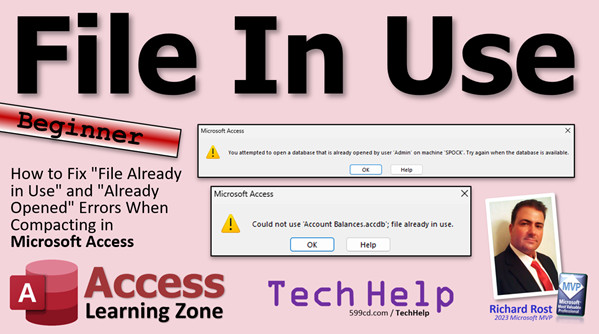
access 2016, access 2019, access 2021, access 365, microsoft access, ms access, ms access tutorial, #msaccess, #microsoftaccess, #help, #howto, #tutorial, #learn, #lesson, #training, #database, Can't compact database, file already in use, could not use, accdb, you attempted to open a database that is already opened by user x on machine y, try again when the database is available, fix corrupted microsoft access database, How to Recover and Repair Corrupted Access Database Files, ACCDB Recovery Tool, access database repair services
 Subscribe to File In Use
Get notifications when this page is updated
More InformationTranscript Welcome to another TechHelp video brought to you by AccessLearningZone.com. I'm your instructor, Richard Rost.
Today we're going to talk about what to do if you experience the "file already in use" error message. When you try compacting your database, or sometimes even when you just try opening it, you might get that error message. You might also get a slightly different one that says you attempted to open a database that is already opened by another user and you're the only user. How does that happen? We'll talk about both of these issues today.
Today's question comes from Kirin in Miami, Florida, one of my Platinum members:
"I try to compact my database at least once a week, like you told me in your compacting video. But it seems most of the time when I do, I get an error message saying the database is already in use. I do have a few other people on my network, but I always make sure that everyone is logged out. In fact, no one else is here in the office and all the computers are off, but I still get the error message. What gives?"
Well Kirin, this could be caused by a number of different things. We're going to walk through all of them in just a minute.
Before we get started, this is a beginner video, but if you don't know about compacting and repairing your database, this is very important. Make sure you go watch this video first. This is something you should do at least once a month. I prefer once a week, or even daily if you've got a database that's used a lot. So make sure you go watch this video first if you don't know about compacting and repairing.
This is a problem that might pop up just randomly when you try to compact and repair your database, not if your database is open, especially if forms have been loaded that have VBA code behind them. You're more likely to see this problem.
If you have the database open and you go to compact and repair, nine times out of ten it's going to run just fine. But if you do any design work, I've noticed this happens more often when I do design work, especially VBA work. If you move some things around, or you go into the VBA editor, make some changes in here - they don't have to be major changes - just any changes at all, save it, and then we're going to save this and close it.
Now let's see. Sometimes it does it, sometimes it doesn't. This is kind of random. In that case it worked. You might have to do this two or three times and, boom, I had to do it like five or six times off camera, but I got it to happen once in a while. It does this.
Usually it's just kind of random, and honestly, if you hit OK and you shut everything down and you open it back up again (I made a second copy when I was playing around here, ignore that one), you open it up again, and then you go ahead and run your compact and repair, and there, see? Then it ran fine.
Normally that happens. Just shut it down. Make sure every copy of Access is closed. Make sure that no one else is using the database, then try it again and most of the time it will work. But sometimes it doesn't. Sometimes you get that persistent issue where no matter what you do, it won't compact.
Now, I kind of cheated. For those of you who know what a split database is, I split the database and I linked to the backend tables. I put them in a different database, and I opened up the second database and I went in here and started designing a table, made some changes in here, and then you compact this guy, and... oh, see? It made a liar out of me again. Sometimes you get away with it, sometimes you can't.
Let's see ... sometimes because the two of them aren't out there... there it goes. See, the two of them aren't always connected. But if you're doing something in the backend database, that's definitely one major reason why this happens, especially if you've got a split database and the table database is in use.
But even if you've just got a single database without splitting it into front and back ends, I've seen this happen too. I've had those persistent databases that I couldn't get to compact, so I made this list of what to check.
First up, make sure everyone is out of the database, including you. Make sure all copies of Access are closed on your computer. If you're on a server, make sure no one else is connected to it. Make sure they're logged completely out of Windows. If someone is connected to the database, you will find this LACCDB file. ACCDB is Access database, L is a lock file.
You can see there are two of them right there. There's one right there for the copy, that's the backend that I made, there's another one right here. That file indicates that someone's got that database open. Usually when you close the database, that file goes away. So if I come over here and close the database, save changes, no, that file went away. If I close the front end that I've got, usually it goes away.
Now, it doesn't always go away. Sometimes, for example, if someone's computer locks up or if Access freezes, that file is left there. You can manually delete that if you want to. Again, make sure no one else is in the database before you do that. But it's safe to delete that file, the LACCDB file. And of course, we're backing up everything nightly. I have to throw this in every now and then. Make sure you're running nightly backups of your data. If not, go watch this video, I explain how to do it.
So you've checked, you've made sure everyone is out of the database, including you. Also, check to make sure there are no tasks running. I should probably add that to the list too. MSACCESS.EXE - run your Task Manager, your Windows Task Manager. Just go to your Start button in Windows, type in Task Manager, and run this guy and make sure that MSACCESS.EXE isn't running, because sometimes Access can lock up and it doesn't look like it's running. It's not going to show up on your Windows taskbar, but there's still a process running in the background.
If that's the case, just right-click on it and End Task, and kill it. I'm not going to do that, but you can check that too, make sure.
So we've gotten that far. We are sure that no other copies of Access are running.
Next, let's try opening the database with the Shift key bypass. What does that do? Well, the Shift key bypasses anything in the startup in the database: your startup form or an AutoExec macro. All you do is click on the database, then hold down the Shift key and double-click to run it. That will open the database. It will usually open up behind the window that you're on - it's back there, see? But it bypasses the startup. Notice my main menu didn't run.
Once that happens, now you can try again compacting the database and then it should compact and reload. Sometimes something that's in your startup might be causing the problem. You want to load the database up fresh and clean with no code loading.
If that doesn't work, try compacting a copy of the database file. Sometimes the database file itself can be corrupted. So just like I did here, take the actual database file, copy and paste it, and then try opening up that guy and compacting that guy. That might fix the problem too.
If that still doesn't work, go in through Access, the application itself. Don't use your startup shortcut that you might have on your desktop. Actually run Access. Go to your Start button, find Access. There it is right there; run it off your Start menu or however else you load it. If you don't see it on here, go to Open, go locate it, browse, find it on my desktop, I made a DB folder, here it is right here. Now click on it once and again hold down the Shift key to bypass the startup and then click Open.
That will open the database again, bypassing startup. Now, again, try compact and repair.
If that still doesn't work, give Windows a restart. Shut everything down, Start menu, restart Windows. Sometimes these processes that run in the background that have nothing to do with Access can keep your database from compacting. I've seen it happen, folks. I've seen weird things happen. You wouldn't believe - I've seen computers that wouldn't boot because of a bad keyboard, like the plug-in keyboard. The weirdest things. Computers are ... hmm.
Restart Windows. If your database still won't compact, if that still doesn't work, do an Office update. Sometimes there are bugs in Access that get released. You know how it is, when they fix one problem, they introduce another one. Do an Office update. Check the bug reports that are out there.
There are a couple different great sites that I go to to check for Office bug reports. Mike Wolfe's site is one of them, No Longer Set. I'll put a link to his site down below. He does a lot of great bug alerts, almost as soon as they happen. Access Forever is another one. I check both of these anytime I have a weird problem. Something comes up, I check these sites.
These guys are on the ball. I get my Access news from these guys and Mike.
Last but not least, if none of those things work, try creating a new blank database and import all of the objects from the old one into the new one. Sometimes the Access ACCDB file can get corrupted, like the shell or container of the file can get corrupted, but all the stuff in the database is still OK. I mention this one last because this does involve a little more work, but essentially, you're going to create a blank new database - DB2, whatever you want to call it - and then you're going to import all of the objects from your existing database.
Go to External Data, New Data Source, From Database, Access. Find your database file, browse to it, there it is right there, open it. You're going to select all the tables, queries, forms, reports, macros, and modules, and you're going to hit OK. You're going to hope they all come in just fine.
If this still doesn't work, if you're still running into problems, try importing the objects one at a time. I know this is a lot of work, but try importing the objects one at a time because you might have a single form or a single report that's corrupted. Import them one at a time and then compact after each step. You will eventually figure out which one of those objects is bad.
I had to do that once a couple years ago and it took me an hour or two, but I finally figured out I had a corrupted report and it was causing the database not to compact.
Hold up, hold up. I know I said that was the last item, but I finished the whole video and I thought of two other things to mention, so I had to go back. I'm editing.
First, turn off file sharing services. I've said in several videos in the past, don't use file sharing services like Google Sync, Dropbox, OneDrive, those kinds of things. Don't run your database on those kinds of file or folder sharing systems because it can corrupt your database. In fact, I have a whole other video that explains why you do not want to do this.
You may be using something like Google Backup and Sync that goes with Google Drive to back up your files. I use it on my system. I love it. It keeps copies of all my files, including my database files, saved off-site in case, you know, house burns down, gets taken by a hurricane, whatever (which we're having one today, but it's not going to hit us anyway).
If you're running your Access database out of a folder that is being synced with Google Sync or Dropbox or any of those things, even if no one else is connected to it, you might be running into an issue where that syncing software has your database file open because it's trying to sync it up to the server. If that's the case, Access might be saying, "Hey, I can't access this file to compact it." So turn off those file sharing services before you try to compact your database.
I haven't used anything but Google in a long time, but basically it puts a little icon down here. You right-click on it, you go up to the settings, and you just go to "Pause syncing." That's it. When it's paused, then it will stop trying to access your Access database (no pun intended) and you'll be able to compact it, probably. I'm not a big fan of those file sharing services for Access databases except to make sure that you're backing up your database.
Now, my main database, I do not have that folder where it can be synced by Google. However, I do have a nightly event that I use that copies all of those files to another folder that is backed up off-site. So there's a lot to it. But for my average everyday little databases that I use - because I've got little tiny databases for everything - those are on my desktop and in folders on my desktop, and that is backed up by Google. So I just have to know if I go to compact and repair, that could be the problem.
Second, you can also try running my troubleshooter on my website. I'll put a link to it down below because sometimes other weird things come up. That's what I put my troubleshooting checklist together for, all the weird stuff. Sometimes you don't even get an error message, it's just stuff doesn't work. Here's the checklist video here. You can watch it, just scroll down these things in order.
Compact and repair, don't use online storage, run on a local drive, check for bugs. There's the sites I mentioned earlier. Here is the actual Access blog from the Microsoft Access team, check them too. Make sure you run in a trusted location. Just run down this list.
So there we go. I think I'm done now.
What do you do if you run through all this stuff and your database still won't compact? Well, you're just out of luck. No, I'm just kidding. I'm just kidding.
There are some third-party software utilities out there that I've seen advertised that claim to be able to repair your database. I have not tried any of them, so I can't speak for them either way. I do know there are also companies that offer repair services, and here are three companies that I've referred people to in the past and I've heard good things about their services. But again, I have not personally used any of these in the past myself, and no, I am not receiving any compensation for referring business. I'm just putting it out there that if you have a corrupt database that you can't get to fix any other way, you could try one of these three companies.
That's pretty much everything that I know about fixing a corrupt database that you can't get to compact and repair, or even if it won't open in the first place.
If you've got any other tips or tricks or things that I might have missed, feel free to post them down below in the comments section.
But that's going to do it for today's TechHelp video. I hope you learned something today. Live long and prosper, my friends. I'll see you next time. Intro In this video, we will talk about what to do if you encounter a "file already in use" or similar error when attempting to compact or open your Microsoft Access database. We will discuss various reasons why these errors occur, including issues with lock files, background processes, and file sharing services like Google Drive or Dropbox. You will learn a step-by-step troubleshooting process, from ensuring all users are disconnected and checking Task Manager, to using the Shift key bypass and importing database objects into a new file. We will also cover when to consider third-party repair services if standard solutions do not resolve the issue. Quiz Q1. What is the primary reason you might see a "file already in use" error when trying to compact and repair an Access database?
A. The database file is being accessed by another process
B. There is not enough disk space
C. Too many tables in the database
D. A missing VBA module
Q2. What does the presence of a LACCDB file indicate in an Access database folder?
A. The database is currently being backed up
B. Someone has the database open
C. The database has been successfully compacted
D. File sharing services have paused
Q3. What is the FIRST thing you should do when faced with a compact and repair error?
A. Upgrade your Access version
B. Make sure everyone is out of the database, including yourself
C. Delete the ACCDB file
D. Import objects to a new database
Q4. If no user is in the database but the error persists, which background process should you look for in the Task Manager?
A. MSWORD.EXE
B. MSOUTLOOK.EXE
C. MSACCESS.EXE
D. EXPLORER.EXE
Q5. What does holding the Shift key while opening an Access database do?
A. Forces the database to open in read-only mode
B. Bypasses all startup routines including forms and AutoExec macros
C. Deletes temporary files
D. Forces a compact and repair on startup
Q6. Why should you try copying the database file and then compacting the copy?
A. The copy will always be smaller in size
B. This process can fix issues caused by file corruption in the original database
C. The copy changes the database's password
D. Compacting a copy always resets user permissions
Q7. What is a potential risk of running your Access database in a folder managed by file sharing services like Google Drive or Dropbox?
A. Larger file sizes
B. The database may be inaccessible only on weekends
C. File sharing software may lock the database file, preventing compact and repair
D. The database will require more RAM
Q8. Which action should you avoid if other users might still be connected to the shared Access database?
A. Deleting the LACCDB file
B. Running compact and repair
C. Viewing database properties
D. Updating linked tables
Q9. What is recommended if you have persistent compact and repair errors that cannot be resolved by simpler methods?
A. Upgrade to a newer version of Access
B. Import all objects from the problematic database into a new blank database
C. Install additional Access add-ins
D. Only use file sharing folders for your backups
Q10. When importing objects into a new database to fix corruption, what should you do if problems persist after importing everything?
A. Try importing all objects again in bulk
B. Import objects one at a time to identify a potentially corrupted object
C. Only import tables and ignore forms
D. Attempt to repair the database using Excel
Q11. Aside from Access issues, which other computer action might clear up a persistent error?
A. Defragment your hard drive
B. Restart Windows to clear any stuck background processes
C. Delete all user profiles
D. Install more memory
Q12. Why is it important to check for Office updates when dealing with Access database issues?
A. Updates increase database speed
B. Updates can fix bugs that might cause compact and repair problems
C. Updates ensure better security only
D. Updates add new data types
Q13. What final step is recommended if you exhaust all troubleshooting steps and still have a corrupt database?
A. Permanently delete the file
B. Contact a reputable third-party repair service
C. Ignore the corruption and keep using the database
D. Only access the database in read-only mode
Answers: 1-A; 2-B; 3-B; 4-C; 5-B; 6-B; 7-C; 8-A; 9-B; 10-B; 11-B; 12-B; 13-B
DISCLAIMER: Quiz questions are AI generated. If you find any that are wrong, don't make sense, or aren't related to the video topic at hand, then please post a comment and let me know. Thanks. Summary Today's TechHelp tutorial from Access Learning Zone covers how to resolve the "file already in use" error in Microsoft Access, particularly when trying to compact and repair your database. This error, or similar messages about the database being used by another user when you are sure you are the only one connected, can be frustrating. Let me walk you through the most common causes and solutions.
If you are not already familiar with compacting and repairing your database, I highly recommend taking the time to learn about it. This is an essential maintenance step you should perform at least monthly, though weekly or even daily might be appropriate if your database sees a lot of use.
Let's begin with a typical scenario: you close your database, make sure everyone else is out, perhaps the office is empty and the computers are off, yet Access still displays the "database already in use" error when you attempt to compact it. This problem often occurs randomly, especially after design work or when you use the VBA editor and make any kind of changes. In my experience, compact and repair usually works just fine most of the time, but after making design changes, this error can appear more frequently.
When this occurs, your first step should be to close all open copies of the database and exit Access completely. Then, reopen Access and try again. Very often, simply making sure that every instance of Access is closed and then reopening the database will resolve the issue.
However, sometimes this error persists. One important thing to check is whether your database is split into front and back ends. The back-end file, where tables are stored, could still be locked if someone is connected, or if you have made design changes there. Even with a single, unsplit database, this issue can still occur.
I keep a checklist of troubleshooting steps for this situation. First, ensure that absolutely everyone is out of the database, including yourself. Check that all copies of Access are closed, and that no one remains connected to the database over the network. Anyone who is still logged into Windows could keep the database file in use.
Look for the presence of a LACCDB file. The ACCDB file is your main Access database, while the LACCDB is a lock file that appears whenever the database is open. If you find this file and know nobody is using the database, try deleting it. Sometimes Access or Windows can crash and leave this file behind, and it is safe to remove if you're sure no one is connected.
Regular backups are vital. Always be sure your data is backed up every night to guard against file corruption or loss.
Another step is to check for lingering processes. Sometimes Access might still be running in the background even after you think it is closed. Open Task Manager in Windows, check for MSACCESS.EXE under Processes, and end the task if it is running.
Next, try opening the database using the Shift key bypass. By holding down Shift while you open the database, you prevent any startup code or forms from running. Sometimes something in the startup routine causes the issue, so this allows you to load the database without any extra code and may free up the error.
If that does not work, copy the database file and try compacting the copy. Sometimes this alone resolves the issue, particularly if the original file is corrupt.
You can also try opening Access on its own (from the Start menu or wherever you have it installed) and then open your database from inside Access, again using the Shift key to bypass startup routines.
If all else fails, restart Windows entirely. This clears up any hidden processes or file locks that might be lingering. Strange as it may seem, a fresh reboot can sometimes resolve problems that nothing else can.
Another troubleshooting step is to check for Microsoft Office updates. Sometimes bugs in Access are to blame, so keeping Office up to date is important. For the latest bug reports or issues, I recommend keeping an eye on helpful sites like Mike Wolfe's No Longer Set and Access Forever. They offer timely updates on Access bugs and workarounds.
If you have exhausted all other options, consider creating a new blank database and importing all your objects from the corrupt database into it. Sometimes, the shell of the ACCDB file itself becomes corrupted, though your forms, reports, queries, and tables might be fine. Create a new database, then import all objects from the old one. If the problem persists, import each object individually and run compact and repair after each one. That way, if you find one object is causing the problem, you can isolate and remove it. In the past, I've discovered a single corrupted report or form causing weeks of aggravation.
Before I finish, I need to mention two more things. First, avoid running your Access database from folders that sync with file sharing services such as Google Drive, Dropbox, or OneDrive. These file syncing services can interfere with Access opening or compacting your database. Even if no other user is accessing the file, the syncing client might be. Before trying to compact, pause all file syncing software. While these services are great for offsite backups, you should not open your working Access file from a folder they sync.
Second, if you're still having trouble, try my troubleshooting checklist available on my website. It covers a range of possibilities, including making sure to use local drives, running in trusted locations, and more.
If, after trying all these methods, your database still will not open or compact, there are third-party repair utilities you can find, and some companies offer professional repair services for Access databases. While I do not personally endorse any particular service, I have heard from others who have had success with a few of these options.
I hope these steps help you fix the "file already in use" or related database errors in Access. If you have any additional tips or have found solutions that I have not mentioned here, be sure to let me know in the comments.
You can find a complete video tutorial with step-by-step instructions on everything discussed here on my website at the link below. Live long and prosper, my friends. Topic List Causes of the "file already in use" error in Access
Steps to check if the database is open by another user
Identifying and deleting the LACCDB lock file
Using Windows Task Manager to end MSACCESS.EXE
Bypassing startup with the Shift key method
Compacting and repairing a copy of the database
Opening the database directly from Access without shortcuts
Restarting Windows to clear background processes
Updating Microsoft Office to resolve Access bugs
Checking official and community bug reports
Importing objects into a new blank database
Importing database objects one at a time to find corruption
Turning off file sharing services like Google Sync and Dropbox
Pausing cloud sync before compacting the database
Running a troubleshooting checklist for Access issues
Using third-party repair services for corrupted databases Primary Topics Microsoft Access, compact and repair, file locking, database troubleshooting, split databases, Access errors, database corruption, backups, file sharing services
Secondary Topics task manager, startup bypass, object import, Office updates, third-party repair services
|




