Task Priority
By Richard Rost

 3 years ago
How to Adjust Access' Task Priority in Windows
In this Microsoft Access tutorial, I'm going to teach you how to optimize your database performance by adjusting task priority levels in Windows. Understanding task priority can make a significant difference in how quickly your queries run, forms load, or reports generate, especially when working with large and complex databases. But remember, with great power comes great responsibility and tweaking these settings can improve performance but can also lead to system instability if not done carefully.
Raj from Denver, Colorado (a Gold Member) asks: I've been building an Access database that involves a lot of mathematical calculations and it has been really slow. I've optimized my queries and made sure my tables are properly structured like you show in your classes, but some operations like running detailed reports still take ages to complete. Is there a way to speed things up without upgrading my hardware. Thanks!
Members
Members will learn how to create a batch file to automatically run your database at whatever set priority you decide, so you don't have to manually change it every time you run Access.
Silver Members and up get access to view Extended Cut videos, when available. Gold Members can download the files from class plus get access to the Code Vault. If you're not a member, Join Today!
Prerequisites
Recommended Courses
Keywords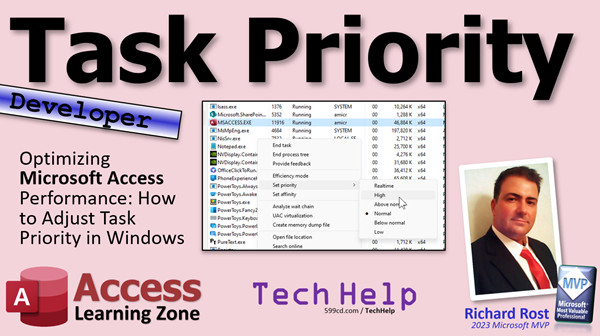
access 2016, access 2019, access 2021, access 365, microsoft access, ms access, ms access tutorial, #msaccess, #microsoftaccess, #help, #howto, #tutorial, #learn, #lesson, #training, #database, task, priority, end task, high, Realtime, above normal, normal, below normal, low, processes, CPU, Improved Performance, Responsiveness, Faster Completion Time, Resource Allocation, System Instability, Resource Hogging, Resource-Intensive, calculations, speed up search
 Subscribe to Task Priority
Get notifications when this page is updated
More InformationTranscript Welcome to another TechHelp video brought to you by AccessLearningZone.com. I'm your instructor, Richard Rost. Today, I'm going to teach you how to optimize Microsoft Access's performance by adjusting the task priority in Windows.
Today's question comes from Raj in Denver, Colorado, one of my gold members. Raj says, I've been building an Access database that involves a lot of mathematical calculations, and it has been really slow. I've optimized my queries and made sure my tables are properly structured like you show in your classes, but some operations, like running detailed reports, still take ages to complete. Is there any way to speed things up without upgrading my hardware? Thanks.
Yes, Raj, one thing you can do once you've made sure your database is properly built is you can optimize performance by adjusting the task priority level in Windows. Understanding task priority can make a significant difference in how quickly things run, like queries, form loads, report generation, that kind of stuff. But remember, with great power comes great responsibility. Tweaking settings like this can improve performance, but it can also cause problems. So let's talk about it.
First, let's talk about when you want to do this. Here's a little if-then statement. If your database is mostly local calculations, in other words, you're not pulling data off of a network, because if you're pulling data from a network server, that's always going to be the slowest bottleneck. That's where the slow performance comes from in most databases - by pulling information over a network or over the internet.
As long as that's not the case, and your database is properly optimized (in other words, you've got good table structure like I show in my classes), you've got multiple tables where necessary, you're properly normalized, your tables are indexed where they need to be, your queries are set up right. If both of those things are true, then we can talk about setting your task priority to a higher level.
I'm marking this as a developer lesson, even though there's going to be zero programming in it. I still think you should be at the developer level before you start messing with Windows Task Manager properties. If you're a newbie, just getting used to working with Access and just starting off, or if you have little Windows experience, don't play with this stuff. Come back in a year. This is for those of us veterans that have been around Windows for a while.
Go ahead and start your database, any database. Once it's open, we're going to press Control+Shift+Escape to start up the Task Manager. Control+Shift+Escape. I have to look this up all the time too, because I don't use this that often. I have a shortcut to the Task Manager on my Windows system, right down on the bottom. So I just click on that, or you can go Control+Alt+Delete and you'll see it on the system menu. Control+Shift+Escape is good if you use it a lot.
Here it is, Task Manager. Here's Microsoft Access. What you're going to do is right click on this guy and go to "Details". Go to "Details". That's going to bring you to the processes, and there you can see msaccess.exe. If you have multiple copies of your database open, or different databases, you might see multiple copies of this. Make sure you find the right one.
What you're going to do is right click and go to "Set priority". You can see it says Normal, Above Normal, and High. We're going to talk about these more in just a minute. I recommend you don't touch Real Time. That can definitely cause some system instability and can cause Windows to crash. I'm going to go here and pick High. Start with Above Normal, see if that does it for you. If not, go to High. Let's just switch to High.
You want to change priority. Click OK. Now, if you do the same thing, you'll see that we are now at high priority. What does that mean? That means that Access is now getting a higher priority than everything else running on your system, including your web browser, Microsoft Word, whatever else you've got running on your machine in the background.
I should also note while I'm in here, this is where you also go to end a task. If Access stops behaving, if it locks up and you can't close it by any other means, usually this happens from bad VBA, it's from bad VB code design, or you're stuck in an endless loop or something. This is where you can also come to end that task. But I'm not going to do that at the moment.
Now you should be able to go through and notice that your application is performing faster. Hopefully it is. It might not be, depending on what the issue is. But it's one more tool in your box that you can try to get Access to run better. Obviously, with my little TechHelp free template here, I'm not going to notice any difference, but you can try it with your application and see.
So, what are some of the benefits of doing this?
First and foremost, you may see improved performance for computations. Mathematical computations, queries and things that run in memory, that kind of stuff. You will probably see better responsiveness of your user interface. One of my pet peeves is when I'm waiting for a form to load and it takes a second before I can actually click on stuff. That should run faster, because most of Access has already loaded in memory, and so it's just literally switching to that form.
Other benefits include faster task completion, iterations, VB code loops, queries, designing and drawing forms and reports - that stuff should speed up. But again, this will not speed up processes that are I/O intensive involving lots of disk read/writes or network data. Keep that in mind. You may get a little performance improvement from disk read/writes, because Access will have priority and will get access to that disk information faster than other processes will, but it's not going to improve a slow hard drive.
If you get a solid state drive, you might notice definite improvement. But if you have an older hard drive, that's your bottleneck right there.
Now, some drawbacks: resource hogging. That means Access is going to get priority. So if you have other stuff running in the background and you switch to your web browser, that might run slower. Excel is going to run slower. It may cause system instability. Access and most of Microsoft Office and newer applications are good with it, but sometimes some older applications, especially, do not like being put in the background and not having the right access to the CPU when they want it, so it could cause other applications to misbehave.
Overheating and battery drain are also possible warnings. It shouldn't be a problem with most newer computers, but if you're really taxing that CPU with your Access application, it could happen, especially if you're overclocking your CPU, which I never think is a good idea. Battery drain - if Access has priority, it's going to drain your laptop battery faster.
Issues for other users: if you're on a network and have a multi-user Access database set up, and your Access database is taking priority, it could slow other people down because you're doing all the read/writes and locking records, which could cause other people to not perform well. You might want to only do this for your weekend reports - you come in on a Friday late and do your weekend stuff.
It's good for complex queries and calculations, like I've already mentioned. If you have a form with a whole bunch of different mathematical computations or a report that's got lots of math in it. Data import and export - you might get a moderate improvement with disk read/writes, but especially with network stuff, no, it's not going to help. Report generation, searching and sorting - especially if those records are already in memory - form loading time and responsiveness, and your VBA loops and recordsets. If you have a lot of iterative recordset loops, those should run faster.
It won't help with IO operations mostly, or memory constraints. If your database is really big and it can't all fit into RAM, then that's not going to help you. If you only have a gigabyte of RAM and you've got a bigger database than that, no, because Access has to keep constantly swapping in and out of memory to the hard drive, and so that's going to slow you down.
Poor database design - make sure your tables are indexed, make sure your relationships are set up properly, and make sure your code is optimized. This is not going to make up for bad code. You have to learn your VBA and your SQL. That's what my classes are for.
Again, with multi-user databases, unless it's one of those things where you kick everybody else out and want yours to run faster for weekend reports, that's fine. But if you do optimize your performance over everyone else, then that's on you.
I do the same thing in my house with my Wi-Fi. You can set something up called Quality of Service, where certain devices get more priority from the Wi-Fi router than others. Don't tell my fans that I do this, but yeah, that's why my Roku always runs better in my bedroom.
Now, in the extended cut, what are we going to do? One of the problems with this method is that if you want your database to always run at higher priority, you have to do this every time you run the database. In the extended cut, I'm going to show you how you can use a batch file with some sleek Windows commands to have your database open in high priority all the time, every time you run it.
That will be covered in the extended cut for the members. Silver members and up get access to all of my extended cut videos and lots of other perks. Check down below, you'll see a link to my membership page to get more information.
That is going to be your TechHelp video for today. I hope you learned something. Live long and prosper, my friends. I'll see you next time. Intro In this video, we'll talk about how to improve the performance of your Microsoft Access database by adjusting the task priority settings in Windows. You'll learn when it makes sense to change task priority, how to do it safely using the Windows Task Manager, and what kinds of operations in Access may benefit from these changes. We'll also discuss the advantages and potential drawbacks of raising Access's priority, and cover some common scenarios where this technique may be helpful or not effective. Quiz Q1. When should you consider adjusting the task priority for Microsoft Access in Windows?
A. Only after you have optimized your database design and queries
B. Before checking your database table structure
C. Whenever Access feels slow, regardless of reason
D. Only after upgrading your computer's hardware
Q2. What is the main benefit of increasing Microsoft Access's task priority in Task Manager?
A. Access uses more memory for storage
B. Improved performance for computations and faster responsiveness of the user interface
C. Access disables other applications automatically
D. Access runs new queries automatically on startup
Q3. Which of the following is NOT recommended when setting task priority for Microsoft Access?
A. Choosing Real Time priority
B. Starting with Above Normal priority
C. Setting priority through Task Manager
D. Changing to High priority if needed
Q4. What kind of tasks benefit the MOST from increasing Access's priority?
A. Network data transfers
B. Local computations, queries, and VBA loops
C. Disk defragmentation operations
D. Installing software updates
Q5. If your database performance is slow due to pulling data over a network, what is likely the main bottleneck?
A. CPU speed
B. Disk fragmentation
C. Network bandwidth and latency
D. Number of tables in the database
Q6. According to the video, who should NOT attempt to change task priority settings in Windows Task Manager?
A. Experienced Windows users
B. Developers familiar with Access
C. New users with little Windows experience
D. IT professionals
Q7. What key combination opens Windows Task Manager directly, according to the video?
A. Control+Alt+T
B. Shift+Escape
C. Control+Shift+Escape
D. Alt+Tab
Q8. What happens when you set Access's task priority higher in Task Manager?
A. Access gets more CPU time than other processes
B. Access always runs in full screen
C. Access stores every query result on the hard drive
D. Other software in the background gets priority over Access
Q9. Which of these problems might occur from raising Access's task priority?
A. Increase in printer speed
B. Slower performance for other applications like web browsers and Excel
C. Automatic database normalization
D. Database files get smaller
Q10. Adjusting Access's priority will NOT significantly help with which types of operations?
A. Large mathematical calculations in forms
B. IO intensive processes like network data transfer or slow hard drives
C. VBA code loops already in memory
D. Report generation with already loaded data
Q11. What is a potential risk of using the Real Time task priority for Access?
A. It causes Excel files to open automatically
B. It may cause system instability and Windows crashes
C. It speeds up all network connections
D. It increases available RAM
Q12. If your computer is a laptop, what is a potential drawback to increasing Access's priority?
A. Database corruption
B. Increased battery drain
C. Automatic screen dimming
D. Loss of wireless connectivity
Q13. Why is adjusting task priority not a substitute for good database design?
A. Task priority modifies queries directly
B. Poor design issues like unindexed tables and bad relationships will still slow things down
C. Task priority repairs broken forms
D. Task priority optimizes VBA code automatically
Q14. In a multi-user database environment, what negative effect might result from increasing your Access instance's priority?
A. Your own queries will always fail
B. You may slow down other users due to resource hogging and record locking
C. You will lose all saved reports
D. Your database will become read-only
Q15. In the extended cut, what is promised as a way to make Access always run at high priority automatically?
A. Upgrading to Microsoft Access Professional Edition
B. Writing a batch file with Windows commands
C. Editing registry settings for Access
D. Installing a new version of Task Manager
Answers: 1-A; 2-B; 3-A; 4-B; 5-C; 6-C; 7-C; 8-A; 9-B; 10-B; 11-B; 12-B; 13-B; 14-B; 15-B
DISCLAIMER: Quiz questions are AI generated. If you find any that are wrong, don't make sense, or aren't related to the video topic at hand, then please post a comment and let me know. Thanks. Summary Today's TechHelp tutorial from Access Learning Zone covers how to improve Microsoft Access performance by adjusting task priority in Windows. My name is Richard Rost, and I'll be walking you through this strategy for getting better speed from your Access applications without upgrading your hardware.
This question came from one of my students, Raj, who has a database with heavy mathematical calculations. Even after optimizing queries and designing his tables well, he finds that reports and certain operations are still sluggish. He's wondering if there's anything else he can do to make Access run faster without investing in new equipment.
To start, if you're confident that you've already done all the essential database optimization and your database does not pull large amounts of data from a network, the next step is to look at how Windows manages system resources. Every program running in Windows gets a certain amount of attention from the CPU, and you can manually influence which programs get higher priority by changing their task priority.
Let me stress that this suggestion is for folks with some experience using Windows and Access. If you're just starting out, you may want to get more familiar with both before tinkering with these settings since changing process priorities can have side effects on your system stability and performance.
To adjust task priority, you first want to open your database. Once that's done, you can open the Windows Task Manager, quickest by pressing Control+Shift+Escape. You could also use Control+Alt+Delete and pick Task Manager from there. In Task Manager, locate Microsoft Access. Next, navigate to the Details tab. This area shows you all the running processes, and you'll see msaccess.exe listed there. If you have multiple Access databases open, you'll spot several instances, so pick the one you want to adjust.
By right clicking on the relevant msaccess.exe entry, you can go to "Set priority" and raise it from the default "Normal" to either "Above Normal" or "High." I recommend trying "Above Normal" first. Only bump it to "High" if needed. Steer clear of the "Real Time" setting, as it can make your system unstable.
What does raising priority accomplish? It tells Windows to give Access a bigger slice of your computer's resources compared to other programs running at the same time. So, when you're running those complex queries, generating reports, or opening large forms, Access should respond faster and complete tasks more quickly. This is particularly effective for computations, VBA loops, form redraws, and memory-based activities. It can also make your form navigation and general responsiveness feel much quicker.
However, keep in mind this tweak will not magically speed up network access or disk operations. If your database is still reading or writing to a slow hard drive, or limited by how much RAM you have, changing task priority won't help much. You'll get a minor improvement in some disk access scenarios, but not enough to solve those bottlenecks. For real speed improvements in those areas, you'll need faster disks or a better network connection.
There are some downsides to increasing task priority. Access will start taking more system resources, potentially slowing other programs like your web browser, Excel, or whatever else you have open. This can cause minor annoyances or even instability with less tolerant applications. If you're on a laptop, this will also eat up your battery a bit faster, and can generate more heat especially if you're performing demanding operations. On multi-user setups, giving Access high priority can negatively impact other network users.
This kind of adjustment is best reserved for scenarios like complex one-off report runs, major data processing tasks on a local machine, or situations where you are working alone and need Access to perform as well as possible. For day-to-day use or in multi-user environments, consider the impact on others.
Finally, remember that this change is temporary. Every time you restart Access, you'll need to repeat the process. However, in the extended cut of this tutorial, I demonstrate how you can create a batch file to automatically launch your database with the desired priority every time, automating the whole process. This extended training is available for members on my website.
If your database is still not performing as you'd like, make sure you revisit your indexing, relationships, and code optimization as well. No operating system trick can compensate for poor data structure or inefficient queries and VBA.
You can find a complete video tutorial with step-by-step instructions on everything discussed here on my website at the link below. Live long and prosper, my friends. Topic List When to adjust Windows task priority for Access
Opening Task Manager for process management
Locating msaccess.exe in Task Manager
Changing Access process priority to Above Normal or High
Effects of task priority on Access performance
Potential benefits for calculations and queries
Improving form load and report generation speed
Limitations for network and disk-bound operations
Risks of system instability and resource hogging
Impact on other applications and system responsiveness
Considerations for multi-user Access databases
Scenarios where high priority is helpful
Downsides like overheating and battery drain
Why IO speed and RAM size are limiting factors
Importance of good table indexing and structure Primary Topics Microsoft Access performance, Windows Task Manager, task priority adjustment, database optimization, application responsiveness, reporting speed Secondary Topics resource allocation, process management, developer-level techniques, drawbacks and warnings |




