Numbered Report Items
By Richard Rost

 19 months ago
Auto Number List Items in Microsoft Access Reports
In this Microsoft Access tutorial, we'll learn how to number items in your reports. Whether you're organizing an invoice or listing customer products, adding numbers to each item is straightforward and enhances clarity. I'll demonstrate using a simple method that requires no advanced knowledge, just a basic understanding of report building, which makes it accessible to everyone. This session will highlight the use of the Running Sum property, yielding sequential numbering across your entire report.
Jeremy from YouTube asks: I googled how to number a list of items on a Report, but didn't get a video of yours. I did get another helpful video, though, but I have become spoiled with your tutorials. Do you have anything on this?
Members
There is no extended cut, but here is the file download:
Silver Members and up get access to view Extended Cut videos, when available. Gold Members can download the files from class plus get access to the Code Vault. If you're not a member, Join Today!
Prerequisites
Links
Recommended Courses
Keywords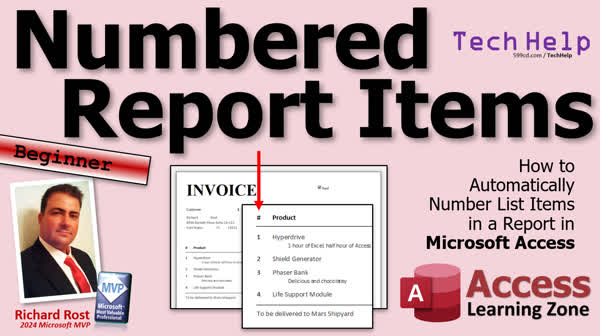
TechHelp Access, number items in reports, invoice report numbering, Access report running sum, numbered lists Access reports, design view report numbering, running sum control source, overall running sum, report design tips, numbered product lists, format report fields, left align Access field, apply running balance, Access report simple numbering, Access report beginner guide, numbered form items preview
More InformationTranscript Welcome to another TechHelp video brought to you by AccessLearningZone.com. I'm your instructor, Richard Rost. Today, I'm going to show you how to put numbers next to items in your Microsoft Access reports. If you've got my invoice report here, you can put little numbers next to each item, customer, product, or whatever you want.
This is a question from Jeremy Singh from YouTube, just to show everybody that you don't have to be a member for me to answer your question. If you give me a good question, especially if it's something that I don't have a video for already, then I will not only answer your question, I'll make a video about it. Jeremy says, "Hi Richard, I googled how to number a list of items on a report, but I didn't get a video of yours. I did get another helpful video though, but I've become spoiled with your tutorials." Thanks. "Do you have anything on this?"
Yes, I do cover this topic, but it's buried in other videos. I've got one like a running balances video where I show you how to do a running balance on a check register, but nothing exactly that shows this and not a video specifically on it. Like I tell everybody, if you Google or search YouTube for something Microsoft Access-related and one of my videos doesn't show up on top, I want to know about it. My goal is to be the number one search result for anything Access-related when it comes to videos.
Let's see specifically how to do this.
Now, I'm going to call this a beginner video because it's really easy to do. It will work with any report and you don't have to know anything fancy. I'm going to show you how to do it nice and simple. As far as prerequisites go, I do recommend you take my Microsoft Access Beginner Level One class first so you understand how to build reports. This is completely free. I'm going to be applying this to my invoicing report. If you want to learn how I built my invoicing system, go watch this video, again, completely free. The technique I'm going to show you today works with any report. You'll find these on my YouTube channel and my website, so go watch those and come on back.
Here I am in my TechHelp free template. This is a free database you can grab a copy from my website if you want to. In here, I've got a customer form, and customers can have orders, and orders can have invoices printed out. Right now, if you look here, each product is just here's a product name, some notes maybe, and the pricing information is over to the right. We want to put numbers next to this stuff.
Let's go into Design View. I'm going to move these over just a little bit. I'm going to draw boxes, just going to touch these guys and slide them over like that so we have room for our number to go right there. You can either copy and paste one of these other boxes from in here, or you can go up to Report Design and grab a new one, and just drop it right down in here somewhere like that. I'm going to delete the label that comes in with it, delete because we don't need it, and we'll just slide this right up into place, right about there. Just so we can see it, I'm going to make sure we bold it.
Now, let's open up its properties. Double-click and go to the All tab first. Let's give it a good name. Let's call this SortOrder or RecordNumber, or whatever you want to call it. In the Control Source, we're going to put in here "=1" just like that, "=1". Now, over on the Data tab, I want you to find Running Sum. There are some different options in here. Let's make it Overall. This means over all the items of this entire report. If you have sorting and grouping on, you can do it by Group. If you don't know what grouping levels are, it's a whole separate video. I'll put a link down below, but I'm going to pick Overall.
Let's slide this product label over and we'll put another product label next. I'm going to copy-paste this one, copy, click paste, and then we'll put this guy right there. I'll change this to a number so you can tell it's a numbered list.
Save it, close it, open it, and there you go. We have some formatting to do, but it's working. I'm going to come back into Design View. Let's click on it and go up to Format. I'm going to drop down Shape Outline and go Transparent, and then maybe we'll Left Align it. Save it, close it, open it, there we go. That looks good. Probably bring it over to the right just a little bit like this, right there. There we go.
Once you know how Running Sum works, then it's easy to understand. You can use it for running balances, like if this instead of an invoice, was a check register. You can use it so over here, you get a running balance with each transaction. I talk about that in this video. What we're doing is setting the value of that box, that text box, to one. As you apply the running balance to it, the running sum to it, with every record it adds one to it - one plus one is two, plus one is three, plus one is four, and so on. That's how that works. It's really simple to implement in reports.
What about a form? What if you have a Customer List Form? These are all auto numbers, and I just added all these in sequence. If you delete a bunch of them in the middle, they're not in sequence. Auto numbers are not for you, but sometimes it's nice to see a nice numbered list in a form. How do you do that? We'll talk about that in tomorrow's video. We'll do numbered form items. It's a little bit more complicated, so I'm going to call it an expert level video. There's no programming involved, but you have to know a couple of functions in order for it to work right. We'll talk about that tomorrow. Reports are pretty easy, so there you go.
Thanks to Jeremy for the question, and that's going to be your TechHelp video for today. Hope you learned something. Live long and prosper, my friends. I'll see you back tomorrow.
TOPICS:
Adding numbers to items in Access reports
Setting properties for report design
Using Control Source with "=1"
Applying Running Sum for Overall
Formatting number display in reports
Adjusting label positions in Design View
Changing Shape Outline to Transparent
Left Aligning text in report fields
Understanding Running Sum mechanics
Implementing running balances in reports
COMMERCIAL:
In today's video, we'll discuss how to add numbers next to items in your Microsoft Access reports. Whether it's customers, products, or any list, we'll make it easy. We'll jump into Design View, show you how to shift elements, and utilize the Running Sum feature to create a numbered list. We won't need anything fancy; it's straightforward enough for beginners. If building reports is new to you, we recommend checking out our beginner course first. Don't miss out on applying this technique to make your reports more organized and professional. You'll find the complete video on my YouTube channel and on my website at the link shown. Live long and prosper, my friends. Intro In this video, I will show you how to add numbers next to items in your Microsoft Access reports by using the Running Sum feature. You'll learn how to set up a simple numbered list on your reports, adjust elements in Design View, set the Control Source, and format the display for a clean look. This technique works for any list in your reports and does not require advanced skills, making it perfect for beginners. Quiz Q1. What is the main topic of the video tutorial presented by Richard Rost?
A. Creating a new database in Microsoft Access
B. Adding numbers next to items in a Microsoft Access report
C. Creating forms in Microsoft Access
D. Importing data into Microsoft Access from Excel
Q2. What prompted Richard to create a video on adding numbers next to items in reports?
A. A comment from Facebook requesting the video
B. A suggestion from an AccessLearningZone.com member
C. A question from Jeremy Singh on YouTube
D. A direct request from Microsoft
Q3. Which Microsoft Access feature allows numbering of items sequentially in a report?
A. AutoNumber
B. RecordSource
C. Running Sum
D. QuickSort
Q4. How does the "Running Sum" feature work when numbering items in a report?
A. It multiplies the existing value by two for each subsequent record.
B. It adds one to each subsequent record.
C. It subtracts one from each subsequent record.
D. It resets to zero after each record.
Q5. According to Richard, what should be the prerequisite knowledge before learning to add numbers to a report?
A. Knowing how to build queries
B. Understanding database relationships
C. Basic knowledge of VBA programming
D. Completion of the Microsoft Access Beginner Level One class
Q6. In what format should you set the "Running Sum" property to number items over the entire report?
A. Specific
B. Detailed
C. By Group
D. Overall
Q7. If you want to remove the label from a newly created box in Design View, what does Richard recommend?
A. Hide it using the Format tab
B. Rename it
C. Delete the label
D. Use a transparent background
Q8. How does Richard suggest making the numbers more visible in the report?
A. Use italics
B. Bold the numbers
C. Increase the font size
D. Change the font color to red
Q9. What topic does Richard mention will be covered in tomorrow's video?
A. Creating advanced queries
B. Numbering items in a Customer List Form
C. Advanced report formatting
D. VBA programming for beginners
Answers: 1-B; 2-C; 3-C; 4-B; 5-D; 6-D; 7-C; 8-B; 9-B
DISCLAIMER: Quiz questions are AI generated. If you find any that are wrong, don't make sense, or aren't related to the video topic at hand, then please post a comment and let me know. Thanks. Summary Today's TechHelp tutorial from Access Learning Zone dives into the process of adding sequential numbers to items in your Microsoft Access reports. I'm Richard Rost, your instructor, and I'll guide you through this simple yet effective technique.
A viewer named Jeremy Singh was looking for a way to number a list of items on a report and reached out for assistance. Jeremy mentioned that he couldn't find a video specifically on this topic in my collection, which prompted me to create one. This is a common request I receive, and if you have a good question that hasn't been covered, don't hesitate to ask. I might just make a video about it!
The technique we're discussing today is straightforward and can be applied to any report without requiring advanced knowledge. However, I do suggest taking the Microsoft Access Beginner Level One class first to understand report building basics. This class and additional tutorials, like the creation of an invoicing system, are available for free on my website and YouTube channel.
Let's begin by applying this numbering technique to a sample invoicing report from my TechHelp free template database. This database is available for download on my website. Within the database, I have a setup where customers can place orders, and invoices can be printed. Currently, the products are listed with their names and other details, but without any numbering.
To add numbers, switch to Design View, and adjust the layout to create space for the numbers. You can duplicate existing text boxes or add a new one from the Report Design options. Once you've placed your box, remove any unnecessary labels and format it appropriately. It's crucial to name it, perhaps something like SortOrder or RecordNumber, and set its Control Source to "=1". Then, activate the Running Sum property under the Data tab, selecting the Overall option to count items across the entire report.
By incorporating this, you create a text box where numbers increment for each record - simply saving, closing, and reopening the report shows the result. Additionally, configuring the format, such as transparent outlines and left alignment, can finalize the appearance.
Understanding Running Sum helps a lot. This feature isn't only for numbering; it can also track running balances, which I cover in other videos. Setting the text box value to one causes the Running Sum to increment it for each listed item, creating a sequential list.
If you're interested in numbering items on a form, such as a Customer List Form, that's a bit more complex and will be discussed in tomorrow's video. It is more than just programming; some familiarity with functions will be necessary for implementation.
Thank you, Jeremy, for the insightful question, and that's today's TechHelp tutorial. For a complete video tutorial with step-by-step instructions on everything discussed, visit my website at the link below. Live long and prosper, my friends. Topic List Adding numbers to items in Access reports
Setting properties for report design
Using Control Source with "=1"
Applying Running Sum for Overall
Formatting number display in reports
Adjusting label positions in Design View
Changing Shape Outline to Transparent
Left Aligning text in report fields
Understanding Running Sum mechanics
Implementing running balances in reports Primary Topics Microsoft Access reports, numbering report items, report design, control properties, Running Sum feature, report formatting, textbox control, overall vs group sum
Secondary Topics running balances in reports, customer forms, grouping levels
|






