I've been thinking a lot about certainty lately. Not knowledge, not confidence, but that absolute, carved-in-stone belief that you're right and the rest of the universe is wrong. The more I watch people argue about everything from politics to diet hacks to whatever new nonsense is floating around on social media, the more I realize certainty is one of the most dangerous things a human can cling to. It feels comforting, like a warm blanket over your brain, but it shuts down curiosity, blocks new information, and turns your worldview into a locked door instead of a window.
A few days ago I made the mistake of replying to a moon landing denier online, and once they locked into their belief, no amount of physics, photos, or independent verification mattered. I showed data, explained the logic, pointed at the evidence, and none of it made the slightest dent because certainty had already sealed the hatch. At that point you're not debating facts. You're debating ego, and ego rarely surrenders. (1)
This shows up in the tech world all the time. I've lost count of how many consulting calls I've taken where someone is convinced Access can't do something that it absolutely can do, or that their database is fine and the problem must be with Windows, or their network, or gremlins. Sometimes the fix is as simple as setting a relationship, but certainty blinds them to even checking. It's amazing how fast a problem clears up when someone finally says, "OK, show me."
You see it in business too. Managers who are certain their strategy's perfect even though the numbers say otherwise. Team leaders who dig in on a bad idea because changing course would mean admitting they were wrong. I've watched entire projects sink because one person clung to certainty like it was a life raft. In reality it was an anchor, and unfortunately no one on the team was qualified to cut the rope.
In politics and society, certainty gets even more toxic. People cling to beliefs handed to them by their party or their favorite talking head, and they treat those beliefs as unshakable truth instead of opinions. It's especially bad when science enters the picture. The moment a belief contradicts evidence, that belief should be up for revision, not immortalized. But too many folks treat science like a buffet line where you only take the desserts and skip the vegetables, or the picked cherries, as it may be. Certainty turns learning into heresy and makes honest discussion impossible. You can't reason someone out of a belief they were never reasoned into in the first place.
Fitness is another fun one. I've watched people swear that their magic diet will save the world while everyone else is doing it wrong. Keto warriors, seed oil crusaders, cardio only purists, you know the type. They treat their plan like a religion. These are the same folks who think eating one donut means they need a three day juice cleanse. But the body doesn't care about ideology. It cares about calories, nutrients, movement, and consistency. Certainty here is just another trap that keeps people from doing what actually works.
Philosophically and spiritually, certainty gets even trickier. I'm not here to tell anyone what to believe about life, gods, or the universe, but the moment certainty turns into weaponry, we lose the ability to coexist. The Religious Right loves that kind of certainty. So does every autocrat throughout history. When your belief system tells you there's no room for doubt, you stop listening. Doubt isn't weakness. Doubt is how you learn. I'd rather have questions that can't be answered than answers that can't be questioned.
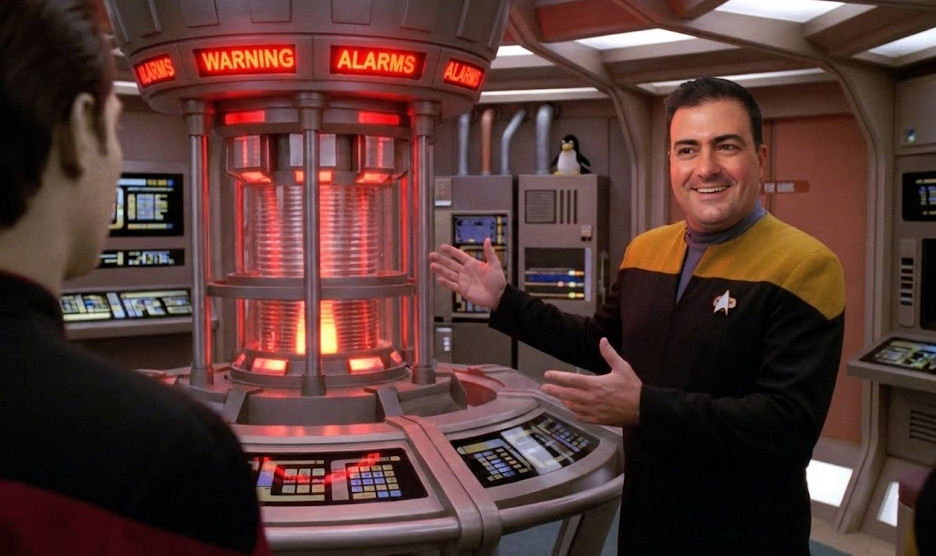
It reminds me of the Titanic. Certainty is the mindset that says a ship is unsinkable because everyone involved insisted it had to be. In the movie they even brag, "God himself could not sink this ship." That's the same kind of confidence you see in an over-confident Starfleet engineer who swears his warp core is perfectly tuned while the warning lights are flashing like a Christmas tree. Certainty tells you to ignore the alarms. Curiosity tells you to actually check the readings.
At the end of the day, I think curiosity beats certainty every time. Certainty freezes you. Curiosity moves you. Certainty shuts the door. Curiosity opens it. I'd much rather live in a world full of people who say, "Show me," instead of people who say, "I already know."
(1) Here's the short list of all the reasons why we know the moon landing wasn't faked: we have retroreflectors still sitting on the lunar surface that anyone with the right equipment can bounce lasers off of, we have telemetry data recorded by multiple independent tracking stations around the world including ones not controlled by the United States, we have rock samples with chemical signatures that don't match anything on Earth, we have thousands of engineers and contractors whose work records, schematics, and test logs line up perfectly across unrelated organizations, we have photographs and video that show lighting, shadows, dust behavior, and vacuum physics that can't be reproduced on Earth, and we have modern high resolution images from lunar orbiters showing the landing sites, tracks, and equipment exactly where they were left. Even hostile foreign governments at the time tracked Apollo and never disputed it, because the evidence was obvious to anyone with basic science literacy.
I'm sure Gracce Hopper had her fair share of naysayers. I had two old-school bosses tell me my dreams for a db shell were impossible. They thought the klunkers they wrote were as state-of-the-art as any user might ever want.
Now that I think about it, I might have the same mindset, but at least I'm open to new ideas and that's why I like this site. A constant barrage of ideas that make me go hmm.
Michael Olgren
@Reply 9 months ago
I think this is the most important problem of our time. What can you do with masses of people locked into certainty in beliefs that worsen society? One facet: if I am certain that Finns [I am of Finnish heritage] are a murderous, drug-dealing scourge of the US, and will do anything and everything to remove them… where does that leave our society? What can you do with tens of millions of people who are locked in to a similar belief/certainty and support actions committing atrocities against said people?
Michael That hits the heart of the problem. Once a big group of people locks into a belief that paints some other group as dangerous or less-than-human, you stop having a disagreement and start having a public safety issue. And it always starts the same way: a group gets singled out. We literally saw that yesterday with the president's comments about Somali refugees and people of Somali descent living here. I'd say the exact same thing no matter which public figure said it. You can't paint an entire population based on heritage. That's not analysis. That's prejudice, pure and simple. And this isn't a dig at Trump. I'd call out anyone who made such comments.
It's the same deal with the guy who shot those National Guardsmen. He happened to be from Afghanistan. That doesn't mean all Afghans are a threat any more than one criminal of Finnish descent makes all Finns dangerous. What's next? All Black people? All Native Americans? Once you buy into that logic, there's no end to the list of groups you can deem suspicious.
My mother's side is all Italian, so if we followed that same twisted logic, I guess that would make me a mobster by default. Or part of some shadowy organized crime ring. And on the flip side, does that automatically mean I know how to make the world's greatest lasagna or a perfect cannoli? Heritage doesn't dictate character, morality, or skill. It's just where your ancestors happened to come from.
My father's side is mostly of German descent. Yes... Italian + German. Add your own prejudice here. LOL.
Now, it's different when you're talking about choices. Political affiliation is a choice. If someone says they're a Republican or a Democrat or a libertarian space pirate, I'm going to assume certain tendencies because those are chosen identities baked around stated beliefs. You sign up for that worldview. But skin color, ancestry, national origin... nobody chooses those. Treating those as moral indicators isn't just inaccurate. It's straight-up prejudice.
Religion's a little trickier. Yes, as an adult you can choose to join a religion or leave one, but most people start out simply absorbing whatever they were raised with. When something's been presented as absolute truth since childhood, it's understandable that someone might carry those beliefs for a long time without ever questioning them. Because of that, I try not to make assumptions about a person based on their religion alone. It's only when someone uses their beliefs as a weapon, coming at me with fire and brimstone, that I push back. But even then, I'm responding to the behavior, not the label.
The scary part is that you can't reason with certainty once it's taken hold. You can only hope to chip away at it by creating environments where doubt is safe and curiosity isn't punished. If someone is convinced that some group is an existential threat, that belief didn't come from evidence. It came from identity, fear, and repetition. Once people tie their self-worth to a belief, they hang onto it tightly.
What do we do with tens of millions of people like that? Honestly, the only thing that works long-term is slowing the spread. You fight bad ideas the same way you fight bad code: you refactor the environment, you limit the damage, and you introduce better models bit by bit. You're not flipping the ones already locked in, but you can keep the next generation from falling into the same trap by teaching them to question things before they calcify. Education is key.
When I write something here or on social media, my goal is to present evidence and build my opinions on it. There are very few things I go with on gut alone. I try to follow the science wherever I can. And honestly, I'm not writing for the hardcore moon landing denier or the committed anti-vaxxer or the folks who see conspiracies and chemtrails in every cloud pattern. They're not my audience. I'm writing for the people who are unsure, the ones who hear a claim and think, well, maybe there's something to that. Those are the folks who can still be reached with clear evidence and a little patience. I try to offer what I think of as micro-inoculations, small bits of information and perspective that help people think a little more critically each time. I'm not trying to turn anti-science diehards into astrophysicists. I'm just trying to give the fence sitters a sturdier foundation. Maybe come over to the side of reason. We have better beer. :)
Certainty's a hell of a drug. Doubt and healthy skepticism are the antidotes. The trick is getting people to see that doubt isn't a threat. It's the thing that keeps it from going off the rails.
Matt Hall
@Reply 9 months ago
I think we, as a society, have embraced ignorance for a couple of decades now. I think the model of adopting an emotionally based position vs a fact based opinion has become kind of mainstream. That impedes the ability to hold a rational debate or even consider that the "enemy" may even have any valid point to make.
I have a 70+ year old family member, whom I love and respect, ask once, "How can you vote for that person?!" After I answered, I got a measured, "Oh, I guess I can see that.". I didn't persuade her politically but I did demonstrate a rational and thoughtful consideration behind my position. We share opposing views, but we listen. That is what is missing. That is what I enjoy here.
Richard, you are absolutely right about about groups of people painting other groups as less than. For years we have witnessed this happening live, in the public square as anti-vaxxers, snowflakes, deplorables, low information voters, tea-baggers, etc. As a people, we have to figure out how to love our country more than we hate each other. "United we stand, divided we fall."
Thomas Gonder
@Reply 9 months ago
I've been supporting the German/Italian mafia for three years now?!!!
I sit politically in the middle, not really supporting any side becuase, well, I haven't seen a middle-of-the-road candidate since, umm, I don't know when? There is a young guy in social media, the left counter-point I suppose to Charlie K. I love to hear how dozens of supposedly informed and professional (USA) Americans, the most recent being a claimed CFO, say the tarrifs are paid by foreign governments! Heaven (putatively) help us.
Sorry, only students may add comments.
Click here for more
information on how you can set up an account.
If you are a Visitor, go ahead and post your reply as a
new comment, and we'll move it here for you
once it's approved. Be sure to use the same name and email address.
This thread is now CLOSED. If you wish to comment, start a NEW discussion in
Captain's Log.