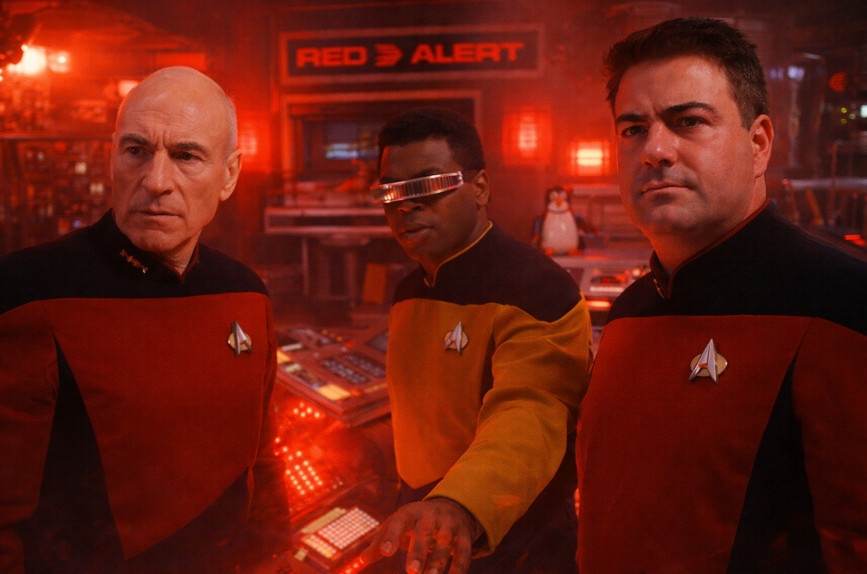
I have noticed that even those who assert that everything is predestined and that we can change nothing about it still look both ways before they cross the street.
This morning's reflection came to me the way many of them do. Coffee in hand. News feed scrolling. Brain booting up somewhere between "system check" and "engage warp drive." And then I hit a headline that made me stop mid-sip and just stare at the viewscreen.
The current administration has reversed the EPA's long-standing "Endangerment Finding" on greenhouse gases. In plain English, that's the official scientific determination, first made in 2009, that greenhouse gases like carbon dioxide and methane pose a danger to human health and the environment. That finding wasn't based on opinion. It wasn't based on politics. It was built on decades of atmospheric data, epidemiology, climate modeling, and peer-reviewed research. In other words... actual science.
And here's the key point that keeps echoing in my head: this isn't some unresolved debate in the scientific community anymore. Among climate scientists, the role of greenhouse gases in driving climate change is settled science. You'll always find outliers. You can find someone who thinks the Earth is flat too, but the overwhelming consensus, backed by measurable data, is clear. Greenhouse gases trap heat. Rising concentrations correlate with rising global temperatures. That warming has downstream effects on weather, oceans, agriculture, and public health.
So when a policy decision comes along and effectively says, "We're no longer recognizing that scientific conclusion," it's not just regulatory change. It feels like looking at a warp core breach alarm and deciding the computer is being dramatic.
Now, I try very hard not to turn this platform into partisan space politics. I've got students across the entire political spectrum, and that's exactly how it should be. You can believe whatever you want about taxes, spending, regulations, or the proper size of government. Reasonable people can disagree on policy outcomes all day long.
But science isn't supposed to be partisan. Science is the operating system everything else runs on.
And that's where this one sticks in my craw, because computers, databases, and software development, the stuff we do here every day, are built entirely on scientific principles. Boolean logic. Electrical engineering. Semiconductor physics. Error detection. Mathematical modeling. You don't get to vote on whether binary works. Imagine trying to run Access on "feelings" instead of structured query logic. Your SELECT statements would return whatever the server felt like giving you that day.
That's not how reality works. The scientific method is why your code compiles, your GPS knows where you are, and your backups restore when things go sideways. We test hypotheses. We gather data. We replicate results. We refine models. That process is the closest thing humanity has to a universal debugging tool.
And when I look at this EPA reversal, it doesn't feel isolated. It feels like part of a broader pattern we've seen over the years. Climate regulations rolled back or weakened. International climate agreements abandoned or sidelined. Scientific advisory panels reshuffled or reduced. Environmental monitoring and research programs cut back. Pollution and chemical exposure limits loosened in certain sectors. Public rhetoric that frames established science as optional, exaggerated, or politically motivated.
You can argue the economics of any one of those decisions. You can argue regulatory burden. You can argue industry impact. Those are valid policy conversations. But dismissing or overriding the underlying science itself? That's where it veers into "we're ignoring the sensors because we don't like the readings." On the Enterprise, if Geordi tells Picard the hull integrity is down to 20%, Picard doesn't say, "Well, let's get a second opinion from someone who doesn't believe in hull breaches." He orders repairs. Because physics doesn't negotiate.
That's really the heart of today's log. This site, this community, everything we do here, is rooted in scientific thinking. You build and test your database. You validate your inputs. You verify your outputs. You trust repeatable results over gut instinct. That mindset is what makes someone a good developer, a good troubleshooter, a good systems architect.
You don't fix bugs by ignoring error messages. You don't optimize performance by pretending metrics don't matter. And you don't advance civilization by sidelining the scientific method when it becomes politically inconvenient.
Now, I'm not saying science has all the answers and that it's perfect. It doesn't, and it's not. Science is iterative. Models improve. Data gets refined. Conclusions get updated as new evidence comes in. That's the strength of it, not the weakness. It self-corrects. It's the best thing we've got for understanding the universe and how things work.
But throwing out a 17-year scientific foundation that's only grown stronger with time? That feels less like refinement and more like unplugging the computer because you didn't like what was on the screen. At the end of the day, whether you're writing code, building databases, or piloting a starship, reality still runs on the same core engine: evidence, measurement, and reproducibility.
Ignore that engine long enough... and eventually something critical stops working.
I love that I've been putting penguin easter eggs in pictures for YEARS and people are just now starting to notice them. LOL. It's part of my standard prompt. I haven't been putting them in EVERY picture, but a lot of them.
Sandra Truax
@Reply 7 months ago
I've got to admit, I've never noticed the penguins, but I just went back through I don't know how many of your posts in the Captain's log, just looking at your pictures and hunting the penguins. It's like a game of "Where's Waldo?" only with penguins!
Michael Olgren
@Reply 7 months ago
Richard This is my greatest despair. I would argue that close to half of all Americans simply choose to disbelieve science. And there is no way to change that because if someone doesn’t believe in facts/science, then persuasion with a rational argument is futile. This is why power has been allowed to be concentrated (per you previous log).
Matt Hall
@Reply 7 months ago
When we presume "everyone who disagrees with me is just stupid", we lose the ability to see any competing perspective. Modern politicians have leaned into this thought process recently, for political benefit. That is the entire point of terms like climate-denier, anti-vaxxer, or flat-earther. It is just a way to call anyone who disagrees stupid and also refuse to hear their point of view.
I think that some of what is presented as "science" is actually power pursuit, thinly disguised as scientific finding. Much of this is done through dis-ingenuous funding, by power-seekers funding entities that reliably return findings favorable to the cause of helping them accumulate more funding and power. It seems like many of the "climate" science determinations are oddly attached to massive spending initiatives.(Green New Deal) Also odd, is that to address global climate issues some countries are obliged to comply and others are not. "Global", to me, would imply that everyone need to be involved, unless there is another purpose. It is up to us to try to sift the junk out.
The rules being eliminated actually remove considerable power from the EPA to regulate entire industries into or out of business. In my mind, decisions of this magnitude need and deserve to be openly debated by people who are accountable to the voter.
In my opinion, this is part of the current effort to reduce the concentration of power in the federal government and force these issues to be debated publicly and fairly, before they are implemented.
As someone who supports this, it is because science told me that carbon dioxide is kind of important for sustaining photosynthesis. Yes, it is a waste gas from animals but also a consumable for plants.
The "determination" that CO2 - the stuff we breathe out - is dangerous to humans, was made by the EPA, which only had the authority to do so because they gave themselves that authority. To me, that is a naked power grab and was wrong when they did it.
In short, its not because I don't believe in science but because I do believe in corruption and power hunger. I just believe someone can be a scientist and also corrupt.
In the same vain, I concede that it is possible that I could be wrong or right, and also stupid. ;)
Michael Olgren
@Reply 7 months ago
Matt I'm not sure either Rick or I are calling anyone stupid. I bemoan the folks who choose to ignore piles of scientific evidence. Yes, some studies on Product X have been funded by the companies that make Product X. Who else will fund them? [Answer "the government" if you'd like to throw me into a convulsive laughing fit]. Those studies are reviewed by experts, who yes, are not infallible. However, when a study on something like climate change is repeated literally dozens of times and agreed upon by over 93% of experts in the field, we have to hold that as "truth" until something clearly better come along.
You only have to look at Dr. Oz, literally begging people to get vaccinated for measles now that thousands of (primarily kids) are suffering, to see what the FAFO crowd has engendered by convincing people NOT to vaccinate. At least he is manifesting a glimmer of conscience.
“Take the vaccine, please,” Dr. Mehmet Oz, administrator of the Centers for Medicare & Medicaid Services, said during an interview on CNN’s State of the Union. “We have a solution for our problem.”
Michael, I think you summed up the persuasion problem pretty well. There's an old saying that fits here: you can't reason someone out of a position they didn't reason themselves into. If someone's conclusion is rooted in identity, tribe, or emotion instead of evidence, throwing more data at them usually just makes them dig in harder.
Matt, I actually agree with part of what you're saying. There absolutely have been bad actors funding research to serve their own interests. The tobacco industry is the textbook example. For decades they bankrolled "studies" designed to muddy the waters about smoking risks. So yes, corruption can exist in science because scientists are human, and humans are susceptible to money and power like anyone else.
Druish princesses are often attracted to money and power, and I have both... and you know it!
And you're also right that there are industries today that stand to gain financially from climate policy. There's a lot of money circling green energy, carbon markets, and infrastructure spending. It would be naive to pretend otherwise. Whenever government money is involved, opportunists show up. That's just reality.
But where I draw the line is when we move from "some research may be biased" to "the entire scientific consensus is suspect." When you're looking at 90+ percent agreement across independent institutions, countries, methodologies, and decades of replicated data, it becomes much harder to dismiss that as coordinated corruption. At that scale, consensus isn't manufactured, it's emergent.
On the global participation point, I actually agree with your instinct that everyone should be involved. The logic behind developing nations getting looser requirements is largely economic. Industrialized countries like ours built wealth during eras when we burned coal with abandon and had minimal environmental regulation. Telling developing nations they can't go through similar growth phases without providing affordable alternatives creates a fairness and feasibility problem. I don't necessarily love that tradeoff either, but that's the policy rationale.
And yes, I also agree that decisions of this magnitude should NOT rest in the hands of a single executive office. I wrote about that here. There's too much unilateral power concentrated in the presidency. Major regulatory reversals or scientific determinations that affect the entire economy should involve Congress. Granted, watching Congress function lately doesn't exactly inspire confidence, but structurally that's where this kind of debate belongs.
On the CO2 point, you're absolutely right in the narrow biological sense. Carbon dioxide is essential for photosynthesis. Plants need it. We exhale it. Without it, terrestrial plant life collapses. No argument there.
The issue isn't the existence of CO2, it's the concentration. The dose makes the poison. Study after study shows that increased atmospheric CO2 enhances the greenhouse effect. The atmosphere acts like an insulating layer, trapping heat that would otherwise radiate into space. Methane compounds that effect even further. At extreme levels, greenhouse warming can become self-reinforcing. Venus is the classic example of a runaway greenhouse environment, though Earth is nowhere near that scenario and won't be in any timeframe relevant to us.
There's also a deep-time perspective that's fascinating. Early Earth's atmosphere was indeed heavily CO2-dominant with very little oxygen. When photosynthetic organisms evolved, they began releasing oxygen as a metabolic byproduct. At the time, oxygen was toxic to most existing life. It triggered what's called the Great Oxidation Event, wiping out huge portions of anaerobic organisms. Over time, life adapted, and oxygen became foundational for complex biology.
So atmospheric composition has absolutely shifted over geological time. But those shifts occurred over millions of years, giving ecosystems time to adapt. The concern today is the rate of change compressed into centuries, or even decades.
And just to be clear, I'm not calling anyone here stupid, and I don't think Michael was either. If you're participating in this community, building databases, writing code, troubleshooting logic problems, you're exercising analytical thinking by definition. No one here is stupid.
My frustration isn't with people who don't know something. A lack of education or understanding is fixable. I teach for a living. That's what I do. I love teaching people new things. My issue is with willful ignorance, the conscious rejection of evidence because it conflicts with ideology or talking points.
A lot of folks have been conditioned to distrust expertise altogether. "Don't listen to scientists, they're elitists." But science is hard. Climate modeling, epidemiology, atmospheric chemistry, these are complex fields. It's easier to absorb a sound bite from a pundit than to read peer-reviewed research.
The vaccine example Michael brought up is a perfect modern case study. When I was a kid, childhood vaccination wasn't controversial. You went to the doctor, they said it was time for MMR, you rolled up your sleeve. No Facebook debates. No YouTube rabbit holes. It was just standard public health practice that saved millions of lives.
I'm not a mechanic, so when my mechanic tells me a timing belt needs replacing, I don't argue torque ratios. I trust domain expertise. Same principle applies to medicine and science. (1)
None of this means scientists are infallible or incorruptible. Skepticism is healthy. Scrutiny is necessary. But skepticism should scale with evidence. When the overwhelming weight of replicated research points one direction, dismissing it outright isn't critical thinking, it's selective acceptance.
And unlike the trope in sci-fi movies, where the lone mad scientist is the only one who sees the asteroid coming, real science moves through collective validation. If the planet were facing an extinction-level threat, it wouldn't be one guy yelling into the void. It would be thousands of independent sensors all lighting up the same warning panel.
That's the system working as designed.
LLAP
RR
(1) And just to clarify, when I say I trust domain expertise, I mean it both ways. I don't argue with professionals in their field when they've put in the study time I haven't. I haven't rebuilt an engine, so I listen to my mechanic. I haven't gone to medical school, so I listen to my doctor.
Which reminds me of a funny moment from years back. I was sitting at a bar after a softball game with the guys. One of the newer players, didn't really know me, had no idea what I did for a living, starts telling me about some Excel thing he was doing at work. I don't remember the exact details now as this was 20 years ago, but DLookup was definitely part of the conversation.
At first, I did try to explain where he was going wrong. Not in a condescending way, just conversationally. "Well, actually, the function works more like this..." That kind of thing. But he wasn't having it. He kept cutting me off, talking over me, doubling down, explaining his method like it was carved into stone tablets. Absolute confidence. Zero interest in hearing a different perspective. And I remember sitting there thinking, "This guy is completely backwards... and he refuses to listen to me."
So eventually I just stopped correcting him. I nodded. "Yeah... yeah... interesting... uh-huh." I basically let him hang himself with his own rope. Finally, toward the end of the conversation, I said something along the lines of, "Well, if you ever want to really learn how to do that properly, you might want to swing by Barnes & Noble and pick up a copy of my book on Excel."
The look on his face when he realized he'd just spent ten minutes arguing with a published Excel author was priceless. Like watching someone passionately debate football strategy... and then finding out they're talking to John Madden halfway through the wings.
Moral of the story: sometimes the loudest confidence comes from the shallowest pool of understanding. And sometimes... it pays to know who's sitting on the next barstool before you dig in.
Matt Hall
@Reply 7 months ago
Michael I sincerely apologize for being unclear. I never meant to insinuate any disparagement by anyone. Any self deprecating comments were voluntary. :)
I was just pointing out that instead of exploring diverse opinions, contemporary politics and media has embraced simply dismissing the person. For example, someone might exhibit skepticism about their infant needing a hepatitis vaccine at 2 days old. They then get labeled as an "anit-vaxxer". This is not intended to explore and/or allay their concerns but to dismiss the person. Another play is to intentionally conflate skepticism with argumentativeness. An argumentative person just wants fight. A skeptic is a person with questions seeking answers. I have met very few professionals unwilling to provide answers to questions. I have met charlatans that fear questions as they are a threat of exposure. I was just trying to suggest that people's differences of opinion might be more rational than the treatment modern politics and media prescribe. Skepticism is not arguing, it is seeking answers.
Contemporary politicians and media outlets have taken to using "science" as a shield for their positions while also demanding zero skepticism or scrutiny. How can any government allow for the requisite skepticism and scrutiny while also creating a "Disinformation Governance Board"?
To me, there is wisdom in disconnecting the entity that stands to gain power from research findings (EPA) from the financing of scientific research and the entities that perform that research. The power the EPA derived from that determination about CO2 it gave itself in making that determination. It's worth noting that, divesting power from the EPA is divesting power from the executive branch. In my mind, the attempts to scale back these executive offices, is an admission of excess power concentrated in the executive branch and tangible attempt to correct that, by the executive branch.
Many people have a pretty keen sense of when they are being played. Like Richard, many of them won't necessarily call an entity out on their behavior. They just lose respect in that entity.
Richard rightly points out: "None of this means scientists are infallible or incorruptible. Skepticism is healthy. Scrutiny is necessary. But skepticism should scale with evidence." I would go a step further and say that skepticism should also increase with the size of the sacrifice.
The differing opinions may not be so simple as people choosing to be ignorant. They may be differences in the personal trust requirements based on what they are being asked to sacrifice.
If you are a Visitor, go ahead and post your reply as a
new comment, and we'll move it here for you
once it's approved. Be sure to use the same name and email address.
This thread is now CLOSED. If you wish to comment, start a NEW discussion in
Captain's Log.