And you know what really drives me absolutely bonkers? Those viral math problems people post on social media just to stir the pot. You've seen them: a string of numbers and symbols with no context, followed by "Only geniuses can solve this!" or "90% will get this wrong!" And sure enough, the comments are filled with people confidently defending the wrong answer like it's a hill they're willing to die on. You can practically hear the echoes of middle school math lessons they slept through. And when someone tries to explain the actual order of operations, they get downvoted or told they're "overthinking it." No, Karen, it's not overthinking. It's math. It has rules.
Let's test your math brain for a second. What do you think about this one?
8 + 2 x 5
Just do it in your head. Got it?
Okay, how about this one: (1)
100 / 10 x 2
Feel good about it? One more:
12 / 3(2)
Yeah. That one. If you're like most people, at least one of those tripped you up. Maybe all three. And don't feel bad if they did, because even some math teachers argue over how to interpret that last one. But there's a reason these confuse people: they look simple... and they're designed to take advantage of how poorly we remember something we all learned in 5th grade.
Let's talk about PEMDAS. (2)
Most people were taught it as a way to remember the order of operations in math:
P - Parentheses E - Exponents M - Multiplication D - Division A - Addition S - Subtraction
But here's where things go sideways: the acronym PEMDAS is misleading.
People think it means:
- Do all the P's, then all the E's, then all the M's, etc. - M comes before D, and A comes before S.
Wrong.
In reality, M and D are on the same level, and you do them left to right. Same with A and S.
So it really works like this: Parentheses first, then exponents, then multiplication or division (left to right), then addition or subtraction (left to right).
It should be written as PE(MD)(AS) or:
P - Parentheses E - Exponents MD - Multiplication & Division AS - Addition & Subtraction
Let's go back and break those three problems down.
First one: 8 + 2 x 5 If you added 8 + 2 first to get 10, and then multiplied by 5 to get 50, sorry. That's not how it works. Multiplication comes before addition. 2 x 5 = 10 8 + 10 = 18 18 is the correct answer.
Second one: 100 / 10 x 2 If you divided 100 by 10 to get 10, and then multiplied by 2 to get 20, nice job. That's the correct way. But if you did 10 x 2 = 20 first and then 100 / 20 = 5, nope. Multiplication doesn't come before division. They're equals. You go left to right.
Third one: 12 / 3(2) Now this one causes chaos. Some people treat 3(2) like a grouped expression, like 3 x 2 stuck inside invisible parentheses. That leads them to say: 12 / (3 x 2) = 12 / 6 = 2
But according to the standard interpretation of order of operations, there's no parentheses enclosing that denominator. So: 12 / 3 = 4 Then 4 x 2 = 8 So the correct answer is 8. 3(2) is just shorthand for multiplication. The parentheses are only making it look grouped. They're not actually doing anything.
Still not convinced? If that were meant to be grouped, it would be written: 12 / (3(2)) or better yet, it should be written: 12 / (3 x 2)
Ambiguity is the real enemy here. And that's a problem not just in math, but in writing, programming, and logic in general. The human brain hates ambiguity. But you have to recognize it before you can fix it.
Let's do a few more, just for fun.
6 - 3 + 2 A lot of people think subtraction always comes last. Wrong again. Subtraction and addition are equals, so we go left to right: 6 - 3 = 3, then 3 + 2 = 5
20 - 5 x 2 Multiplication first: 5 x 2 = 10 Then 20 - 10 = 10 Not 30.
10 + 4 / 2 4 / 2 = 2 Then 10 + 2 = 12
One more, just to show how this creeps into the real world...
Say you're doing your monthly budget, and your spreadsheet has this formula:
=Income + TaxRate * Income
If you don't use parentheses, Excel will multiply TaxRate x Income first, then add it to Income. That's fine if you're calculating total with tax added. But what if you meant to apply the tax after subtracting some deductions? Now you have to be explicit:
It's the same logic Access uses in calculated fields. You want to be crystal clear about how things evaluate, or your results could be quietly wrong.
Bottom line: PEMDAS is not a list. It's a hierarchy, with tie-breakers.
Parentheses and exponents are strict rules. But multiplication vs. division? Left to right. Addition vs. subtraction? Same.
If you're ever in doubt, write in more parentheses. Clarity beats cleverness.
And if you think this only matters in math class... think again. Misunderstood rules lead to miscalculated budgets, broken Access formulas, and yes, even arguments over what a formula like 12 / 3(2) really means.
What do you think? Should we go deeper into some real-world examples in Access next time? Or do you want me to test you with a few more PEMDAS puzzles?
Let me know in the comments. And double-check your math before you hit Enter.
(1) For those of you non-programmers, the forward-slash / is used to represent division in most programming languages. I prefer using it instead of the division symbol because... well... reasons. LOL
(2) Some of you may have learned it as BODMAS: Brackets, Orders, Division, Multiplication, Addition, Subtraction. Same thing, different terminology, more British.
P.S. And yes, I'm literally writing this Captain's Log post so that any time I see some dumbasses arguing over a math problem on social media, I can just post a link to this. SMDH.
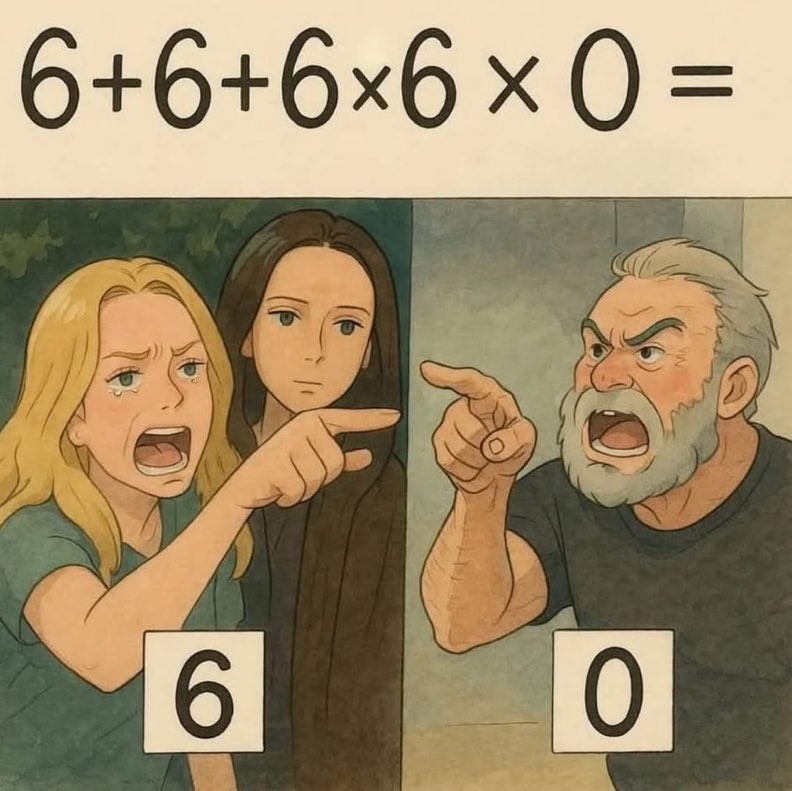
P.P.S. Do you know what the answer to the equation in the picture is? If so, post it below.
My second degree is in Applied Mathematics and Computer Science. I can do math, it's arithmetic that gets me every time.
Add left-handed dyslexia on top of that, and I am useless with adding, subtracting, multiplication, and definitely division. I am totally useless.
Jeffrey Kraft
@Reply 9 months ago
There are a lot of people that forget about PEMDAS and go left to right period... including my wife, whose father taught math at a college I went to. I have been burned on the M & D part if they are on the same line a few times.
The answer is the same as the number of videos available at this time on Fitness Database 14
3/1 = 3 2*2 = 4. Now it's 7 + 3 + 4 which = Fitness Database 14
Bill Carver
@Reply 9 months ago
the answer is x
Thomas Gonder
@Reply 9 months ago
How about "solving" something in these social media posts that isn't an equation? Aggghhhh!
Thomas Gonder
@Reply 9 months ago
Sami Don't worry, a lot of modern calculators can't get it right either.
Jeffrey Kraft
@Reply 9 months ago
Thomas That is why I sometimes say get a programmable calculator (Scientific) or launch Google Sheets, or Excel (granted neither sometimes gets it right either).
Anybody want to solve this one? Answer in the details...
DetailsThe answer is 30.
That first part, "5 5/5" is a mixed number (5 and five-fifths). Here's how PEMDAS applies:
1. Simplify the fraction: 5/5 = 1
2. Add to the whole number: 5 + 1 = 6
3. Multiply by the last 5: 6 x 5 = 30
So the answer is 30.
If you didn't recognize the mixed number and treated it strictly as written without spacing context, the math might be interpreted differently, but in normal math notation, this is 30.
Simplifying a complex number actually comes before PEMDAS.
PEMDAS tells you the order in which to apply operations, but before that, you're expected to interpret the notation correctly and simplify any implied values - things like mixed numbers, fractions, and radicals.
Here's how it fits in:
A mixed number like 5 5/5 isn't an operation to perform later. It's shorthand for 5 + (5/5), so you rewrite it first.
Once rewritten, you can apply PEMDAS: first division (5 / 5), then addition (5 + 1), then multiplication by the other 5.
It's kind of like "step zero" in PEMDAS - clarifying and simplifying the notation before running the order of operations.
Think of it like this, if the value was "5 1/2" you would have easily known to replace that with "5.5". Since they used "5 5/5" instead of just writing "6", the goal was to trick you.
But still, I've seen computer programs come down to this kind of an equation, so you still need to know it, watch for it, and know how to handle it.
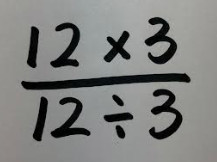
Here's another one that messes people up. Care to take a stab at it? Answer in the details...
DetailsThe horizontal fraction bar means the numerator and denominator are handled as separate expressions first, following the order of operations within each.
Numerator: 12 x 3 = 36
Denominator: 12 / 3 = 4
Then 36 / 4 = 9
So the final answer is 9.
So I guess it really should be SPEMDAS...
S - Simplify Fractions
P - Parentheses
E - Exponents
MD - Multiplication & Division
AS - Addition & Subtraction
Treat the numerator and denominator as if each is inside its own parentheses. Then once both are simplified, perform the division between them.
I saw so many people online arguing (wrongly) that the problem was really:
Details12 x 3 / 12 / 3
which would have been:
36 / 12 / 3
3 / 3
1
which is of course wrong.
The Dunning-Kruger Effect is strong in people. Can't blame them though. Our US public education system has gone to shit in recent decades.
Jeffrey Kraft
@Reply 8 months ago
My wife would have gotten that one wrong likely. Sad part is her dad was a college math instructor. I solved it and m my math skills at the wrong time become nill. I agree tha the US education system has gone to heck. Even when I was in school going back to the 70's.
Matt Hall
@Reply 8 months ago
Richard The confusion in 5 5/5 + 5 question comes, in part, from the ambiguity in multiplication. We can use an "x", "*", interpunct, parenthesis, and sometimes nothing at all to infer multiplication. For example, replace some of the numbers with variables and the operations look different. E.g., 5 A/B +5. To be more obvious, replace 5/5 with a variable and it becomes 5A +5.
Since variables represent numbers and not operators, we can know that the operations can be context sensitive. While I agree with your answer, I can also see where someone becomes confused. I understand that this is why you are explicit in creating your math functions while programming, instead of relying on knowing how access handles ambiguity.
In my opinion, it's the responsibility of the person writing the equation to be as clear as possible. A lot of these equations that you see on social media are just gotcha questions trying to confuse people. But the problem is they're not written very clearly. That's why I will sometimes overuse parentheses in the equations that I write in my programming, and my Excel formulas, and so on.
Donald Blackwell
@Reply 8 months ago
Richard great as long as it doesn't get to where you have more parentheses than number, variables, etc, like access sometimes does in its SQL
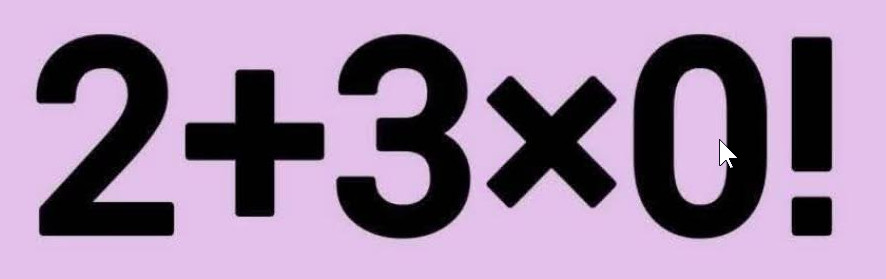
Anybody want to take a stab at that one? Answer's in the details.
DetailsHere's a fun one that trips people up:
2 + 3 x 0!
Most folks know that factorial means you multiply the number by every smaller whole number down to 1. So:
5! = 5 x 4 x 3 x 2 x 1 = 120
And of course:
1! = 1
But here's the trick: 0! is also equal to 1. That seems weird at first, but it makes sense if you think about it as keeping the pattern consistent. Each step down in factorials divides by the next number, so if 1! = 1, then 0! must equal 1 to make the math work.
Another way to see it is through the idea of an "empty product": if you multiply nothing at all, the result defaults to 1, not 0. That's why 0! = 1. With that in mind, the problem becomes
2 + 3 x 1 = 2 + 3 = 5
So the answer to the problem above is 5. Did you get it right?
I know - I forgot the 0! = 1 rule from high school too. Had to look it up. :)
Kevin Robertson
@Reply 8 months ago
No, I didn't know the rules with the exclamation point. Now I do so thanks for that.
I did, however, copy the image to my graphics program and removed the pointer (just for fun). LOL
And I just thought of a great idea for a TechHelp video: How to do factorial in VBA since there is no built-in factorial function. You have to write your own.
Thomas Gonder
@Reply 8 months ago
I taught college statistics. I don't ever recall looking at 0! for any practical problem there.
My gut reaction would have been to say 0! = 0. We learn something (useful?) every day here.
I suspect that the rules are bent for 0 for some obscure set logic that shouldn't have a 0 result.
Isn't multiplication by 0 kind of odd when you think about it?
My gut also says (from old, old calculus) that the function is going to do an iterative process, since I don't think there is an equation that will do the same as for addition: (n * (n + 1 ) )/2. -- The Carl Friedrich Gauss (1777 - 1855) story.
Remember my explorer/coconut programmer test problem?
Yeah, I had GPT explain to me, and it came out to be like that. There's a series with a function and a blah blah blah, and that's why it's one. LOL.
Kevin Robertson
@Reply 7 months ago
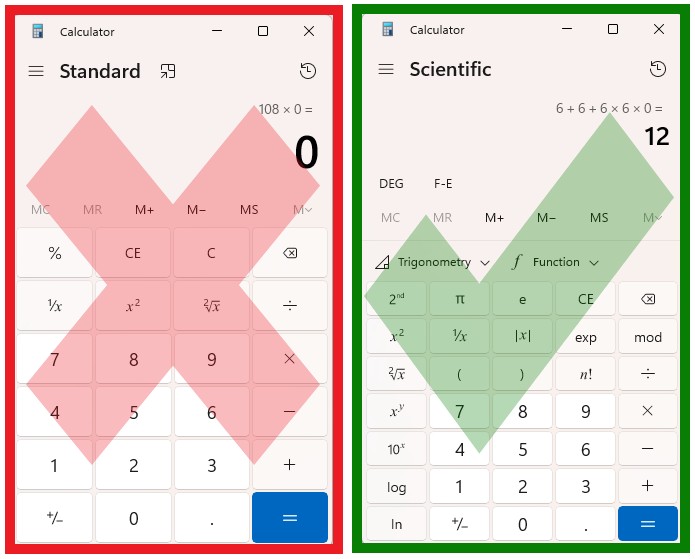
When both options are wrong...
Sami Shamma
@Reply 7 months ago
12
Kevin Robertson
@Reply 7 months ago
Standard v. Scientific
Lars Schindler
@Reply 7 months ago
Thomas In combinatorics, 0! does occur from time to time.
Example:
How many ways are there to choose 5 out of 5 Access seminars? Admittedly, this is an incredibly difficult question. ;-)
But the correct term would be (5 5) [i.e. the binomial coefficient] and would be calculated as 5!/(0!*5!).
If 0! were not 1 but 0, we would have a big problem: division by 0. ^^
Kevin yeah, I saw this one this morning on Facebook. I was just waking up, so I wasn't going to bother posting it, but yeah, there's lots of these online.
Jeffrey Kraft
@Reply 7 months ago
Almost (and it's because the coffee wasn't running yet) flopped on that one. Saw it and others like online... I try to avoid because well...
Thomas Gonder
@Reply 7 months ago
Kevin I use RealCalc Scientific Calculator on my Android, and never paid too much attention to what it displays while doing these calculations. But it got it right and the displayed values seem to make sense as it progresses.
Sorry, only students may add comments.
Click here for more
information on how you can set up an account.
If you are a Visitor, go ahead and post your reply as a
new comment, and we'll move it here for you
once it's approved. Be sure to use the same name and email address.
This thread is now CLOSED. If you wish to comment, start a NEW discussion in
Captain's Log.