When "Free Trial" Isn't Free: My Frustration with Adobe Premiere Pro
I've been on a quest to find software that can easily convert my 16:9 YouTube videos into 9:16 vertical format for TikTok, Instagram Reels, and YouTube Shorts. This should be a simple task: resize the video, follow the action (like cursor movements), and export it. Yet, this has turned into an unnecessarily frustrating journey.
I've tested several online tools and apps, many of which fell short. Some were slow, some didn't handle cursor tracking, and others just weren't intuitive. But when I heard about Adobe Premiere Pro's Auto Reframe feature, I thought this might finally be the solution I need.
Adobe is a well-established name in the industry. I'm very familiar with Photoshop (in fact, years ago I made lessons to teach Photoshop) I have no problem paying for quality software. In fact, I already pay for many tools and apps I use for recording and editing my tutorials. So, when I saw that Adobe Premiere Pro offers a 7-day free trial, I was excited to give it a shot.
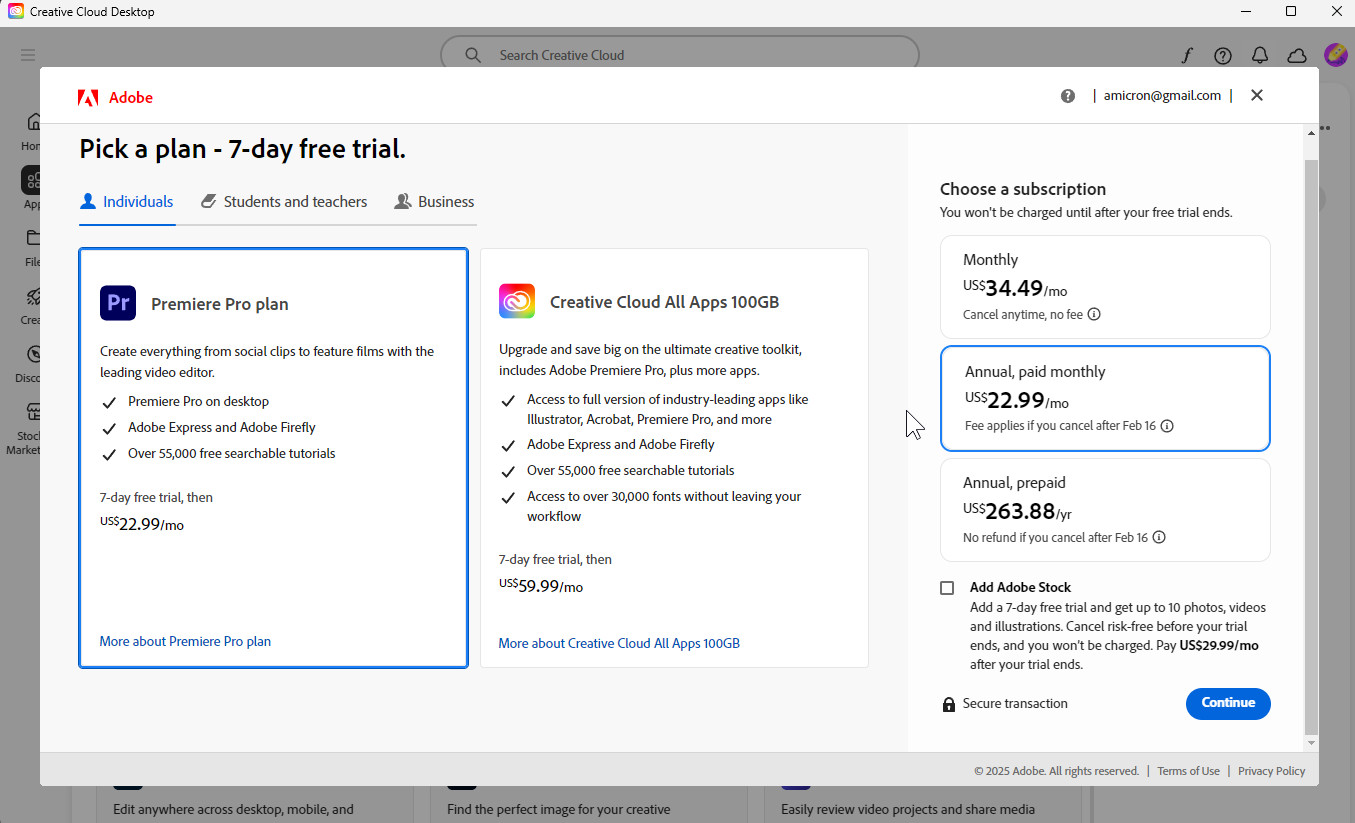
Here's the catch: the "free trial" isn't free. To access it, you're required to sign up for an account, select a subscription plan, and provide your credit card information. Only then will they let you use the software, and you'd better remember to cancel the subscription before the trial ends, or you'll be charged. That's not a free trial. That's a bait-and-switch. You don't need a customer's credit card number up front. It's very easy to install software and then disable it 7 days later if you want. I should know, I write software.
This approach is deceptive and alienates potential customers. If you're advertising a free trial, it should be free, no credit card, no strings attached. Let users explore the software, see if it fits their needs, and then decide if they want to commit. This is how I run my own business. All of my Beginner Level 1 classes are free. There's no commitment, no payment information required, and no risk to the user. I want people to feel comfortable trying my lessons before they decide to buy anything. That's how you build trust with your audience.
Adobe, on the other hand, seems to operate on the assumption that users will forget to cancel and end up paying for a subscription they might not even want. This tactic might boost their short-term revenue, but it's a terrible long-term strategy for customer satisfaction.
If Adobe Premiere Pro could deliver the features I need, I'd gladly pay the subscription price. But forcing me to sign up and provide payment information before I can even evaluate the software? That's a dealbreaker. I've now wasted time downloading, installing, and ultimately uninstalling the software without ever getting a chance to properly test it. This has left me even more frustrated than when I started. Until Adobe changes this practice, I'll keep looking for alternatives. If you're a software developer or company reading this, take note: transparency and genuine trials go a long way in earning customer trust and loyalty.
This brings me to another point: Microsoft. They do offer free online versions of Word, Excel, and PowerPoint through Office.com, which can be used without providing a credit card. However, for Access, there isn't a free version. Access is part of the Microsoft 365 Business or Office Professional suite, which typically requires a paid subscription. Microsoft does offer a trial for their Office 365 suite, but like Adobe, it usually requires payment information upfront, and you would need to cancel before the trial ends to avoid charges. I'm not trying to tell Microsoft how to run their business, but, see above.�
Honestly, if I hadn't learned Access back in the 90s, I probably wouldn't try it today. The lack of a free version to at least sample it before committing to a subscription is a major deterrent. For anyone new to Access, it's hard to justify diving in without a way to test its capabilities first. This is potentially costing Microsoft - and any software company - lots of business. With so many truly free options available today, your software has to be damn good for people to be willing to pay for it - especially if you're charging a monthly subscription price.
In fact, had it not been a free trial, back in 1997, I probably never would have been exposed to and then developed interest in Access. Back then, there was a sampler cd (or heck, might have even been a 3.5 floppy) inside a magazine with various free trials which included MS Office. Which back then was Word, Excel, Publisher, PowerPoint, and Access and they were all prominently advertised. Unfortunately, there was no subscription available then and I was only working 20ish hours per week making only about $8/hour so it wasn't in the budget to spend a couple hundred bucks into the thousands. But at least the truly free trial piqued my interest enough that, when I could get it, I made sure I did!
Yes, if anything, I will agree that I think the subscription model has definitely made expensive software more affordable for a lot of people. I, too, remember back in the '90s when buying a copy of Microsoft Office Professional was $200 or $300, and at the time, I wasn't making very good money at all. That was a big chunk of change. But now, you could get Access as part of an Office subscription for like $8 a month. Well, it's going to be $12 a month after their price increase, but still, that's peanuts compared to having to shell out that kind of money if you don't have it.
If anything, I think the subscription model is better for software companies because it cuts down on piracy. It now comes to the point where it's cheap enough to not go out of your way to pirate the software and possibly download a bad copy. Plus, you get updates and security patches. I'm a supporter of subscription-based software. Heck, I generate most of my revenue from a subscription base, where instead of charging a big upfront cost for a giant course, I sell individual lessons, and people can subscribe and cancel whenever they want.
I support subscription-based models; however, they have to come with a free trial. And I mean an honest free trial where you don't have to give your credit card number upfront. If I can't at least kick the tires and do a test drive of your product, I'm just going to go to whoever's next.
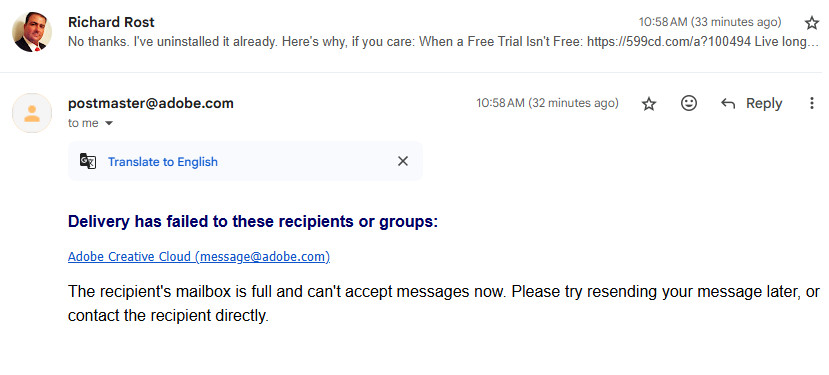
It's funny because I replied to the email address that they gave when they sent me the welcome email, saying, "Hey, thanks for installing and trying Adobe Creative Cloud. Let us know what you think," and this is what I got when I replied...
So today Adobe gets a big FAIL in my book, and I was honestly thinking of possibly redoing my Photoshop lessons, but given this, I doubt it now. Besides, AI is getting to the point where it's just going to be you tell it commands like "remove the tree from this picture," and it just does it. The days of having to know how to do manual photo editing are coming to an end, and I guess you could say that about programming too. But photo editing is pretty much there already, whereas good quality human-written programming is still a good decade away from being replaced. So I've still got time to teach you all some VBA, lol.
Alex Hedley there are a lot of apps that resize the video, but does it FOLLOW the action? Will it follow my mouse pointer, for example?
Thomas Gonder yeah, they're sneaky, and who actually takes the time to read the Terms and Conditions. I have a Terms page and I can see from the logs that almost no one reads them. The question is what's legally enforceable. And that's also why I only shop online with a credit card. Amex and Capital One are very good about returning my money if I get "taken."
Thomas Gonder
@Reply 21 months ago
In two recent complaints about sneaky language, both BofA and PayPal have declined to refund the trial "deposit".
Some of the offers come with tricky language that says you're paying for the product, but it's the subscription that you can cancel.
I sent a request for a refund near the end of the trial period, but then later they say I didn't cancel the subscription, so they end up charging me twice before I can "properly" cancel just the subscription part. All this is deep in the fine print.
I think these vendors are getting more pull with the banks somehow as they challenge the complaint with the fine print.
I've resorted to passing on offers that require giving my credit card number for a "trial".
If you are a Visitor, go ahead and post your reply as a
new comment, and we'll move it here for you
once it's approved. Be sure to use the same name and email address.
This thread is now CLOSED. If you wish to comment, start a NEW discussion in
Captain's Log.