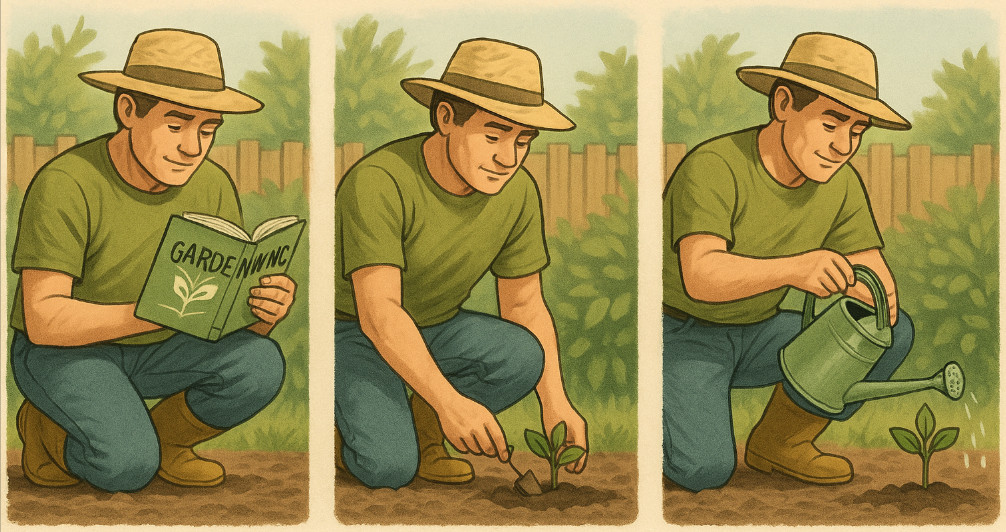
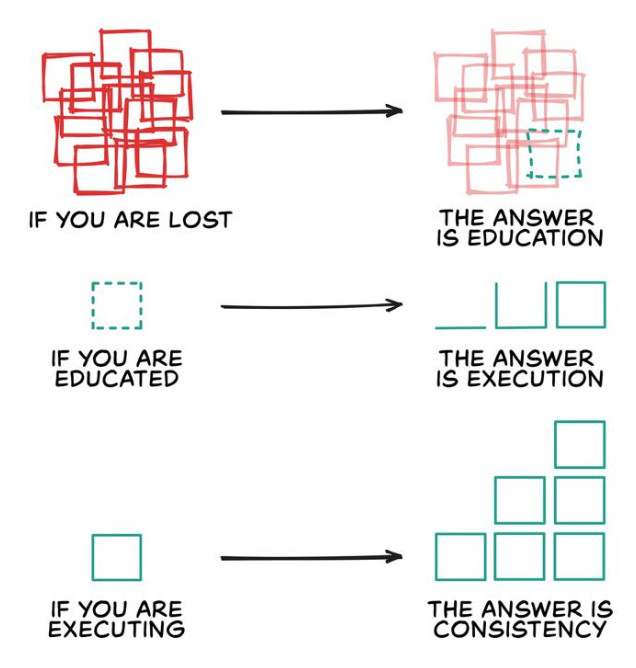
My friend and site admin Alex sent me a graphic that's too good not to share. It's deceptively simple: three rows, three stages, and three answers. If you're lost, the answer is education. If you're educated, the answer is execution. If you're executing, the answer is consistency. It hits hard because it's true across the board.
Let's say you're building your first Microsoft Access database. At first, you're just clicking around and praying nothing breaks. So you start reading some books, watching some videos. (1) You learn what a primary key is, how to write a query, how to build a form that doesn't terrify your users. That's education. But the real progress starts when you start building consistently using your new knowledge. You make mistakes. You fix them. You keep going. That's execution. And if you want to get good - really good - you have to keep doing that. Build lots of things. Tweak them. Support them. Consistency turns you into someone other people call for help.
Starting a business follows the same path. At least, it did for me. In the beginning, everything feels like chaos - licenses, websites, pricing, customers, taxes. You're staring at a half-finished spreadsheet wondering if you need a lawyer, an accountant, or an exorcist. That's the "lost" phase. The answer is education: books, videos, mentors, real-world experience. But knowing how to write a business plan or set up a CRM doesn't build a customer base. That's where execution comes in. You have to send the emails, make the calls, launch the product - flawed or not. And once you do? You keep doing it. Every day. Even when sales are slow, even when no one responds. That's consistency, and it's what separates the businesses that thrive from the ones that fade away. Most people quit too early, not because their idea was bad, but because they stopped showing up.
I went through this exact process with my YouTube channel. Early on, I'd post random class videos, but unless I uploaded an entire course, those standalone lessons didn't make much sense. And if I gave away the whole course, I had nothing left to sell. It took years of trial and error to realize that short TechHelp clips, tips and tricks, and Q&A videos were the sweet spot. They brought in search traffic, answered real questions, and funneled people to my website where they could buy the full lessons. That strategy only worked because I stuck with it - experimenting with content, refining my approach, and then showing up every day to post a new video. Execution and consistency are what built my business. Five years later, I now rank near the top for almost every Microsoft Access keyword worth having. (2)
Leadership works the same way. If you're trying to solve a real-world problem, you can't just go with gut instinct or whatever's trending on social media. You need data. Solid, reliable, unsexy data. That means listening to people who know what they're talking about. If the issue is healthcare, bring in the doctors and epidemiologists. If it's infrastructure, get the engineers in the room. Once you've diagnosed the actual problem, you have to execute a thoughtful plan - not a soundbite, not a gimmick, but a real policy solution. And then, maybe hardest of all, you have to stick with it. Policy takes time. You don't fix education or public health in a single news cycle or a single presidential term. Without consistency, even a good plan gets abandoned before it has a chance to work. Smart government is just like smart business or smart fitness: figure out the truth, follow the evidence, and stay the course. (3)
In the fitness world, this is the entire roadmap. First, you learn. You figure out what proper form looks like, what macros are, why you can't out-train a bad diet. That's education. But just knowing those things won't change your body. You've got to execute. Get under the bar. Track your meals. Do the hard stuff, even when you're tired. But even then, if you quit after two weeks, it's all wasted. The real change comes from consistency. Doing it over and over, week after week, when no one is watching and progress feels invisible. That's where transformation actually happens. It can take six months to see any meaningful change.
Without education, execution is just guessing. You're taking shots in the dark, hoping something works but not really understanding why. Education gives you the map. Execution is the journey. And consistency is what gets you to the destination.
Education without execution is just trivia. You might know all the right answers, but if you never apply them, it's just noise in your head. You're the guy who corrects everyone at trivia night but hasn't built anything since high school shop class.
Execution without consistency is just chaos. You're busy, sure, but you're starting over every time because nothing sticks. One good day at the gym or a productive Monday at work doesn't build anything by itself.
You need all three: learn what matters, do the work, and keep showing up. That's the formula. Not a secret. Just a commitment.
Don't get discouraged if you're not seeing results. Check which step you're in. If you feel lost, learn. If you've learned, act. And if you're acting, stay the course. There's no shortcut past the work.
Star Trek even gives us a textbook case of this process in the TNG episode Force of Nature. When scientists discover that warp travel is causing long-term damage to subspace, Starfleet doesn't just brush it off. Once the data is validated, they take action - limiting warp speeds in affected areas, encouraging further research, and updating policy. It's not dramatic. It's not sexy. But it's responsible science-based governance. You learn, you act, and you stay the course. That's how Starfleet explores the galaxy, and it's not a bad way to run your business, your government, or your personal life either. (4)
(2) I am always on the lookout for new keywords that I don't have a video show up for. So if you do a Google or YouTube search for anything Microsoft Access related and you don't see one of my videos in the top three results, I want to know about it.
(3) And that's one of the problems with our system of government here in the USA, is that they think so short term. A president's only worried about re-election in four years. Whether for him or for his successor, not enough time to implement meaningful change. It can take decades for new policies to make meaningful and lasting change. And if your successor just comes in and erases everything you did and flips everything over, well now you're just not only back where you started from, you could be worse off.
(4) That theme even carried forward into Voyager, whose warp nacelles tilt upward before entering warp. While the show never explicitly says this design is to reduce subspace damage, many fans believe it's a nod to that earlier revelation - possibly a more subspace-friendly drive system. Whether canon or clever fan theory, the point holds: progress comes from education, execution, and consistency.
P.S. Yeah, I know I said in a previous Captain's Log that I wasn't going to write these long essays every day. Honestly, my intention was to just write something short. Alex sent me that graphic over the weekend and I'm like "oh that would make a great captain's log". Then as I started writing, the ideas just kept flowing. I love doing this every morning, so sometimes I just can't help myself. Fortunately, I only spent about a half an hour today on this article, so that's progress. LOL.
I almost forgot to include the actual graphic that Alex sent me. LOL.
Michael Olgren
@Reply 15 months ago
Another great post full of wisdom. Yes- I was thinking, “he’s still writing long posts, but lucky me!”
For me, the hardest part is consistency, which requires discipline. When you discover the key to maintaining discipline please let me know. It’s easy to have discipline with what you love. I need to know how to have discipline with what I hate, e.g. limiting the calories that pass thru my pie hole.
Yeah, that's an issue for me too. When it comes to fitness, especially food, I try to find healthy meals that I actually enjoy. For example, I really love canned tuna and canned salmon. Mix those with a little Minute Rice - usually brown rice, but let's be honest, white rice tastes better. It's a small sacrifice. Add in some canned vegetables or frozen peas, and you've got a healthy meal I genuinely like, all for about 400 - 500 calories.
As for exercise, I can't stand cardio. I do a little for heart and lung health, but I really enjoy weight lifting. I stick to the exercises I love. There are plenty I don't like, but I focus on the ones I enjoy and build my full-body routine around them.
People always ask me, "What's the best exercise?" The truth is, the best exercise - and the best diet - is the one you'll actually stick with. If you hate jogging (and I do, with a passion), don't jog. Pick something else. I love biking, so for now, an indoor bike is the best I've got.
You'll stick with what you enjoy.
Sorry, only students may add comments.
Click here for more
information on how you can set up an account.
If you are a Visitor, go ahead and post your reply as a
new comment, and we'll move it here for you
once it's approved. Be sure to use the same name and email address.
This thread is now CLOSED. If you wish to comment, start a NEW discussion in
Captain's Log.