Anyone who stops learning is old, whether at twenty or eighty. Anyone who keeps learning stays young. The greatest thing in life is to keep your mind young.
Today we're heading back to the Logical Fallacies department.
"I don't understand how that could work... therefore it must be wrong."
That's personal incredulity (1) in a nutshell. And it's a logical fallacy that shows up everywhere: in arguments, in debates, on Facebook, in that one uncle's rants about the moon landing being faked. It's the act of rejecting something not because of evidence or logic, but simply because it's difficult to grasp.
In the IT world, this happens all the time. Ask any sysadmin about personal incredulity and they'll probably point to a printer. "It won't print - it hates me!" No, Susan, the printer doesn't have feelings. It has a print queue with a stalled job from 45 minutes ago. But rather than entertain that there's a technical explanation, people often leap to the idea that the machine is just being irrational or unfair. That's not how hardware works. That's how toddlers work. Why does it say "paper jam" when there is no paper jam!?(2)
In Access development, this fallacy pops up often with beginners. For example, someone will spend hours designing the perfect form layout - buttons in the right spot, colors just how they like it - and then get completely frustrated when nothing they type in the form actually saves. "Access is broken!" they say. But it's not broken. The form just isn't bound to a table or query. Access can't store data unless you tell it where to go. It's a simple fix once you understand the structure, but when something doesn't work the way a new user expects, it's easy to assume the system is wrong instead of realizing you're missing a key concept. That's personal incredulity in action. The answer isn't to give up - it's to dig in and learn what you didn't know. It also shows up when someone sees referential integrity or a subquery for the first time. "How can one table be connected to another? That makes no sense!" It makes perfect sense. You just haven't learned it yet. You're used to Excel.
In personal life, this fallacy usually creeps in during arguments. You're trying to understand why your spouse or friend feels hurt, and instead of listening, your brain goes, "Well that makes no sense to me, so it must not be valid." But people don't need your understanding to feel what they feel. Emotions aren't compiled code. Just because you don't see the bug doesn't mean it isn't there. Maybe you forgot an anniversary, or made a joke that hit a nerve. You're standing there thinking, "How is this a big deal?" But that's the trap. You assume that because you don't feel the same way, their feelings must be irrational. It's easier to dismiss it than to investigate it. But the better response is curiosity, not contempt. Ask questions. Try to see the source of the reaction. Because more often than not, the issue isn't the logic - it's the impact.
In business, I've seen decision-makers scoff at new tools, new models, or new markets just because they're unfamiliar. "That AI stuff? I don't get it. We're not touching it." That's not leadership. That's fear in a necktie. The best entrepreneurs admit what they don't understand, then go learn it or hire someone who does. If you can't grasp how a new system might improve efficiency, that's a sign to dig deeper, not dismiss it.
In politics, personal incredulity fuels everything from climate denial to opposition to basic healthcare systems. "You're telling me the planet is getting warmer because of invisible gases? Nah." Well, yes. That's exactly what the data says. Science doesn't care if it sounds weird to you. It's not supposed to match your gut. It's supposed to match reality. And if the reality seems complicated, that's a clue that we should trust those who study it, not shrug it off.
When it comes to world philosophies or long-held traditions, this one gets especially delicate. I've heard people dismiss evolutionary biology or cosmology with a wave of the hand because "I just can't believe something so complex could happen by chance." But that's not really an argument. It's an admission of confusion. And it's okay to be confused. What's not helpful is using personal incredulity as a shield against evidence. That doesn't move us forward. It locks us into the dark. It's okay to say, "I don't know." In fact, that's where real understanding begins. The beauty of science is that it tries. It's not perfect, and it doesn't claim to know everything. Some things may even be unknowable. But that doesn't mean we get to make up answers just to feel better. Not knowing is honest. Pretending is not.
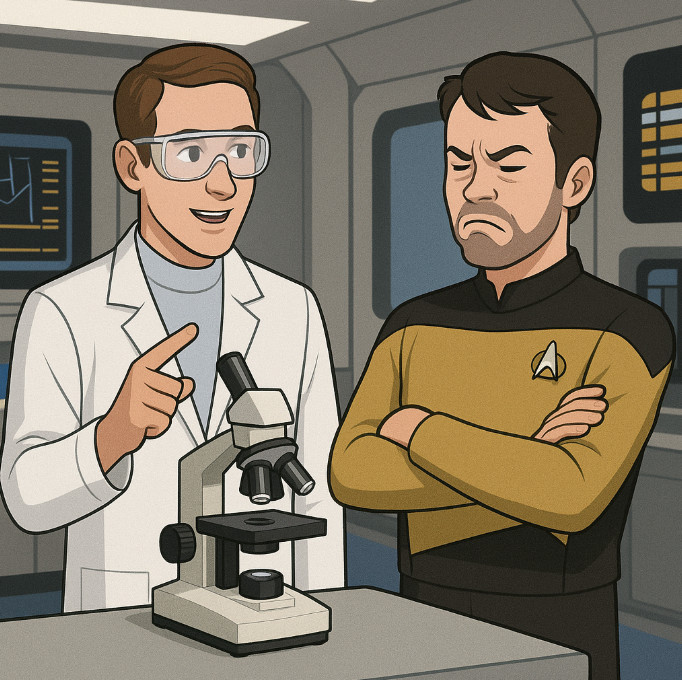
And of course, Star Trek gave us plenty of examples of people struggling with the unknown. Remember in TNG's "Where No One Has Gone Before," when the Enterprise ends up in a part of space where thought becomes reality? Everyone's freaking out, and yet it's The Traveler - the one who understands how it works - who calmly explains it. The others dismiss it at first because it makes no sense to them. That's personal incredulity. But Starfleet's best trait is their ability to learn from the unknown, not reject it.
That's what this fallacy robs us of: the chance to learn. The chance to say, "Okay, this seems strange to me... let me look into it." That moment - that little bit of humility - is what separates the scientist from the cynic, the engineer from the conspiracy theorist, the captain from the mutineer.
So next time your brain shouts, "That can't be right!" - pause. Maybe it can be. Maybe you just haven't caught up yet.
I did this only once. I was giving a lecture at the university about a major historical figure who lived 750 years ago. Once I finished my lecture, one of the students said, "He has never heard these arguments made before, therefore they must be wrong." I debated with myself for about 5 seconds and then I said to him, "Your ignorance cannot be used as an argument against my knowledge." I regretted saying that to him, but boy it felt good.
Donald Blackwell
@Reply 14 months ago
Yeah, some times it takes extra effort to not want to just shake the willful ignorance out of some people.
I'm perfectly accepting of people who are ignorant just because they were never taught something. That's fine, as long as they have a willingness to learn. But incredulity is the complete lack of caring whether or not you know something, and that's what irritates me - people who are intentionally dumb as if intelligence is some kind of an impairment. They revel in their dumbness.
Darrin Harris
@Reply 14 months ago
Hi all
I believe in you Richard Rost, your web site is awesome, your content is great.
Live long, and prosper.
Michael Olgren
@Reply 14 months ago
I saw a TikTok that changed my thinking on the anti-science crowd. You have to acknowledge them as a cult, and then apply the science related to that. It’s a more empathic way to understand why they choose to actively oppose known data. This cult is tens of millions of Americans, so you can’t just ignore them. We have to address their concerns (address, not give into) or we spiral into anarchy (after a harsh period of authoritarianism).
Michael yeah, I think you're absolutely right - treating the anti-science crowd like a cult actually makes a lot of sense. Once you view it through that lens, you stop expecting rational debate to work. That's why I try to approach it using what I call "micro-inoculations." You can't just slam people with raw data and expect them to suddenly shift their worldview. It rarely works, especially when their identity is wrapped up in it. But you can drop little bits of reality that might slowly get them thinking.
It's kind of like what I did with my kids when they were young. Their mom was really into all the usual childhood myths - Santa Claus, Easter Bunny, the whole nine yards. I wasn't a fan of pushing those as literal truth, but I also didn't want to crush their imagination. So instead, when they got old enough, I helped them reason through it themselves. I'd ask, "Does it make sense that a guy flies around the world in one night delivering presents? Think about how many houses there are. Do you really think reindeer can fly?" And eventually the light bulb went on. They figured it out on their own.
Same thing with science denial. If someone thinks the moon landing was faked, ask them which is more plausible: that hundreds of thousands of scientists, engineers, and contractors conspired and stayed silent for decades... or that we actually did it, because we were in a high-stakes race with the Soviets and had the political and financial will to pull it off? Which one lines up better with how the world actually works?
You're not trying to win an argument in that moment. You're planting a seed. And with enough small nudges, some of those seeds might eventually grow.
Sorry, only students may add comments.
Click here for more
information on how you can set up an account.
If you are a Visitor, go ahead and post your reply as a
new comment, and we'll move it here for you
once it's approved. Be sure to use the same name and email address.
This thread is now CLOSED. If you wish to comment, start a NEW discussion in
Captain's Log.