We all know the saying: "If it seems too good to be true, it probably is." But some lessons in life have to be learned the hard way - and scammers are counting on that.
One recent story out of Florida hit especially close to home. A local man got a phone call from someone claiming to be Verizon, offering a $20-a-month promotion on his TV and internet. Sounded amazing. Too amazing. They told him to log into his app to prove the deal was real, and sure enough, he saw a $50 credit posted to his account. But it wasn't a real payment - it was a fake. The scammers had used a bogus checking account to "pay" the bill. Some companies allow payments without logging in, if you just have the account number. The system accepts the payment initially, and it shows as pending. But a day or two later, the bank bounces it once it realizes the account is fake. That was the setup. Once the payment "went through," the scammers said, "Now all we need is a Target gift card to complete the deal."
And there it is. The moment someone asks for a gift card, you can stop right there. It's a scam - every time. People have been duped by scammers posing as government officials or IRS agents, demanding payment in the form of gift cards. But here's the truth: the IRS will never ask you to pay a bill with a gift card, and neither will your local sheriff's department. That's not how legitimate agencies operate.
In your personal life, this kind of thinking shows up in relationships too. A friend of mine spent months chatting with a woman on Facebook who he thought was the love of his life. He was getting ready to drive cross-country to meet her - until she started asking for money, gift cards, and other "help." Catfished. Hook, line, and sinker. When something seems perfect and easy and tailor-made for your heart, slow down and verify. Emotional scams are some of the most devastating, and they all start the same way: it just feels too good to be fake.
Fitness scams are ubiquitous. Ever seen a new supplement that promises six-pack abs and instant brain power? My inbox is flooded daily with miracle drugs and fad regimens claiming overnight results. It's always the same trap: too-good-to-be-true promises with zero real evidence. The truth is, transformation comes from consistent effort over time - not from some "secret pill" you saw in an infomercial at 3 a.m.
In finance, it happens constantly. I watch a lot of American Greed - partly because I find financial fraud fascinating, and partly because it's a master class in what not to fall for. The show is packed with stories of people who lose everything not because they were naive, but because they were greedy. A fast-talking "advisor" promises a 30% return, guaranteed. Red flag. But they hand over their life savings anyway, convinced they've found a shortcut to wealth. I don't feel bad for these folks - not really. They weren't tricked so much as blinded by their own desire to get rich quick. If someone promises you guaranteed returns that sound like magic? It's a scam. Every time.
In technology and IT, this shows up all over the place. You install a Chrome extension that promises to block every ad, scan every website for viruses, and manage all your passwords... for free. And you never stop to ask how they're paying for it. Remember: if it seems free and you can't figure out what the product is - you're the product. Your data, your habits, your eyeballs are being sold to the highest bidder. It's how social media works. You are not the customer; you're the commodity.
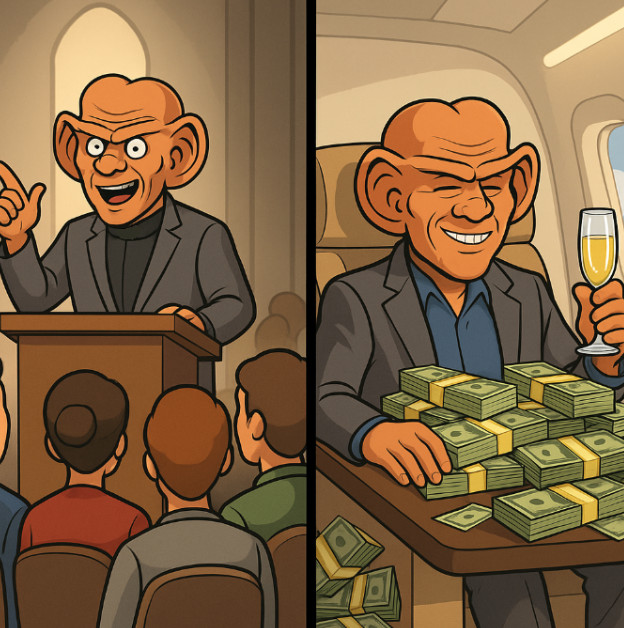
Even in spiritual circles, we see this. Mega-church pastors flying around in private jets tell their congregations that if they just "plant a seed" (usually with a check or gift), they'll receive abundance in return. It's the prosperity gospel version of a Ponzi scheme. The people who can least afford it are told that their hardship is because they didn't give enough. It's spiritual manipulation dressed up as divine economics. And it's not just wrong, it's harmful. It should be illegal. It definitely should be taxed. (1)
In Star Trek, the "too good to be true" theme shows up now and then. One of the best examples is the Voyager episode "False Profits." The crew encounters a pre-warp civilization that's been taken over by two Ferengi con artists. The Ferengi used leftover tech and their natural talent for manipulation to convince the locals they were gods. They handed out gifts, made flashy predictions, and ruled over the planet in comfort and style. All because the locals bought into the illusion. It looked like magic. It seemed like salvation. But it was just a lie wrapped in gold-pressed latinum. Voyager's crew had to carefully unravel the mess without destroying the society in the process. The moral: when something too good to be true shows up in your life, it's usually just two Ferengi in robes trying to sell you snake oil.
Whether it's a phone call, a romantic connection, a financial opportunity, or a promised miracle cure - if it feels too easy, too perfect, too effortless - it probably is. Scammers depend on that one moment when you stop thinking critically and just want it to be true.
So take a breath. Ask the question. And remember: when something feels too good to be true, that's the exact moment when you need to be your most skeptical.
Yeah, and I love doing it, but even I have an ulterior motive. I'm trying to get people to sign up for memberships or buy more classes. But I've often said that even if I was independently wealthy, I'd probably still do this anyway just for the fun of it because I really do enjoy this stuff. Don't get me wrong, I'd probably take a year off and travel. But after that, I'd probably be right back here doing the same stuff. But I got puppies to feed...
Michael Olgren
@Reply 15 months ago
It astounds me that our society lets these scammers get away with it. And yet I realize the answer is simple: we live in a plutocracy, not a democracy. The vast majority of people demanded the "do not call" legislation, but even though it was created, it is simply not enforced because our congresspeople refuse to fight/confront corporate America. The level of Evil it takes to bilk a senior citizen out of their life savings is unforgivable.
Donald Blackwell
@Reply 15 months ago
Sometimes it seems like the "Do not call" list has turned into just the government selling your phone number to telemarketers to pay ... insert pet project here.....
Sorry, only students may add comments.
Click here for more
information on how you can set up an account.
If you are a Visitor, go ahead and post your reply as a
new comment, and we'll move it here for you
once it's approved. Be sure to use the same name and email address.
This thread is now CLOSED. If you wish to comment, start a NEW discussion in
Captain's Log.