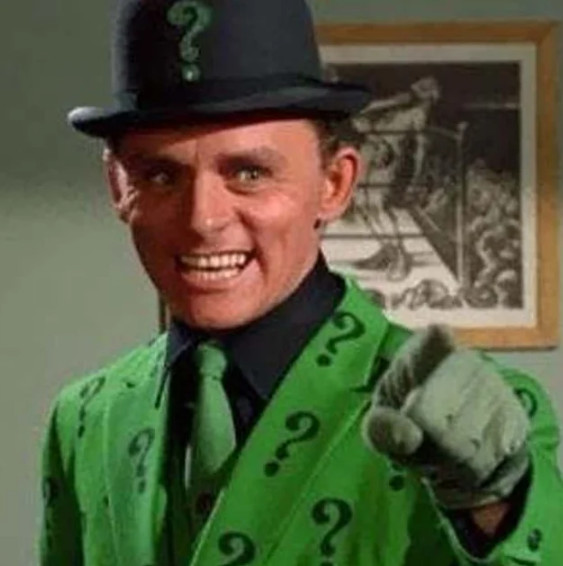
There are huge advertising budgets only when there's no difference between the products. If the products really were different, people would buy the one that's better... Advertising teaches people to be stupid.
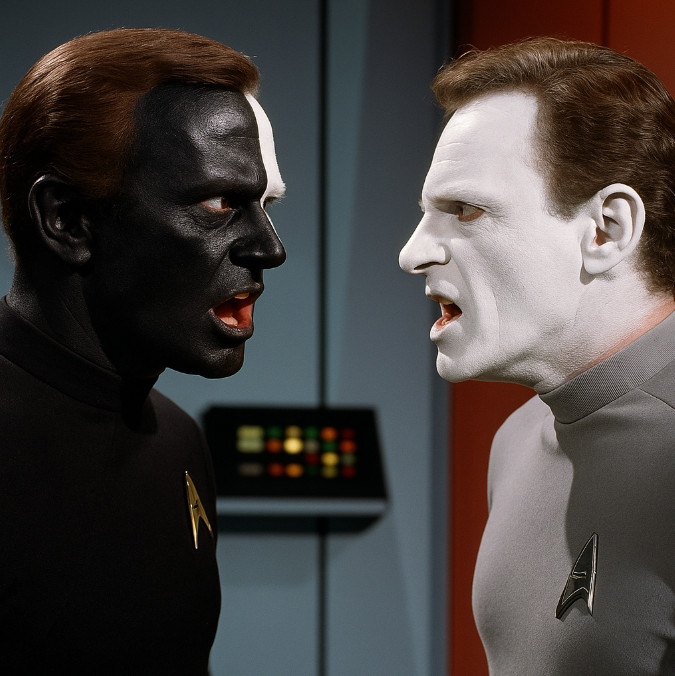
I'm actually going to lead with the Star Trek example today. I've been rewatching some of the old Original Series episodes of Star Trek - many of which I haven't seen in decades - and today's entry is about one that really hit me: "Let That Be Your Last Battlefield". It aired in 1969, and yet it's still one of the sharpest gut-punches about the absurdity of bigotry I've ever seen on TV.
To the crew of the Enterprise, the two aliens locked in lifelong conflict look identical: half black, half white. But late in the episode we learn the "real" difference - their black-and-white halves are reversed. One has black on the left, the other on the right. And that's enough for them to hate each other to the death. It's a stunning metaphor. What's more stunning is how timeless it feels. Fifty-plus years later, we're still dealing with the same kind of irrational division and tribal thinking.
Star Trek didn't suddenly get woke. It's always been woke. (1) This show was dropping truth bombs about racism, war, authoritarianism, religious conflict, and environmental collapse long before most people knew how to pronounce "intersectionality." (2) And it wasn't subtle. The difference now is we're older and (hopefully) wiser enough to recognize it.
And you know what? This kind of bias shows up in every corner of our lives - not just in politics or race, but in tech, health, business, and even friendships.
In the IT world, we see this all the time. Take Microsoft Access. "It's not a real database," some developers scoff, because it's not backed by Oracle or SQL Server or doesn't run in a Docker container in the cloud. But here's the thing: for the people and organizations it serves, Access is perfectly real. It's fast, flexible, and powerful in the right hands. The bias is less about functionality and more about snobbery. You've decided it doesn't count because it doesn't fit your definition of "serious." Sound familiar?
In personal computing, the same thing happens when someone says "I'd never use Android" or "Only idiots use Windows." These aren't thoughtful opinions - they're tribal flags. Bias in tech isn't always about specs or performance. It's about belonging to a camp and treating the other side like a punchline. And we don't even realize we're doing it. We start to judge others not by what works for them, but by what doesn't match our brand loyalty. (3)
In personal life, it shows up in all the subtle ways we judge people without realizing it. Someone speaks with an accent, and you assume they're less educated. Someone dresses differently, and you decide they must be weird. Someone disagrees with you on social media, and now they're "one of those people." And just like the aliens in that episode, we draw our lines based on absurd distinctions - left vs right, red vs blue, mask vs no mask - and forget to see the person beneath.
In politics, this one practically writes itself. We are now so polarized that people can't even acknowledge when someone from "the other side" makes a good point. Bias has become a badge of honor. There's no room for nuance. No space for saying, "You know what, they might be right about that." And until we learn to see past the symbolic face paint - so to speak - we're just going to keep burning everything down.
Even in fitness and nutrition, the same kind of bias shows up. People get so locked into their diet tribe - keto, vegan, paleo, carnivore - that they can't hear science anymore. I've known people who reject perfectly valid advice because it didn't come from "their guy." The same thing happens with workouts. "Cardio is useless." "Weights make you bulky." These aren't facts. They're biases disguised as certainty. And they keep people from making real progress.
In world philosophies, it gets especially thorny. Some folks believe their worldview is the only valid one because it's what they were raised with, or what their parents believed, or what gives them the most comfort. And when they encounter something different - maybe a scientific theory, a different tradition, or just someone who thinks differently - it's easier to dismiss it as "wrong" than to explore it. But when you stop questioning, you stop growing.
And finally, back to Star Trek. "Let That Be Your Last Battlefield" doesn't just call out racism. It reminds us how petty our divisions can be, how silly they seem from the outside, and how deadly they become when we don't check our biases. Picard once said, "We think we've come so far. Torture of heretics, burning of witches, it's all ancient history. Then - before you can blink an eye - suddenly it threatens to start all over again." Star Trek doesn't predict the future. It reflects the present - and dares us to be better.
Of course, I have to mention one of my favorite songs from Rush: Witch Hunt. It's a quote from that song I actually used as my senior quote in the yearbook - "Those who know what's best for us must rise and save us from ourselves." I've got a whole article coming on just that song eventually because it's layered and brilliant, but for today, it fits this discussion perfectly. Some people are so entrenched in their own worldview, so blinded by bias, that they take it upon themselves to enforce it on everyone else. That's when it stops being opinion and starts being oppression. That's when good intentions morph into something far more dangerous... especially when tribal biases get written into law.
Bias isn't evil in and of itself. It's just a mental shortcut. But when we leave it unchallenged, it becomes the wall between reason and truth. And if we don't learn to see past the paint on each other's faces, we're doomed to destroy each other over nothing.
(1) The word woke has been twisted into a kind of cultural insult lately, often used to mock or discredit anyone who points out social injustice or calls for basic decency. But at its core, being "woke" just means you're awake to inequality and systemic problems. You're paying attention. You're trying to treat people fairly, no matter their background. Personally, I'm not a fan of the term. I think it sounds a little smug and silly, and I don't use it in my own vocabulary. But the idea behind it - recognizing and respecting the lived experiences of others - is something I'll always support. The problem isn't the concept. It's how some folks weaponize the word to shut down progress.
(2) "Intersectionality" is the idea that different forms of discrimination - like racism, sexism, ageism, ableism, and so on - can overlap and compound. For example, a Black woman might face biases that are different from those experienced by a white woman or a Black man. It's not just about adding up problems; it's about understanding how those identities interact in real life. It helps explain why some people deal with a heavier load than others, even if it's not immediately visible. It's basically empathy with a lens.
(3) I still refuse to use Apple products, however. LOL
Not to make a commercia this is just the reason that I subscribe to ground news especially with the bias comparison. They have an AI system there that does a pretty good job of checking that so with the risk of having information here this is an example
eft-Leaning outlets frame the incident as a pointed critique of the speculative art market, emphasizing Maurizio Cattelan’s condemnation of its failure to support artists and highlighting the absurdity of a $6.2 million banana as emblematic of elite excess.
They use subtly loaded language like “bananas” to underpin this skepticism.
Right-Leaning coverage similarly underscores the artwork’s high monetary value but often adopts a mocking or derisive tone toward contemporary art’s perceived frivolity, framing it as cultural decay—with phrases like “million-dollar banana taped to a wall” conveying incredulity.
The pivotal dividing line centers on interpretations of value and legitimacy in modern art, triggering sharper passions in right-leaning outlets, while left voices focus more on systemic criticism.
Center-Leaning reports maintain a neutral, factual tone without embracing either emotional or ideological framing.
Shared acknowledgment exists around the artwork’s perishable nature, quick museum response, and Cattelan’s provocative intent, revealing a common factual baseline beneath these divergent narratives rooted in broader cultural and ideological fissures.
Bill Carver
@Reply
15 months ago
By the way the above story examples was about somebody eating a $6.2 million banana from a museum
Yeah, I generally avoid any cable news - the 24-hour news channels like CNN, MSNBC, and Fox News. I try to get my news from the big national news networks like ABC, NBC, CBS, and of course, BBC. They're a little less skewed left or right.
Bill Carver
@Reply
15 months ago
Actually, abc, nbc and cbs, who puts the bs in news. (Just kidding, but just remember that good humor always has a small element of truth to it.) And the truth is, yes, Fox News and cnn and nbc have their own level of bias, although Fox News's coverage is good during the day. At night is the editorial page. Ditto for CNN, who was pretty decent during the day for coverage. MSNBC should be as Rush Limbaugh used to call it MSDNC. And BBC is definitely a stellar organization when it. comes to journalism, but they still also have a bias. The truth. is all news agencies have a bias of some type. and that's where ground news was fantastic at the risk of making a commercial for them. They bring all the sources. that they follow. Put them together and analyze them. Each story has whether it's left or right or center and also a Fact Check in the middle of that. Check it out. They're really good.
If you are a Visitor, go ahead and post your reply as a
new comment, and we'll move it here for you
once it's approved. Be sure to use the same name and email address.
This thread is now CLOSED. If you wish to comment, start a NEW discussion in
Captain's Log.