There's this little town - struggling, rundown, one of those places where everyone seems to owe money to someone, but nobody actually has any cash on hand. The hotel is barely operating, the businesses are scraping by, and debts have quietly piled up everywhere like junk mail no one wants to open.
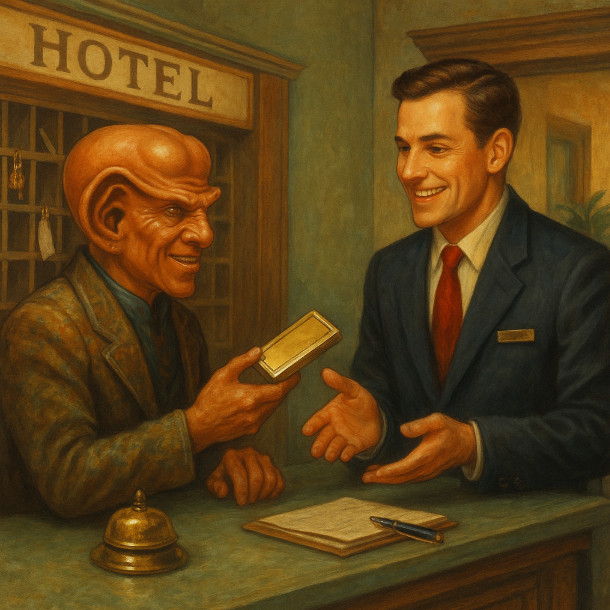
Then, one day, a wealthy traveler rolls into town. He stops at the hotel, says he might stay the night, but before committing, he asks to take a look at the rooms first. The hotel clerk, desperate but still holding onto some formality, asks for a refundable deposit before handing over the keys. The traveler agrees and puts some money down.
Now, it just so happens that the deposit is exactly the amount the hotel owes the chef for three months of unpaid wages. So the hotel owner takes the money and pays the chef.
The chef breathes a sigh of relief - because that's precisely what he owed the grocer for months of tabs he hadn't been able to settle.
The grocer, now flush for the first time in ages, finally clears his bill with the local doctor.
The doctor uses that same cash to pay the nurse he's been behind on.
And the nurse? She's new in town and had been staying at the hotel while house-hunting. She owed them rent for her stay. And now, with money in hand, she pays the hotel.
So the hotel ends up right back where it started - deposit in hand, all debts cleared.
The traveler finishes his tour, decides he's not impressed, takes back his deposit, and heads out of town. Nothing was purchased. No one kept the money. And yet somehow... everyone is debt-free.
So what changed?
Nothing... and everything.
What actually happened here is kind of amazing. One unit of money passed through every person in the loop, and because each debt was perfectly matched to the next, the entire cycle canceled itself out. No one gained anything. No new wealth was created. But everyone walked away with a clean slate.
Which raises the question: if a single dollar that disappears at the end can eliminate everyone's debt, did the debt even really exist? Or was the problem simply that money wasn't moving?
This kind of scenario pops up in more places than you'd think.
In Access development, I've seen people build complicated accounting or billing systems with lots of unpaid balances floating around. But when you step back and look at the relationships between vendors, customers, and internal accounts, a lot of that "debt" is just circular references. Vendor A owes Client B, who owes Department C, which already has a credit from Vendor A. If you don't model these flows properly, you end up chasing phantom balances. It's like trying to balance your checkbook with invisible money. Sometimes, one well-placed transaction (or redesign) clears it all.
In relationships, we do the same thing emotionally. You're mad at someone because they're mad at someone else who once ignored you. Nobody talks about it directly, but the tension is there, bouncing from person to person like a passive-aggressive game of telephone. But one honest conversation can collapse the whole chain. Nobody owes anyone anything anymore. Everyone just breathes easier. Debt resolved. Nothing gained, but everything lighter.
In politics, this idea plays out in the form of "budget offsets" or "spending neutral" bills. Politicians will propose funding something new by cutting something old, but when you trace it, the savings come from cancelling out programs that were never fully funded to begin with. It looks like fiscal responsibility, but often it's just money moving around in a loop. No real change, just shifting numbers to make everyone feel better.
In economics, this is a classic illustration of liquidity vs solvency. Every person in that hotel town was technically solvent. They had the ability to pay, just not the cash flow. They weren't in trouble because they were broke, but because they couldn't move money fast enough to settle their debts. One dollar in motion fixed everything. It's a small-scale version of how economies get stuck in recessions, not because there's no money, but because no one's spending. It's why stimulus checks and quantitative easing exist. Keep the dollar moving.
And in the banking system? Oh, don't even get me started. Banks operate on fractional reserve principles. They lend money that doesn't really exist in physical form. If you and everyone else tried to withdraw your savings at the same time, the bank wouldn't have it. The whole thing only works because we trust that the money is there when we need it. That trust is the guest in the hotel. It shows up, kicks off a cascade of transactions, and vanishes. And as long as nobody looks too closely, everyone feels like their accounts are in order.
So did the debts in that town really exist? Kind of. But maybe the bigger question is: how many of our daily problems are just locked-up cycles, waiting for a spark to start the chain?
Sometimes all it takes is one dollar. Or one gesture. Or one well-placed line of code.
It reminds me of the Deep Space Nine episode "Treachery, Faith and the Great River," where Nog talks about the Great Material Continuum - a kind of spiritual metaphor for Ferengi trade. Everyone wants something, someone has something, and if you just trust the flow, value can move through the system in ways that don't always make sense to an outside observer. In that episode, Nog ends up securing a critical starship component through a bizarre chain of trades involving Captain Sisko's desk, a bottle of bloodwine, and a holophoto frame. Nobody spent any money. Nobody technically "lost" anything. And yet, everyone ended up with what they needed. Just like in the hotel story, the pieces moved in a circle, debts were settled, and no new wealth was created - just redistributed through trust, timing, and participation in the system. That's the Great Material Continuum.
And in some ways, it makes more sense than our actual economy.
I taught my kids that everything we buy, sell, save, or give is ultimately our time. Our time is actually our only commodity and it is limited. In bartering, we have the additional effort spent haggling over the conversion from doctor hours to cobbler hours to baker hours and so forth.
Money is the universal and tangible intermediary that simplifies trading and allows us to hold our time in our hand, for making transactions.
The "Hotel Paradox" isn't really a strict paradox. Although it bends the mind a bit, it does show the velocity of money to solve an allocation problem. It only works if all the debts are equal and each participant is honest enough to pay their debt immediately. Pretty much the same thing happens if each buyer makes their purchase with cash instead of debt.
One of the problems with our banking system is that credit card companies take a little chunk of every transaction. So the same hundred dollars gets passed around between 5-6 different vendors paying with a credit card. Eventually that whittles down into $50. Trust me, I know. My business is 100% credit card transactions and PayPal. They all get their chunk.
Sorry, only students may add comments.
Click here for more
information on how you can set up an account.
If you are a Visitor, go ahead and post your reply as a
new comment, and we'll move it here for you
once it's approved. Be sure to use the same name and email address.
This thread is now CLOSED. If you wish to comment, start a NEW discussion in
Captain's Log.