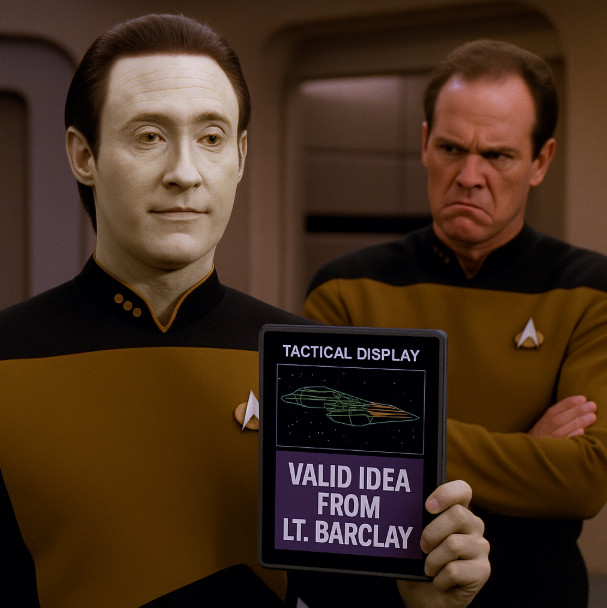
Back when I did more on-site Access consulting, I worked with a company that had gone through several developers before me. When I first walked in, the manager looked at me and said, "Please tell me you're not like that last guy - he built this mess and swore it was good design." I hadn't even opened the database yet. Just showing up apparently carried baggage.
Later that day, I spotted a clever little workaround in the VBA code. I pointed it out and said, "Hey, this was actually a smart way to handle the form filter." She immediately waved it off. "If it came from him, it's probably a bad idea."
That, my friends, is the genetic fallacy in action.
It's the instinct to judge an idea purely based on who said it - or where it came from - rather than whether it holds up to scrutiny. And we do it constantly.
In Access development, I've seen entire chunks of working code ripped out just because the previous dev was unpopular. The new dev assumes "If he did it, it must be wrong." But sometimes, bad people write good code. And sometimes, great developers leave behind spaghetti (1). You can't tell which is which unless you actually read it.
In tech support, it happens when a junior staff member suggests a fix and the senior guy shrugs it off without even listening. "You just got here - how could you possibly be right?" But the printer still isn't printing, and sometimes the intern actually knows what a driver conflict looks like.
In relationships, I've seen people dismiss advice from a friend or family member just because of past baggage. "Well you don't exactly have a great marriage, so why should I listen to you?" But even flawed messengers can deliver truth. A broken clock is still right twice a day.
In fitness, this shows up when someone hears a tip from a TikTok influencer and scoffs, "Oh they're just a fitness model - they don't know real science." But what if the advice is solid? Or the opposite - someone blindly follows a PhD because of their credentials, ignoring the fact that their advice is based on outdated or cherry-picked data. What matters is the claim and the evidence, not the credentials stapled to it.
In medicine, you'll see this when a freshly minted doctor walks into the exam room and the patient immediately gets nervous. "You're new? How much experience do you have?" There's this instinct to trust the gray-haired veteran over the young graduate, just because of seniority. But the truth is, that new doctor might be working with the most current research, the latest treatment protocols, and fewer outdated habits. Judging their competence based solely on when they got their degree, instead of how well they understand the problem in front of them, is exactly how the genetic fallacy sneaks into our thinking - without us even realizing it.
In politics, this fallacy is practically the fuel. A policy idea could be sound - balanced budget, tax simplification, universal healthcare - but if it came from "the other side," people shut down before they even hear the proposal. "Oh that came from them? Then it must be garbage." The source becomes a stand-in for the argument. And we all lose when that happens.
I'll admit, I'm guilty of this myself when it comes to the news. I try to stick to sources I consider relatively fair and balanced - NBC, ABC, BBC - because I know the 24-hour news channels are usually loaded with opinion. MSNBC leans left, Fox News leans right, and I'm just trying to get the facts without someone telling me what they mean or how I should feel about them. So yeah, I filter based on source. That's technically a form of the genetic fallacy. Guilty. But I'd argue it's not always wrong - as long as you're aware you're doing it. Sometimes the source does matter. Just don't let it be the only thing that matters. Content still counts.
And of course, Star Trek gives us a perfect example. In the TNG episode Redemption, Part II, Data is given temporary command of a ship during a high-stakes blockade to catch Romulan ships violating the Neutral Zone. From the moment he takes command, his first officer, Lieutenant Hobson, questions every decision - openly doubting Data's ability to lead. At one point, he even says, "No one would suggest that a Klingon would make a good ship's counselor, or that a Berellian could be an engineer. Why should an android be given command of a starship?" It's not about performance. It's about the source. Later, when Data orders a risky but calculated maneuver to detect a cloaked Romulan vessel, Hobson objects again, warning that it will flood a compartment with radiation. Data holds the line, executes the plan, and it works. The Romulans are revealed. Hobson is forced to confront the reality: his resistance wasn't about logic. It was about bias. He rejected sound judgment because of who it came from. That's the genetic fallacy in full uniform.
So today's log is about cutting through that noise. Be skeptical of sources, sure. But don't stop there. Look at the content. Ask if it holds up. Even jerks, trolls, former coworkers, and 24-hour news channels can be right once in a while. And even people you admire can get it wrong.
The truth doesn't care who said it. And neither should you.
If you are a Visitor, go ahead and post your reply as a
new comment, and we'll move it here for you
once it's approved. Be sure to use the same name and email address.
This thread is now CLOSED. If you wish to comment, start a NEW discussion in
Captain's Log.