I think we're going to the moon because it's in the nature of the human being to face challenges. It's by the nature of his deep inner soul... we're required to do these things just as salmon swim upstream.
A lot of people have the wrong idea about free speech. They think it means you can say whatever you want, whenever you want, without consequences. That's not what the First Amendment says. What it really means is that the government can't throw you in jail for your words, even if those words are vile, hateful, or flat-out wrong. But that doesn't mean you're shielded from other consequences. Employers can fire you, organizations can kick you out, people can sue you for libel or slander, and private communities can set their own boundaries. Free speech is not absolute - it's about context and boundaries.
Take my website as an example. Here, I'm the captain of the ship. If I say that I don't want partisan mud-slinging or religious brawls in the forums, that's the law here. You want to argue about Access databases? Go for it. You want to share thoughtful comments on science or philosophy in the Captain's Log? Perfect. But if you come in throwing bombs at "all Democrats" or "all Republicans," you're going to find yourself shown out of the airlock. It's not about silencing opinions. It's about keeping this space safe, respectful, and productive.
We've seen the same thing play out in the news recently, with people posting inflammatory comments on social media and then losing jobs or memberships when it blows back on them. Some people cry, "What about free speech?" But the truth is, that's not a First Amendment issue. That's the real-world consequence of your words. Freedom of speech doesn't mean freedom from fallout.
Take the case of Colin Kaepernick. When he chose to kneel during the national anthem to protest racial injustice, he exercised his First Amendment right - no government body arrested him. But the NFL and its team owners decided they didn't want that kind of political spotlight tied to their brand. The result? Kaepernick was essentially blacklisted from the league. His right to speak was intact, but his career paid the price.
On the other side of the aisle, look at Roseanne Barr. In 2018, she fired off a racist, politically charged tweet while starring in her own rebooted sitcom. ABC didn't prosecute her - again, the government had no role here - but the network canceled her show overnight. She had every right to tweet her views, but her employer had every right to decide that she no longer represented their values.
Then there's Jimmy Kimmel. He made comments on his show about the death of Charlie Kirk, accusing some of trying to politicize it and "score political points." The backlash was swift. His show was suspended indefinitely by ABC, several affiliates dropped his broadcast, and regulatory pressure followed. Once again, he wasn't jailed or legally silenced - but his words had real consequences from his employer, the network, and the public.
Since the very beginning of broadcasting, the real pressure has often come not from government censors but from advertisers. Networks have always had to keep one eye on the sponsors' reactions. Entire shows have been canceled, hosts taken off the air, or scripts rewritten when advertisers threatened boycotts. Even back in the 1950s, Lucy and Desi were shown sleeping in separate beds on I Love Lucy because producers worried about offending sponsor sensibilities. It wasn't about government limits on speech - it was about professional backlash and advertising dollars steering the boundaries.
And here's the value statement I want to close with: I want my site to be a place where people feel free to share their thoughts without being attacked. I've seen too many social media groups where one comment brings thirty people dog-piling on the poster. I don't want that here. We can disagree without name-calling. We can debate ideas without smearing entire groups of people. I'm not here to silence anyone, but I am here to make sure this community stays civil, adult, and worth being part of.
So yes, free speech is a right. But it's also a responsibility. Words have weight. Use them wisely.
P.S. In fact, I intentionally avoid sharing too many of my personal views on politics, religion, philosophy, or other hot-button issues here because I want this to be a safe space. Many of you respect me as an instructor, and I value the trust you've placed in me when it comes to technology and learning. I'd hate for a political disagreement to ruin that. So I'll talk about issues, but you won't hear me attacking one side or the other, and I won't permit anyone else to do that here either.
P.P.S. The one exception is science. My views there are non-negotiable. If anyone - politician or otherwise - pushes anti-science nonsense, you'll hear me push back, because I believe the way to a brighter future is through the scientific method. The very computer you're reading this on right now is a product of that method.
Jimmy Kimmel didn't follow that age-old (and famous) rule of "comedy equals tragedy plus time." You need to wait considerable time before you can make jokes about a tragedy, especially one involving death. In some cases, that time may be extremely long or even indefinite. Several years ago, someone made a joke about Lincoln's assassination at the Oscars, and no one in the audience laughed.
Kevin - I thought all a comedian had to say after the bad joke was, "what? Too soon?" LOL
Jeffrey Kraft
@Reply 13 months ago
What's different to me with this is the FCC Head threatened to pull ABC's license and block a merger over the statement and does nothing when somebody on Fox exercising same rights saying the U.S. should give involuntary lethal injections to homeless people living with mental illness. To me it's all political. And politics suck.
Jeffrey from what I found, the FCC Chair did criticize Kimmel's remarks and said ABC could face regulatory scrutiny, but there's no evidence he formally threatened to pull their license or block a merger, and ABC chose to suspend the show on their own. Brian Kilmeade did make the "involuntary lethal injection" comment on Fox and later apologized, and while it drew criticism, there's been no FCC action on that either. I get what you're saying, though - I try to look at the facts as impartially as possible, and it wouldn't be right for the FCC or any government agency to use regulatory pressure to hinder free speech.
Jeffrey Kraft
@Reply 13 months ago
OK I spoke out of turn but CNN reports (as do others) that FCC Chair Brendan Carr told Podcaster Benny Johnson on Wednessday. Carr suggested the FCC could move to revoke ABC affiliated licenses as a way to force Disney to punish Kimmel.
“We can do this the easy way or the hard way,” Carr said. “These companies can find ways to change conduct and take actions on Kimmel, or there’s going to be additional work for the FCC ahead.” It's a sticky wicket because the backlash could be people cancel their HULU accounts, Disney +, EPSN +, and trips to Disney over this... which of course people can do.
And speaking on Fox Wednesday night, Carr suggested broadcasters would see more of this kind of pressure in the future.
“We at the FCC are going to force the public interest obligation. There are broadcasters out there that don’t like it, they can turn in their license in to the FCC,” Carr said. “But that’s our job. Again, we’re making some progress now.”
I know a lot of it can be hot air. And yes ABC made the final decision, much like they did Rosanne Barr.
Jeffrey I just watched the same coverage. Carr did tell Benny Johnson that broadcasters could face remedies and said, we can do this the easy way or the hard way, while stressing the FCCs public interest standard. ABC then suspended Jimmy Kimmel Live!, and several affiliates preempted it. There is also a planned $6 billion merger involving many ABC affiliates (the Nexstar - Tegna deal), which would need FCC approval. I have not seen credible reporting that Carr explicitly tied that merger to ABCs handling of Kimmel, but one can read between the lines. My view is the same as yours on principle: it is not right for a government agency to use licensing or merger pressure in response to protected speech, no matter who is speaking.
Ironic that this just showed up in my news feed on FB
Sam Domino
@Reply 13 months ago
Richard You are 100% correct. A lot of people don't understand that the 1st Amendment does not "protect" them from the consequences of their speech. It only protects them from the Gov't (except for a very few exceptions like shouting fire in a crowded room, inciting people to violence, etc.)
As the old saying goes "I may hate what you say, but I'll defend your right to say it with my life!"
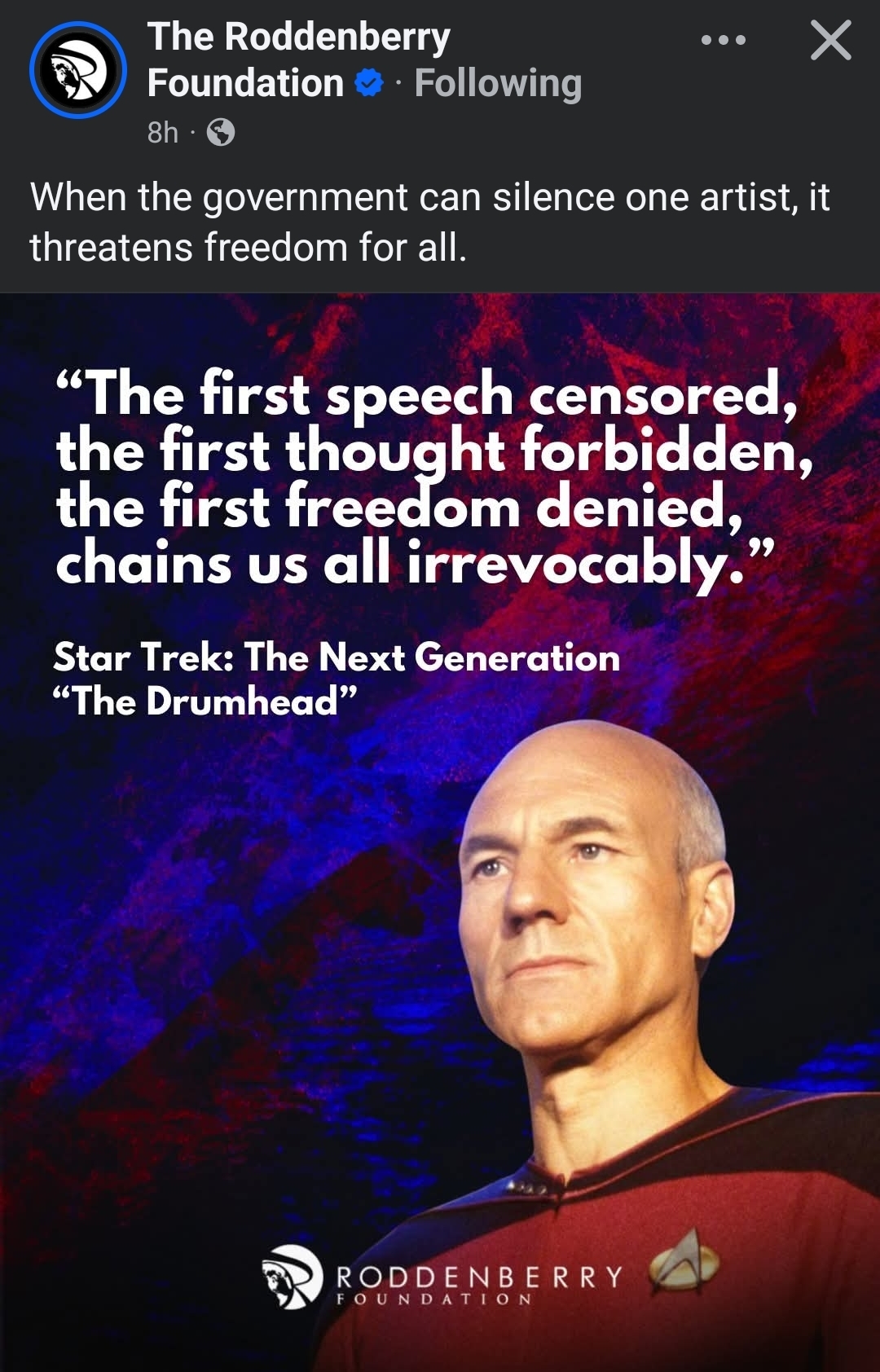
BTW, I love ST:TNG's "The Drumhead". Picard's speech during the trial was one of the series most powerful speeches (and lessons).
Eric Barrie
@Reply 13 months ago
Can someone explain this in Access terms? What does this mean for Dev 51?
Eric This is part of my Captain's Log, which is my personal blog here on the site. I write a little bit every morning about whatever happens to be on my mind that day. It usually takes me about 10-15 minutes with my first cup of coffee, and it helps jump start my brain and get me ready to be productive. It keeps me sharp, and I enjoy the thoughtful discussions that often come out of it.
Most of the people who stop by here are intelligent and curious, and I like having adult conversations about things outside of just computers. Social media is full of people yelling at each other in all caps, and this is a nice change of pace.
As for Dev 51, I'm still working on it. I'm getting a bit ahead on TechHelp videos first, and then I can shift my focus to more Developer-level lessons, SQL Server topics, and a few other projects I've got planned. My primary job is still making sure new TechHelp content keeps coming out regularly for the members, but this morning writing routine is just something I enjoy doing alongside that.
If the Captain's Log isn't your thing, that's totally fine, but that's what this is and why I do it.
Lisa Snider
@Reply 13 months ago
Richard Methinks, considering the source, it wasn't a coincidence. Just saying. ;)
Eric Barrie
@Reply 13 months ago
Richard Hey Richard! No misunderstanding on my end as my reply was totally satirical. Not sure if you keep up with sports, but when something major happens in the NBA, like the Luka Doncic trade for example, people will often respond to that news with "Can someone put this trade in NFL terms? What does this mean for the [Insert Random Sports Team/Person]." My apologies if this was juvenile; ultimately, just trying to make light of the situation.
Eric thanks for clarifying - I appreciate the explanation. I wasn't sure how to read it at first, since I do sometimes get the "stick to computers, not politics" type of pushback. That's why I explained why I write the Captain's Log in the first place: it's my space to stretch my brain a bit in the mornings, get some writing in, and have thoughtful conversations with smart people like all of you. It's not meant to be work-work-work all the time - like Jack Nicholson typed in The Shining, "All work and no play makes Jack a dull boy."
As for pro sports, I'll admit that's one arena I'm pretty clueless about. I played plenty of baseball and softball throughout my whole life, but I never got into following pro teams. There were a few years there where I watched a lot of Yankees games, but that's about it. Growing up in Buffalo, it was "Bills, Bills, Bills" all day every day, and honestly, that kind of burned me out.
I'd rather talk about databases, science, or Star Trek. Put a football group and a Star Trek group together in the same room and you'll see why I stay in my lane. Which sucks because most of the adult friends I met were from playing softball... and very few of them were into anything other than sports.
Anyway, thanks again for explaining the joke. No offense taken, and I'm glad we cleared it up.
Sorry, only students may add comments.
Click here for more
information on how you can set up an account.
If you are a Visitor, go ahead and post your reply as a
new comment, and we'll move it here for you
once it's approved. Be sure to use the same name and email address.
This thread is now CLOSED. If you wish to comment, start a NEW discussion in
Captain's Log.