There are many hypotheses in science which are wrong. That's perfectly all right: it's the aperture to finding out what's right. Science is a self-correcting process.
When I was in high school in the late 80s, the path was clear: smart kids went to college. I graduated high school in 1990, and like everyone else in the AP track, I was groomed for higher education. It wasn't really a choice - it was expected.
But once I got there, I realized quickly how far behind the classroom was. Computer Science 101 had us learning Pascal, which was already outdated, while I was teaching myself C++ at home. By the time a curriculum makes it through committees, textbooks, and professors, the tech world has already moved on. In IT, the real innovation happens in basements, consulting shops, and startups - not lecture halls.
Later, when I ran my own PC sales and consulting business and hired a dozen employees, the difference became obvious again. Candidates with degrees often knew less than the ones who had simply been in the trenches solving problems. A diploma never fixed a client's network outage. Skills did. And when I was the one being hired, none of my clients ever asked whether I had a degree. They wanted to know if I had experience, references, and solutions.
That's why I run my courses the way I do. I get asked all the time: "Do these classes count for credits?" or "Will this help me pass a certification?" My answer is always no. I don't teach for exams. Exams test your short-term memory. I teach for practical skill. Because in this industry, degrees are static. Certifications expire. Skills adapt. A computer science degree from 1995 is a relic. But SQL, VBA, networking, and real-world database design? Those skills keep paying the mortgage.
Now, I'm not saying degrees are worthless. If you want to be a neurosurgeon, you'd better have one. But in IT - especially if you're working solo or running your own shop - skills almost always beat degrees.
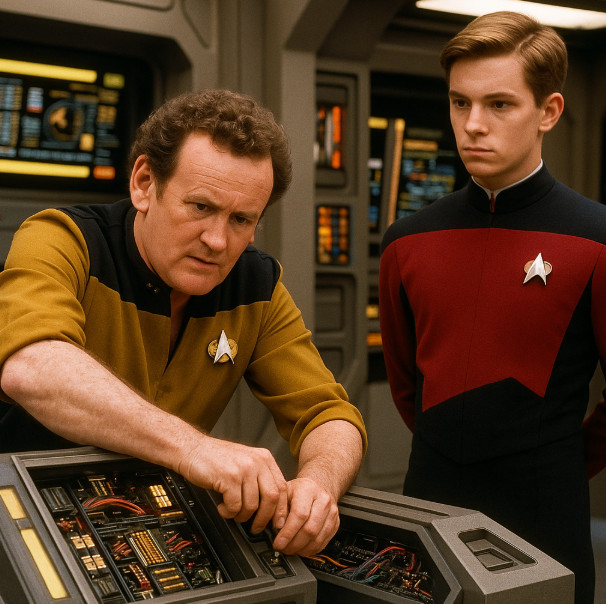
Even Star Trek knew this. Sure, Starfleet Academy turned out fresh officers. But when the transporter failed or the EPS conduits blew, who did everyone rely on? Chief O'Brien. He wasn't glamorous, but he was experienced. He had the scars to prove it. When things broke, you wanted O'Brien in the room - not a cadet with a diploma.
It is often the "average" kids who benefit most from college. Above-average kids may already know what it takes to make it in the real world, while below-average high-school kids may not be able to cope with the increased workload (and financial burden) of college. So it is the average kids who benefit: they have the bare minimum of qualifications to get in and handle college, and they will be able to learn what they couldn't learn in high school: what it takes to have the tireless, dogged spirit to pursuit knowledge no matter how hard -- reading books several inches thick (every day), doing big projects instead of "homework," knowing that failing a course means losing (big) money because college isn't free, etc. This kind of grueling exercise for four years COULD make a big difference to an average kid who might not get these lessons otherwise.
Regarding college courses becoming out of date when you graduate, that is true, especially in tech fields. But again, the grueling, 4-year exercise could still count for a lot in the growth of a young person. The real world's tough lessons -- hard work, team work, responsibility, etc. -- are things that often can't be taught or learned, but have to be experienced. College often provides a good "dry run" for real life. Nowadays, there is the common (?) desire to not go to college for one reason or another, and I worry about that. College still provides something crucial in one's life, namely education, as corny as it may sound. One may argue whether it is worth having a $40k student loan debt (or whatever the latest number is), but a good college education is still invaluable.
Donald Blackwell
@Reply 12 months ago
I'm not anti-college, however, I think there should be a bigger push for trade schools. There's still the book work but a higher push in actually doing it and getting the hands-on experience before being unleashed onto society "knowing it all".
The full "college" should be reserved for critical things like, as with what Richard said, advanced science, medical and research fields, legal, etc.
If the student hasn't figured out that doing the work is important by the time they finish high school, then no amount of schooling, college or otherwise will change that.
Gary James
@Reply 12 months ago
Richard, your blog really resonated with me. After graduating from a Cleveland Public Schools trade program in electronics in June 1968, I was staring down the possibility of being drafted and sent to Vietnam. After many summer nights spent thinking alone in the dark, I came up with a brilliant plan to beat the draft—I enlisted.
That decision, along with my electronics training in trade school and the Air Force, shaped my entire career. After completing my tour and a couple years in the Ohio Air National Guard, I landed a job with a Danish company in Cleveland repairing their sound and vibration analyzers. That led to a role at Keithley Instruments as a repair tech, then into engineering as an engineering technician.
From there, I moved to Gould Electronics, where—despite not having a degree—I was promoted to software engineer. When Gould was bought out and downsized, friends in the industry helped me land a senior software design role at IOtech. All of these positions, at major American electronics firms, came without a college degree—at a time when that was considered essential.
Eventually, I did earn my degree through evening classes, funded by the G.I. Bill. I share this as proof that determination, self-confidence, and a self-taught education can absolutely lead to a successful and fulfilling career.
>If the student hasn't figured out that doing the work is important by the time they finish high school,
> then no amount of schooling, college or otherwise will change that.
If high school graduates haven't figured it out, maybe it's because their high schools didn't prepare them well enough for that. Getting pat life lessons like "hard work = good" is no comparison to actually seeing serious, major-league hardship that you face only in real life. Until you actually face that, you have no idea what it is and don't really know how well you can handle it. And college, being the stage right before real life, is the only thing that approaches giving students a taste of that.
Kevin Yip
@Reply 12 months ago
Gary But you DID go to college. The training you got after high school until you had your first meaningful position, THAT was your "college." The point is that everyone needs an intermediate stage of "higher learning" between high school and the real world before the person has a shot of succeeding in life. For many it's college, and for others it's something else.
Donald Blackwell
@Reply 12 months ago
Kevin You missed that part where I said trade school, and for some, military, if that's what they feel is right for them.
There is a need for actual college (or University as some call it) but not for everyone.
Kevin I used to get the same pushback from my kids in high school when they were learning things like trigonometry. They'd say, "I'm never going to use this." My answer was that it doesn't matter if you ever use it again. The point is that it's teaching you how to solve problems: here's the problem, here's the formula, here are the steps. That process wires your brain to think scientifically, troubleshoot, and reason rationally. I actually have a whole Captain's Log planned on this. Sure, you might never need to calculate an arc tangent, but the real value is in learning the tools for problem solving. And of course, back in my day teachers used to warn us, "You're not always going to have a calculator in your pocket." Well... huh. Fooled you. Look who's talking now.
Donald I definitely agree that most kids would do much better in trade school.
Gary That is awesome, and it's exactly the point I was making. Your story shows perfectly how skills, determination, and the willingness to keep learning can carry you just as far - if not farther - than a traditional degree path. Thank you for sharing such a great real-world example.
Kevin Yip
@Reply 12 months ago
Donald But life IS for everyone, whether one likes it or not. If you go to trade school, you will still have to face the same grueling hardship from real life that Ivy League graduates will have to face, perhaps even harder. We all probably know this already, but I'm not sure the public at large does. Many people think they can just "take the easy way out," thinking real life will not catch up to them, but it always does. When someone like Richard dropped out of college, they did it because they had already built a foundation of knowledge of how to handle real life, and felt ready to take on the world. But many people drop out of college because they give up! This is why it is always a concern when the sentiment of giving up college comes up: it will only encourage more people to give up, especially the "average" kids who are on the fence but would most likely benefit from college. To people like Richard who have enough foundation to quit college, you DON'T need to tell them this anti-college speech! Their mind is already made up!
Kevin Yip
@Reply 12 months ago
Richard If high school kids said that to me, I would say that they may not need grade-school math in life, but it is a prerequisite for learning other advanced math fields (and even non-math fields) that they WILL need and use in life, unless they want a lifetime of menial work. Kids can be forgiven because they don't know how complicated life will get yet.
Sorry, only students may add comments.
Click here for more
information on how you can set up an account.
If you are a Visitor, go ahead and post your reply as a
new comment, and we'll move it here for you
once it's approved. Be sure to use the same name and email address.
This thread is now CLOSED. If you wish to comment, start a NEW discussion in
Captain's Log.