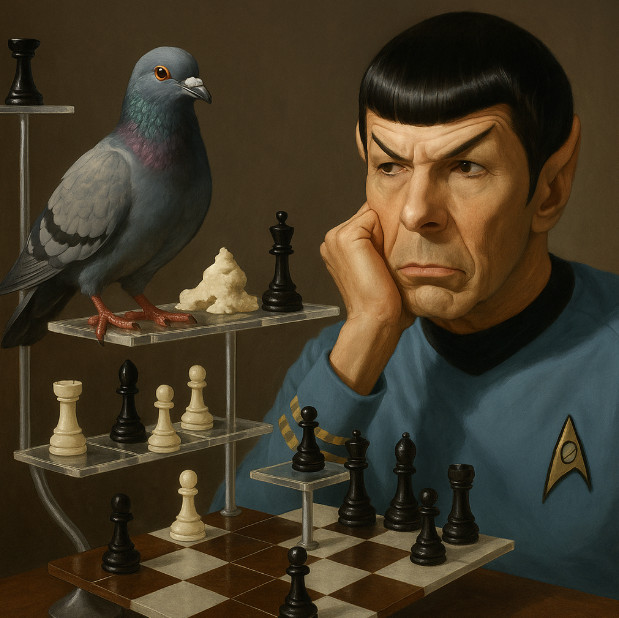
It is said that arguing with an idiot is like playing chess with a pigeon. They knock over the pieces, crap on the board, and strut away declaring victory. It's a funny picture, but also a troubling one. Because while evil is dangerous, stupidity can be even more so.
When someone is openly evil - a murderer, a liar, a cheat, a con artist - it's clear what side they're on. People can unite against them. History proves it: in World War II, the good of the world rallied together to defeat tyrants who threatened freedom on a global scale. Communities, nations, even rival powers found common cause in opposing something so unmistakably wrong. Evil is obvious, and because it's so visible, it often carries the seeds of its own destruction. The very nature of evil invites resistance, backlash, and ultimately downfall. However, as dangerous as it is, evil is not the greatest threat.
Stupidity is a different beast entirely. Society is strangely tolerant of it. We shrug off ignorance with a chuckle and say, "Well, they don't know any better." We excuse it instead of confronting it. We don't generally fault people for being dumb because it feels cruel, and so ignorance is allowed to fester unchecked. The real danger is that a stupid person isn't just uninformed - they're also closed off to reason. You can't argue with them, because logic and evidence don't stick. They double down, they move the goalposts, they dismiss facts they don't like. And unlike evil, which can be recognized and opposed, stupidity hides behind good intentions or plain obliviousness. It slips past our defenses, because we underestimate just how much damage it can cause when it's stubborn, loud, and immune to persuasion.
That's why stupidity is so dangerous - because it becomes a tool for evil. Evil rarely acts alone. It needs foot soldiers, amplifiers, and enablers. A tyrant can't rise without people willing to cheer him on. A con artist can't thrive without marks who never ask questions. A corrupt executive can't push through a foolish deal without board members too dim or distracted to see the trap. Stupidity provides the cover, the manpower, and often the votes that evil needs to succeed. And the worst part is, the people being used often think they're acting in good faith. They believe they're doing the right thing, when in reality they're just carrying water for someone else's scheme.
Hackers and scammers thrive on this exact dynamic. The evil is in the phishing scheme, but it only works if someone is dumb enough (or careless enough) to click the link. You've seen those social media "fun quizzes" that ask for your mother's maiden name, your first car, or your favorite pet. That's not harmless - those are the same questions banks use for security. Or you'll get an email from what looks exactly like your bank's website - except the domain name is one letter off. Evil designs the trap, stupidity springs it. And the fallout isn't just embarrassment, it's stolen money, stolen identities, and real-world damage. Worse yet, once the hacker is in, your computer can become the host for their virus - hijacked to send spam, spread malware, or take part in massive DDoS attacks. In other words, stupidity doesn't just hurt you - it strengthens the hacker.
Years ago, not long after I started my video tutorial business, when I was still doing software consulting, a student sent me a database to "take a quick look at." Now, I had a personal rule back then: never just open someone's Access file without first checking under the hood. So I peeked into the VBA code - and sure enough, I found some malicious routines buried in there. If I'd just opened it blindly, it would've trashed my system. That was the day I made a stricter policy: no more free attachments, period. If I'm looking at your database, I'm charging you for the 15 minutes it's going to take to make sure it's safe first. His whole scheme depended on someone being careless enough to just click and trust. The code was harmful by design, but the whole scheme only worked if the recipient was careless enough to open it. (1)
This type of "evil taking advantage of stupid" dynamic is everywhere in life once you know to look for it. You see it in business. A toxic executive doesn't usually swing the axe himself. He whispers in the ear of a gullible middle manager, who then enforces bad policies with a smile, convinced he's "just doing his job." The executive gets his way, the manager thinks he's being loyal, and the employees and customers are the ones who suffer. Layoffs happen, corners get cut, quality drops, and morale tanks. The evil plan only works because someone foolish enough went along with it. "I need you to lay off 5,000 workers and approve this $2 million bonus package for me," the CEO says. And the manager, instead of questioning it, nods and signs the paperwork. Evil doesn't need to twist arms when it can simply find someone too naive, too ambitious, or too dim to realize they're being used.
You see it in personal life. Everyone knows that one friend who isn't malicious, but always ends up being the pawn because he's just not the sharpest tool in the shed. They lend money that never comes back, get talked into errands that aren't their responsibility, or carry messages in someone else's drama. They mean well - sometimes they've even got the biggest heart in the room - but that makes them easy prey. The evil friend doesn't have to do much: just tug the right strings, stroke the ego a little, or play on guilt. Before long, the "nice guy" is worn down, taken advantage of, and left holding the bag. That's the trap of stupidity mixed with good intentions: it isn't mean, but it's malleable, and evil loves nothing more than clay it can shape.
The slick fitness influencer records a video as he struts through the grocery store, phone in hand, pointing at everyday foods and calling them "toxic." Bread? Poison. Milk? Garbage. Cereal? Practically death in a box. He scares people out of common sense while conveniently pushing the miracle powder, supplement, or detox tea from his own online store. The grift works because his audience isn't evil - just gullible enough to believe him. He makes millions, his followers waste money and ruin their diets, and the cycle repeats. Evil cashes the checks, but it's stupidity that opens the wallet.
You see it in religion. History is full of clever leaders who wrapped themselves in divine authority and convinced followers to march into wars, join crusades, burn books, or persecute neighbors. Few of those leaders lifted a sword themselves. They didn't need to. Convincing others to act was enough. Religion is full of shepherds who fleece their flock - standing in front of packed arenas every Sunday, preaching fire and brimstone while convincing grandma to empty her wallet even though she can't afford her heating bill. Then the preacher climbs into his tax-free private jet and flies away, paid for by the sacrifices of people who trust him.
And of course you see it in politics. Demagogues thrive by manipulating the gullible. They shout in simple slogans, point to imaginary enemies, and ride the wave of uncritical support straight into office. History is full of strongmen like Hitler and Mussolini who bent crowds to their will and built empires of destruction on the back of mass stupidity. Evil doesn't seize power alone - it rallies the stupid to do the heavy lifting. But sometimes the face of power isn't the mastermind at all - it's the puppet. A popular figure with charisma, or a knack for stirring crowds can be just as manipulable as the audience he entertains. Handlers feed him lines, whisper targets in his ear, and let him play the showman while they pull the strings behind the curtain. He thinks he's leading, the followers think he's brilliant, but in reality he's just another fool marching in front of someone else's parade.
Even Star Trek warned us about this. Think about Khan. He was brilliant, charismatic, and manipulative. His genetically engineered crew followed him with absolute loyalty, even when it meant marching into disaster. Joachim, his own number one, tried at one point to reason with him. But by then Khan was consumed with vengeance against Kirk, and nothing would sway him. The irony is that these were not stupid people by any normal measure - they were genetically engineered superhumans, superior in strength and intelligence to ordinary humans. But compared to Khan's towering intellect and ruthless focus, they were naive children. Their loyalty made them blind, and their brilliance only amplified the reach of his obsession. In the end, their downfall was because they followed a leader they could never match.
The lesson is sobering: Evil is dangerous, but stupidity weaponized by evil is catastrophic. You can resist a villain. You can argue with a skeptic. But when ignorance and malice team up, the results can topple civilizations.
So what's the antidote? Education. Not just memorizing facts or passing standardized tests, but true education - the kind that trains people to think critically, to question, to test ideas against evidence. From the earliest years, kids should be learning the scientific method, logic, and reasoning. And alongside that, we need philosophy to sharpen moral judgment, and history to recognize when old mistakes are about to repeat themselves. Armed with those tools, people are much harder to manipulate. They're less likely to fall for demagogues, snake-oil salesmen, or false prophets. Education builds citizens who can tell the difference between charisma and truth, between a leader and a con man. Evil thrives when stupidity follows blindly.
So how do you even debate stupidity? You can't win with facts alone, because the stupid person isn't listening. They think "doing their own research" means scrolling TikTok or parroting something they skimmed from Bob's Conspiracy Site. They don't know how to weigh evidence or separate sources. They don't even know how to read the abstract of a scientific paper (let alone the paper itself). You can't just drop a data dump and expect a breakthrough. That's where the idea of micro-inoculations comes in. The concept, borrowed from psychology, is that you don't flip someone's worldview in one shot. Instead, you plant small seeds of truth. Little questions. Simple facts. Things that make them pause and think, "Hmm, maybe this guy has a point." Over time, those small doses of reason can build up like antibodies against nonsense.
The only real defense against evil and stupidity is a society that knows how to think for itself.
(1) This was back in the Access 2003 days, before Microsoft introduced Trusted Folders in Access 2007. Back then, if you opened a database with embedded code, it just ran. No warnings, no protections. Unless you took the time to inspect the VBA yourself, you were basically on your own. But, obviously, this dude didn't know who he was messing with [flexes biceps]. LOL.
I agree 100% with everything you said. And if people would just ask themselves... WHY are some people so intent on destroying public schools? This is exactly the reason. This is the reason EVERY person should be fighting to defend public schools. Private schools have their own agendas, and sadly, many times it is to teach only what they want people to know. Do you think we learned in Catholic school anything about the crusades and their cost in human lives to indigenous peoples around the world? There was a scene in The West Wing, written by Aaron Sorkin, that we all should take to heart. "Education is the silver bullet. Education is everything. We don't need little changes, we need gigantic, monumental changes. Schools should be palaces. The competition for the best teachers should be fierce. They should be making six-figure salaries. Schools should be incredibly expensive for government and absolutely free of charge to its citizens, just like national defense. That's my position. I just haven't figured out how to do it yet."
Kevin Yip
@Reply 12 months ago
Richard We can't entirely blame this on stupid people and lack of education. The evil-doers you mentioned may also be educated, or even highly so, but still choose to do bad deeds. Their followers may also be highly educated and choose to follow the evil-doers. It's not as if good and evil people go to different schools; we all go to the SAME schools and receive roughly the same education. Yet some people choose to commit frauds (Enron, Elizabeth Holmes, etc.), cheat in sports (Lance Armstrong, etc.), etc. There is a fundamental human fallacy (or nature) in this phenomenon. You can teach people the "right" lessons and they may still do bad things.
Lisa I love The West Wing, although I have to admit I did not watch too many episodes when it was on originally. It is one of those shows I have always meant to go back and watch. The ones I did catch in reruns, I really enjoyed. And yes, I agree 100% - we need to invest more in the future, and teachers definitely deserve to be paid better. I have no idea what administrators do to earn their salaries, but the teachers on the front lines are the ones shaping the next generation, and they deserve far more recognition and compensation.
Kevin I have come to realize there will always be a small percentage of people who are simply evil. That is just part of human nature. Thankfully it is a very small group, but they can be very smart. Look at some of the most notorious serial killers. Brilliant and evil. The point of my article was not about them, but about the larger group of people who are not evil but just stupid. Those are the people the evil ones can manipulate into doing their bidding. If we can educate the non-evil but naive, we stand a much better chance of resisting the truly bad actors.
I really do believe that the majority of people are good at heart. That has been baked into us over hundreds of thousands of years of evolution. Our ancestors who cooperated and formed tribes thrived and reproduced, while those who were antisocial or cruel were pushed aside. Even today, with billions of people, the truly evil are still a very small fraction. But the only way society can effectively stand against them is through education. It is like herd immunity with vaccines: you cannot stop disease unless enough people are vaccinated. The same principle applies here - you cannot stop evil unless enough people are educated.
Kevin Yip
@Reply 12 months ago
Richard Au contrare, "evil" exists in all of us. All of us have "dark sides," base instincts, id and ego, both rational and irrational thoughts, etc. We all have the capability to do bad deeds, just as we have it to do good ones. Crimes are committed by all kinds of people: smart, super-smart, dumb, psychopathic, etc. Also, we can't define anyone as merely dumb or smart, as there is a spectrum and gradation. If only dumb people caused problems in our world, we would have a lot fewer problems than we do now. Problems are caused by "all of us," and we greatly outnumber all the dumb people. WE are our own enemy. Our world is what we make of it. So in a topic like this, all I can say is that I try to be the best that I can be, and hope everyone in the world does too.
Kevin of course you are right that evil exists in all of us. It is an oversimplification to divide people into neat boxes of evil vs good, or smart vs dumb. Life is not black and white. When you are a kid you think that way, but as you get older you start to appreciate the shades of gray. Nobody is 100% pure evil or 100% pure good, just like nobody is 100% smart or 100% stupid. Well, I could make some comments about a few people I know, but I will keep that to myself. LOL.
Exception: you're playing D&D and you're a Lawful Good Paladin or a Chaotic Evil Necromancer. :)
The truth is crimes and mistakes happen all up and down the spectrum. Sometimes good people make bad choices, and sometimes people who have done terrible things also do something redeeming. Words like "evil" and "stupid" are just overgeneralizations for the sake of argument.
What I do believe is that most people, by their very nature, want to cooperate and help each other. Evolution shaped us that way. If you saw someone in need, chances are you would step up and help. That is why I am generally optimistic that the common good outweighs the common evil.
And as far smart vs dumb, I fully believe education can redeem those who might be considered "stupid." I do not mind someone who simply does not know something but wants to learn. Heck, that's what I do for a living - helping people who want to learn and improve themselves.
What I can't stand are people who are willfully ignorant - who have no desire to improve themselves. That is what really irritates me.
Matt Hall
@Reply 12 months ago
I think when we are discussing the nature of people, the shades of gray are understood and presumed to be built into the conversation. It is like when solving calculus problems, the associative properties of addition and multiplication are understood and presumed to be built into the problem. We don't explicitly declare that to be part of the solution.
To your point about the relationship between evil and ignorance, I believe that there are people who are both smart (people with the educated-ignorant balance beyond the tipping point to be regarded as generally educated) and evil (people with the evil-good balance beyond the tipping point to be regarded as generally evil) that recognize the point that you are making. The goal seems to be to degrade the education of people to the point that there are more ignorant people available to be co-opted into their army of useful idiots.
As for the willfully ignorant, they seem to posses a mix of narcissism and ignorance. I think this is a result of popular culture lionizing ignorance and narcissism over the last 30 years.
In my opinion, in much the same way that intellectual education can combat ignorance, moral education can combat evil. I think that we have lost emphasis on the moral education of our youth in recent years.
Matt Hall
@Reply 12 months ago
For clarity, in my mind this is a 2 dimensional conversation. If you plotted people on a chart, good would be at the top, evil at the bottom, ignorance on the left and enlightenment on the right.
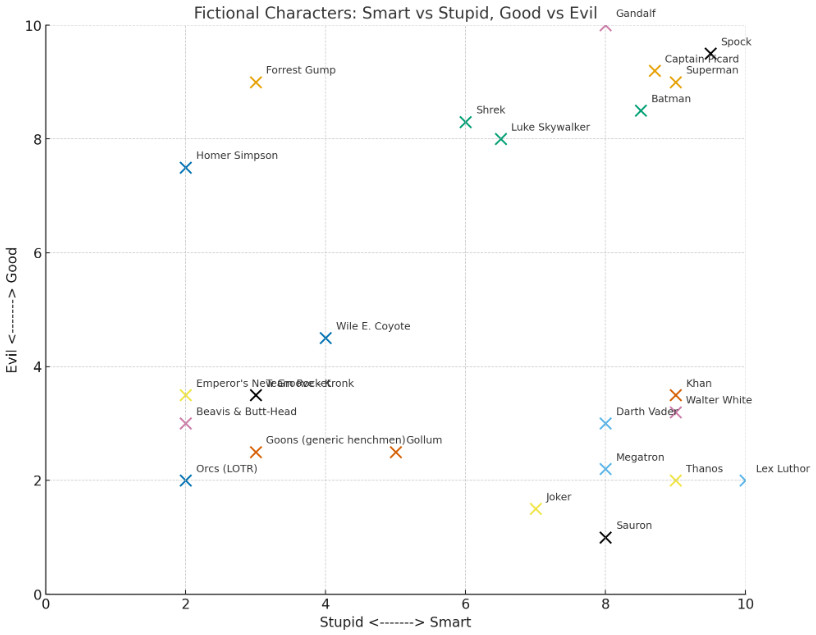
I asked ChatGPT to generate me a chart with good vs. evil on one axis and stupid vs. smart on the other, including a bunch of fictional characters. The results are quite interesting, although I don't think that Beavis and Butt-head belong where they are. They're not really evil; they're just incompetent. So they're definitely too high on the smart/stupid axis. But they could be higher on the good/evil axis.
Matt Hall
@Reply 12 months ago
I like it. The fictional characters make it interesting for pondering. I would have guessed batman to be smarter on that scale and superman to be higher on the good scale. I agree with your thoughts on Bevis and Butthead.
Michael Olgren
@Reply 12 months ago
Great initial points and discussion. Although I agree education should help, I believe that we all have an Intelligence score as in D&D, and that score is fixed (not like D&D). I believe that some folks just cannot be taught beyond a certain level. I have met many of these folks over a long career that involved teaching. Most of us have probably heard "you can't teach common sense." Believing this, I cannot hold those folks accountable for not understanding when Evil uses them. But yes, everyone should be educated in critical thinking to *their* maximum level.
As a sidenote, I believe the number of Evil people in the US is increasing. Chaotic Neutrals have seen that being Evil has many benefits without consequences, so they are sliding over. If *true* faith was more prevalent, this would be less likely to occur, but as Rick pointed out, our religions have been sliding too. The only way to stop this, IMHO, is for Paladins to start kicking butt.
Matt Hall
@Reply 12 months ago
Michael , I have recently come to agree with your assessment of IQ as a potential. If the willfully ignorant had been morally educated to overcome their narcissism, they would be more likely to reach their intellectual potential.
I think that evil always has consequences. People lacking a moral education just can't see it.
Kevin Yip
@Reply 12 months ago
Michael To your point about the "ceiling" of intelligence that some people have, many people are just slower learners. If they never stop learning, their ceilings can always be raised. But what usually happens is that their ceilings cannot be raised at a pace that would keep up with the increasing challenges; so it would seem that their ceilings have never been raised. So the key is to make slow learners become fast learners -- by teaching them better ways to learn. This is the one thing our education system doesn't do, other than feeding information to students and expecting them to take it all in. When I see people like Einstein or Newton, I don't think about whether their ceilings are off the charts or not; I think about whether they had found ways to become great learners and thinkers during their lives.
Many excellent points, gentlemen. As someone who is an educator myself, I like to think that anyone can learn anything given enough time, the right approach, and a teacher that reaches people how they need to be reached.
I had subjects in high school and college that I absolutely hated, but the teacher was so good that they drew me in. On the flip-side, I had subjects that I loved (computer science for one) with teachers who were boring as Eff and I ended up dropping the course because I was bored and hated the instructor. So that's one of the reasons why I try to keep my stuff as entertaining as possible. Keep their attention and make it fun, and people stick around.
Michael Olgren
@Reply 11 months ago
Kevin We can agree to disagree. We do agree that people learn more with the right teacher, environment, etc. I still think that we all have a ceiling somewhere. Some people, no matter the teaching, time, and environment, are not going to be rocket scientists. That said, I also believe that finding that ceiling is very tricky, and IMHO, a fool's errand bc you shouldn't stop trying to educate, in general. However, realizing that a person is not going to understand your point (the pigeon on the chessboard) will help you retain some semblance of sanity in our current insane conditions.
Donald Blackwell
@Reply 11 months ago
My 2-Nickels (since apparently here in the U.S. we don't make cents anymore), I believe everyone has very good points. To Michael's latest, I think everyone has a ceiling but that ceiling is different for different topics as well.
Someone may have a low ceiling for some subjects, while having an extraordinarily high ceiling for others. And sometimes, it's like a jigsaw puzzle. A classic example is taking a student athlete struggling with algebra but they find that one teacher/coach/tutor or whatever who can get the pieces to click by relating a formula to figuring out how many points their team needs to win the game.
And, yeah, that doesn't mean they'll become a neurosurgeon or rocket scientist, but that little change in the rubik's cube of learning may raise the ceiling in other subjects.
It just goes back to the fundamental foundation of people learning critical thinking and reasoning skills because if they can't figure out what 157 x 295 is because it wasn't in the multiplication table their 3rd grade teacher made them memorize, then they'll never get life.
Donald Blackwell
@Reply 11 months ago
I'll add that, sometimes, it's less of a ceiling than an escape hatch. Both figuratively and literally.
On a more tragic example (not specifically science, math or education, but still a tragic lesson to learn), many, many years ago, I had friends that used to go out every night, clubbing, drinking, partying, driving home in the wee hours of the morning often likely over legal limits. Then, one morning they wake up with a notice from police that their parents had been involved in a major accident; they had been T-Boned by a drunk driver. Their father was paralyzed and passed less than a year later from complications and their mother, still suffers from her injuries more than 5 years later.
The point being, sometimes something has to happen for the "student" to be willing to open that hatch and learn. In my friends' case, on of them quit drinking all together, and the other at least finally quit drinking and driving.
I know, not directly on topic but, the point of sometimes needing a "catalyst" to break through the ceiling/hatch.
Donald - That story resonates with me. A little over five years ago, after a Super Bowl, my now wife (then girlfriend) and I had a few too many at a local bar. I was sucker punched and ended up in the hospital, losing vision in my left eye. That night was a catalyst for me - you won't find me out late at bars anymore. I've cut back on drinking a lot. These days I might have a drink or two on vacation or for a special occasion, but that experience was definitely a life changer for me.
Donald Blackwell
@Reply 11 months ago
Richard I actually had a comparable occurrence in 2008...
My date and I were at a night club. Walked out the front door and there was a fight going, nothing to do with me but since I didn't see it, walked out the door and got clocked. Not as bad as you... woke up in hospital with a concussion...
Only major loss, if you can call it that, was date left with someone else instead of going to hospital with me. Definitely better off without that one, lol Don't need that in my life anyway.
Damn - yeah that sucks. Fortunately my girlfriend stuck with me - which is one of the reason's she's my wife today. :)
But it made me realize that if I was not inebriated, I might have had a slightly faster reaction time to move out of the way or raise my hands to block, but nope... I didn't see it coming and the douchebag clocked me right in the side of the temple. He actually hit her first, then as I turned to look at her, he hit me. Classy guy.
Sorry, only students may add comments.
Click here for more
information on how you can set up an account.
If you are a Visitor, go ahead and post your reply as a
new comment, and we'll move it here for you
once it's approved. Be sure to use the same name and email address.
This thread is now CLOSED. If you wish to comment, start a NEW discussion in
Captain's Log.