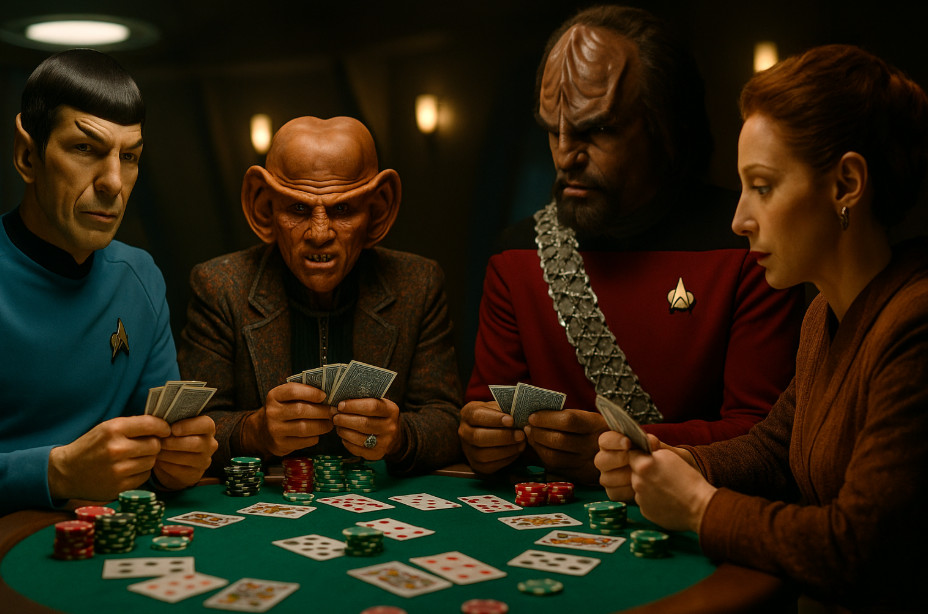
It's Sunday, and on Sundays, I like to get a little more philosophical. Maybe dive into some other topics like politics or religion. You know, those "taboo" topics. Today I'd like to talk about Pascal's Wager. It has always fascinated me because it's less about religion and more about risk management. Blaise Pascal basically said that even if you can't prove that a god exists, it's safer to believe, because if you're wrong you lose nothing, but if you're right you gain everything. That's not faith. That's math. And it's also a lesson for life, business, and technology.
Take PC backups, for example. You might never lose your data. You might go years without a corruption, crash, or accidental delete. But do you really want to bet your entire system on that assumption? Setting up automatic nightly backup is your version of Pascal's Wager. If nothing goes wrong, you've lost a few minutes and a little disk space. But if disaster strikes, you've saved yourself from total annihilation. And if you're one of those people who says, "I've never lost a file," congratulations - you're statistically overdue. (1)
It's the same logic as wearing a seatbelt or buying insurance. You're betting on a safer outcome, not certainty. We do this all the time in everyday life without even thinking about it. We buy health insurance hoping we never need it. We pay for car insurance and hope we never crash. We install smoke detectors, not because we expect a fire, but because the cost of being unprepared is too high. Nobody enjoys paying for coverage they may never use, but that small ongoing cost is a hedge against catastrophic loss. It's the only product you buy hoping you never have to get your money's worth. The same principle applies to your data, your business, your health, and pretty much every other part of life where prevention is cheaper than regret.
In fitness, the Wager applies too. You might never develop heart disease, but would you rather gamble your health on that? A few minutes a day of exercise and a balanced diet are your insurance policy. In business, it's having savings, redundancy, and disaster recovery plans. In politics, it's building systems that protect against the worst possible disasters - not just assuming that "it can't happen here."
Of course, Pascal's argument falls apart when you ask which god you're supposed to bet on. If you pick the wrong one, you might annoy the real one. Believe in Zeus and maybe you anger Thor. Believe in Thor and maybe you get smited by Ra. It's like divine rock-paper-scissors with eternal consequences. That's the fatal flaw in the Wager: it treats belief as a safe bet when there's actually a casino full of competing alternatives, each with different odds.
And besides, you'd have to assume that if an omniscient god existed, he could see right through such a ruse. If your belief is just a pragmatic insurance policy, he'd know it. You can't exactly bluff an omniscient opponent - it's like trying to cheat at poker with someone who can see your cards. You're not demonstrating faith - you're hedging your bets. Any god worth the title would see that kind of hollow calculation for what it is. Of course, that also assumes that such an omniscient being actually exists.
Pascal also assumes that belief costs nothing, but that's rarely true. Religion often asks for real commitments of time, money, and devotion. Many people find great value in that, but for others, those obligations can come with real costs that aren't always acknowledged. If this life is all you get, that's a steep price to pay just for hedging your bets on the next one. The Wager pretends belief is free, but it can be one of the most expensive investments you'll ever make.
Then there's the problem of evidence - or rather, the lack of it. Pascal's logic tells you to believe because of what you might gain, not because the claim is true. That's like believing in dragons just in case they're real and you are crunchy and taste good with ketchup. It reduces belief to a game of odds instead of truth. The real world doesn't reward people for what they believe - it rewards them for what they can prove, build, and test.
And finally, there's the mathematical problem. Pascal treats infinite reward as an automatic trump card, but if multiple religions offer infinite rewards or punishments, the equation breaks. Infinite rewards cancel each other out. You can't rank infinities, so the "expected value" logic falls apart. In other words, once you have more than one god in play, the logic collapses under its own weight.
The real moral of the story is that Pascal's Wager only looks wise if you blur the line between real risk and wishful thinking. It's smart to hedge your bets against things we know can happen - drive carefully, buy insurance, save money, back up your data, take care of your health. Those are measurable risks with mountains of evidence behind them. But believing in a god "just in case" isn't risk management - it's treating faith like a gamble instead of a conviction.
Faith can have real value if it brings comfort, community, or meaning to your life, and that's perfectly fine. But we shouldn't treat scripture like an actuarial table or a science textbook. It's one thing to find peace in belief, and another to use belief as a substitute for evidence. We have centuries of proof that hard drives crash, economies fail, and bodies age. Entropy always wins, and it doesn't take faith to believe in that. What we don't have is a single verified example of divine punishment for disbelief. Preparing for the real world is rational. Wagering on unproven possibilities is not.
And you might think this is a criticism of religion itself, but that's not the purpose behind this article. Faith is fine. If belief brings you comfort or connection or a sense of purpose, that's a good thing. What I'm criticizing is the idea of believing "just in case" - treating faith like a safety net instead of a conviction. That's the flaw in Pascal's Wager. Belief should come from sincerity, not strategy.
This is not about tearing down religion - it's about being honest with ourselves about why we believe. Personally, I think humanity is at its best when we celebrate our differences - whether it's food, music, philosophy, or belief. Every culture adds something unique to the mix. As Spock once said, invoking the Vulcan IDIC - Infinite Diversity in Infinite Combinations - the beauty of existence is found in its variety. Just like Star Trek's universe thrives on the coexistence of countless alien species, our world thrives when we appreciate the many ways people find meaning.
My response to Pascal would be (if I were his contemporary): you can believe God all you want as long as you give diligent efforts in proving God's existence or otherwise. If you only have blind faith and do nothing but hoping that God exists, that's hardly constructive. Scientists, the supposed non-believers, are the ones who have actually explored the natural world and beyond, and thus are the best-qualified to say if God or any intelligent life exists outside Earth or not. Another nuance in this kind of debate is that we only need to "sufficiently prove" if God exists or not.
I've mentioned this example here before. Suppose you need to know if a bear is inside a cave or not without actually going inside it. You set up surveillance cameras outside the cave 24/7. You put powders near the cave to catch any footprints. After days or weeks with no sign of bears, you have "sufficiently" proven that there is no bear, or if there is one, it has died of hunger. Nobody is going to say, "But guys! We haven't even been inside the cave, so we don't know for sure!" Everyone has already packed their bags and moved on to other projects. This is basically the crux of any scientific endeavor. We don't need absolute proof to do anything when it comes to science. We only need "sufficient proof." That's why medicine has tons of side effects and we still use it, and software has lots of bugs and we still use it. To "sufficiently prove" God doesn't exist, we don't need to reach every corner of the universe and multiverse. Nowadays, with the level of science we have, we can "safely" bet on the exact opposite of what Pascal would bet on.
What if the cave has a secret, hidden, back entrance that only the bear knows about? :)
(BTW: I agree with you, I'm just playing Devil's Advocate.)
Kevin Yip
@Reply 12 months ago
We can look for other cave entrances, use baits, consult biologists on bear habitats, history of bear sightings, etc. We may never get the absolute truth, but with diligent effort, we'll be closer and closer to it, eventually reaching a point where we can sufficiently declare an acceptable conclusion.
There used to be tons of alien abduction stories in decades past. But ever since cellphones became widespread, all abduction stories have ceased to exist. That's because if someone claims to have been abducted, he'll be asked, "Where was your phone, and why didn't you take a picture?" The die-hards will continue to believe in alien abduction. But any average person nowadays knows this belief is basically "sufficiently" debunked.
Michael Olgren
@Reply 12 months ago
Kevin Sorry, but as a scientist, I believe that "sufficient proof" just temporarily allows us to believe something is true. History is rife with examples of things we thought were sufficiently proven, only to find out later that we didn't know enough to know that there was indeed "another entrance to the cave." To prove God, you have to know everything. We will never achieve this, so I do not believe we will ever *prove* or disprove God's existence. To believe we (humans) have unlimited capabilities is the ultimate hubris, recognized in tales (Icarus, Odysseus) from ancient times.
Michael Olgren
@Reply 12 months ago
Richard More than half the world believes in the same God. Christianity, Islam, and Judaism all start with the same God. I'm betting that's the God referenced by Pascal, since that gives the best odds. I do agree that just picking a god as a backup plan is not really a viable choice for salvation.
Kevin Yip
@Reply 12 months ago
Michael But "sufficient" scientific proof is a pretty high standard. It doesn't mean accepting something that is false, or accepting something that is true and later proven to be false, which would never happen. That is the beauty of science: an proven scientific truth, no matter how empirical or "basic," is an objective proof that will never be undone. After Newton discovered his laws of motion, they stay true up to today, even after Einstein discovered his theories of relativity that function where Newton's laws fail. Newton's laws are still true here on Earth, and they are "sufficient" for our everyday applications. Einstein's theories simply added to the knowledge, and became a "superset" of Newton's knowledge. Therefore, Newton's laws (and many like them) are an example of "sufficient proofs". Nobody in Newton's days would say, hey, we'd better wait till better theories before doing anything.
Kevin I think you nailed it with your point about science being a process of refinement, not replacement. When Newton's laws gave way to Einstein's, and then Hawking's, it didn't mean Newton was wrong - it meant we learned more. Science isn't about declaring ultimate truth - it's about building progressively better models of reality. Every "law" is provisional, contingent on the evidence we have so far.
That's one big difference between scientific and theological reasoning. Science evolves because it can be tested, falsified, and updated. Faith, by definition, can't be. That's why I agree with Michael that we can't ever prove a god doesn't exist - but that doesn't mean we should fill that uncertainty with assumptions. You can't prove there's no Celestial Teapot orbiting Mars either, or that the Flying Spaghetti Monster isn't secretly pulling the strings. The burden of proof always lies with the person making the claim.
The real problem with "the god" question is definitional. Ask ten people what "god" means and you'll get ten different answers - creator, energy, consciousness, personal deity, metaphor for morality. Before you can even discuss existence, you have to define what you mean. Otherwise, we're debating fog. Once you start assigning attributes - omnipotent, omniscient, benevolent - then logic can enter the conversation. Can an all-powerful being make a rock too heavy for itself to lift? Can omniscience coexist with free will? These aren't cheap "gotchas" - they're demonstrations that some definitions of "god" contain contradictions by their own logic.
This is where, when people refer to holy texts, you can actually take a closer look and analyze them logically. You start to notice internal contradictions, inconsistencies in definitions, and stories that simply don't align. That doesn't have to be disrespectful - it depends on how you approach it. You can take scripture on faith as divine inspiration, or you can claim it's the literal, infallible Word of God. But those are two very different positions. If you treat it as allegory, it becomes a collection of moral lessons and cultural insights. If you treat it as literal truth, then it's open to factual and logical scrutiny. Either way, at least you now have a defined framework to discuss and evaluate, instead of an undefined, amorphous idea of "god" that shifts depending on who's speaking.
And that's where science's humility is valuable. It doesn't claim absolute certainty, only sufficient evidence to justify confidence. We accept vaccines not because they're perfect, but because the weight of data overwhelmingly supports their safety and efficacy. When something goes wrong, scientists don't say "mystery of the universe" - they investigate, revise, and learn.
That's how I see belief systems too. They're hypotheses about meaning and existence. Some are poetic and inspiring, some are rigid and exclusionary. But without evidence or falsifiability, they remain in the realm of personal conviction, not universal truth. And that's fine - as long as we recognize which is which.
If you are a Visitor, go ahead and post your reply as a
new comment, and we'll move it here for you
once it's approved. Be sure to use the same name and email address.
This thread is now CLOSED. If you wish to comment, start a NEW discussion in
Captain's Log.