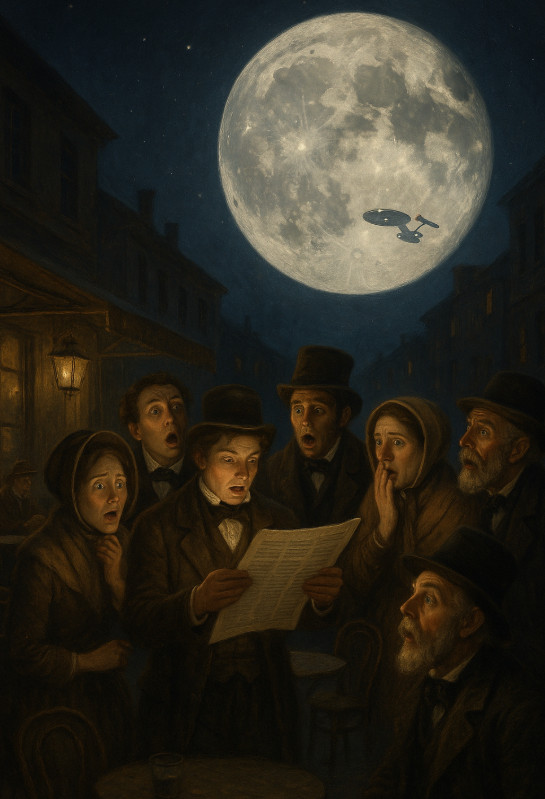
In 1835, the New York Sun pulled off one of the greatest hoaxes in journalism. They published a series of articles claiming that an astronomer using a powerful new telescope had discovered life on the moon. The stories described lush forests, unicorns, bipedal beavers, and most famously, winged humanoids called "Vespertilio-homo" - basically bat-people. Readers were captivated. Circulation exploded. Nobody wanted to believe it was fake. It turns out, humans have always been suckers for a good story.
What fascinates me about the Great Moon Hoax isn't the lie itself, but how easy it was for people to fall for it. There was no telescope powerful enough to see a bat-man colony. (1) There were no photographs. But because it was printed in a newspaper, people accepted it as fact. Sound familiar? The 1835 equivalent of clicking "share" before checking the source.
As a database guy, this reminds me how easily garbage data can spread. If you put junk in a table, queries and reports will happily regurgitate that junk with an air of authority. (2) The format gives it legitimacy. In Access or Excel, a number looks official because it's in a box. I've seen more than one spreadsheet treated like holy scripture just because it had a header row and some color-coding. In media, a sentence looks true because it's in print. But formatting doesn't equal truth. Data validation matters - whether in software or society.
We haven't learned much since 1835. Today, we still see modern versions of moon hoaxes. Viral posts claiming vaccines contain microchips or cause autism. Politicians spreading conspiracy theories that wouldn't fool a middle school science class. TV preachers claiming divine guidance on political choices. It's the same psychology: we love stories that confirm what we already believe, even when the evidence is nonsense.
In consulting, I've seen a similar pattern with clients. Someone builds a database that "works," so they assume it's correct. I once had a client who insisted her sales report was accurate even though the totals changed every time she opened it. She believed the numbers because the computer told her so. When I showed her the missing joins and bad criteria, she looked genuinely betrayed. Belief is powerful - even in Access.
The same bias shows up in health and fitness. People jump on miracle diets or supplement fads because they promise easy results. We crave shortcuts, not science. "Lose 20 pounds in a week!" sounds a lot more appealing than "Eat right and lift weights for the next six months." Our brains are wired to prefer the fantasy of the moon-bat-people version of reality. If kale tasted like donuts, we might have a fighting chance.
Politically, we still fall for shiny distractions too. Entire movements form around false narratives because they offer belonging and purpose. Belief feels good. But truth requires work. That's probably why so few campaign slogans include the word "homework." Truth demands humility and the willingness to say, "I might be wrong." That's harder than shouting in ALL CAPS on social media.
So what's the moral of the Great Moon Hoax? Don't outsource your thinking. Whether you're reading an article, analyzing a spreadsheet, or watching the news, ask yourself: "Does this make sense? Could this be verified? What evidence supports it?" In the 19th century, people had an excuse. Today, we have search engines, telescopes, literal photos of the moon, and everyone carries a device in their pocket with access to the sum of human knowledge. If we still fall for bat-people, that's on us.
As Spock once said, "Insufficient facts always invite danger." He said it during the episode Space Seed, when the Enterprise crew first encountered Khan. They had limited data about the mysterious ship they'd found drifting in space, and their assumptions nearly got them killed. It was a warning against acting on belief instead of evidence. The Great Moon Hoax carried the same lesson nearly a century earlier. Without enough facts, people filled in the blanks with imagination, hope, and wishful thinking. Whether it's a 19th-century moon colony or a 23rd-century superhuman, the danger is the same: when we trade logic for comfort, we become easy prey for fiction disguised as truth.
As Rush warned in "The Weapon," fear and ignorance are tools for control. When we stop thinking critically, we hand over our defenses. The Great Moon Hoax didn't need weapons or armies - it just needed a story people wanted to believe. Without skepticism, we're all just one good story away from believing in flying beavers.
(1) We still don't have a telescope today powerful enough to resolve images that small from the surface of the earth. We've got satellites orbiting the moon that can, but they didn't have those in 1835. They didn't even have airplanes yet.
(2) Remember, no data is better than bad data! See Required.
Many people do indeed need better education (we all do, in fact), but something else is going on here too. Here in the mid-21st century and we still have people who believe the Earth is flat, or the Earth is only a few thousand years old. They would defiantly defend their beliefs, (often almost to the point of trolling). This phenomenon has been with us since the dawn of man. Knowledge HURTS, especially if it's new. That's why many people refuse to learn when faced with new knowledge, and would rather cling to old knowledge, which gives them comfort. Instead of accepting the painful reality that life on Earth was the result of millennia of slow and methodical evolution, they cling to the comforting notion that life came from a couple of naked lovers frolicking in the Garden of Eden.
One scientific measure of the power of belief: the placebo effect. This is why a good study is a "randomized (placebo) controlled trial," since placebo effects have reached above 30% in some studies. There's even a case report from 1950 when a doctor gave a patient complaining of nausea syrup of ipecac (the stuff we used to give to kids to make them vomit). She got better.
A good use of this power is associated with the phrase "attitude is more important than fact." Search that under Charles Swindoll for the full quote. Yes, I know it's not technically true. However, when used positively, it can motivate some people to persevere when they are ready to give in. Unfortunately, this has now been abused by our society...
Absolutely. That explains why acupuncture has a high success rate - people WANT it to work.
Peter Yates
@Reply 11 months ago
Agree totally. The version I hold to is "The Emperor's New Clothes" (for anyone who doesn't know the story - go Google), but in a Today() context an example would be that, if you tell enough people, often enough, in the right way that you are the greatest, you might get the Nobel Peace Prize. [Appologies in advance, I'm really not making a poitical point and I don't want to upset Americans or Republicans] However, it really is relevant to your Moon Hoax point that people (that is we, all of us, any of us) can very easily be convinced about all sorts of things, (hence your point about trying to check or think for yourself) and with modern communications, this is more true now than ever it was.
Chad Lowery
@Reply 11 months ago
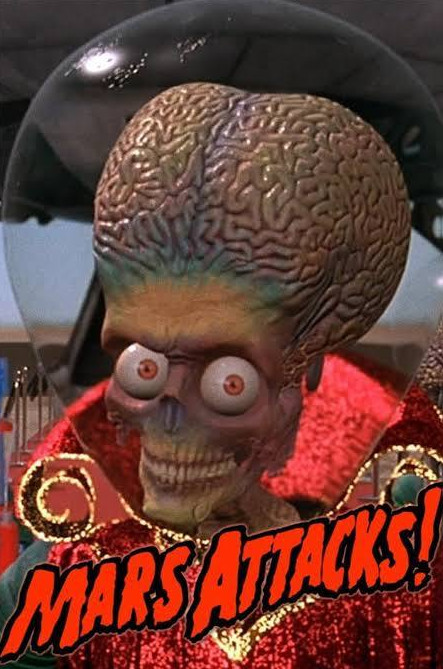
Don't forget the 1930's (?) radio play "Mars Attack". By Orson Wells.
WHAT? Flying beavers are not real? No..... LMAO!!!
Unfortunately, there is not enough time in the day (week, month, year, etc.) to verify that something we've read or seen is "fact". We have to constantly make judgements on the validity of the data and its source. Maybe in the future, we can "trust" AI to assimilate petabytes of data, judge its validity, and summarize what he/she/it "thinks" is the "fact". But, I'm afraid that the average human can only make a "best guess" at the "fact" and must be willing to "rethink" when new info changes their understanding of what that "fact". Maybe there is no such thing as a "fact", only an ever evolving understanding of sensory input and the framework we use to collect the "facts" into a cohesive "picture". (I guess I really should have taken a philosophy course in college... LOL!!!).
Sorry, only students may add comments.
Click here for more
information on how you can set up an account.
If you are a Visitor, go ahead and post your reply as a
new comment, and we'll move it here for you
once it's approved. Be sure to use the same name and email address.
This thread is now CLOSED. If you wish to comment, start a NEW discussion in
Captain's Log.