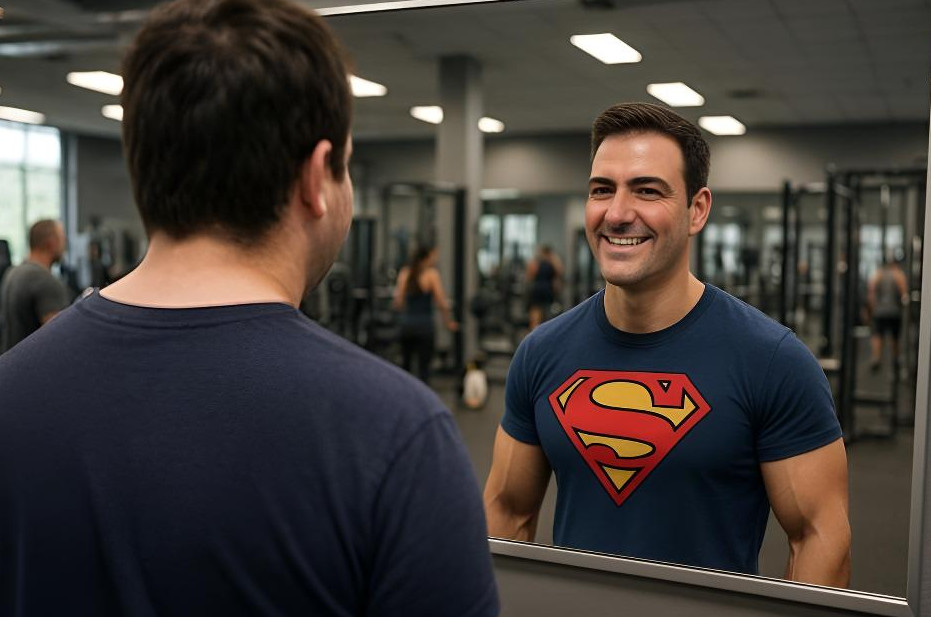
I have always been fascinated by the idea that our beliefs do not just sit quietly in our brains like dusty books on a shelf. They actively change how we see the world. Not in a magical think-positive-and-the-universe-will-deliver way, but in a measurable, neuroscientific, top-down-processing way. Your brain looks at the world through whatever filter you have installed. If you believe you are capable, you hunt for evidence of capability. If you believe you are not good enough, your brain will hunt for proof that you are falling short. Your perception of reality is not a camera lens. It is a custom configured software filter that you keep updating, often without even realizing it. There's actual science behind this. (1)
When I was a kid, I played piano, sang in chorus, performed on stage like I owned it, and believed I was good at it. Was I actually good? Who knows. Maybe I was average at best, but average plus belief beats talented plus terrified. (2) That early confidence shaped the way I approached my teenage years and my eventual career as a professional musician in a rock band, as short-lived as it was. I was also a computer nerd, and I believed I was good with technology. Eventually that belief blended into business. When it came time to start my own company, I walked into it thinking, yeah, I got this. My optimism was a mix of courage and pure ignorance, like clicking Yes on a Windows dialog without reading any of it. Spoiler alert: I did not know a single thing about running a business, but belief kept me trying long enough to learn instead of running away.
In the tech world, mindset is not just motivational poster fluff. If you have ever built a database, you know that queries return what you ask for, not what you wish for. The same is true for your mind. If you believe people hate your ideas, you will subconsciously ask yourself questions like, "What will they reject next?" If you believe your ideas have value, your internal query changes to, "How can I present this clearly and test it?" Access developers know that the wrong filter returns garbage even if the tables are fine. The human brain works exactly the same way, except without a friendly Ctrl-Z.
This applies to business too. I have watched companies fall in love with consultants who radiate confidence but lack skill. They buy the salesman, not the system. Shiny PowerPoint slides should come with a warning label. Confidence is not competence, but it absolutely affects perception. If you believe you cannot succeed, you will sabotage yourself before the first invoice is printed. If you believe success is possible, even if you have no clue how to achieve it, you will try, test, fail, adjust, and eventually build something useful. The difference between a successful entrepreneur and a failure is often nothing more than how long they stayed in the game before folding.
Fitness is another perfect example of belief shaping behavior. If you walk into the gym thinking you are the kind of person who never makes progress, you will lift timidly, doubt your form, skip reps, and avoid anything that looks challenging. Your brain will notice every wobble and whisper and then quietly say see, told you so. Mine usually whispers something about donuts. But if you walk in believing you are a work in progress instead of a hopeless case, you push a little harder, track what you do, try new things, and learn proper technique. Nothing magical happens to your muscles just because you believe, but belief changes consistency and effort, which eventually changes strength, mobility, and confidence. Most people quit fitness not because their bodies fail but because their beliefs give out.
Another place we see the power of belief is in politics and public messaging. If you repeat an idea often enough and confidently enough, people start accepting it as true, even when the evidence does not support it. Politicians, advertisers, influencers, and self help gurus all use the same psychological loophole: repetition feels like truth. The brain likes patterns, and if a claim is repeated long enough, it can start to feel familiar, and familiar feels real. That is how bad ideas get elected, marketed, monetized, printed on T-shirts, and tattooed on forearms.
On a personal level, belief shapes relationships. I know people who walk around convinced they are unattractive or unworthy. They are neither trolls nor ogres. They are perfectly normal humans, but their internal script tells them to apologize for existing. The funny part is that confidence is often more attractive than appearance. People who believe they are worth knowing behave like people who are worth knowing. People who believe they are not worth knowing shrink, avoid eye contact, and never cross the threshold of connection. The world does not reject them. They pre-reject themselves.
Now, that's not to say belief is without limits. You cannot think yourself into superpowers. If you jump off a building because you believe you can fly, the sidewalk will deliver objective feedback. (3) Belief does not replace physics or biology. But belief can change performance, persistence, mood, attention, and communication. That is enough to change life trajectory. A brain that expects success behaves differently than a brain that expects failure. And those behaviors lead to different outcomes. That is as close to reality bending as humans get. This ain't The Matrix. No floppy spoons here.
Many people look to prayer or spiritual intention as a way to influence outcomes in the world, and if that brings comfort, hope, or clarity, there is nothing wrong with it. But it's also possible that the real power of prayer is not that it rearranges the cosmos, but that it rearranges the wiring behind your own eyes. When you pray, meditate, or set an intention, you are not necessarily moving angels, demons, or cosmic levers. You might simply be shifting your own mindset, calming your nervous system, clarifying your goals, and strengthening your belief that change is possible. The result still matters, but the power might come from inside yourself rather than somewhere above the clouds.
I love the scientific angle because it keeps our feet on the ground while letting our minds take the stairs. Cognitive neuroscience shows that expectation shapes perception. Your brain literally lights up differently based on what you think is possible. You cannot manifest a Ferrari by thinking about it, but you might learn the skills, habits, and contacts required to buy one if you truly believe you could and then put in the work. Belief is not magic. It is a software update.
A great Star Trek example of belief shaping reality comes from Reginald Barclay. When we first meet him on The Next Generation, he is socially anxious, timid, and convinced he does not belong among the best of Starfleet. His skills were never the problem. His belief about himself was the bottleneck. Across multiple appearances, we see him gain experience, earn small wins, and gradually build confidence. By the time we see him working with the Pathfinder Project later in the Voyager timeline, he is no longer the nervous junior officer hiding in the holodeck. He is confident, assertive, and plays a crucial role in helping Voyager make contact with Starfleet and eventually return home. His world changed because his belief changed, not because his intelligence suddenly doubled. If it can happen to Lieutenant Broccoli, it can happen to anyone.
So if you want to change your life, start by debugging your brain. Look at what you already believe about yourself. Ask if those beliefs serve you or limit you. You are not stuck with the defaults you inherited from childhood or past failures. Humans can rewrite their own code. You wouldn't accept a corrupted Access database that's constantly throwing up errors that are fixable. So don't leave your beliefs that way either. You can refactor your thinking and get cleaner output.
I believe in what I see I believe in what I hear I believe that what I'm feeling Changes how the world appears - Rush, Totem
P.S. Since belief is so powerful, it is also worth making sure the things you believe are actually true. Belief alone can get you moving, but evidence keeps your wheels aligned. If you build your life around ideas that do not match reality, you can end up working really hard in the wrong direction. The most useful beliefs are the ones that give you strength while still holding up under logic, data, and real world results. I am not talking about believing whether or not you can succeed, or that you're attractive, or your ukulele playing is good. I am talking about tangible facts. Like I said earlier, you are not Clark Kent, and if you put on a cape and jump, the pavement will not applaud.
(1) Here's just one study. There are many more. I always bring references to the party.
(2) Or for the nerds: (average + belief) > (talented + terrified)
(3) How many of you have had that recurring dream/nightmare? I have it all the time.
I thought you were going to bring in TOS Mudd's Women episode for an example...
My dad had a sign on his desk at work saying "Attitude is more important than fact." I would recommend reading the longer Swindoll quote here: https://faculty.kutztown.edu/friehauf/attitude.html. Of course I do not believe this should be taken literally, but it is meant to capture ideas similar to your post.
I have had falling dreams, but not off a building. Usually I fall into an earthquake or nuclear bomb generated pit... 😢
Michael Olgren
@Reply 11 months ago
Richard And you know I will challenge you about prayer. 😁 Similar to what you pointed out, prayer can be looked at as "spiritual meditation." Meditation has a mountain of evidence for beneficial effects. However, beyond that, I suggest you read over this fascinating study from the NIH:
https://pmc.ncbi.nlm.nih.gov/articles/PMC2802370/
Perhaps most interesting is the triple-blind prospective study where IVF implantation was more effective in the group that had "distant prayer" intervention. I would not say that this proves God exists. It does make me wonder about forces we do not yet understand.
Peter Yates
@Reply 11 months ago
Well done Richard. I love your lessons and really appreciate that you are confident enough to open up to such a big audience about how you think. I know this is a world of "echo chambers" and my empathy comes from having similar thoughts, ideas and outlooks as you do. Seeing things in black and white or binary when there is a clear choice, but having tollerance and understanding of "shade of grey" or "on a spectrum" when that's appropriate, which I think is important on complex issues.
Your words about "mindset" I can really endorse. Personally, when I was young I really lacked any self confidence. In school, being in any sort of spotlight, like being asked a question by the teacher, was a living nightmare. I would blush visible and become speachless and incompetent (even though I often knew the answer). It was a very gradual process to overcome this. I once (my late 20s or 30s) took a job as an instructor even though the prospect of talking to any sort of group terrified me, but I took the job anyway, overcame my fears and turned out to be pretty good at it. I'm 82 now, but I guess, despite what I've just described, deep down I believed in myself. So I agree, your mindset, or the way you look at things, is really important.
Michael now that I'm back from vacation, I gave that NIH paper a solid skim. It actually reinforces the same issue I always run into when people try to study prayer scientifically. The whole field runs into a giant category error. We can measure blood pressure, implantation rates, EEG patterns, whatever. But measuring spiritual intent, divine involvement, or cosmic influence is a completely different thing. You can run an RCT on how many embryos implant, but you cannot run an RCT on what an omniscient deity is thinking.
The studies themselves are all over the place. Some show benefits, some show nothing, some show worse outcomes, and a few claim retroactive effects where the prayer supposedly helped after the fact. That kind of variability usually means you're hitting noise, placebo, chance, or human psychology. And that is actually the part I do think is real. Meditation, focus, belief, reduced stress, and a sense of support all have well documented physiological effects. That's solid neuroscience. Prayer-as-meditation fits neatly into that box.
But if you're trying to test whether prayer works as a literal supernatural intervention, you hit a logical wall. If the deity is omniscient, then of course he or she knows you're running a study. In that case you have to accept one of a few uncomfortable possibilities. Either the deity doesn't exist, or the deity exists but doesn't care about being tested, or the deity exists and actively refuses to participate in your experiment, or the deity is annoyed at being audited like a CPA checking receipts. Any way you slice it, the experiment isn't actually measuring the thing you think it is measuring. You cannot run a controlled trial on the supernatural without assuming that the supernatural will politely sit still for your clipboard. Have you seen The Conjuring? Oh, you brought instruments? Great, let me throw a chair at your face.
This is why the James Randi million dollar challenge ran for decades without a single verified hit. The moment someone claims a supernatural ability and you set up a controlled test, suddenly the power shuts off like a bad WiFi connection. Every time. If something only works when no one is looking, it's not evidence of divine intervention. It's evidence of human psychology.
My wife is a great counterpoint to all of this because she absolutely believes in psychic abilities. She watches the shows, listens to the podcasts, and pays for the occasional reading. Meanwhile I play the role of the resident skeptic. She'll say, the psychic mentioned something about your grandma, and I'll come back with, Oh really? Then ask her to ask my grandma this one specific thing she couldn't possibly guess. And my wife always says, well it doesn't work that way. Which, to me, is exactly the problem. It never seems to work in any way that could actually be tested.
So yes, I think prayer can help people feel calmer, more focused, more hopeful, and more resilient. That alone can influence outcomes in subtle, positive ways. But testing it as a cosmic force that reaches across space to nudge embryos into implanting is where everything falls apart scientifically. Different tool set, different domain.
I love that you challenge me on this stuff. This is what mature, healthy, intelligent discussion is supposed to look like. Keeps me on my toes. :)
Michael Olgren
@Reply 11 months ago
Richard I cannot argue your points, but would suggest an alternative explanation as to why God doesn’t interfere with experiments: rather than see it as not caring or annoyed (wait for it…) “I will choose the path that’s clear, I will choose free will.”
So God leaves us be, even for some to commit atrocities. However, I still believe free will can be intact if God performs the occasional miracle. Not a popular position in the world of philosophy…
Michael I love that you brought in the Rush line. Far be it from me to argue with Neil Peart. :)
What you are describing sounds a lot closer to the classic deist position, which many of the Founding Fathers espoused. A god sets the universe in motion, steps back, and lets it run. That is basically the cosmic equivalent of setting up a long Access VBA sub, hitting Run, and walking away to get coffee. The machine does what it does, but the designer is not sitting there nudging records one at a time. That is very different from the interventionist model where a god tweaks outcomes day-to-day and helps people find their car keys.
This actually reminds me a lot more of that speech Al Pacino gives in The Devil's Advocate, where he goes off on the idea that God is an absentee landlord. God sets everything up, walks away, never shows his face, and then expects everyone to praise him for the mess they are stuck living in. It is that whole rant about free will, suffering, and silence from above. It is exaggerated for drama, of course, but the core idea is the same one you are hinting at: a deity who values human autonomy so much that he refuses to intervene, even when things go off the rails.
It's almost a Lord of the Flies situation, just scaled up to a whole planet. I mean, if you look at the history of humanity, we are basically a bunch of murderous 12-year-olds. Divided over nonsense, such as who's god is the right one.
And since you opened the door with Rush, here is one of my favorites:
They shoot without shame
In the name of a piece of dirt
For a change of accent
Or the color of your shirt
Better the pride that resides
In a citizen of the world
Than the pride that divides
When a colorful rag is unfurled
Wouldn't a truly benevolent creator stick around and make sure his creation is taken care of? I mean, I am not going to have a bunch of kids and then say, "you guys figure it out." That hands-off model only makes sense if the designer either cannot intervene, chooses not to intervene, or never expected the system to go off the rails in the first place.
Michael Olgren
@Reply 11 months ago
I draw the line somewhere between a deity's total control (no free will) and completely hands off (no room for miracles and no evidence of beneficence). Evil is "allowed" because humans must be allowed to make evil choices. Using your family example-- surely you allowed your kids to make some mistakes, so they could learn and grow. I've certainly seen how "helicopter parents" have hampered their child's ability to perform even simple tasks.
How does God decide when and where to intervene? We obviously will never know that. I believe that these interventions (i.e. miracles) are sprinkled around for the faithful and those on the fence to reaffirm their faith. You can call them "highly improbable events" that happened anyway-- I have no scientific argument for that. Believing in God always comes down to faith.
Just this morning I saw a picture on Instagram of a paramedic who pulled a man out of a burning car, saving his life. That man happened to be the doctor who saved that paramedic's life 20-some years ago when he was born a 2 lb premie. Low probability coincidence or miracle? To-may-to, to-mah-to...
I get where you're coming from, and I respect the way you think about this. If someone sees that paramedic story as a miracle and someone else sees it as an incredible coincidence, neither view hurts anything. We're all trying to make sense of a pretty complicated world using whatever tools we have. For me, I lean toward psychology, probability, and human storytelling. For you, it feels more like evidence of something benevolent weaving in and out of our lives. I can appreciate that even if I don't share the conclusion.
I'm with you on the parenting analogy too. Helicopter parents drive me a little nuts, but you also see a difference just between moms and dads. Stereotypically, moms are more likely to say, "Don't touch the stove," "Don't climb that tree," while dads are more like, "Is it going to kill them? No. Is it going to seriously injure them? No. All right, let them do it." I wouldn't let my kids play in traffic, but if they're climbing a tree to a height where a fall might mean a broken arm instead of instant death, I'd probably let them learn that lesson. Breaking a bone or two is kind of part of growing up. Heck, my friends and I used to partake in bicycle-broomstick jousting as kids. We all survived. LOL.
Either way, I enjoy these conversations with you. You always bring thoughtful points without getting hostile or preachy, which is rare on the internet these days. I'm glad we can disagree, compare perspectives, and still keep it friendly. That's how grown-ups are supposed to talk. :)
Sorry, only students may add comments.
Click here for more
information on how you can set up an account.
If you are a Visitor, go ahead and post your reply as a
new comment, and we'll move it here for you
once it's approved. Be sure to use the same name and email address.
This thread is now CLOSED. If you wish to comment, start a NEW discussion in
Captain's Log.