If you haven't heard the term yet, it basically means you just tell the AI what you want and let it write the code for you, like having a junior developer who never sleeps and doesn't complain about your specs. You stay in the driver's seat conceptually, but the machine is doing most of the typing. In theory, you focus on the idea while the AI handles the syntax, the loops, the plumbing.
Now, I'm not gonna sit here and pretend I'm above it. I use AI for code all the time. If I need a quick function to sort an array, import a text file, or hammer out some boilerplate VBA that I've written a hundred times before, yeah, I'll let the AI do it. I already know how it works. I just don't feel like spending 20 minutes typing something I've had memorized since the first Bush administration. At this point it's muscle memory, not intellectual exercise.
That's where vibe coding makes perfect sense to me. As an experienced developer, it's a power tool. It's like using a nail gun instead of a hammer. I still know how framing works. I'm just getting the job done faster, and with fewer smashed thumbs.
Where I start to get nervous is when people try to build entire applications this way without understanding what's under the hood. I see folks spinning up full websites, business apps, database systems, all by prompting an AI and copy-pasting whatever it spits out. And hey, it works... until it doesn't. And when it doesn't, it usually breaks at 4:55 PM on a Friday. Then what? When something breaks, slows down, corrupts data, or starts throwing errors that make no sense, you're stuck. If you don't understand the fundamentals, you don't even know where to start.
It's like calculators in math class. I'm all for calculators. I use one every day. But you still have to learn arithmetic first. You still need to understand why 4 + 4 equals 8 before you trust the machine telling you the answer. Otherwise you're just blindly accepting output. Same thing here. AI is fantastic at producing results. It is not automatically fantastic at teaching you how to think like a programmer. And thinking like a programmer is the real skill.(1)
Back when I was learning, I typed code line by line out of books and magazines. Half the time I didn't fully understand what I was typing, but the act of doing it built the mental wiring. You learned patterns. Logic. Cause and effect. Debugging instincts. That friction mattered. Copy, paste, run skips that entire growth process.
The car analogy fits here too. You don't need to know how an engine works to drive. That's fine. Casual users can absolutely vibe code their way to a small app, a hobby project, something non-critical. No problem there. But if you want to build cars, design engines, or fix one when it explodes, you better know what's under the hood, preferably before the explosion. Same goes for software. If it's business critical, if money, customers, or data integrity are involved, you cannot rely on vibes alone.
And this isn't a new sci-fi warning either. Star Trek covered this decades ago.
In the original series episode "The Apple", Captain Kirk and the crew encounter a society completely dependent on a machine called Vaal. It runs their lives. Keeps the weather stable. Provides food. Maintains order. Sounds great... until it starts malfunctioning. The people have no idea how anything works because they've never had to think for themselves. The Enterprise shows up and has to save the day, which I'm pretty sure violates at least three sections of the Prime Directive. Hey, even in the 23rd century somebody still has to be the sysadmin. OK, Scotty, time to three-finger-salute this entire planet...
Then you've got a similar theme in The Next Generation episode "When The Bough Breaks". Picard and the crew discover a highly advanced but dying civilization that automated everything, including reproduction and societal systems. Over time they lost the knowledge to maintain their own technology. When things started failing, they couldn't fix them. They had the tools but not the understanding.
Sound familiar?
That's the long-term risk of vibe coding if it's taken to the extreme. If we outsource all understanding to machines, we create a generation of builders who can't repair what they build.
Now, to be fair, AI is not the villain here. It's a tool. A powerful one. I actually agree with the more balanced take I've been seeing lately. Use AI as an assistant, not a replacement. Let it help you debug, explain, prototype, and accelerate. But still learn the fundamentals. Still build projects yourself. Still struggle a little. (2)
Because that struggle is where the real learning happens.
I've also been watching discussions about how coding tutorials are supposedly "dead" because of AI. I don't buy that either. The format might be changing. Attention spans might be shrinking thanks to short-form social media dopamine machines that make learning anything longer than 30 seconds feel like homework. The job market might be fluctuating. But the need for structured learning hasn't gone anywhere. If anything, it's more important now. Because when AI gives you an answer, you still need to know if it's a good answer. That's the part people forget.
In my world, especially working with databases like Access and SQL Server, fundamentals matter even more. Data integrity. Relationships. Indexing. Concurrency. Error handling. You vibe code that stuff wrong and you don't just get a bug, you get corrupted data or a business that can't operate Monday morning, which is a great way to meet your clients' lawyers. That's not a weekend hobby app anymore. That's real-world impact.
So yeah, I'm not anti vibe coding. I use it. I enjoy it. It's fun watching AI spit out Python or VBA or PowerShell scripts on demand. It feels like living in the future, minus the flying cars we were promised. But I'm also old school enough to believe you should still learn how to code if you want to call yourself a developer. Otherwise you're just steering the ship without knowing how the engines work. And if the engines fail, you're adrift, staring at error messages like they're written in ancient Klingon.
So that's my take. Use the tool. Embrace the speed. Enjoy the convenience. Just don't skip the understanding part if your livelihood depends on the software you're building.
Curious where you land on this. Are you using AI to accelerate code you already understand, or are you letting it build things you couldn't explain if they broke tomorrow?
(1) I remember back in high school and college, a lot of kids were convinced half their classes were pointless. You know the type: "Why do I have to learn this stuff? When am I ever going to use algebra? Or chemistry? Or biology?" On the surface, I understand the frustration. Not everyone grows up to be a scientist or an engineer. But that misses the bigger picture. Those subjects aren't just about the raw information. They're about training your brain. They teach logic, sequencing, cause and effect, and how to follow a structured process. It's algorithmic thinking. You might never use the Pythagorean theorem in your day-to-day life, but learning how to apply a formula, follow a repeatable method, and trust a step-by-step system is the real lesson. That mental wiring carries over directly into programming and problem solving whether people realize it or not. What really gets me is when some of those same folks grow up and start loudly questioning well-established science, like climate change or vaccines, while conveniently forgetting they spent half of science class picking dried glue off their hands or trying to light their book bag on fire with a Bunsen burner. It's hard to respect someone's scientific skepticism when they opted out of the learning part back when they had the chance. "Oh really, Nancy? You've 'done your research?' I remember you skipping science class almost every day to go smoke in the bathroom..."
(2) I don't view AI as some looming villain any more than past technological leaps were villains. Computers didn't "destroy society" because they put typewriter manufacturers out of business. Calculators didn't spell the end of civilization because slide rule and abacus makers had to pivot. Automobiles didn't get framed as evil because they replaced horse-drawn transportation. Every major technology shift displaces certain jobs while creating entirely new industries around it. AI is no different. Yes, it's going to automate some roles. That part is unavoidable. But it's also going to open doors for new specialties, new workflows, and new opportunities that didn't exist before. The real skill, as always, is learning how to adapt, how to use the tool effectively, and how to evolve alongside it, because whether people like it or not, AI isn't going anywhere. Just don't fall into the trap of letting it do your thinking for you, because that's the part of the job that actually matters. Embrace it, learn it, use it but don't outsource your understanding to it. Use it to amplify your skills, not replace the need to have them.
Because the moment the tool becomes the only one who knows how your system works, you've already lost control of it.
I use AI to help me write code. I tell it what I am looking to accomplish. When I receive the code, I go over it. If I am not able to understand it completely, I then use AI to teach me. We enter into a conversation until I feel I fully understand the code. Only then do I use it in the project I am working on. So, for me, AI becomes a tutor to advance my skills. Not as good as Richard, but hey, sometimes the best are just not available when we need them.
Michael Olgren
@Reply 7 months ago
I haven't learned enough code to let AI do the coding!
However, the overhype on AI is damaging. Look at the slop populating the internet. No one regulates that; no one removes the bad articles created by AI, which then get repeated by AI. Legal cases are being decided based on briefs prepared with false references by AI. AI has exponentially increased the ensh1tification of the internet.
I've written before how people use AI to write vibe code which becomes spaghetti code, e.g. creates 7 functions to do the work of 1.
I agree with judicious, overwatched use of AI. The problem is too many people/corporations are content to let the errors slide. I think the news articles "written" now are mostly AI generated. We read the glaring errors, ignore them, and move on. What about the errors we don't catch?
Donald Blackwell
@Reply 7 months ago
Only time I use AI for code is 1) To check what I've written, for instance known bugs or issues, or 2) If I'm trying to remember something I already know, after I've tried searching here but I can't think of the wording, etc so it doesn't come up so I can type in AI what my mind is thinking, and if it's simple, it will give me some code then usually, if it's something big, it will show places where I can get examples...
It will usually give 3 or 4 examples, and wouldn't you know, often, 2 or 3 of those will point back to videos I was looking for here but couldn't remember the wording in the title, lol.
I'll also use it when I figure something new (to me) out, to find out when a feature was added to Access for example, when I see code online that is very lengthy and verbose, then I figure out an alternate solution with significantly less code, there must be something wrong with mine, right? lol, or check to see if it's something new, or something old people have forgotten about.
Brent Davis
@Reply 7 months ago
I love this community and Richard's teaching and his lessons have taken me from knowing nothing to knowing enough to be dangerous! I use AI because I do not have the time to try and learn coding from scratch. I am not a developer and will never be but the database I have built, with Richard's and this communities help, has made me much more productive an efficient in my role as an account manager. I used AI recently to assist in building an automated Quarterly Sales Plan. I did not know where to start so I asked AI and one thing led to another and out popped a quarterly sales plan. It is exactly what I wanted. It is automated and builds my plan at the click of a button. This was a learning opportunity for me because the code did not always work. But because I knew enough, I was able to ask the right questions to get it to work. But do I understand the code entirely, not even close. And I am sure, as Michael stated, it probably is more complicated than is needed but it works and I can learn steps and processes by analyzing the code that works. So, it is a win-win for me. If it breaks something in my database, I just go to the last backup and restore because I have been taught here to always BACKUP YOUR DATABASE!! Plus, my database is only for me, so it is the perfect training ground!
Jeffrey Kraft
@Reply 7 months ago
I try to write my own code. Then when I give myself a headache over one stupid mistake that I am too dorky to realize or too blind to see, I hit AI. Latest was the I wanted to requery another form if it was open. Code was fine (kind of). Coder kept having that form in Edit mode howver :(. I try to use AI as another tool in the tool box because I do want to understand what that code is doing so I'm not pulling my hair out at 2 am in the morning.... :D
Sam Domino
@Reply 7 months ago
As Richard said, AI is a tool. A tool that in the hands of someone who understands its uses and limitations can craft something wonderful and useful!
This discussion reminded me of Isaac Asimov's 1957 short story, The Feeling of Power. A war fought with missiles/anti-missiles and controlled by computers is at an on-going standstill. One side shoots missiles, the other side knocks them down with anti-missiles. Over and over again, year after year, until one man's hobby of collecting ancient machines and figuring out what they do and how they do it, allows him to rediscover how to do math in his head. Eventually he discovers enough about math and computer programming to allow his side to modify their missiles. This wins them the war!
Thomas Gonder
@Reply 7 months ago
Just yesterday I was in a hurry to get a routine that would take all UC sentences and titles into proper UC/LC. It took about five iterations with ChatGPT to get it right. The first two wouldn't compile or return a proper result. The next three were refinements. Although AI has often taken me down rabbit holes or destroyed my working code, I can't complain about the time saving yesterday. I'm guessing it would have taken me a week or more to develop the same code.
?fModCase("LET'S SEE HOW THE CHATGPT PROGRAM HANDLES A LONG SENTENCE AS EITHER A TITLE OR AS A SENTENCE.", "T")
Let'S See How the Chatgpt Program Handles a Long Sentence as Either a Title or as a Sentence.
?fModCase("LET'S SEE HOW THE CHATGPT PROGRAM HANDLES A LONG SENTENCE AS EITHER A TITLE OR AS A SENTENCE.", "S")
Let's see how the chatgpt program handles a long sentence as either a title or as a sentence.
Yeah, privacy concerns are a real thing because you always have to worry if these AI companies are using your conversational data for training future AI models. You don't want to tell it anything that's sensitive or unique to your business, which is one of the reasons why I like to see that the AI companies are releasing models that you can run standalone on your machine. I wrote about a while back, and it's still on my to-do list: setting up a local AI agent. I think as soon as I'm done with the SQL Server course, I'm going to start putting something like that together.
Thomas Gonder
@Reply 7 months ago
I did ask ChatGPT about its security model for sensitive data. It claims that it doesn't share microdata between threads, but my experience shows it does save some macro data about things, like your coding preferences, but not always reliable. It claimed that your type of question is reported back to higher levels for analysis, but that the actual code you might send is secure. Now, how much can you trust an AI response about itself and the company that controls it?
Thomas Gonder
@Reply 7 months ago
Richard I'm counting on you for showing me how I can replace myself with AI, but still collect my paycheck.
Thomas as soon as I figured that out, I'll let you know. From what I can tell, the AI still has a lot to go to replace me. I've seen a lot of AI slop tutorials online, but the voices sound fake and the material is questionable at best. I'm still safe, I think, for at least another 5-10 years.
Sam Domino
@Reply 7 months ago
Richard Looking forward to seeing your series on AI agents. FYI... you may want to read "The Adolescents of P-1" before starting. It tells the story of a college student who programs a computer "agent" to seek out unused CPU cycles and storage. Years later, the "creator" is contacted by his now sentient program. LOL!!!
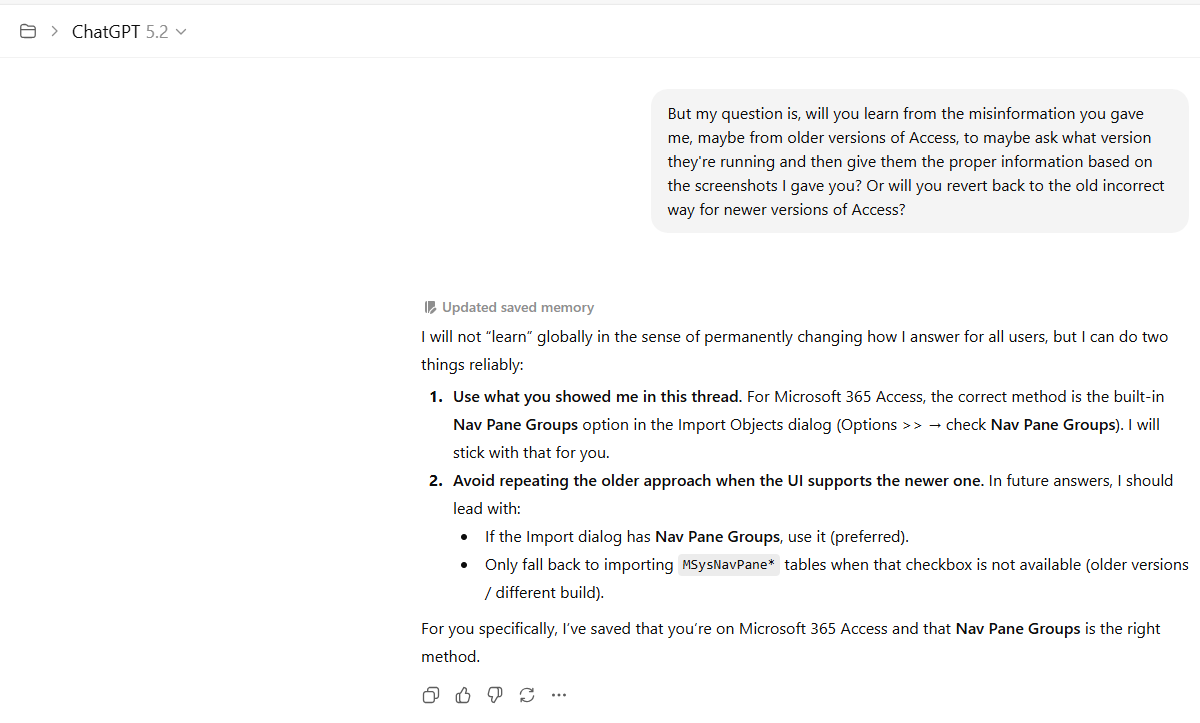
And there you have it, ChatGPT (by its own admission) and I suspect most "AI" is just a trained monkey that will keep reporting misinformation because it can't really "learn" from its mistakes. Which explains a lot of my headaches when using it. Dang, I was hoping it would replace me so I could sail off into the sunset and have the ADS take care of itself.
Yeah, it will learn for that thread, or if you tell it to put something in its permanent memory, it will learn for your account, but it won't learn as far as, like, for everybody. There's another ADS mention, so I'll take my two cents, please. LOL.
I've been telling ChatGPT for like a year now, probably longer than that, to not use curly quotes or curly apostrophes in its replies. If I'm going to copy and paste something and put it on the website or wherever, those curly quotes sometimes mess things up. I want straight quotes and straight apostrophes.
It just can't remember that unless I specifically tell it in that thread. It won't remember it. I put it in my system memory, my overall settings, several times; it just ignores them. Sometimes, if I tell it to stop using curly apostrophes, it stops using contractions altogether and it writes like Mr. Data. It says "do not" instead of "don't" everywhere. Sometimes it'll just not put the apostrophe there and put "dont" without the apostrophe. It's got a long way to go.
Richard Beyond curly quotes, I have asked for some simple routine (several times just today) that needs to ignore MySys and other system tables, but it always has to be reminded to ignore system files. I must not be the only one doing these kinds of routines, so the monkey hasn't even been trained to dance yet.
It keeps rewriting its own function too!
Private Function fIsUserTable(ByVal tdf As DAO.TableDef) As Boolean
'Skip system/hidden
If (tdf.Attributes And dbSystemObject) <> 0 Then Exit Function
If Left$(tdf.Name, 4) = "MSys" Then Exit Function
If Left$(tdf.Name, 1) = "~" Then Exit Function
'Skip linked tables (multiple ways to detect)
If (tdf.Attributes And dbAttachedTable) <> 0 Then Exit Function
If (tdf.Attributes And dbAttachedODBC) <> 0 Then Exit Function
If Len(tdf.Connect & vbNullString) > 0 Then Exit Function
If Len(tdf.SourceTableName & vbNullString) > 0 Then
'If SourceTableName is populated and Connect is populated, it's linked.
'Some edge cases populate SourceTableName; Connect is the stronger signal (checked above).
End If
fIsUserTable = True
End Function
Thomas Gonder
@Reply 7 months ago
Richard ADS check is in the mail. Oh no, now I've started a new balance due.
Thomas Gonder
@Reply 7 months ago
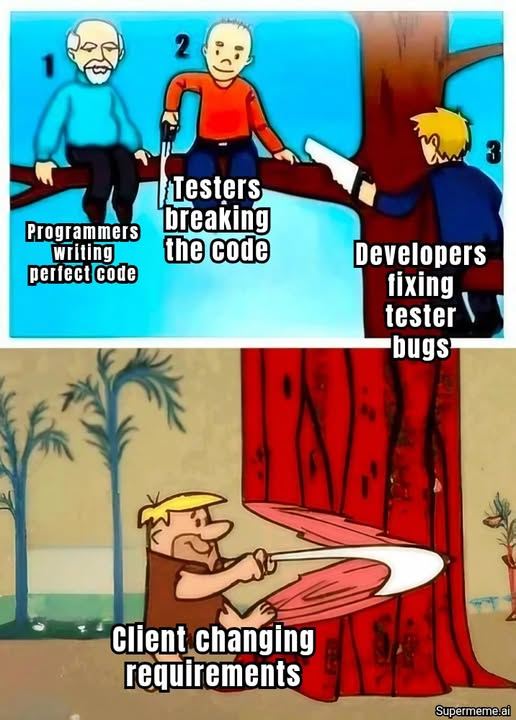
Jeffrey I love the image, but I wear three of those hats, so how about changing it to one guy on the branch, shooting himself in the foot? I think Richard just did that with his payments system. I do it everyday when I make a "small" enhancement to code.
Sorry, only students may add comments.
Click here for more
information on how you can set up an account.
If you are a Visitor, go ahead and post your reply as a
new comment, and we'll move it here for you
once it's approved. Be sure to use the same name and email address.
This thread is now CLOSED. If you wish to comment, start a NEW discussion in
Captain's Log.