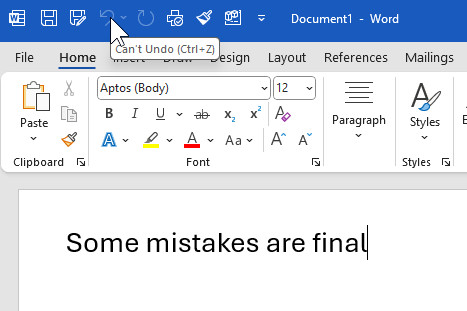
CTRL+Z is basically humanity's greatest invention. If we could apply it to conversations, marriages, and late-night Amazon orders (1), society would ascend.
Think about it. CTRL+Z is more than just a keyboard shortcut. It's forgiveness, it's humility, it's the ability to say, "Okay, that didn't work - let's try again." No judgment, no lectures. Just a second chance with one simple keystroke. Accidentally deleted a whole paragraph? CTRL+Z. Made a giant Excel formula explode across seventeen columns? CTRL+Z. Spent four hours trying to align labels in Access reports and then broke everything with one bad click? CTRL+Z, baby.
In the digital world, it's built in. In real life? Not so much. We make mistakes, but we don't always get the quick undo. We say things we shouldn't, buy things we don't need, launch policies without thinking them through. And instead of hitting CTRL+Z, we double down. We justify, we defend, we act like we meant to do it all along.
But imagine if we didn't.
Imagine if we paused, admitted the misstep, and tried again - without ego. If leaders could revise policies, if spouses could retract a careless word, if society could roll back bad code before it crashes the whole system. That's the power of undo.
But here's the catch: the real-life version of CTRL+Z starts with admitting you were wrong. That takes maturity. You can't take your words back, but you can say you're sorry. You can own the fact that maybe you acted out of haste or frustration, that you spoke before thinking it through. That moment of humility is the first step in the real-world undo process. It doesn't erase what happened, but it opens the door to fixing it. And often, that's all people want - to know you care enough to try.
I could go through a million examples of where this would be helpful in personal life. You forgot to take out the trash, and instead of doubling down with "Well, you didn't remind me," you just say, "You're right. I forgot. I'm sorry." You snap at someone because you're tired or stressed, and instead of justifying it, you own it: "That was on me. I shouldn't have said it like that." Did you accidentally leave someone out of a dinner invite? Instead of pretending it didn't happen, you admit it and make it right. That's real-life CTRL+Z. Growing up, that's all our parents really wanted to hear: that you were sorry, that you'd try better next time. And in adult life, it's no different. Your spouse wants to hear it. Your friends want to hear it. Your team at work wants to hear it. We all just want to know the other person gets it - and cares enough to try to undo the damage. That's how trust is built.
Let's take a look at some examples of real-life undo moments in business:
Netflix and Qwikster: Netflix announced it was splitting its DVD and streaming services into two separate companies, with the DVD portion being rebranded as "Qwikster." The backlash was immediate and brutal. Customers hated the idea of having to manage two separate accounts and websites. Within a month, Netflix admitted the move was a mistake and scrapped the Qwikster plan. They issued a public apology and learned from it. Fast forward to today, and Netflix is one of the most dominant players in global entertainment. CTRL+Z, executed.
Coca-Cola and New Coke: Coca-Cola tried to replace its classic formula with "New Coke." Consumers revolted. It became one of the most infamous product flops in history. But instead of doubling down, Coca-Cola admitted the mistake, brought back the original formula as "Coca-Cola Classic," and turned the PR disaster into a triumph. Sales actually increased afterward. Not bad for a global CTRL+Z moment.
Domino's Pizza: Domino's ran a brutally honest ad campaign admitting their pizza just wasn't very good. They listened to customer complaints, overhauled their recipe, improved ingredients, and retrained staff. That transparency and humility paid off - sales surged, and Domino's became one of the most respected turnarounds in the fast food world.
Microsoft and Windows 8: Windows 8's full-screen Metro interface was not exactly beloved. The missing Start Menu caused massive confusion and criticism. Microsoft heard the feedback and responded with Windows 10, which brought back familiar features and fixed many of the pain points. They didn't pretend nothing was wrong - they listened, adjusted, and moved forward. (2)
Here are two strong examples from politics where a leader admitted failure, made changes, and ultimately came out stronger:
JFK after the Bay of Pigs: In 1961, the Bay of Pigs invasion was a disaster. Kennedy had only been president for a few months, and the failed CIA-backed mission to overthrow Castro made him look weak and inexperienced. But to his credit, JFK publicly took full responsibility. No dodging, no finger-pointing. He admitted the mistake and used it as a learning moment. From then on, he changed how he handled military and intelligence advice - leading to a much stronger performance during the Cuban Missile Crisis a year later. That one pivot arguably saved the world.
Barack Obama and healthcare rollout glitches: When the Affordable Care Act launched in 2013, the HealthCare.gov website was a mess. It crashed constantly, sign-ups failed, and people were furious. Obama admitted it was a failure, told the country, "There's no excuse," and brought in a SWAT team of tech experts to fix it. Within weeks, the site was functioning, millions eventually enrolled, and the law became a defining success of his presidency. The honesty and follow-through helped restore confidence.
Fitness and nutrition are full of these real-life "undo" moments where science (and culture) got it wrong, admitted it, and moved forward with better information. Here are a few good ones:
Eggs and cholesterol: For decades, eggs were demonized as cholesterol bombs. "Don't eat more than two a week or your heart will explode," they said. But as nutritional science advanced, researchers realized that dietary cholesterol doesn't have nearly as much impact on blood cholesterol as they thought. Now eggs are back on the menu, yolk and all, because they're packed with protein and nutrients. It took admitting the original advice was based on incomplete data.
Fat is bad. Wait, no it's not: In the 1980s and 90s, "low fat" was the gospel. Supermarkets were full of low-fat everything, and people loaded up on sugar and carbs instead. The result? Obesity rates climbed. Eventually, researchers realized that not all fat is bad. In fact, healthy fats (like those from nuts, fish, and olive oil) are essential. The real enemy was excessive refined carbs and added sugar. Big oops. But the industry slowly corrected, and now we get to enjoy avocados again without guilt.
Lifting makes women bulky: This one still lingers, but for years women were told to avoid weight training because it would make them look like bodybuilders. Turns out, that was nonsense. Lifting weights helps women build strength, bone density, and lean muscle mass. It's one of the best things women (and men) can do for long-term health. The undo here is still in progress, but the fitness community has mostly owned the error. It takes A LOT of lifting and eating in a calorie surplus to "bulk up." Believe me. I've tried. You're not going to "accidentally" get jacked.
And hey, even Starfleet gets it wrong sometimes. But they course-correct. They analyze the situation, acknowledge the mistake, and adjust. That's how progress is made.
Picard to Q in "Deja Q": After Q is stripped of his powers and left as a mortal, he annoys the crew of the Enterprise for most of the episode. But when a deadly threat attacks, Q sacrifices himself to protect the ship. Once he's restored to his omnipotent self, he saves the day. Picard, normally proud and guarded, does something rare: he thanks Q and admits, in his own Picard way, that he misjudged him. It's not quite "I'm sorry," but it's the closest you'll get from Picard.
Spock in "Star Trek VI: The Undiscovered Country": Spock hand-picks Valeris to be his protege, but she betrays the Federation and becomes part of a conspiracy to sabotage peace talks. When the truth comes out, Spock is visibly shaken and quietly says, "I was responsible for your appointment. I have nothing but my own logic to blame." It's a powerful, humble moment of taking responsibility for a major misjudgment.
Janeway in "Equinox, Part II": In this two-parter, Janeway becomes obsessed with stopping another Starfleet ship that's been committing atrocities. In her pursuit, she pushes her crew too far and crosses lines even she regrets. At the end, Chakotay calls her out on it. Janeway reflects, admits she went too far, and recommits to her principles. She doesn't say the words "I was wrong" outright, but her change in behavior is a clear acknowledgement of it.
Kirk in "The Conscience of the King": Kirk suspects a visiting actor of being a former war criminal, but his personal biases and desire for justice cloud his judgment. By the end, he confronts the truth, admits to himself and others that he was too emotionally involved, and realizes he may have been manipulated. It's a subtle example, but it shows even Kirk had to pause and reevaluate.
And probably the best moment of all might again be from Star Trek VI: The Undiscovered Country. It's the final arc of Kirk's long journey with the Klingons, and it hits harder because it's so personal. For years, he blamed them for the death of his son. In fact, early in the movie, he records in his log, "I've never trusted Klingons, and I never will. I can never forgive them for the death of my boy." That very log entry is later read aloud during his trial on Qo'noS, used as evidence of his prejudice. But by the end of the film, after unraveling a plot to sabotage peace between the Federation and the Klingon Empire, Kirk finally evolves. He risks his life to stop the conspiracy, saves the new Chancellor, and delivers a quiet but powerful shift in his worldview. When asked why he helped, he replies, "Some people think the future means the end of history. ... But we're not going to kill today's people in the name of tomorrow. We've got to make this work." No melodrama, no speechifying, just a man who finally sees that peace requires letting go of old grudges. It's an admission that he was wrong, and that he's ready to change.
That's Starfleet at its best. That's real growth. And it proves that no matter how stubborn or scarred we are, everyone can change. Even Captain Kirk.
CTRL+Z isn't just about fixing typos. It's about embracing the idea that we're all going to mess up - but what matters is whether we hit undo, or pretend nothing's wrong and keep typing.
(1) Especially those orders made after having a few glasses of wine. I'm talking to you, wife. :)
(2) Microsoft skipped "Windows 9" because many legacy programs used version-checking code like if (version starts with "Windows 9") to identify Windows 95 or 98. Naming the new OS "Windows 9" could have triggered misbehavior in older software. So they skipped straight to 10 to avoid the headache.
P.S. Just make sure you hit that Ctrl+Z key before the situation becomes unsalvageable. Some relationships can bounce back from a mistake or two. But go too far - say the wrong thing one too many times, keep justifying instead of apologizing - and eventually, the damage sticks. Some friendships can't be fixed after repeated carelessness. Some bonds don't survive one final push. Just like a Word document, once you save it, close the file, and shut down the app, that precious "undo" option disappears. So if you've messed up, fix it now. Say you're sorry. Admit you were wrong. Learn from your mistakes and stop making them. Because after a certain point, even the best apology won't bring it back. And one thing I've learned in my 52 years is that not every mistake gets a another chance. Some really are final.
P.P.S. And hey Microsoft, while we're on the topic... that would be a fantastic feature idea: save the undo history with the document. Imagine reopening a file and still being able to hit Ctrl+Z to fix something you did yesterday. Give us real-time regret protection. Now that would be innovation. I get credit for the idea. :)
P.P.P.S. If you really want to watch a great movie, check out About Time. It's technically a time travel movie, but at its core, it's about so much more. It follows a man who discovers he can travel back in time to fix things in his life. But the real story is about love - love between a man and a woman, and even more powerfully, the love between a father and son. I tear up every time I watch it. Same with The Time Traveler's Wife. Yeah, I've got a thing for science fiction and time travel stories - but both of these are perfect reminders that even if you could go back and undo your mistakes, it doesn't always solve everything. Sometimes, the only way forward is to admit you messed up, and then do the work to make things right.
Dammit. I spent another hour on a Captain's Log today. Well, I guess my speech about not spending an hour a day writing these was pretty much meaningless.
I'm sorry.
I love writing these. Once again, this literally started with just a simple idea I had about CTRL-Z, and I ended up fleshing it out to what it is above. I get started and just don't know when to stop.
I just don't want to set the expectation that I'll be writing one of these long articles every day. Because I will... don't threaten me with a good time...
LOL
Thomas Gonder
@Reply 15 months ago
No worries, it only takes us two hours to read them. Rasbery!
Sorry, only students may add comments.
Click here for more
information on how you can set up an account.
If you are a Visitor, go ahead and post your reply as a
new comment, and we'll move it here for you
once it's approved. Be sure to use the same name and email address.
This thread is now CLOSED. If you wish to comment, start a NEW discussion in
Captain's Log.