I saw a meme the other day explaining the logical fallacy of ambiguity with a little story. A guy gets ticketed for illegal parking, and when the judge asks why he parked there, he says, "Well, the sign said 'Fine for parking here,' so I thought it was okay." That's ambiguity in action. A single word - "fine" - used in more than one sense, and that slippery language becomes the basis for an excuse.
This is a textbook example of semantic ambiguity, where a word or phrase has multiple meanings and the speaker picks whichever one benefits them most. It's often used for laughs, like this guy trying to dodge a parking ticket, but ambiguity can do real damage when it's used to confuse, mislead, or conveniently reinterpret reality.
Take Microsoft Access. I was helping someone build a simple book sign-out database, and they had a Yes/No field labeled "Active." But no one could agree on what it actually meant. Some thought it meant the book was currently checked out. Others thought it meant the record was valid and still in use. So the data was all over the place. That's the problem with ambiguous labels. If you don't clearly define your terms, users will guess. And they'll guess wrong in different ways.
I even talk about this in my Access Beginner 1 class when I teach the IsActive field. I explain that an active customer means someone currently buying products, getting emails, maybe still under warranty. But even then I pause to say, "Active doesn't mean they like to go to the gym." It's a Boolean field, not a lifestyle choice. So if you don't define your meaning up front, the data falls apart. Ambiguity will destroy consistency every time.
There's a VBA error called "ambiguous name detected" that pops up when you've got two procedures (subs or functions) with the same name, or when a control on your form shares a name with a variable or object in your code. The compiler basically throws up its hands and says, "I don't know what you mean. Be more specific." It's Access's way of reminding you that clarity isn't optional. Ambiguity might fly in conversation, but in code, it breaks everything.
Ambiguity isn't just a database problem either. In IT support, it's everywhere. I once worked with a client who told their team to "archive old files." Half the staff moved them to a backup drive. A few zipped everything and stuck it on OneDrive. One guy just renamed the folders "OLD-" and left them where they were. No one did the same thing, because no one asked what "archive" was supposed to mean. In tech, vague instructions are how backups get overwritten and projects get delayed. If the language isn't clear, the outcome won't be either.
Same thing happens in business. A client says, "We'll revisit that after Q2." You think that means, "We'll talk in July." They meant, "We'll push it off until next fiscal year." Or someone says, "We're looking to bring you on in a more permanent capacity," but never defines what that actually means. Is it full-time? Contractor with benefits? Or just a euphemism for, "We want you to work more without paying you more"? The ambiguity is convenient... for them.
In politics? Ambiguity is practically a campaign strategy. Candidates promise "affordable" healthcare, "strong" borders, or "protecting freedom," but those words mean radically different things depending on who's hearing them. That's the point. They're designed to be vague so they can appeal to multiple audiences. Later, if challenged, the speaker just shrugs and says, "That's not what I meant." Ambiguity gives cover.
Even in fitness, we fall into the ambiguity trap. What does "eating clean" actually mean? No sugar? No processed foods? Organic? Vegan? It's a feel-good phrase that sounds disciplined, but lacks any actual nutritional clarity. I've seen people justify cookies and ice cream on "cheat day" while still claiming they're "sticking to the plan." Okay, but... what plan?
And don't get me started on belief systems built around ancient texts. So many of them lean heavily on language that's ambiguous by design. One passage is taken literally, another metaphorically, and somehow that mix still gets labeled as "absolute truth." I've heard people argue that one chapter must be followed word-for-word, then turn around and say the next one is just symbolic. Pick a lane.
Even in relationships, ambiguity gets weaponized. Ever hear someone say, "I never said that," when they clearly implied it, or when their carefully chosen phrasing gave them wiggle room to deny something later? That's the same fallacy. If your words are open to multiple interpretations, and you benefit from the confusion, you're not communicating - you're gaming the system. And fellas... when she says "fine," it's definitely not fine.
Even in Star Trek, ambiguity causes chaos. In the episode "A Matter of Perspective," Riker is accused of murder, and the investigation hinges on conflicting eyewitness accounts. Each person gives a version of the truth, but when the holodeck recreates the events, the same conversations look completely different depending on who's telling the story. Riker thinks he was being professional. Another character saw it as aggressive. The words are the same - but the tone, intent, and body language shift everything. That's ambiguity. And when the stakes are high, unclear language doesn't protect you - it just gives everyone more room to get the story wrong.
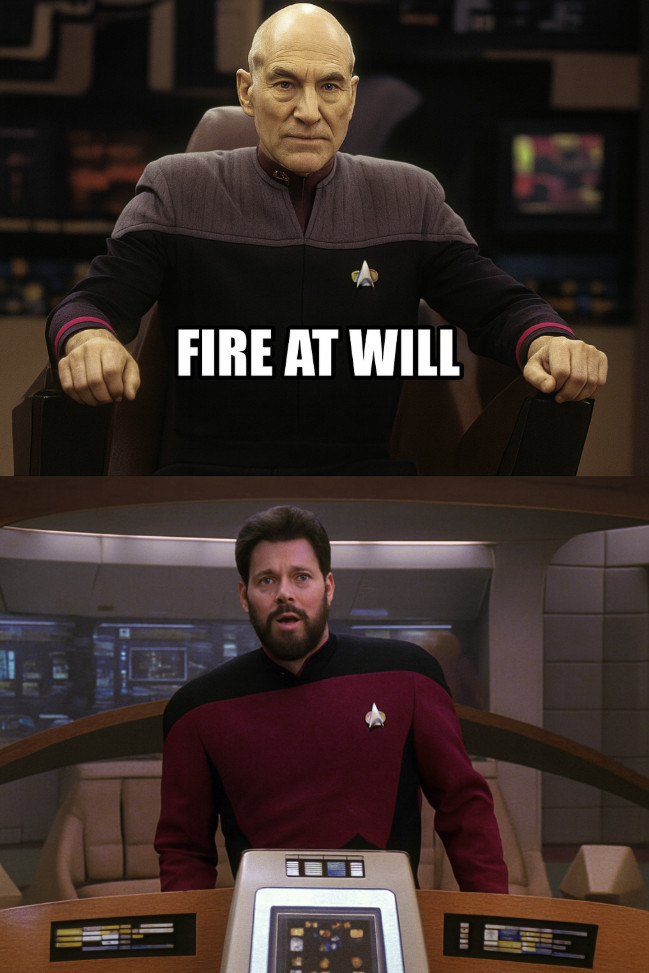
And speaking of Star Trek, one of my all-time favorite joke memes is a shot of Captain Picard sternly saying, "Fire at will." Now, of course, he's telling the tactical officer to target the enemy ship. But if you read it a different way, it sounds like he's ordering everyone to open fire on Commander Riker. The look on Will's face in the meme is priceless. That's ambiguity at work. Same phrase, two wildly different interpretations - and one very nervous first officer.
Even in my own marriage, this comes up. My wife and I text each other a lot - even when we're both at home. If I'm working and perhaps she's in the living room watching TV, she'll send me a message instead of walking in and interrupting me. Smart. Especially if I'm mid-recording. So she'll ask, "How about having chicken for dinner?" And I'll reply with a quick "Fine." What I mean is, "Sounds good, I'm just busy, so here's a short answer." But sometimes she reads it as, "Fine, whatever!" like I'm annoyed. That's the tricky thing with written communication - it strips away tone, facial expression, all the little cues that tell you how something is meant. That's ambiguity in a nutshell. You don't always need a fallacy to create confusion. Sometimes a plain old "fine" will do the trick.
If there's a moral here, it's this: clarity isn't just polite - it's ethical. Whether you're writing a database, leading a project, drafting legislation, planning your meals, or talking to your spouse - say what you mean. Avoid slippery words. Define your terms. And if you're on the receiving end, don't be afraid to ask, "What exactly do you mean by that?"
Because "fine for parking here" might just cost you 75 bucks.
And yes, I realize I wrote about ambiguity a couple weeks ago. It's an important concept. It deserves repeating. And I completely forgot I already wrote about it. Bug off. It's my blog. LOL. Besides, I think this article is better. :)
Robert Allen
@Reply 14 months ago
Fine.
Lars Schindler
@Reply 14 months ago
"But sometimes she reads it as, 'Fine, whatever!' like I'm annoyed."
Of course.
After all: "when she says 'fine', it's definitely not fine." ^^
Sorry, only students may add comments.
Click here for more
information on how you can set up an account.
If you are a Visitor, go ahead and post your reply as a
new comment, and we'll move it here for you
once it's approved. Be sure to use the same name and email address.
This thread is now CLOSED. If you wish to comment, start a NEW discussion in
Captain's Log.