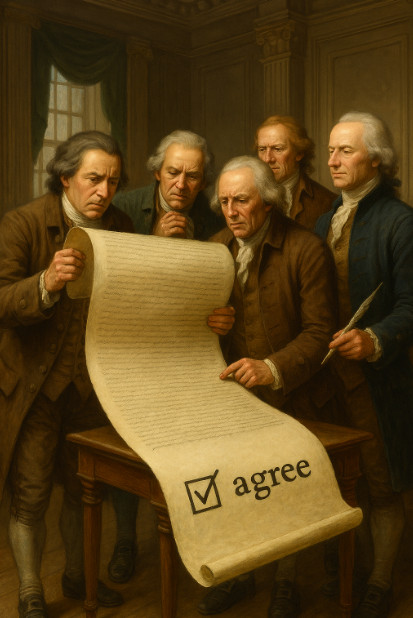
How many of you actually read software license agreements? Let's see a show of hands. Post in the comments if you have ever scrolled through one of those endless walls of text and actually read it. Most people don't. They just click "I agree" at the bottom and move on. I'll admit it, I've done the same thing. Even on my own website, every order form has a line at the bottom: "By placing this order, you agree to my terms of sale." I try to help out with a no-bullshit version up top - a bulleted summary in plain English - but the legalese is still there below, because it has to be.
So here's the big question: are these agreements legally binding? The short answer is yes. Courts recognize that people rarely read them, but that doesn't automatically make them invalid. As long as you had a meaningful chance to review the terms, clicking "I agree" counts. That said, there are limits. You can't sign away basic consumer protections. You can't agree to something illegal. And courts will usually strike down what they call "unconscionable" terms. So if a license said, "By clicking OK you agree to give us your firstborn child," you can rest easy - that one wouldn't stand.
Got Apps on your phone? People will download some free game, hit "Allow access" five times in a row, and never realize they just gave the developer permission to read their contacts, track their location, and listen through their microphone. We treat privacy settings like another software license agreement - just scroll, tap, and hope for the best. And why does a flashlight app need to use my microphone?
But this problem isn't limited to software. Think about business contracts. Most executives don't personally read every clause. They hire lawyers for that, because they know tricky wording can come back to bite them. In the real world, "not reading the fine print" can cost companies millions.
It's the same with the rules of the road. How many people actually read their state's driver's manual cover to cover? Down here in Florida, I'd swear most people haven't even cracked it open. Right of way, when to yield, zipper merges - it's all in there. But people wing it, and the result is the daily demolition derby we call traffic. (1)
Politics is no different. How many senators and congressmen actually read every bill put on their desk? These bills can run thousands of pages, filled with cross-references and legal jargon. In reality, most lawmakers rely on their staff to break it down and explain the highlights. The President doesn't read every line of every bill either - he gets a summary from legal counsel and policy advisors. So just like with software agreements, the people signing off aren't always the ones who read the fine print.
Religion is similar. There's a meme I once saw: "The Bible is like a software agreement - hardly anyone actually reads it, they just scroll to the bottom and click OK." Many believers trust their pastor or priest to interpret it for them, because it's a big, complicated document. In that sense, clergy are like the lawyers of religion - translating the fine print into something people can act on.
The same goes for school. Students sign honor codes, parents sign permission slips, and almost nobody reads the fine print. I can't tell you how many times I initialed forms in school just because the teacher said "sign here." It was homework for your parents, and everybody knew it was going straight into the backpack abyss.
Even in fitness, most folks take the easy route and "click OK" without thinking too hard. Government food pyramids, diet fads, or influencer advice - people assume it must be good because it looks official, but few dig into whether the research really backs it up. Same with exercise programs: the flashy routine looks great on Instagram, but does it actually work?
Health care is another one. Every time you go to the doctor they hand you a clipboard with HIPAA disclosures, liability waivers, and treatment consent forms. Most of us sign and move on without reading a word, just wanting to get through the waiting room faster. We're literally putting our signature on something that could shape our care, but in practice it's just another "click OK" moment.
And then there's finance. Credit card applications, mortgage paperwork, loan agreements - page after page of fine print. The part most people pay attention to is the shiny "0% introductory APR." Everything else might as well be in Klingon (without subtitles). Until, of course, that 29% interest rate shows up on your next statement and you realize what you agreed to. (2)
And of course, Star Trek has its own version. Think about all the times Starfleet officers signed treaties or agreements with alien species they barely understood. In "Devil's Due," Picard famously beat Ardra in arbitration because she tried to enforce a 1,000-year-old contract with vague, manipulative terms. It was a perfect reminder that the details matter - and that confidence and presentation aren't enough if the agreement can't hold up under scrutiny. (3)
The moral here is simple. Whether it's software, contracts, traffic laws, religion, fitness, or even interstellar treaties - don't just scroll to the bottom and click OK. Take the time to understand what you're actually agreeing to.
(1) This gets exponentially worse when the snowbirds are here from December thru April. Ugh!
(2) My rule of thumb: if you can't pay off your credit card balance in full by the end of your billing cycle (before interest kicks in) don't buy it. Period. So many young people don't understand this (including 20- to 30-year old me).
(3) I was originally going to use the Ferengi Rules of Acquisition as my Star Trek example - because really, how many Ferengi have actually read all 285 of them? But then I thought about it, and in Ferengi society I bet they drill those rules into the minds of every child from the time they can talk. They probably can all recite them forwards and backwards by number.
The interesting thing about law is that the courts will uphold it, until one doesn't. I anticipate that one day, after lawyers continue to make the agreements more obfuscatory and people get conditioned to just ignoring them, a court may find that it is not reasonable to expect a customer to pay a lawyer hours to review and explain an agreement for a piece of software that the customer has already paid for. An argument could be made that a "common man" could not read and understand a particular set of terms as provided, no matter how much time he took. Alternatively, if the person checking the "accept" box was a minor, would it still be binding. If I understand it correctly, the "common man" concept makes the application of law kind of a moving target based on ever-changing societal norms.
I agree with you. There really should be two levels of contracts. One version should be written for the average consumer at about an 8th-grade reading level, something short, clear, and easy to understand. The other version can be the detailed legalese for complicated business matters, where lawyers are expected to get involved.
The problem today is that companies bury us in 30,000-word software agreements that require a law degree to decipher. That doesn't protect consumers, and honestly, it doesn't protect the company either because nobody is actually reading them. Keeping things simple for everyday users would go a long way toward fairness and transparency.
Again, that's one of the reasons I made the "no BS" version at the top of my Terms page.
Matt Hall
@Reply 12 months ago
I couldn't agree more with that idea. Also, many of the places we have agreements, they are not needed. Just send me a bill, due May 31, for June cell service. If pay, I have service and if I don't pay, I don't have service. That is all the agreement that is needed. Fyi, Mint mobile works like this.
Michael Olgren
@Reply 12 months ago
Part of the reason no one reads the EULA is because the alternative (not using the product) is not really an option. If you want a cell phone, you're going to agree to one of those long vague agreements. Otherwise, no cell phone. How many products would you not buy or services would you not use if you disagreed with the EULA?
Although I agree most Christians have not read the Bible, we do exist. I have read ecumenical, annotated versions of the entire Bible (with Apocrypha) three times. I've also read an annotated Quran, the Te Ching, and am currently reading the Bhagavad Gita. It's funny (ironic) that I suspect most people who quote the Bible for some political purpose are likely the ones who haven't read the whole work.
And having driven in Florida and here in this retirement community known as Cape Cod, I will definitely challenge you as to who deals with the worse drivers!
Kevin Yip
@Reply 12 months ago
Most software EULAs say the usual things: can't re-sell, can't hack, can't sue, can't pirate, can collect info.
Michael I think you nailed the core problem with EULAs. For a lot of modern products there is no real opt out. With phones you are picking an ecosystem, not just an app, and every ecosystem ships its own long agreement. Even if you switch vendors, you still end up clicking I agree somewhere else. Windows vs Linux vs Mac is a choice in theory, but in practice there are network effects, app lock-in, and hardware costs that make it a high-friction move. So yes, most people accept terms they do not love because the alternative is functionally no phone or no apps.
On the faith point, I hear you. My own experience was very different though. I was raised by Catholic grandparents, and I can guarantee you no one in my family ever sat down and read the Bible. We had one. On the coffee table. It sat there unopened. They dragged me to church a couple of times a year - Christmas, Easter, maybe Ash Wednesday - but that was about it. They made sure I went through communion, but that was the extent of it. Didn't mind the money I got from the party though. LOL.
When my grandfather passed away and I went to live with my mother. She had become a born-again Christian (the one who burned all my D&D books). She did read the Bible, but only in the sense of following whatever passages the pastor picked out for Bible study that week. That kind of cherry-picking has always bothered me. If you're going to claim the Bible as your guide, I think you need to read it in its entirety and try to understand it in the context in which it was written.
I'm not a scholar - I've never tackled it in Aramaic or Greek like some very smart people I've met - but I have read it cover to cover twice. Once as a young teenager, and again later as an adult. And like you, I've found that the people who are most eager to toss out single verses to make a political point are usually the ones who haven't read or understood the whole thing in context.
And as for drivers, I will see your Cape Cod and raise you a Florida snowbird season. My money says a chunk of your retirement daredevils are the same folks I see down here when the plates change color. LOL
Sandra Truax
@Reply 12 months ago
Well said. Especially about what you said regarding using credit cards.
Sandra I'll admit, when I was younger and much younger, I used to look for those 0% balance transfer cards. If I had a couple of thousand dollars on one card, I'd apply for a new one and then just transfer the balance, having 0% interest for 90 days or whatever the introductory period was. But you got to be careful because once that period is up, they really whack you. Now I'm very strict. If I can't pay off the balance in full before the end of the billing cycle, I don't buy it. I'll save up and pay cash when I can. Or at least I'll save up until I have the cash to pay off the credit card by the end of the billing cycle. But better that money sit in my savings account earning 4% than me paying them 29% to pay off that purchase that I really didn't need in the first place. Obviously emergencies are one thing. If something happens and you gotta replace the roof on your house and you don't have the money then yeah you gotta put it on a credit card and deal with it and pay the interest, but everything else if you can wait then wait.
Michael Olgren
@Reply 12 months ago
Richard So you’re saying we deal with the same drivers, just in different seasons? 😂
Sandra Truax
@Reply 12 months ago
Richard I've got a couple of different cards that give the 0% for one year, so I have been helping my daughter out so she can get hers paid off, and when the year is up on one, I transfer it to the other one usually a 3-4% fee, but still saves her a lot. It's taken a few years, but she is almost debt free.
Sandra smart. And you're a good mom for doing that. I've got two cards that give you multiple months of free financing. One is a Paypal Credit card. I try to put stuff on that whenever possible. AirBNB takes it, which is nice when we travel. The second is Care Credit which is only usable for medical expenses, but still... nice to have 12 months interest free for all this damn dental surgery I've had.
If you are a Visitor, go ahead and post your reply as a
new comment, and we'll move it here for you
once it's approved. Be sure to use the same name and email address.
This thread is now CLOSED. If you wish to comment, start a NEW discussion in
Captain's Log.