I received an email today from a former student named Susan that got me thinking about AI and where programming is headed. She had moved away from Microsoft Access some time ago to another development platform, but she told me that she's now largely left that behind too. These days, she's using AI to help build web applications, and while she admits she still prefers coding by hand, the productivity gains from AI have become too significant for her to ignore.
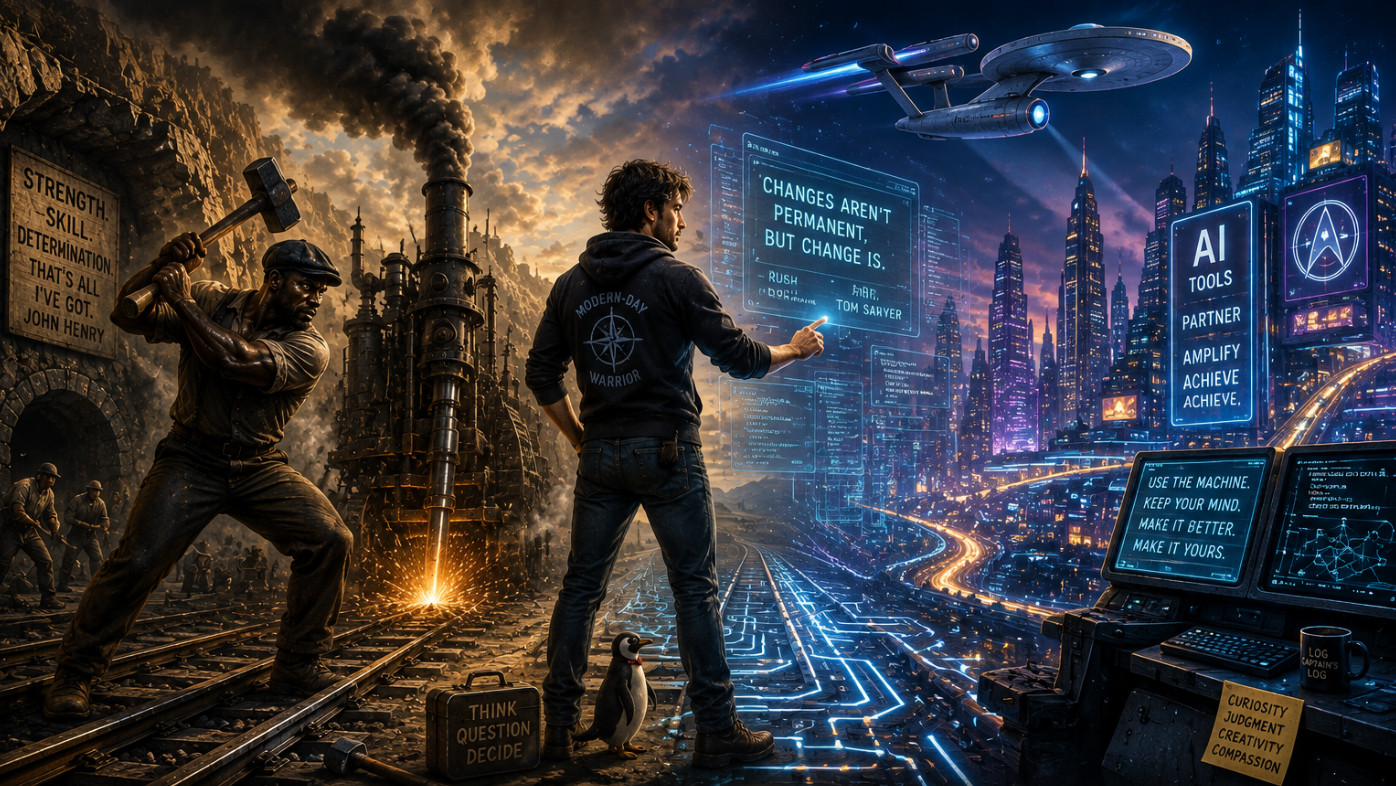
She summed it up with a great analogy: she doesn't want to become a modern-day John Henry, fighting the machine just to prove she can still do the work herself.
In case you're not familiar with the story, John Henry is an American folk hero who worked as a steel-driving man during the railroad era. According to legend, when a new steam-powered drilling machine threatened to replace workers like him, John Henry challenged the machine to a contest. He actually beat it, proving that a skilled human could outperform the machine, but he pushed himself so hard that he collapsed and died afterward. He won the contest, but ultimately lost the battle against progress.
That got me thinking, because I've found myself arriving at much the same conclusion. You can't fight progress, and the people who insist on standing in front of the train tend to be the ones who get run over by it. :)
Funny enough, I literally just got an email a few minutes ago from someone thanking me for my lessons for exactly this reason. He's using AI more and more to help him with Access and VBA, but he said that if he didn't have the fundamental understanding he got from my lessons, he wouldn't know what to ask the AI in the first place. And, just as importantly, he wouldn't necessarily know whether the answer it gave him was right.
I use AI constantly myself now. All day long, in fact. I'm using it right now to help me* draft this article, as I do with most of my writing these days. I can pour out the mental stream of consciousness that blabbers out of my brain hole, and AI can arrange it into something a little more coherent. LOL.
For coding, I look at AI as a fantastic junior assistant, not a guru. I'll have it write things that I absolutely could write myself, but if it can do in five minutes what would take me an hour, why wouldn't I use it? "Write me a quick recordset loop to do this," or "take this text and post it to this field," or "give me a function that does XYZ." I know how to do those things. I just don't necessarily want to spend half my afternoon doing them anymore.
The important part, at least for me, is that I don't want AI building things that I don't understand. Just the other day, my AI and I built an MCP so ChatGPT could communicate directly with my database through my website. There were pieces of it that I didn't completely understand going in, so as we built it, I had AI explain those pieces to me. I actually learned quite a bit in the process. That's one of the things I love about it.
What worries me is the whole "vibe coding" mentality where someone with no fundamental understanding of programming just describes what they want and blindly trusts whatever the AI builds. That may work wonderfully until the day it doesn't. What happens when the code breaks? What happens when ChatGPT is unavailable? What happens when Claude goes down? If your business depends on software that you don't understand well enough to maintain without the AI that created it, you've put yourself in a potentially dangerous position.
My rule is that I should still understand the code well enough that, if necessary, I could maintain or rebuild the important parts myself. I may not want to spend all day doing it by hand anymore, but I should be capable of it.
So I completely agree with her John Henry point. Trying to prove that I can out-code the machine would be silly. I don't want to beat the steam drill. I want to be the guy operating it. AI is another tool in the toolbox, albeit probably the most powerful tool we've gotten in our careers. The trick is knowing how to wield it.
And I think there's an interesting symbiosis developing too. AI exists because humans created all of the knowledge, code, documentation, books, discussions, examples, and discoveries that it learned from. As AI gets better, we can learn from it and use it to push ourselves further, which in turn creates new human knowledge. Ideally, it's a circle where we both keep moving forward rather than one simply replacing the other.
So no, I definitely wouldn't recommend becoming John Henry. Work with the machine, not against it. Just don't hand it the hammer and forget how to swing one yourself. :)
Rather than John Henry, I tend to think of myself as a Tom Sawyer, the "modern-day warrior," someone who thinks for himself and isn't afraid to face a changing world on his own terms. And there's one line from that song that I've always loved that seems especially appropriate today: "Changes aren't permanent, but change is." The AI tools we're using today will change. The programming languages will change. The platforms will change. But change itself isn't going anywhere.
The answer isn't to fight the machine like John Henry, nor is it to blindly surrender your thinking to it. Learn how it works. Understand what it's doing. Learn from it, teach it what you know, and use it to make yourself better at what you already do. And really, isn't that the most Starfleet thing of all? Embrace new technology, explore what it can do, keep learning, keep improving, but never surrender the human curiosity, judgment, and creativity that got us here in the first place.
* The distinction "help me" is very important here. While I use AI to help organize my thoughts, clean up my spelling and grammar, and make my stream-of-consciousness rambling a little more coherent, I never have it write for me. I don't sit down and say, "Write me an article about [topic]." Even though AI is quite capable of doing that, I personally can't stand AI slop. I can usually tell immediately when I come across some generic, soulless AI-generated garbage on YouTube, and I immediately thumbs-down that shit. The ideas, opinions, stories, and personality are mine. AI just helps me clean up the mess afterward.
People in tech fields (like the person you mentioned) have been using AI for decades, way before the current divisiveness over it. The current controversy mainly involves the arts fields, especially in creating pictures (including computer-generated graphics) and writing essays and literature. Those people have, for decades, thought their hand-crafted jobs were largely immune to automation, but now they are feeling the heat too, from authors, illustrators, to filmmakers. In video games, for instance, where tech is already heavily used, hand-drawn graphics are being replaced with AI-generated counterparts. Technology like DLSS and DLAA (where "DL" stands for deep-learning, code word for AI) are found in almost all modern video games.
Kevin Yeah, I'm guilty of using AI to make artwork because I'm not an artist. I know Photoshop pretty well, and I've actually done some Photoshop training in the past, but graphic arts is definitely not my forte. I could spend hours trying to create an image myself, and it probably wouldn't look half as good as what AI can give me in a couple of minutes. So that's absolutely one area where I'm happy to embrace AI and let it do most of the work.
But for me, those AI-generated images are really just an embellishment. They're a pastime, they're fun, and they add a little extra creativity to my articles and videos, but they're not my product. My business would function exactly the same without them. I'm not interested in spending years becoming a great illustrator, so if AI can take an idea that's in my head and turn it into a cool image, fantastic.
I look at it the same way I look at outsourcing anything else that isn't where I want to spend my time. I can fix a toilet. I know how to take one apart, replace the plumbing, snake a drain, and all that stuff. But I'd much rather hire a professional who can come in and do the job properly in 15 minutes than have me screwing around with it all day. Could I do it? Sure. Do I want to? Hell no.
That's very different, though, from using AI as a crutch for the things my business actually depends on. I wouldn't want AI developing critical code for my website that I don't understand and couldn't maintain myself, and I certainly wouldn't want it creating or teaching my Access lessons for me. Those are my core skills and my actual product. AI can absolutely help me do those things faster, just like it can help organize my thoughts or knock out some routine code, but the creativity, ideas, knowledge, and understanding behind them still need to come from me.
I think there do need to be some guardrails when it comes to protecting people's creative work, though. I can certainly understand why an artist would be upset if their work were used to train an AI without their permission, especially if that AI can then turn around and generate something that closely imitates their work or style. The same goes for actors who don't want their face, voice, or likeness reproduced in movies and television without their consent. We're still figuring out where those lines should be drawn, and I don't pretend to have all the answers.
For someone like me, though, it's a little different. I create articles and videos and deliberately put them out there publicly for people to learn from. Have AI systems probably learned things from material I've published over the years? Absolutely. Realistically, I can't prevent every AI company in the world from spidering my website, watching publicly available videos, or learning from information I've put online. For me, attribution is probably the biggest thing. If an AI learned something from one of my tutorials and someone asks it a related question, I'd love for it to say, "If you want to learn more about this, Richard Rost has a lesson on it," and point them back to me.
I think that's where the creative fields have a legitimate concern. There's a difference between learning from someone's work and simply replacing that person with a machine that was built using their work. Humans have always learned by studying what other humans created. I'm no exception. AI complicates that enormously because it can do it at a scale no human possibly could. I don't know exactly where the legal or ethical line ultimately belongs, but I do think creators deserve some reasonable degree of control, credit, and protection. At the same time, I don't think we're going to put the genie back in the bottle. The challenge now is figuring out how creators and AI can coexist in a way that's fair to the people whose work helped make these systems useful in the first place.
Kevin Yip
@Reply 2 months ago
Richard Your AI pictures are not the main purpose of your work, so I would say they are less problematic than, say, works where AI products are the main purpose and goal. But I do want to point out the "uncanny valley effect" of certain AI pictures: viewers react positively to AI-created human resemblance *until* the resemblance reaches almost totally human-like, but not quite totally human-like level, at which point their positivity turns drastically negative. This has to do with human psychology. Only total (100%) human-like appearance and behavior would ensure a positive reaction; a 99% resemblance would ironically create a great level of unease or even revulsion. And this is what happens with today's AI images: pictures or videos of people that look "almost" like real but not. This also explains why many people are against AI creations of these things. AI-created human likeness still looks like Stepford Wives or Stepford Husbands (to me). You may want to do a test about this: use almost human-like AI photos of you versus more cartoony or abstract pictures of you.
Kevin, that's a very good point. The uncanny valley is absolutely real. When an AI image is obviously a cartoon, painting, or sci-fi illustration, people accept it for what it is. But when it is trying to look like a real photograph of a person and gets 98% of the way there, the little things that are off can be deeply unsettling.
I've noticed that myself, especially with faces, hands, teeth, eyes, and expressions. Sometimes you can't immediately identify what is wrong with an image, but your brain knows something is off. It has that Stepford quality you described.
I generally prefer using AI for more stylized, humorous, or clearly fantastical artwork anyway. It fits my articles better, and it doesn't try to fool anyone into believing it is a real photo.
It can also be very hit-or-miss in terms of quality. Sometimes the results look remarkably good, and other times they look terrible. A good example is Star Wars. In one episode of The Mandalorian, when the young Luke Skywalker showed up to rescue Grogu and tore through all those Dark Troopers, I thought they did a fantastic job. But in some of the later attempts to recreate younger versions of characters, such as Princess Leia, the effect looked awful to me. It really is a double-edged sword.
Sorry, only students may add comments.
Click here for more
information on how you can set up an account.
If you are a Visitor, go ahead and post your reply as a
new comment, and we'll move it here for you
once it's approved. Be sure to use the same name and email address.
This thread is now CLOSED. If you wish to comment, start a NEW discussion in
Captain's Log.