SPOILER ALERT: I'm going to talk about the entire season, including the finale. If you haven't watched all of Season 4 yet, stop reading now. You've been warned. Apparently I have to say that. LOL.
I've been thinking about Strange New Worlds as a whole this season, and I still really enjoy the show. I like the cast, I think the acting is excellent, and I love these characters. I'm also completely willing to go along for the ride when Star Trek decides to get weird. In fact, some of the weird stuff has been my favorite stuff.
The Muppet episode? Fine. It was completely ridiculous, but I kind of enjoyed it in a weird way. It was silly, it knew it was silly, and ultimately it turned out to be a dream anyway. The black-and-white detective noir episode was kind of cool too. Give me some weird scientific explanation for why nobody can see colors and let's have some fun with it. I'm there.
The planet with the intoxicating atmosphere was silly, but okay. You established the rules of the story, and I'll play along. Last season we had a musical episode, which was completely absurd, but again, the show gave us an in-universe reason why everybody was suddenly singing and dancing. Fine. Let's have a musical.
And the fantasy episode this season had me laughing my ass off. When they revealed Kirk looking like Prince Charming with his hair blowing around like Fabio, I lost it. That was hilarious. So my problem with this season isn't that Strange New Worlds is getting too weird. Star Trek has ALWAYS been weird, and I'm perfectly happy with weird.
My problem is when the show gives me bad science and doesn't bother giving me a Star Trek explanation for it. There's an important difference. I've already accepted the basic rules of the Star Trek universe: warp drive exists, transporters exist, artificial gravity exists, inertial dampers exist, shields exist, and subspace exists. I'm not sitting there complaining that you can't accelerate a starship to Warp 9. Those are the MacGuffins we've agreed to accept so that Star Trek can exist.
But once we've established those fictional technologies, I expect the rest of the universe to behave somewhat realistically unless you give me an explanation for why it doesn't. That's where the black hole in the season finale lost me.
They actually started out doing it right. Scotty explains that they've modified the shuttle's shields to protect it against the enormous gravitational shear near the black hole. Okay! Perfect! That's exactly what I want from Star Trek. Obviously we don't have technology that can do that, but this is Star Trek. Tell me Scotty modified the shields to compensate for the tidal forces, and I'm perfectly happy to accept it.
But then somebody gets out of the protected shuttle in a spacesuit and starts flying around next to the black hole. No, no, no, no. Now you've lost me. And here's the frustrating part: it would have taken ONE LINE OF DIALOGUE to get me back.
"The suit's gravimetric compensator generates a localized subspace field that neutralizes the tidal gradient."
BOOM! I'm back on board.
Is that bullshit? Absolutely. But it's STAR TREK bullshit. You've acknowledged the actual scientific problem and you've given me an established fictional technology that explains how our characters can survive it. That's all I need. Geordi and Data did that in practically every episode.
Or don't call the thing a normal black hole in the first place. Call it a subspace singularity, an inverse gravimetric anomaly, a temporal singularity surrounded by a stable subspace membrane, or a verduron particle vortex. I don't care. Give Spock 20 seconds of dialogue explaining that it looks like a black hole but has completely different properties because of some interaction with subspace. Great. Now you can do whatever you want with it. That's what Star Trek technobabble is for.
But if you specifically tell me that something is a black hole, you're invoking something that actually exists and whose basic physics we understand pretty well. An event horizon isn't a physical surface that you can float up to, touch, and then back away from. Once you cross it, there is no coming back out.
Tidal forces are a very real problem too. With a stellar-mass black hole, the tidal gradient near the event horizon would be enormous, and you'd be spaghettified before you could casually float around down there fixing equipment. With a sufficiently supermassive black hole, interestingly enough, you actually could cross the event horizon without immediately being torn apart because the tidal gradient at the horizon can be much smaller. But once you've crossed it, you're still not coming back.
Then there's the accretion disk. If that giant glowing material around the black hole is actually supposed to be an active accretion disk, you've got another problem entirely. That's incredibly hot material producing enormous amounts of high-energy radiation. You're not taking a leisurely spacewalk through it in a spacesuit. Again, though, GIVE ME AN EXPLANATION. Tell me the suit has special shielding, the drones generate a protective subspace bubble, or this particular singularity is surrounded by some exotic field that suppresses the normal tidal forces and radiation. I'll buy it!
That's the contract between Star Trek and the audience. If you're using a known phenomenon, respect the known physics unless you explicitly tell me what fictional technology or phenomenon changes it. If you're using an invented phenomenon, go nuts. Just be internally consistent.
That's why transporters don't bother me. Nobody can say, "That's not how a transporter works." There are no transporters. Star Trek gets to make the rules. But black holes are real. If you call it a black hole and then have it behave nothing like a black hole simply because the story needs it to, that's not imaginative science fiction. That's just lazy writing.
And Star Trek has one of the greatest get-out-of-jail-free cards in the history of science fiction: "Captain, we're detecting some kind of spatial anomaly." There you go. Problem solved. Now make up some particles and let's boldly go.
As far as the episode itself goes, I actually enjoyed it up until the stupid probe space baby delivery thing started. The acting was very good, and I loved some of the little touches, especially the hairstyles that matched the original 1960s look. Nurse Chapel's hair and Uhura's hair were awesome. I loved seeing that attention to detail. It was also great seeing Kirk in command of the Enterprise a year in the future, knowing that's where all of this is eventually headed. There was a lot of good stuff in this episode, and despite all my complaining about the black hole, I really did enjoy it.
But this has been an ongoing frustration for me, not just with this episode or even this season. Strange New Worlds has had its share of it, and Discovery and Starfleet Academy have suffered from it too: bad writing and, especially, bad science when there was absolutely no reason for it. Can we please get a science consultant on the set? Get Neil deGrasse Tyson in there, or somebody whose job is simply to say, "No, that shouldn't behave like that. Explain it a different way." That's all you've got to do. You don't have to make Star Trek scientifically accurate. Just give us something plausible within the universe you've created, and stop insulting those of us who have at least a tiny bit of science knowledge.
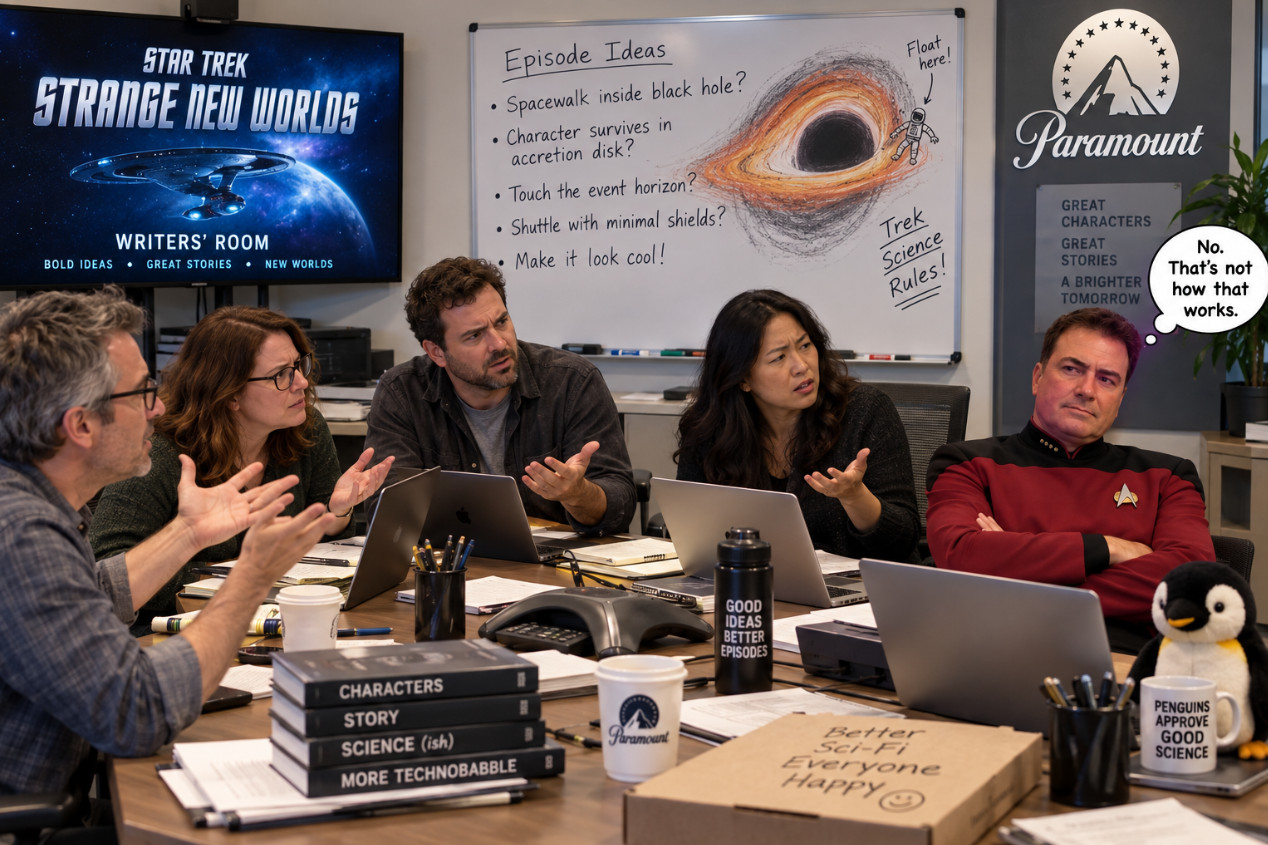
And hey, Paramount, if you need someone to sit in the writers' room and occasionally say, "That's not how that works," I'm available. Hint, hint. :)
I'm still looking forward to Season 5, and I'm still hoping they find a way to continue with this cast afterward because I really like these people in these roles. Spock is great. I like the new Kirk. Scotty is pretty cool, and I'm really looking forward to seeing who they eventually pick for Bones. There's a fantastic cast here and a lot of potential. Let's get back to some solid storytelling, give the science a little more respect, and when reality gets in the way, give us some good old-fashioned plausible Trek science to explain it. That's all I'm asking.
Unfortunately, IMO, the problem is less about the "Wokeness" people have complained about in the recent Star Trek series. It's more about the OOOOooo AAAaahh effect. I like the cool special effects as much as the next person, but not at the complete and total expense of a viable story.
In the episodes you talked about, last season's musical episode actually turned out not bad overall once the in episode explanation was given. Far better than many other TV shows throw in musical episodes.
This season's goofy episodes, there were just too many back to back to back. And when you're cutting the season down to 10 episodes, it just kills the vibe. I think there were only 2 or 3 good episodes this season and with the final season only having 6, I hope they step up their game a bit.
Sam Domino
@Reply 2 days ago
I can't comment on "recent" ST series (I still believe that everything after ST:E is not ST...LOL!!!). But I've seen "bits and pieces" of episodes and read about these series. Richard and Donald make several valid points. Personally, ST must have a "consistent" set of universal laws even if they are not "real" laws. Consistency is the key. You can't use a "law" in one episode, and then totally ignore it in the next episode without a very good reason. Next is Roddenberry's vision for ST. He saw it as a mechanism to show a future where Humanity has grown; not a utopia, but making progress. I don't say every episode has to be a "heavy" episode, but I like when most are. But there are also "traditional" episodes, like time travel to Earth's past and a alternate universe (Evil Empire) one. As I said earlier, I haven't seen ST:SNW's muppet, B&W, musical, etc. episodes so I don't know if they were just silly or had good lessons (don't do drugs, Rock & Roll is bad, etc.) But many ST episodes tried to tackle "modern day" issues in a "far future" way. The episodes didn't slap you in the face with "...this is bad...", but presented it in such a way that made you think about it. Well this is probably way too long. I think I'll go grab lunch and drink a Fallout cola (If you haven't seen them in Costco, you're missing out) LOL!!!
Yep, that's a big part of it, Donald. Spectacle is great when it supports the story, but it can't be the story. And with only 10 episodes, spending several of them on back-to-back gimmick concepts leaves very little room for the kind of character and exploration stories that made Trek work so well.
Sam, I agree completely about consistency. Trek has always bent its own rules when the plot required it, but the better episodes at least made an effort to establish why this week's anomaly changed the rules. The social commentary worked best when it was wrapped in a good science-fiction story and trusted the audience to connect the dots instead of beating them over the head with the message. "Let That Be Your Last Battlefield" was all about racism at a time when the country was very racially charged, but it wasn't heavy-handed about it, and you didn't get it until the end... How stupid it was.
And yes, the evil Mirror Universe is practically mandatory Trek at this point. It's in the Constitution somewhere, right next to the clause requiring at least one time-travel episode.
Sorry, only students may add comments.
Click here for more
information on how you can set up an account.
If you are a Visitor, go ahead and post your reply as a
new comment, and we'll move it here for you
once it's approved. Be sure to use the same name and email address.