I seem to have been only like a boy playing on the seashore, and diverting myself in now and then finding a smoother pebble or a prettier shell than ordinary, whilst the great ocean of truth lay all undiscovered before me.
I am 70 yrs. old & would like to continue my education. I've always wanted to learn how to code. I would like to know your opinion on what language I should start out with first & why?
Thank you for your time.
Kevin Robertson
@Reply 3 years ago
I personally started with Visual Basic 6.0 before upgrading to VB.NET. VB, in my opinion, is the easiest to learn.
C# is a little harder, but not too bad. C++ is probably the hardest of the 3 that I have experience with.
Whichever you choose you will need to download Visual Studio. You can download the free Community Edition from Microsoft.
Kevin Yip
@Reply 3 years ago
I would suggest BASIC as a the first language for any beginner, because it has the most "English-like" syntax. Access and Visual Studio both use a version of BASIC, but they are very complicated software for beginners to use and maintain. So I would suggest a much simpler tool that uses BASIC, such as Microsoft Small Basic. If you remember Windows 3 and XP, you may remember the QBasic tool that came with them. This is the descendant of that:
This site has plenty of PDF tutorials for you to study and practice with: https://smallbasic-publicwebsite.azurewebsites.net/tutorials
You can download the tool, or write code directly online: https://smallbasic-publicwebsite-code.azurewebsites.net/
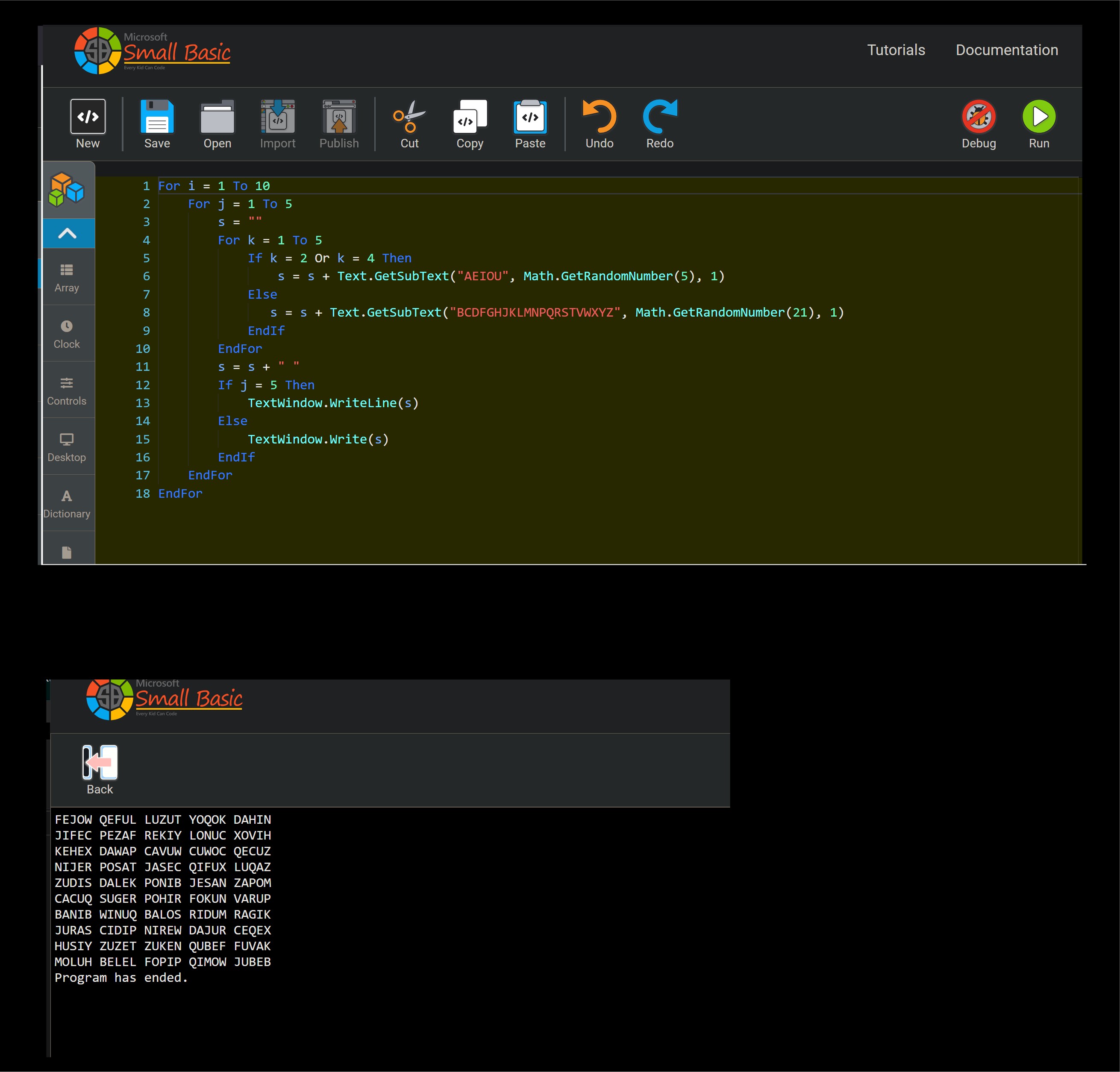
The picture below is a sample piece of code I did. It creates 50 random words, shown in a 5-by-10 layout, with each word composed of random consonants in the 1st, 3rd, and 5th letter, and random vowels in the 2nd and 4th letter. This is the essence of programming: a deceptively brief piece of code is able to perform tasks that may be very time-consuming to do manually. This task is an actual homework assignment that I got in my 10th grade computer class in the early 1980s (the dawn of today's computer age).
Nowadays, elementary schools teach coding fairly early. Here is a kind of coding via "block-building" that kids may learn today: https://scratch.mit.edu/projects/editor/?tutorial=getStarted . If you didn't have computer classes in your early school years, you may take a look. If it is too child-like for you, you may go straight to "text-based coding." That's why I suggest you learn the most English-like coding language first. Most other languages may look like alien language to you at this point.
Kevin Yip
@Reply 3 years ago
Sorry, only students may add comments.
Click here for more
information on how you can set up an account.
If you are a Visitor, go ahead and post your reply as a
new comment, and we'll move it here for you
once it's approved. Be sure to use the same name and email address.
This thread is now CLOSED. If you wish to comment, start a NEW discussion in
Visitor Forum.