|
|||||
VB 101MsgBox, Buttons, Labels, Calculator, EXEWelcome to Visual Basic Beginner 101. In this course you will learn the basics of Microsoft Visual Basic, including what Visual Basic is and how to create a simple program. We will discuss how to use the MsgBox command, introduce important controls like command buttons, text boxes, and labels, and cover decision making with If...And statements. You will also see how to compile your program into an executable file and review the prerequisites needed for working with Visual Basic on Windows systems. Lessons
ResourcesLesson SummaryWelcome! Basic Program with MsgBox & Labels - In this lesson, we will provide an introduction to Microsoft Visual Basic programming, discuss what Visual Basic is, and walk through creating a basic program. We will cover basic Visual Basic commands like MsgBox, introduce controls such as command buttons, text boxes, and labels, and discuss decision making with If...And statements. We will also talk about compiling your program into an executable file and review prerequisites for the course, including familiarity with Windows and programs like Word or Excel. This lesson uses Visual Basic and Windows XP, but the material applies to most Windows versions.
Lesson 1: Objects, Properties, Methods, Events - In Lesson 1, we will cover some basic definitions essential to understanding programming, focusing on what a program is and how Windows programs differ from earlier methods of programming. We will discuss the key components of Windows programs such as objects, properties, methods, and events, with examples from Microsoft Calculator. You will learn what Visual Basic is, and how its programming environment combines a programming language with a graphical interface to make creating programs easier.
Lesson 2: Button & MsgBox: Your First Program - In this lesson, we will walk through starting Visual Basic, creating a new Standard EXE project, and building your first program. I will show you how to add a command button to a form, write a simple line of code to display a message box when the button is clicked, run your program, and save your work properly. We will also briefly discuss the Visual Basic interface and some key windows within it, but most of the focus is on building and running your first program step by step.
Lesson 3: Edit Object Captions & Colors - In this lesson, we will walk through the basic properties of objects in our Visual Basic project, including how to change the Caption and name properties of buttons and forms. I will show you how to make your form and button labels more user-friendly, adjust background colors, and explain what happens in your code when you rename objects. We will also discuss other properties you can modify and highlight some common issues that occur when renaming buttons, along with how to fix them.
Lesson 4: Labels, Textboxes & Input Tips - In this lesson, we will walk through how to add and use a label and a text box in your program. You will learn the purpose of labels for displaying information, how to make their background transparent, and how to resize them. We will also discuss adding a text box, setting its properties, and giving it a meaningful name. Finally, I will show you how to use the value from the text box to display a personalized message in a message box, covering how to concatenate text so your app greets users by name.
Lesson 5: Simple Calculator With Text Boxes - In this lesson, we will walk through building a simple calculator program in Visual Basic. I will show you how to create a new project, add text boxes for user input, set their properties, and add a command button to perform the calculation. We will discuss how to write code to process input values as numbers using the val function instead of as text, and I will demonstrate how to display the result in a third text box. We will also briefly talk about control arrays, which we will cover in a future lesson.
Lesson 6: Add, Subtract, Multiply, Divide Buttons - In this lesson, we will expand our simple calculator to support subtraction, multiplication, and division in addition to addition. We will walk through adding and configuring new buttons for each operation, updating their properties, and writing the corresponding code. I will show you how to address runtime errors like division by zero with proper error handling using IF statements and show how to display a user-friendly message. We will also discuss saving your program, working with the code window, and the importance of keyboard shortcuts when working with Visual Basic projects.
Lesson 7: Compile VB to EXE & Find EXEs - In this lesson, we will walk through how to compile your Visual Basic program into a standalone executable file so you can run it directly from Windows without needing the Visual Basic editor. I will show you how to save your project, generate the .EXE file, locate it in your file system, and create a desktop shortcut. We will also discuss file extensions, explain how to identify your executable, and touch on what you need to know if you want to share your compiled program with others, including a brief mention of the Package and Deployment Wizard for distributing your Visual Basic program.
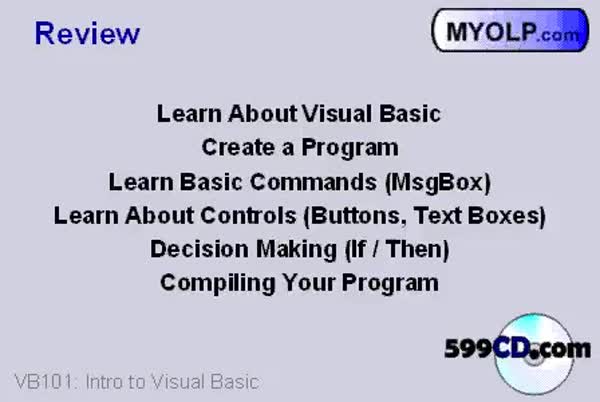
Lesson 8: MsgBox, Controls, If, Errors, Build - In this course we learned about Visual Basic and Windows programs, including creating basic programs like a message box display and a simple calculator. We covered key Visual Basic commands, explored controls such as command buttons, text boxes, and labels, and discussed decision making with If Then statements, as well as basic error handling. We also talked about compiling programs into standalone executables, distributing them to users, and where to find further tutorials. Information on support and how to obtain a certificate of completion was also discussed.
NavigationKeywordsVisual Basic, VB 6, MsgBox, command button, label, textbox, If Then, object properties, captions, colors, calculator, control array, error handling, compiling, exe file, Package and Deployment Wizard, Windows programs
More InformationTranscriptWelcome to Visual Basic 101, Introduction to Microsoft Visual Basic Programming, brought to you by MyOnlineLearningPartner.com and 599CD.com. I am your instructor, Richard Rost, and you can reach me at [email protected]. What are we going to learn today? We are going to learn about Visual Basic and what it is. We are going to create a basic program. We are going to learn Visual Basic commands such as MessageBox to display a message on the screen. We are going to learn about some Visual Basic controls like command buttons, text boxes, and labels. We are going to learn about decision making in your programs using an If and statement. We are going to show you how to compile your program into a standalone executable file. Our goal for today is to get you up and running quickly. We are going to cover a lot more details in future classes. Our goal today is to get you writing programs. I would like to do this with a lot of my 101 level classes. We are going to skip a lot of the theory in today's class because there is a lot of theory behind programming that you do not really need to know right now. My goal is to get you up and start writing programs in about an hour. There are some prerequisites for today's class. You should at least know our Windows 101 Introduction to Computers and either Windows 102 Introduction to Windows 98 or Windows 110 Introduction to Windows XP course material. These are pretty basic courses that cover all the Windows basics, how to use a mouse, how to use a keyboard, editing text, and so on. We also strongly recommend that you become familiar with Windows programs like Word, Excel, or PowerPoint. Familiarity with any of those Windows programs will help you become a better programmer. It is not necessary to be an expert with these programs, but if you are proficient with a word processor and spreadsheet, you will have a much easier time when it comes to writing your own programs. What version of Visual Basic are we using? In today's class we are using Microsoft Visual Basic 6.0. If you are using VB5, you should notice very little difference between what we are covering today and what you are seeing on your screen. You will also notice that we are using Windows XP as our operating system, but this makes little difference. You should be able to follow along with today's course regardless of whatever Windows version you are using. IntroIn this lesson, you will get an introduction to Microsoft Visual Basic programming, learn what Visual Basic is, and create a basic program using Microsoft Visual Basic 6.0. I will show you how to use commands like MessageBox, work with basic controls such as command buttons, text boxes, and labels, and introduce decision making with If statements. You will also learn how to compile your program into a standalone executable file, all with minimal theory so you can start writing programs right away. This is lesson 1. QuizQ1. What is the main goal of this Visual Basic 101 course? A. To learn all programming theory behind Visual Basic B. To get students up and running writing programs quickly C. To become an expert in Windows operating systems D. To create complex visual designs Q2. Which Visual Basic command will be taught to display a message on the screen? A. PrintScreen B. InputBox C. MessageBox D. ShowText Q3. Which of the following is NOT mentioned as a Visual Basic control in the video? A. Command button B. Text box C. Drop-down menu D. Label Q4. What programming concept is introduced for making decisions in programs? A. Loop statement B. Select Case statement C. Do While statement D. If and statement Q5. What is the recommended prior knowledge for this Visual Basic 101 course? A. Knowledge of web development languages B. Familiarity with Windows basics and Microsoft Office applications C. Advanced programming experience in C++ D. Experience with graphic design tools Q6. Which version of Visual Basic is used in this course? A. Visual Basic .NET B. Visual Basic 5.0 C. Visual Basic 6.0 D. Visual Basic 4.0 Q7. What operating system is demonstrated in the course? A. Windows Vista B. Windows XP C. Windows 7 D. Windows 95 Q8. Is it necessary to be an expert with Word, Excel, or PowerPoint for this course? A. Yes, expert knowledge is required B. No, only basic knowledge is needed C. No prior knowledge of any programs required D. Advanced knowledge of databases is required Q9. According to the video, how important is theoretical knowledge of programming at this stage? A. It is the main focus of the class B. Only a little is necessary right now C. It will be covered in every detail today D. Students must read a textbook first Answers: 1-B; 2-C; 3-C; 4-D; 5-B; 6-C; 7-B; 8-B; 9-B DISCLAIMER: Quiz questions are AI generated. If you find any that are wrong, don't make sense, or aren't related to the video topic at hand, then please post a comment and let me know. Thanks. SummaryToday's video from Visual Basic Learning Zone is an introduction to Microsoft Visual Basic programming. My name is Richard Rost, and I will be guiding you through the basics of Visual Basic today. If you need to reach out to me for any questions, my email is [email protected]. This lesson will begin by explaining what Visual Basic is and what it can do for you. We will start off by creating a simple program so you can get a hands-on feel for how everything works. I will introduce you to a few fundamental commands in Visual Basic, such as the MessageBox command, which allows you to display a message to the user. We will also discuss some important controls you will use frequently, including command buttons, text boxes, and labels. Decision making is key in programming, so we will also look at how to use If statements in your code to make your programs more interactive and responsive. By the end of this lesson, I will also show you how to turn your program into a standalone executable file so you can run it independently of the development environment. The main goal today is to get you comfortable with starting and running your own Visual Basic programs as quickly as possible. We will be skipping over some of the deeper programming theory for now. I want to focus on giving you practical experience so you can get up and running and actually write some code in about an hour. Before you start this course, there are some basic prerequisites. You should be familiar with material covered in Windows 101 Introduction to Computers as well as either Windows 102 Introduction to Windows 98 or Windows 110 Introduction to Windows XP. These foundation courses cover essential Windows skills, including using the mouse, keyboard, and basic text editing. I also highly recommend that you have some familiarity with standard Windows applications like Word, Excel, or PowerPoint. Prior experience with these applications is not strictly required, but if you are comfortable working with a word processor or spreadsheet, you will find it easier to progress with programming. For this class, we will be working with Microsoft Visual Basic 6.0. If you have Visual Basic 5, you should have no problem following along, as the differences are minimal for what we are covering today. The operating system featured in this lesson is Windows XP, but it does not matter much which version of Windows you are using; the instructions and techniques will be the same. You can find a complete video tutorial with step-by-step instructions on everything discussed here on my website at the link below. Live long and prosper, my friends. Topic ListIntroduction to Visual Basic and its uses Creating a basic Visual Basic program Using the MessageBox command to display messages Adding and configuring command buttons Adding and using text boxes in a program Working with labels in Visual Basic Implementing decision making with If statements Compiling a Visual Basic program into an executable file Primary TopicsVisual Basic overview, creating a basic program, Visual Basic 6.0, MessageBox command, controls (buttons, text boxes, labels), If statements, compiling executables Secondary Topicsprerequisites for beginners, Windows XP compatibility |
||||||||||||||
|
| |||
| Keywords: Visual Basic, VB 6, MsgBox, command button, label, textbox, If Then, object properties, captions, colors, calculator, control array, error handling, compiling, exe file, Package and Deployment Wizard, Windows programs PermaLink How To Get Started With Programming, Controls, and Creating Executables in Microsoft Visual Basic 6.0 |