|
|||||
|
|||||



|
|
|||||
|
|||||
|
Richard Rost
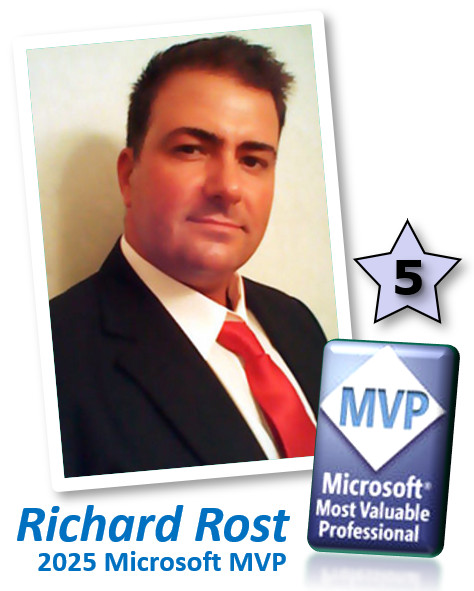
A self-taught computer nerd, I started programming at the age of 8 on TRS-80 that they had in my school. Of course, I just had to have one, so I begged my grandpa to buy me a Tandy Color Computer 2 for Xmas. From that point on, I was hooked. I learned BASIC programming (and computers in general) mostly from books and magazines. Remember, there was no public Internet back then. I wish I had the resources available now! I was a CoCo fanatic until I got my hands on my first IBM-PC compatible machine in the late 1980s. I taught myself how to program in C just so I could modify the computer bulletin board (BBS) system that I was running. Mine had a fantasy role-playing theme (D&D, etc.) and was based on the WWIV platform. Before the Internet, this was how nerds communicated. You'd fire up your 2400 baud modem and hope for a dial tone. After I "graduated" high school, I did go to college for a couple of years. I dropped out because the classes weren't teaching me anything I hadn't already learned on my own. This was the early 90s and they were teaching stuff that I knew when I was 12 years old. Plus, I was working for a company doing phone-based tech support, and I hated that job too. So, I decided to start my own company. I founded Amicron Computing in 1994 to provide custom-built computer systems and related services to the Western New York area. In addition to building computers myself, I also offered my customers networking solutions, custom software development, and personalized training solutions to meet their individual business needs. My personal specialty is building database solutions using Microsoft Access. I opened my first dedicated Computer Training Center in 1996 in Amherst, NY. Centered around small group instruction, I taught classes in Microsoft Windows, Word, Excel, PowerPoint, Web Design, QuickBooks, Photoshop, WordPerfect, and more. What really set my training center apart, however, was the availability of advanced developer-level instruction in Microsoft Access, Excel, and Visual Basic. I developed all of my own training materials from my years of computer experience. As the computer industry changed following Y2K, so did my business. As computers themselves became more "commercialized," and big companies - as they always do - put the squeeze on the smaller ones, I decided to stop providing hardware and PC service and focused more on training and consulting. It was during this time that I opened a new, larger training facility in Amherst NY. In addition to the small group training I had offered previously, I started holding large seminars and workshops for groups of 20 to 30 students.
After teaching live seminars for over a year, I developed highly-refined video tutorials under the very popular 599cd name. My goal was to offer tutorials at a price low enough so everyone could afford them. After much debate and research, I decided on a price of $5.99 for my beginner, one-hour lessons. Since the lessons were initially only available on CD-ROM, the name 599cd just made sense, plus it was a nice, short, available .com domain name. Today, I have many different levels of courses available (beginner through advanced) in several different topics. See the complete story behind 599cd here, if you're interested. As of May of 2022, my YouTube channel has over 200,000 subscribers and over 36.5 million views.
In October of 2013, I moved to Cape Coral, Florida. I just couldn't take any more Buffalo winters and lack of sunlight. Give me palm trees and sunshine, please. Buffalo is great in the summer... both weeks of it. If I never see snow the rest of my life, I'll die a happy man. In 2019, I moved to nearby Fort Myers, Florida, and rebranded my company Computer Learning Zone. Too many people kept asking me what 599cd meant. It's 2023. Back to Cape Coral. What can I say? I couldn't stay away. Also, I received the Microsoft MVP Award for a 3rd time this year after being away for a few years for various reasons, including some health issues. Thanks to MVP Mike Wolfe for nominating me for my second time. 2025: I'm in the "MVP Five-Timer's Club." Got awarded my 5th MVP. Do I get a jacket or something now? :) I was awarded MVP for the 6th time in 2026. My YouTube channel is now over 254,000 subscribers, and over 51 million views. My channel isn't as popular as those that post gamers or stupid cat videos. However, people have spent a combined 3.3 million hours watching my videos. That's 137,500 days or 376 years. That means if Isaac Newton had started watching my videos when he was seven years old, he'd be just about finished now. Math. Wow. You can read more about the history of 599cd, Amicron, and Computer Learning Zone here. For my (almost) daily words of wisdom, check out my blog: The Captain's Log. Considering a career as a freelance software consultant? Be sure to read my Advice for Consultants page. RR Q&ASince I get asked a lot of the same questions, I decided to put together a little Q&A section. And yes, I'm very flattered that people always ask me these questions. I had no idea that people wanted to get to know me this much. So here goes... Q: How old are you? I was born in October of 1972. You do the math. That makes me old enough to remember when there was no Internet, no Google, and if you wanted to learn how to program, you grabbed a book or a computer magazine and figured it out yourself. Honestly, I'm glad I grew up when I did. I learned how computers actually work instead of just learning how to use apps. I still think my generation had the best childhood. We played outside all day, came home when the streetlights came on, and somehow survived without cell phones. Q: Where are you from? I'm originally from Hamburg, New York (a suburb of Buffalo). I mostly grew up in Hamburg. Then I moved to Angola and graduated from high school there. After that I lived in Blasdell, Depew, Cheektowaga, and finally Amherst. I did the "tour-de-WNY" you could say. I lived in Amherst until 2013, when I finally decided I'd had enough of snow. Buffalo is a wonderful city with wonderful people. I still miss the food. I still miss the summers. I always say "I love the summer in Buffalo, both weeks of it." But after shoveling snow for forty years, I was done. These days I live in Cape Coral, Florida, and if I never have to scrape ice off a windshield again, I'll die a happy man. Q: Do you have any pets? Two black Labrador retrievers. Actually... we have a dog, and our dog has a dog. When Lauren and I moved in together, she already had an older black Lab named Coal. As he got older, we realized he needed a companion, so we adopted Carter. When Coal eventually passed away, Carter needed a companion, so we adopted Cooper. Now the two of them pretty much run the house. Q: Why are you always posting penguins? That started because of my wife. Most penguin species mate for life, so somewhere along the line penguins became "our thing." We started calling each other penguin, buying penguin gifts, watching penguin documentaries... and before long I became genuinely fascinated with them. Then Lauren's mom made a comment one day that I walked like a penguin. At the time I was about fifty pounds heavier than I am now, so... yeah... I kind of waddled. The nickname stuck. Now I just love penguins. They're fascinating animals. Smart, social, loyal, funny, and surprisingly tough. If you see penguins pop up in my graphics from time to time, now you know why. Q: What's your favorite food? Sushi. Specifically, salmon avocado hand rolls. If a restaurant has them, I'm ordering them. That being said, I'm a 200 and "something" pound guy. There aren't many foods I don't enjoy. Q: Coffee or tea? Coffee. Definitely coffee. Captain Janeway and I would get along just fine. Every morning starts with a good cup of coffee. After that I try to switch over to water for the rest of the day, although I do enjoy flavored zero-calorie water and the occasional diet soda with dinner. I like tea too, but coffee wins every time. Q: Do you drink? Not much anymore. When I was younger, I probably drank a little more than I should have from time to time. Like a lot of people in their twenties and thirties, going out with friends after work or after a softball game usually meant a few beers. It was more about the socializing than the drinking, but those calories add up over the years. These days, alcohol really isn't part of my regular life. The only time I'll usually have a drink is on vacation. It's become a bit of a tradition that the first thing I order after arriving somewhere in the Caribbean is a pina colada. It just feels like vacation has officially started at that point. Every once in a great while, if my wife and I go out for a nice steak dinner, I'll have a glass or two of Cabernet. That's about it. The biggest reason I've cut back is health. Alcohol is essentially a poison, and while I do enjoy it occasionally, I'd rather save it for those special moments than make it part of my everyday routine. Life's too short not to enjoy a good pina colada on a tropical beach or a nice glass of wine with a great steak. But for me, those are treats, not habits. Q: What are your favorite movies? I'm a huge science fiction fan, so this probably won't surprise anyone. My favorite movie of all time is Star Trek II: The Wrath of Khan. It's nearly a perfect movie. Great characters, unforgettable villain, wonderful storytelling, and one of the best endings ever filmed. The Empire Strikes Back is another masterpiece. I enjoy the original Star Wars, but Empire is where everything came together. Personally, I think the rest of the movies never quite lived up to it. For comedy, nothing beats Spaceballs. I've probably seen it a hundred times, and I still laugh. One of my favorite little trivia facts is that Tim Russ, who later played Tuvok on Star Trek: Voyager, is the soldier combing the desert. "We ain't found shit!" Still cracks me up. And he's said in interviews that still today, more people recognize him as that character than Tuvok. I'm also a big fan of the original Iron Man. Robert Downey Jr. absolutely nailed Tony Stark, and it's still one of the best superhero movies ever made. The rest of the Avengers series started going downhill, in my opinion, but that original first Iron Man movie is classic. I'm also a sucker for good time-travel movies. Back to the Future Parts I and II are fantastic. Part III was okay, but I'm not much of a western fan. The first two Terminator movies are classics too. Everything after that... not so much. I've loved pretty much everything that Schwarzenegger has done, though. He was like the classic action hero I had growing up. Loved the two original Conan movies as well. Q: What kind of music do you listen to? "In my van, it's all Rush all the time." If you get that reference, you're probably not only a Rush fan, but a sci-fi nerd like me. Rush has been my favorite band since high school, and I never get tired of listening to them. Neil Peart was the greatest lyricist and drummer who ever lived. I enjoy plenty of classic rock and progressive rock, but if I'm choosing what's playing, it's probably Rush. That said, my musical tastes are all over the map. I grew up listening to everything from Duran Duran and The Police to Van Halen. I love '90s grunge bands like Stone Temple Pilots and Alice in Chains. If it's classic rock, progressive rock, or good '80s and '90s music, there's a pretty good chance I'll enjoy it. The one genre I never really got into was country music. I'm sorry... I just can't get excited about songs where the truck broke down, the dog ran away, the girlfriend left, and somehow everyone still has time to go fishing. I know that's an unfair stereotype, but it always makes me laugh. When I'm working (and not recording videos), I usually have movie soundtracks playing in the background. John Williams is a genius, so you'll often hear Star Wars, Superman, or Indiana Jones playing through my speakers. I also love the Lord of the Rings soundtrack by Howard Shore. Instrumental movie scores are perfect for working because they're inspiring without distracting me from whatever I'm programming or writing. Ever since Rush announced Anika Nilles as their drummer for the R50 tour, I've been listening to a lot of her music too. She's an absolutely phenomenal drummer, and I'm really looking forward to seeing them in Tampa this November. Q: What's your favorite book? I honestly don't know if I have one favorite. I love The Lord of the Rings, although Tolkien could spend three pages describing a tree if you let him. The world building is incredible, but it's definitely not light reading. The Hobbit is much easier to get through and is always fun to revisit. The books I probably enjoyed the most were the original Dragonlance Chronicles and Dragonlance Legends series by Margaret Weis and Tracy Hickman. I absolutely loved those books in high school. I couldn't put them down. Nowadays, I spend most of my reading time on biographies, autobiographies, science books, and technical books. I don't read nearly as much fiction as I probably should. Q: What do you do for fun? These days, the honest answer is... but I genuinely enjoy what I do for a living. I know that probably sounds like a cliche, but it's true. I wake up every morning excited to make videos, write software, answer student questions, and work on new projects. I feel incredibly fortunate that my job is something I'd probably still do even if nobody paid me for it. Outside of work, I don't have a lot of hobbies anymore because I simply don't have much free time. When I do, I enjoy spending it with my wife and our two black Labs. Whether it's taking the dogs for a walk, swimming with them in the pool, going out for a nice dinner, or taking a weekend trip somewhere, that's my idea of a good time. I'd much rather take an occasional cruise or a short vacation than have a lot of idle time sitting around the house. I've also made fitness much more of a priority over the past few years. I try to work out every day, even if it's just a half-hour walk or lifting weights in the garage. Put on some Rush, lift some iron, and that's a pretty good workout. Earlier in my life, though, my biggest hobby was Dungeons & Dragons. I absolutely loved it, and I actually enjoyed being the Dungeon Master more than being a player. I loved creating worlds, drawing maps, designing adventures, inventing villains, and watching my players figure out the puzzles I put in front of them. When my kids were old enough, I introduced them to the game and ran a campaign for them and their friends. Watching them get excited as they solved problems and worked together was every bit as much fun as playing when I was younger. For the record, my favorite version of Dungeons & Dragons will always be the old boxed BECMI edition: Basic, Expert, Companion, Master, and Immortals. That's the version I grew up playing, and I still think it's one of the best role-playing game systems ever created. If you've ever wondered why my Microsoft Access courses are organized into Beginner, Expert, Advanced, and Developer levels, you can blame D&D. The idea of breaking a huge subject into progressively more advanced "boxes" came directly from those old boxed sets. Even the different colors subconsciously influenced me. Those games made a lasting impression on me, and I guess that influence found its way into how I teach today. I still have all of my old BECMI books, and every now and then I'll pull one off the shelf just for the nostalgia. Years later, after I moved to Florida, I found another gaming group, and we played together for a couple of years before life got in the way. People moved, schedules changed, and the group slowly drifted apart. I'd love to play again someday. The only thing I'm missing now is time. Still got my dice. Q: Do you play video games? Not anymore. Growing up, absolutely. I had an Atari 2600 as a kid and spent countless hours playing Pac-Man, Pitfall, and a lot of the early classics. Later after I had a PC, I enjoyed games like Baldur's Gate, Warcraft, StarCraft, and strategy games where you actually had to think. The funny thing is, though, I was always more interested in making computers do things than using them. I'd rather build a game than play one. That's still true today. After spending all day on a computer making videos and writing software, the last thing I usually want to do is spend another four hours in front of a screen. Unless I'm watching Star Trek, of course. Q: Are you a sports fan? Professional sports? Not really. I grew up playing baseball and loved it. I played Little League as a kid, coached Little League when my own kids were young, and later played everything from hardball with wood bats to men's slow-pitch softball. I kept playing softball for years, right up until my eye injury. Now that I only have vision in one eye, judging a fly ball is a little more difficult, and I'm not willing to risk taking one in my good eye. I can still hit a golf ball because it doesn't move. LOL I still love going to a baseball game. I also enjoy attending football and hockey games. There's something about being there in person, surrounded by the crowd, that makes it fun. I was also a season ticket holder for the Buffalo Bandits indoor lacrosse team for years. Those games were a blast. If you've never seen indoor lacrosse live, it's fast, loud, physical, and extremely entertaining. People from Buffalo will understand. Bandits games were always a great time. Watching professional sports on television, though? Not so much.I can enjoy being at a game, but I can't sit on the couch every weekend watching hours of sports and memorizing everyone's statistics. I don't know who rushed for how many yards in Super Bowl XIV, and I couldn't tell you who currently leads the league in anything. Whenever my wife and I are traveling, or when we meet someone here in Florida and they hear I'm from Buffalo, one of the first questions is usually, "Oh, you're from Buffalo? Are you a Bills fan?" Not really. I stopped being a Bills fan after they lost four Super Bowls in a row. LOL. There's only so much heartbreak a person can take. When I used to play softball, we'd often go to the bar afterward for a couple of beers. I was one of the first people in the group with a phone that could easily look things up online, so whenever the guys started arguing about who won a particular Super Bowl or some other sports statistic, they'd hand the question to me. "Hey, Rick, look this up." I was basically the team's official sports dispute resolution department. Me and my trusty Sidekick phone. Remember those? I also like teasing hardcore sports fans a little. They'll wear jerseys with another man's name on the back, paint their faces, scream at the television, and spend hundreds of dollars dressing like their favorite players. Then some of those same people make fun of someone for dressing like Mr. Spock or a Klingon at a science-fiction convention. Come on, guys. You're cosplaying too. Your costume just has shoulder pads and a number on it. And I've always said that fantasy football is basically Dungeons & Dragons for people who used to make fun of the kids who played Dungeons & Dragons. You select a team of characters, track their statistics, argue about rules, and spend hours pretending their imaginary performance matters. That's D&D. And yes, I'm sticking with that joke. Q: Why do you love Star Trek so much? I was born in 1972, so I grew up watching reruns of the original Star Trek after school and on the weekends. At first, I loved it for the same reason every kid did. It had spaceships, aliens, phasers, transporters, cool gadgets, and adventures across the galaxy. I wanted to be an astronaut when I was growing up, so Star Trek was right up my alley. As I got older, though, I started appreciating what Star Trek was really about. It wasn't just spaceships and laser fights. Star Trek has always been about optimism. It's about humanity trying to become better tomorrow than we are today. It's about science, exploration, curiosity, diplomacy, and solving problems with your brain instead of your fists. That's the future I want to believe in. When The Next Generation premiered in 1987, I was completely hooked. I was thirteen years old, which is a pretty impressionable age. Sure, the first couple of seasons had their rough spots, but once the show found its footing, I was glued to the TV every week. I couldn't wait for the next episode. Looking back, I think there was another reason the show resonated with me so much. I grew up without much of a father figure. I was raised by my grandparents, and while my grandfather was a wonderful man, he worked long hours and passed away when I was still pretty young. There wasn't really anyone in my life that I looked up to in that fatherly role. In a strange way, Captain Picard became that person for me. He was calm. Intelligent. Fair. Compassionate. He didn't solve every problem by punching somebody. He listened before he spoke. He admitted when he was wrong. He led by example instead of fear. Those are qualities I've always admired, and I'd like to think they've influenced the kind of person I've tried to become. Star Trek also sparked my lifelong love of science and astronomy. Even though the technology isn't always scientifically accurate, it encouraged me to ask questions, wonder how the universe works, and imagine what humanity might accomplish someday. I honestly believe Star Trek inspired generations of scientists, engineers, astronauts, and programmers, and I'm probably one of them. That's why I've stuck with Star Trek for over fifty years. Sure, I enjoy the spaceships. But it's the optimism that keeps me coming back. Q: What's your favorite Star Trek series? The Next Generation. No question. I watched every episode as it originally aired beginning in 1987. Sure, the first couple of seasons were a little rough, but once the show found its footing, it became one of the best television series ever made. The characters felt like family. The stories made you think. It wasn't just entertainment. It often asked difficult moral questions without telling you what to think. Q: Who's your favorite Star Trek captain? I actually split this into two different questions. If you asked me which captain I'd want to hang out with, have a drink with, or go on an away mission with, I'd probably pick Kirk. He's adventurous, funny, and always entertaining. If you asked me which captain I'd actually want commanding the ship while my life depended on it... Picard. Not even close. Picard is calm under pressure, thoughtful, diplomatic, and almost always makes the right decision. I trust he'd have a much better chance of getting everyone home safely. Kirk lost an awful lot of redshirts. Q: What do you think of the other Star Trek series? Deep Space Nine started slowly, but once the Dominion War got going it became excellent. Sisko was a fantastic commander and later captain. Voyager had a rough beginning too, but really found its stride. Janeway is one of my favorite captains. Enterprise disappointed me. I was so excited for it before it came out because they had this wonderful opportunity to show the early days of Starfleet and the development of all the technology we know from later series. Instead, they spent far too much time on the Temporal Cold War storyline, which just never worked for me. Ironically, just as it was getting really good in the fourth season, it got canceled. Discovery just never clicked with me. I wanted to like it, but I never connected with most of the characters. To me, Star Trek has always been about optimistic leadership and people you aspire to become. Discovery never gave me that feeling. I wasn't a big fan of Lower Decks either. I understand why people enjoy it, but it just wasn't for me. Starfleet Academy is Meh. Season 1 was OK. I'll wait until Season 2 is over before I give a final verdict. It had a couple of really good episodes, but also a couple of sleepers. Strange New Worlds is awesome. Probably the best intro of any Trek show. They've had a few silly episodes (musical? Really?) but overall it's been "back to basics" Trek that I really have enjoyed. Season 4's opener with the dinosaurs was really cool. As for the Kelvin movies, I thought the casting was outstanding. Zachary Quinto was an excellent Spock. Karl Urban absolutely nailed McCoy. Chris Pine was a fun Kirk. I just wish the scripts had leaned a little more toward science fiction and a little less toward action movies. Q: Star Trek or Star Wars? Star Trek. Duh. Now, don't get me wrong, I enjoy Star Wars too. The original movie changed cinema forever, and I still think The Empire Strikes Back is one of the greatest movies ever made. It's nearly perfect. But to me, they're two completely different kinds of stories, and I don't think it's really fair to compare them. Star Trek is science fiction. Sure, they bend the laws of physics from time to time, but they at least try to build a universe that feels grounded in science. It's about exploration, discovery, diplomacy, and imagining a future where humanity has grown beyond many of the problems we struggle with today. That's the future I want to believe in. Star Wars, on the other hand, is fantasy. It just happens to take place in space. Instead of knights riding horses, you've got Jedi carrying laser swords. Instead of magic, you've got the Force. Instead of dragons, you've got the Millennium Falcon. At its heart, it's a classic fantasy adventure, and there's absolutely nothing wrong with that. In fact, one of the things I loved most about the original Star Wars trilogy was that it didn't try to explain everything. The Force was mysterious. It wasn't supposed to be understood scientifically. It was simply part of that universe, and that mystery made it more interesting. One of the things I liked least about the prequels was the attempt to explain the Force with midichlorians. No... please don't. Sometimes it's better to leave a little mystery in the universe. Not everything needs a scientific explanation, especially in a fantasy story. So while I enjoy both franchises, they scratch completely different itches. When I want swashbuckling adventure, memorable villains, and good-versus-evil storytelling, I'll watch Star Wars. When I want stories that make me think about science, philosophy, ethics, leadership, and what humanity could become, I'll watch Star Trek. If I could only keep one... It's Star Trek. Every time. Q: What's your favorite science topic? Astronomy and astrophysics. When I'm not working, you'll often find me watching documentaries about black holes, galaxies, exoplanets, or the history of the universe. I've always been fascinated by space. I watch a lot of StarTalk with Neil deGrasse Tyson, along with astronomy channels on YouTube. Whether it's science fiction or real science, if it's about space, chances are I'm interested. Q: Do you own a telescope? I do, although it spends more time in storage these days than it does under the stars. It's an 8-inch Schmidt-Cassegrain telescope. When I first bought it, I lived in a much darker part of Cape Coral, so observing was easier. Since then I've moved, and light pollution has become more of an issue. I've seen just about everything an amateur telescope can show you: Saturn's rings, Jupiter and its moons, Venus, plenty of lunar observing, star clusters, nebulae, and galaxies. Once you've seen Saturn a dozen times, though, you're mostly waiting for something unusual like a bright comet or a close asteroid flyby before dragging the telescope back out. Q: If NASA called tomorrow and offered you a seat on a spacecraft, would you go? Absolutely. I'd love to see Earth from orbit or walk on the Moon. Mars? I'm not so sure. A trip to Mars is a huge commitment. You're talking about years away from Earth. Ask eighteen-year-old me and I'd have said yes without hesitation. Ask fifty-something-year-old me... Let's invent warp drive first. Q: If you weren't teaching computers, what would you teach? Science. I think science education is one of the most important things we can invest in. If I had unlimited time and money, I'd love to spend my days teaching critical thinking to kids and young adults. One of the most important lessons we can teach isn't what to think. It's how to think. That's really what science is all about. Q: What was your first computer? The first computer I ever used was a TRS-80 at school when I was about eight years old. I was instantly fascinated. I just had to have one of my own, so I begged my grandfather for a Tandy Color Computer 2 for Christmas. He got it for me, and that pretty much changed the course of my life. I learned BASIC from books and magazines because there wasn't an Internet back then. If you wanted to learn something, you either found a book, bought a magazine, or figured it out yourself. My first storage device wasn't even a floppy disk. It was a cassette tape drive. You literally saved your programs to audio cassette tapes and hoped they loaded back correctly. Kids today have no idea how good they've got it. Q: What programming language did you learn first? BASIC. It was the perfect language to learn on because it let you see results almost immediately. You could type in a few lines of code, run it, break it, fix it, and keep experimenting. I fell in love with programming right away. Even today I tell people that programming isn't about memorizing syntax. It's about learning how to solve problems logically. Once you understand that, learning a new language is mostly learning new vocabulary. After that I taught myself how to program in C. I got my first IBM-compatible PC in high school. I started a bulletin board system called The Dungeon BBS. It ran overnight at first (get off the phone, mom!) until I could afford my own phone line. It had a Dungeons & Dragons theme and was based on the WWIV BBS software. One of the coolest things about WWIV was that the source code was available. There was just one problem... It was written in C. So I bought a copy of Turbo C and Herbert Schildt's Teach Yourself C, sat down, and taught myself the language simply because I wanted to customize my BBS. Looking back, I'm really glad I did. C teaches you what's actually happening inside the computer. It's an incredibly powerful language, but with great power comes great responsibility. If you're not careful, it's also very easy to shoot yourself in the foot. I spent countless hours modifying that BBS, adding new games, new features, and probably breaking it more times than I can remember. It was some of the most fun I've ever had programming. Q: How did you discover Microsoft Access? Completely by accident. Back in the early 1990s, I had a client who needed a database application. Being the stubborn programmer that I was, I decided to write the whole thing in C. This was before Windows took over everything, so it was a DOS application. After months of writing menus, forms, keyboard navigation, file handling, and everything else by hand, a friend asked me a simple question. "Why don't you just use Microsoft Access?" I had never really looked at it. So I got a copy. Within a few hours I was building forms that would have taken me days to write in C. I was hooked. I realized Access wasn't just a database. It was a complete rapid application development environment. I've been in love with it ever since. Q: Why do you like Microsoft Access so much? Because it lets small businesses solve real problems quickly. People love to argue about programming languages and databases, but at the end of the day, software exists to solve problems. Access lets one person build an application in days that might take a whole team months using other technologies. Is it the right solution for every project? Of course not. But for the kinds of businesses I work with, it's often the perfect solution. I've built systems that have been running businesses successfully for decades. That's pretty impressive for a product people have been claiming is "dead" since the 1990s. Q: Mac or PC? Oh boy... Don't get me started. I've never liked Macs, and it's really a philosophical thing more than anything else. I'm a tinkerer. I like opening things up, changing settings, writing software, experimenting, and occasionally breaking stuff just to see how it works. Apple has always taken the opposite approach. They build a polished ecosystem where everything is designed to work a certain way, and they don't really encourage users to color outside the lines. There's absolutely nothing wrong with that if that's what you're looking for. For me, though, I've always preferred the openness of Windows and Android. I like having choices. And for the people who've asked me if I'll ever do lessons for the Mac or iPhone, here is your answer. Q: What computer do you use? These days I use Lenovo Legion laptops almost exclusively. I actually own several of them. Every couple of years I'll buy a new one, then move the previous one down the chain to another workstation. I've always preferred laptops over desktop computers. They're portable, powerful enough for everything I do, and I can take my office with me anywhere if I need to. Q: Do you use AI to make your videos? Absolutely. But probably not the way people think. You'll never hear an AI voice pretending to be me. Think of AI like Photoshop for photographers. It helps you work faster, but it doesn't make you an artist. My videos are my voice, my ideas, my teaching, and my personality. I do use AI as an assistant. It helps me organize outlines, polish scripts, brainstorm ideas, proofread, generate transcripts, and automate some of the repetitive production work. Think of it like having a really smart intern. It speeds up the boring parts so I can spend more time doing the part I actually enjoy... teaching. I also spend a lot of time building AI tools into my own workflow. If I can automate something that normally takes me twenty minutes, I'll happily spend two hours writing software to make it happen with one button click the next time. That's just how my brain works. Q: Why did you start your own company? I never really planned on becoming an entrepreneur. It just kind of happened. After high school, I went to college for a couple of years because that's what everyone expected you to do. At the same time, I was working in technical support, and I quickly realized I didn't enjoy either one very much. College wasn't teaching me anything I couldn't learn faster on my own, and sitting on the phone reading from support scripts wasn't exactly my dream job. So I decided to take a chance on myself. I started Amicron Computing in 1994 building custom computers, setting up networks, writing software, and teaching people how to use technology. Looking back, it was one of the best decisions I ever made. Q: Why did you switch from consulting to teaching? There are a lot of reasons. The biggest one is philisophical and it's the one I like to believe is the most important: teaching helps more people. If I spend an hour consulting with one client, I've helped one client. If I spend that same hour making a video, that lesson might help thousands of people over the next few years. That's a much better use of my time. There's also the business side of it. As a consultant, you're always trading hours for dollars. There are only so many hours in a day. The only way to make more money is to work more hours or charge more per hour. With teaching, I can create something once and help people for years. To make $100, I can help one person for one hour and charge them $100, or I can make a video and charge 20 people $5. I like the 2nd option. I also genuinely enjoy teaching more than consulting. I like making videos. I like writing lessons. I like trying to explain difficult concepts in a way that makes someone say, "Oh... now I get it." That's a great feeling. Q: Do you still do consulting? Not anymore. Years ago I made the decision to stop taking consulting work so I could focus entirely on creating courses and videos. There are only so many hours in a day, and I'd rather spend them building new lessons than writing custom software for individual clients. If you need one-on-one help, I do have an Access Developer Network with consultants I trust, and they're much better equipped to take on custom projects than I am these days. Q: Why don't you answer technical questions by email? I get asked this all the time, and I wish I had a better answer than "there just aren't enough hours in the day." Years ago, when my business was much smaller, I tried answering everyone's technical questions by email. It worked for a while, but eventually I reached the point where I was spending three or four hours every day just replying to emails. That's three or four hours I wasn't spending making new videos, writing new lessons, or improving the website. As Computer Learning Zone has grown, so has the number of emails I receive, and it's simply impossible for one person to keep up with that volume of technical support. That's one of the biggest reasons I created the forums. If you post your question there, not only can I answer it when I have time, but the moderators and other experienced members can often jump in with suggestions too. Better yet, if someone else has the same question a month or a year from now, they'll be able to search the forums and find the answer instead of having to ask it all over again. It creates a growing knowledge base that helps everyone, not just the one person who asked the original question. I still read my email every day because there are plenty of things that have to be handled privately. If you can't log into your account, you're having a billing problem, a video isn't playing correctly, or you have another account-related issue, absolutely send me an email. Those are things only I can help you with. But if your question is about Microsoft Access, Excel, SQL Server, VBA, or another technical topic, the forums are almost always the best place to ask. Believe me, if there were thirty hours in a day, I'd happily answer everyone's questions personally because I really do enjoy helping people. The problem is that I sit down in the morning, start working on projects, and before I know it I look at the clock and it's already ten o'clock at night. I'm left wondering where the whole day went. By using the forums instead of email for technical questions, you're actually helping me spend more time creating new lessons that benefit everyone. It's the only way I've found to scale what I do without sacrificing the quality of the content. Q: How long does it take to make one of your videos? Longer than most people think. Even a relatively short 15-minute TechHelp video usually takes two or three hours from start to finish. There's planning, testing, recording, editing, creating graphics, writing descriptions, uploading, proofreading, generating transcripts, updating the website, and answering comments afterward. People see a twenty-minute video. I see several hours of work behind the scenes. Some of my larger courses take weeks or even months to finish. Q: Do you script your videos? Sometimes. For the shorter videos, I'll usually make myself an outline so I don't forget anything important. For the larger courses, especially the beginner material, I often have detailed notes and examples prepared ahead of time. When you're teaching someone who's brand new to a subject, every word matters. I want to make sure I'm using the right terminology, introducing concepts in the proper order, and explaining everything as clearly as possible. It's very easy to accidentally skip over something because it seems obvious to me after doing this for thirty years. The more advanced the material gets, though, the less I tend to script it. Once I'm teaching developer-level topics, I'm usually just sitting down with the code and thinking out loud as I work through a problem. Those lessons are much more conversational and off the cuff because the audience already understands the fundamentals. At that point, I'm not defining every term anymore. I'm showing you how I actually think when I'm programming. That said, I ad-lib quite a bit regardless of the topic. If you've watched enough of my videos, you've probably noticed I like going off on little tangents or telling stories that relate to the lesson. I think those stories make the material easier to remember, and they help keep database programming from becoming too dry. Q: Why don't you appear on camera? People ask me this all the time. The first reason is simple: I don't think educational videos need a talking head. Some of my favorite educational YouTube channels never show the presenter. If I'm watching a science video, I want to see galaxies, planets, and animations. If I'm learning programming, I want to see the code. The second reason is practical. I live in Florida. Most days I'm wearing shorts and a T-shirt, and I don't really feel like getting dressed up every time I record a lesson. The picture you see on my website, my YouTube channel, and my business cards was actually taken before I went to a wedding years ago. I happened to be wearing a suit and a red tie, looked in the mirror, and thought, "damn, I'm lookin' good." So I snapped a selfie. I've been using that picture ever since. There's one more reason. A few years ago I was assaulted and suffered some serious facial injuries that left me blind in my left eye. From a distance it isn't very noticeable, but on camera my eyes don't track together correctly anymore, especially in close-up shots. My bad eye doesn't converge normally as the target I'm looking at gets closer. So my right eye is looking at you, but my left eye is looking off to the left. It tracks with the right eye. So they still move in unison, but it doesn't look natural. Most people probably wouldn't care, but it makes me self-conscious enough that I'd rather keep the focus on the lesson instead of on me. Q: Why don't you livestream? Mostly because of my eye injury. Along with the vision loss, I ended up with some nerve damage that occasionally causes migraines. Most of the time I'm perfectly fine. But every once in a while one hits out of nowhere, and the only thing that helps is lying down in a dark room for a while. When you're livestreaming or speaking at a conference, people are counting on you to be there at a specific time. I don't like making promises I can't guarantee I'll be able to keep. Pre-recorded videos let me work around those occasional bad days while still producing content consistently. Q: Why don't you publish a production schedule? Because I hate deadlines. When I was doing consulting, deadlines were simply part of the job. These days I'd rather release something when it's ready than rush it out just because a calendar says I should. Some lessons take longer than expected. Sometimes I discover a better way to explain something halfway through production and decide to start over. I'd rather spend the extra time making a better lesson than checking a box because I promised a release date. Q: What do you enjoy most about your job? Watching that moment when something finally clicks for someone. Every teacher knows the look. Someone has been struggling with a concept for days or weeks, and then suddenly... "Oh! I get it now." That's one of the best feelings in the world. I don't get the see the look, but I can read it in the comments. I love that. I also enjoy being creative. Making videos lets me combine programming, writing, teaching, storytelling, humor, graphic design, and software development into one job. I honestly can't think of many careers I'd enjoy more. Q: Would you ever retire? Probably not completely. If I won a $300 million Powerball tomorrow, I'd still make videos. You just wouldn't get one every day. LOL. Maybe I'd make one a week while sitting on the balcony of a cruise ship somewhere. I genuinely enjoy what I do. I'm incredibly fortunate to have built a career around something I love, and I don't see myself walking away from it... ever. Now if I had millions of dollars, I might put a little more into production quality, but I wouldn't change much. Q: What advice would you give your 18-year-old self? That's an interesting question. First, I'm assuming it has to be generic advice - nothing too specific that would alter the future. I've seen enough time travel movies to know how that works out. Also I couldn't tell myself to buy Google, Microsoft, Amazon, or Bitcoin. That would be cheating. The biggest thing I'd tell myself is to skip college and start my business immediately. Back in 1990, computers were changing so fast that I learned far more on my own than I ever did sitting in a classroom. I spent a couple of years in college before finally realizing I was wasting my time. If I had started my business right out of high school, I probably would have been years ahead. The second piece of advice would be to start investing immediately. Even if it's only twenty dollars a week, put something into a low-cost index fund and let compound interest do its thing. Time is your greatest asset when you're young. I just did the math, and if I would have invested $20 a week into an index fund starting in 1990, I would have contributed about $38,000 and that would have grown to almost $400,000 by now. Damn. Q: What advice do you have for aspiring programmers? Keep learning. Technology changes constantly, and the best programmers are the ones who never stop learning. I'd also encourage people to consider working for themselves someday. Job security really doesn't exist anymore. Companies merge, downsize, outsource, and reorganize all the time. If you have a skill that businesses need, don't be afraid to hang out your own shingle and become a consultant or freelancer. There are thousands of small businesses that need software solutions but can't afford massive enterprise systems. You can build a great career helping those companies. Q: What's the biggest mistake beginners make? Trying to build their dream project before they're ready. I see it all the time. Someone watches a couple beginner lessons and immediately wants to build a database to run their entire company. Slow down. Learning programming is like learning a musical instrument. You don't play a concert after your first piano lesson. I like to explain it using the Four Stages of Competence. First, you're unconsciously incompetent. You don't know what you don't know. That's actually the most dangerous stage because you think everything is easy. Next comes conscious incompetence. Now you've learned enough to realize just how much there is left to learn. That's actually a great place to be because you're aware of your limitations. Then comes conscious competence. You know what you're doing, but you still have to think about it. Finally, unconscious competence. You've done it so many times that it becomes second nature. I'd like to think I'm stage four with a lot of Microsoft Access, although I'm still learning new things myself. If I go a whole day without learning something, I feel like I've wasted the day. My advice is simple. Build hobby projects first. My first databases tracked things like Dungeons & Dragons characters, comic books, and baseball cards. Make your mistakes on projects that don't matter. Once you've finished learning the fundamentals, then tackle your company's mission-critical database. You'll save yourself a lot of frustration. Q: Do you ever get tired of teaching Microsoft Access? Not even a little. People sometimes ask me, "Haven't you already taught everything there is to teach?" Nope. Every student asks different questions. Every business has different problems. Microsoft keeps adding new features. Technology changes. And honestly, I enjoy figuring out new ways to explain old concepts. I might explain relationships differently today than I did ten years ago simply because I've found a better analogy. Teaching isn't just repeating information. It's constantly improving how you communicate that information. Q: Why do you still use Microsoft Access when everyone says it's dead? Because people have been saying it's dead since the late 1990s. Meanwhile... Businesses all over the world are still using it every single day. The truth is that Microsoft Access solves a very specific set of problems extremely well. Is it the right tool for every situation? Of course not. Neither is SQL Server. Neither is Excel. Neither is Python. Every tool has strengths and weaknesses. For small to medium-sized business applications, Microsoft Access is still one of the fastest ways to build a professional database solution. That's why I'm still teaching it. Q: If you weren't working in computers, what do you think you'd be doing? I'd still be teaching. I honestly think teaching is what I'm supposed to do. Computers just happened to become the subject I know best. If I had to pick another field, it'd probably be science. I've always loved astronomy, astrophysics, and understanding how the universe works. I think science education is incredibly important, and I'd love to spend more time helping people understand it. Q: Is there anything else you'd like people to know? Just this. Whether you've been watching my videos for fifteen years or you just found my channel this morning... Thank you. I know you have countless ways to spend your time, and the fact that you've chosen to spend some of it learning from me means more than you probably realize. My goal has always been to make technology a little less intimidating and a little more fun. If I've helped you build a database, solve a problem at work, get a promotion, start a business, or simply understand something that frustrated you before, then I've accomplished exactly what I set out to do. I truly appreciate every student, every member, every subscriber, every email, every comment, and every kind word I've received over the years. Live long and prosper. Richard
|
||||||||||||||||||||||
|
| |||
| info Keywords: richard rost about PermaLink Richard Rost |
 Taking the seminars yet one step further, I began offering my training sessions live, online over the Internet in the fall of 2002. They were immediately successful, and I was no longer limited geographically to the people I could reach. Thousands of students from around the world signed up for my online seminars.