AI Took Our Jobs!
By Richard Rost

 3 years ago
Thriving in the Age of AI Disruption. Lifelong Learning!
In this video, I address the growing concerns about AI taking over jobs and share a message of reassurance. Drawing from historical examples of technological advancements, I emphasize that AI is a tool designed to enhance, not replace, our capabilities.
I'll highlight the importance of adaptability and lifelong learning to embrace AI as an opportunity rather than a threat. Through my personal journey from programming to teaching, I'll underscore the need to pivot and adapt in an ever-evolving landscape. I'll explore the unique strengths of human creativity, critical thinking, and context comprehension, which remain irreplaceable in fields like programming and database management.
Ultimately, I assure you that while AI is a powerful tool, it won't immediately disrupt your job, providing you with ample time to learn, grow, and prosper in a changing technological world.
Keywords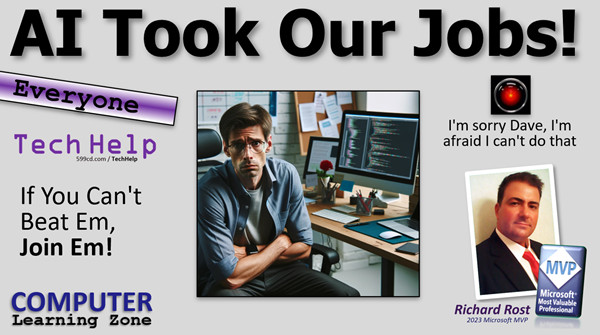
#help, #howto, #tutorial, #learn, #lesson, #training, AI, Artificial Intelligence, Jobs, Career, AI Disruption, Adaptability, Lifelong Learning, Future of Work, Technology Impact, Job Security, AI vs. Human, Automation, Employment Trends, Job Market, Technological Change, Evolving Workforce, Reskilling, Embracing Change, Success Strategies
More InformationTranscript Welcome to another TechHelp video brought to you by ComputerLearningZone.com. I'm your instructor, Richard Rost.
In today's video, we're going to take a look at the complaints I've been getting from people who say that AI is going to take their job. I've lately been getting a ton of email from people, mostly programmers and Access developers, since teaching Access is what I do. They're concerned that AI is going to render their jobs unnecessary in the near future. It kind of reminds me of that episode of South Park where they took their jobs.
My advice to everyone: don't worry, be happy. If you can't beat them, join them. Let's talk about what I mean.
The cycle of new technology destroying the way things are done has been going on since the beginning of civilization. The never-ending march of progress has killed some industries while creating whole new ones at the same time.
Automation in manufacturing led to the decline of manual labor jobs in agriculture and artisan crafts, but it created jobs in factories, urbanized cities, and eventually led to new professions in engineering, management, and more. Whether that was a good thing is still a matter of debate.
The invention of the automobile reduced demand for horse-drawn transport, impacting blacksmiths, stable hands, and carriage makers, but it created a massive automotive industry with jobs in manufacturing, maintenance, and later on, road construction and suburban development. I grew up in the suburbs, and that wouldn't have been possible without the automobile.
Even the very people who are complaining to me got their jobs in the first place from the invention of the computer. The computer reduced the need for manual bookkeeping, typists, and some aspects of secretarial work, while it gave rise to the IT industry. Computer science jobs, digital marketing, programming, Access developers, and lots more.
The creation of the internet impacted traditional retail, print media, and postal services, but it created jobs in web development, digital content creation, e-commerce, online education (that's what I do), and remote work opportunities.
Just to share a personal story, back in the 90s when I first started as a contract Microsoft Access developer, I was contacted by a company to build them a database that would automate their paper system, which they'd been using for decades, probably since the 40s or 50s when the company was founded.
Within about a week I learned their business, I shadowed them, and learned how they did everything on paper. I built them a database that could run their entire company. What used to be a 40-hour-a-week job with their paper bookkeeping system turned into just two hours of work with the automated database that I built them.
I actually made some employees at this company very upset, because they knew that with the new system, their roles would be greatly reduced. What previously needed three or four employees could now just be done by one person in a couple of hours. But the good news is I kept in touch with this company over the years, and they became a whole lot more efficient. They were able to ship a lot more product, and within not too long, they grew and added lots of new jobs. So that was a good thing, I think.
Now, specifically when it comes to AI: AI is a tool designed to augment human capabilities, not replace them. Just like past technologies, AI can make jobs easier, more efficient, and open up new avenues for creative and strategic thinking. AI is likely to create whole new job categories that we can't even imagine yet, much like the internet did. If you would have told someone in 1980 that you were a web developer, they would have asked, "What, do you work with spiders?" Come on, what?
The key to success is to adopt a mindset of lifelong learning and adaptability. It's important to stay updated with new skills and technologies and turn AI into an opportunity rather than a threat.
Again, going from my personal experience, I started learning programming as a nerdy kid on my TRS-80 back in 1980-81, whenever it came out. Then after graduating high school (barely), I decided to start my own computer business because I hated having a real job. I dealt mostly with building custom PCs, selling hardware, fixing computers, and running networking cable.
But then a lot of my customers that were buying computers from me said they really didn't have any good software to run their business. There were some real basic accounting packages out there, QuickBooks and that kind of stuff, but they wanted something custom. So I pivoted and I learned Microsoft Access. I had a programming background, but I had never worked with databases before, so that was new to me. I had to adapt to the changing work environment. And yes, back in my 20s my hair was that fabulous.
Then after a few years of building software, I had customers asking me if I could teach them how to use their computers, and their employees too. So I started a computer classroom and began teaching people Word and Excel, and yes, even Access development for people who wanted to customize databases I built them or make their own.
After teaching Excel 101 for the millionth time, I decided to bottle my knowledge and I started recording videos. I actually burned them on CDs and was shipping out hundreds of CDs a week, because at the time, people didn't have high-speed internet so you really couldn't watch videos online. That's supposed to be me right there packing CDs. I tried to get the AI to make CDs, but no, it gave me stacks of paper.
Finally, YouTube came around and a lot of people had broadband, so I shifted from shipping CDs to teaching online, and that's what I'm doing to this day.
The bottom line is throughout my career, I've had to shift, adapt, pivot, and change what I do to something totally different. I have done it more than a couple of times, completely changing my business model. You have to adapt to survive.
While AI can assist in the creative process, the originality, intuition, and depth of human creativity in arts, literature, music, even computer programming, remains unparalleled. Yes, AI can write code, but AI doesn't usually have a good overall feel for what the program you're trying to build is doing. It can give you snippets, but putting the whole thing together is still uniquely human.
AI can analyze data faster than humans, but humans excel in solving complex, unstructured problems that require critical thinking and innovative approaches. Humans are better at understanding context in communication, including nuances, sarcasm, and cultural references. AI often misinterprets or overlooks that.
Strategic planning involving abstract thinking, long-term considerations, and understanding the broader implications of actions is a complex area where humans excel. This goes especially for programming and database jobs. The overall picture, the big idea. Humans can learn and adapt to a wide range of situations and environments, applying knowledge in various contexts - a flexibility that AI does not yet possess (and I emphasize yet). It's going to be a while, so relax. AI isn't going to destroy the world yet.
Just kidding. Like I said at the beginning of this video, don't worry about it, relax. Yes, I'm using AI to generate the cool graphics for all these slides, but as you can see it's still a long way off from perfect. Notice the spelling errors? It's still got to work on that, so graphic artists, your jobs are safe too... for now.
All right, so while AI is a great tool, don't worry, it's not going to take over your job tomorrow. You have plenty of time to learn. Learn what AI is, how to use it, how to make your job better with it, and overcome and adapt. Don't be stuck in the old ways of doing things. Keep learning.
To me, it's a bad day if I don't learn something new. Yes, I teach for a living, but I'm also constantly trying to teach myself new things. So stay tuned to my channel and I'll be teaching lots of stuff moving forward.
That's about it, that's your TechHelp video for today, folks. Live long and prosper. I'll see you next time.
Thanks for watching. I hope you enjoyed this video. If you're watching on YouTube, make sure you subscribe to my channel and click the little bell icon so you get notified anytime I release a new video.
Make sure you like and share this video with your friends. Make sure you stop by my website for lots of free lessons on all kinds of different topics: Microsoft Access, Excel, Word, Windows, and lots more.
It's ComputerLearningZone.com. I've also got a shorter URL: 599CD.com. That's a long story, but stop by anyway. We hope to see you soon. Intro In this video, we will talk about the concerns many programmers and Microsoft Access developers have about AI taking over their jobs. I'll share examples from history about how new technology often changes the job market, as well as a personal story about shifting careers in response to new tech. We'll discuss how AI is designed to help, not replace, humans and why adaptability and continual learning are important. I'll also cover the unique strengths humans bring to creative, strategic, and problem-solving work, especially in fields like programming and database development. Quiz Q1. What is the main message of the video regarding new technologies like AI?
A. They always eliminate jobs with no positive outcomes
B. They destroy all existing professions
C. They eliminate jobs but also create new opportunities
D. They only impact manual labor jobs
Q2. What historical example does Richard use to illustrate technology changing industries?
A. The rise of smartphones
B. The invention of the steam engine
C. The invention of the automobile
D. The introduction of social media
Q3. How does the video compare current concerns about AI to past technological advancements?
A. AI is fundamentally different and more dangerous than past technologies
B. Past technologies did not affect employment at all
C. The cycle of new technology impacting jobs has always created new opportunities
D. No one ever worried about past technologies
Q4. What personal story does Richard share about automating a company's bookkeeping system?
A. He replaced a computer with a manual bookkeeping process
B. He built a database that reduced weekly work from 40 hours to 2 hours
C. He eliminated all jobs at the company
D. He failed to automate the company successfully
Q5. What happened to the company after Richard automated their operations?
A. It went out of business
B. It became more efficient and eventually created more jobs
C. It stopped using computers
D. It laid off all the employees and replaced them with robots
Q6. According to the video, how should people respond to the potential impact of AI on their jobs?
A. Panic and resist any changes
B. Ignore AI entirely
C. Embrace AI, learn new skills, and adapt to the changes
D. Quit their jobs immediately
Q7. What does Richard say about the unique human abilities compared to AI?
A. AI already surpasses humans in every aspect
B. Human creativity, context understanding, and complex problem-solving remain unmatched
C. AI understands sarcasm and cultural references better than humans
D. AI can adapt to all new environments on its own
Q8. Why did Richard shift from burning and shipping CDs to teaching online?
A. Because CD burners became illegal
B. Because people stopped using computers altogether
C. Because broadband and YouTube made online video feasible
D. Because DVDs replaced CDs
Q9. What is one key to long-term success that Richard emphasizes in the video?
A. Memorizing old technologies
B. Focusing only on one skill set
C. Lifelong learning and adaptability
D. Avoiding all new trends
Q10. What is Richard's advice for dealing with AI as a tool in your profession?
A. Refuse to use it
B. Learn how to use AI to make your job easier and better
C. Wait until AI is perfect
D. Only use AI for graphics
Q11. What reason does Richard give for saying graphic artists' jobs are still safe for now?
A. AI makes perfect graphics with no errors
B. AI-generated graphics still have imperfections like spelling errors
C. The demand for graphics is decreasing
D. Only humans can create graphics with computers
Q12. What recurring attitude does Richard suggest you should have towards new skills and learning?
A. Change is bad, avoid learning new things
B. Only learn when it is necessary to keep your job
C. View every day as a chance to learn something new
D. Focus only on teaching what you already know
Answers: 1-C; 2-C; 3-C; 4-B; 5-B; 6-C; 7-B; 8-C; 9-C; 10-B; 11-B; 12-C
DISCLAIMER: Quiz questions are AI generated. If you find any that are wrong, don't make sense, or aren't related to the video topic at hand, then please post a comment and let me know. Thanks. Summary Today's video from Computer Learning Zone covers a topic that has been coming up a lot lately: people are worried that artificial intelligence is going to put them out of work. I have been hearing from a lot of programmers and Microsoft Access developers who are concerned about the rise of AI. Since teaching people how to use Access is my main focus, many of you have been reaching out to ask if your jobs are in jeopardy.
In response, my message is simple: do not panic. Embracing change and adapting to new technology has always been part of human progress. Technological advances often disrupt certain industries but also create new opportunities and entire new fields.
Looking back throughout history, we can see this pattern over and over. Automation in manufacturing led to the decline of many manual jobs in agriculture or handcrafts, but it also generated roles in factories, management, and engineering. For example, the invention of the automobile greatly reduced the need for horse-drawn carriages and jobs like blacksmiths, but it built a massive new industry around cars and everything that came with them, from factories to road construction and urban planning. My own upbringing in the suburbs was made possible because of this kind of development.
The people expressing concern about AI today often owe their own jobs to past innovations like the computer. The computer reduced the need for many manual office roles, but it created the entire IT industry, including programming, web development, and of course, Access development.
The internet is another great example. While it disrupted traditional retail, printed newspapers, and even postal services, it made possible new careers such as web development, online education, digital marketing, and enabled remote work. I am in one of those new roles myself.
From my own experience as a Microsoft Access developer, I witnessed firsthand how technology can both eliminate certain jobs and lead to growth elsewhere. In the 1990s, I was hired by a company to replace their old, paper-based bookkeeping system with a database solution. I learned their workflow, automated their operations, and transformed what was once a 40-hour job into something that one person could do in just a couple of hours. Initially, some employees were upset because their roles were reduced, but over time, the company became much more efficient, expanded, shipped more products, and eventually hired more people thanks to their improved operations.
When it comes to AI, it is important to view it as a tool that can help us, not necessarily replace us. AI, like other major inventions before it, is poised to make jobs more efficient and open new paths for creativity and strategy. We are likely going to see job types appear in the coming years that we cannot even imagine today. Remember, not that long ago, the title "web developer" would have sounded completely foreign.
The most important habit you can develop is the ability to continue learning and adapting. As new technology appears, updating your skills and learning how to use these new tools will help you thrive.
Personally, my career has had to shift many times. I got started with computers on an old TRS-80 when I was a kid in the early 80s. After barely finishing high school, I started a business building and repairing computers and running network cables. When my customers needed specialized software for their businesses, I taught myself Microsoft Access, even though databases were still new to me. This pivot enabled me to build tailored solutions for them.
Later on, customers started asking if I could teach them, and their employees, how to use these tools. That led me to start a computer training business, offering classes in Word, Excel, and Access. After teaching the same basic Excel classes countless times, I decided to start making videos and distributing them on CDs—back before high-speed internet made online learning possible. Eventually, technology shifted again, and I moved to teaching directly online as YouTube and broadband internet became widespread.
Adaptability has been the key throughout my career. Every few years, I have had to overhaul my business model and learn new things to stay relevant. For everyone concerned about AI or any new technology, I encourage you to maintain flexibility and a learning mindset.
While AI can produce code and analyze data, human creativity, intuition, and understanding of subtle context remain unmatched. For instance, AI can generate code snippets, but it still lacks the insight required to develop a complete, functional system that truly fits a client's needs. Similarly, humans are much better at dealing with complicated, nuanced communication and strategic planning.
Humans excel at critical thinking, solving unstructured problems, and understanding the bigger picture behind any project. Our ability to adapt to new situations is something that AI is still far from mastering.
In short, while AI may provide valuable assistance, it will be a long time before it can truly replace the complex mixture of skills that people bring to the table. For now, creative and technical roles are safe, though using AI to enhance your work will put you ahead of the curve.
I use AI to help create graphics for my slides, but as you may notice, there are still plenty of mistakes in the results and a lot of room for improvement. So even graphic designers need not be overly concerned just yet.
Take this as motivation to learn more about AI, find ways to use it in your own work, and focus on improving your skills continuously. Growth comes from learning and adapting.
Remember, every day is an opportunity to learn something new—I have made a career out of both learning and teaching. Be sure to keep checking back for more tips and lessons, as I will continue sharing what I learn.
You can find a complete video tutorial with step-by-step instructions on everything discussed here on my website at the link below. Live long and prosper, my friends. Topic List This is a discussion and motivational message addressing concerns about AI taking jobs, using historical context, personal anecdotes, and advice about adapting to technological change. Primary Topics AI and automation in the workforce, technology-driven job evolution, impact of AI on programming and Access development, lifelong learning, adaptability in careers, human value versus AI capabilities
Secondary Topics historical technology examples, personal career adaptation stories, using AI as a tool, limits of AI creativity and context, none
|