File Explorer Regression
By Richard Rost

 3 years ago
Lost Feature! What Happened to My File Details?
In this Microsoft Windows tutorial, we examine the changes in Windows File Explorer introduced by a recent Windows 11 update, highlighting the loss of a feature that displayed file details for multiple files simultaneously. This modification has significantly impacted users who rely on this feature for efficient file management. The tutorial discusses the broader implications of such changes in Microsoft's approach to software updates, including the trend of removing essential features. It also offers practical solutions, like custom scripting, to help users navigate these updates while maintaining their workflow efficiency. This guide is designed to assist users in adapting to these new changes and underscores the importance of user-centric software development.
Feedback Hub
I am writing to express concerns about recent updates to Windows 11's File Explorer. A notable issue is the removal of the feature that displayed the total length of multiple selected video files. This was a key tool for efficiently managing video content, and its absence necessitates the use of third-party utilities, which is not ideal. Additionally, the changes in taskbar behavior, particularly the inability to ungroup programs, have added inconvenience. Innovation in software development is important, but it should not come at the cost of removing established and useful features. The balance between introducing new functionalities and preserving essential, familiar features is crucial for a positive user experience. I urge the development team to consider the impact of such changes and to provide options that cater to both new and long-time users of Windows. Thank you for considering this feedback, and I look forward to seeing more user-friendly enhancements in future updates.
Update
As of 2023-11-23, the latest Windows 11 update has added the ability to not combine Taskbar buttons back in. See my notes on the Never Combine page for details.
PowerShell Script
Here's a copy of my PowerShell script. It needs to be launched from a Batch file. So just edit both of these files to set the directory (folder) your video files are in. Save them both. Then run the BAT file. It will in turn launch the PowerShell script.
Free Courses
Keywords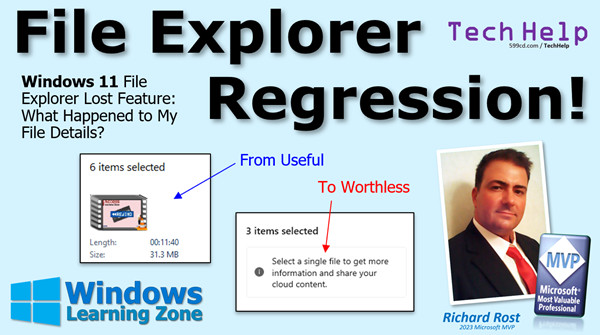
TechHelp Windows 10, windows 11, microsoft windows, ms windows, ms windows tutorial, #windows10, #windows11, #mswindows, #microsoftwindows, #help, #howto, #tutorial, #learn, #lesson, #training, #database, #fasttips, File Explorer Update, Windows File Management, Windows 11 Changes, File Explorer Features, Microsoft Update Impact, Windows 11 File Details, Windows User Interface, Windows Efficiency Tips, Custom Scripting Solutions, Windows 11 File Explorer Regression, Adapt to Windows 11, Windows 11 File Management Tips, File Explorer Video Guide, User-Centric Software Development
More InformationTranscript Today we are going to talk about a feature that Windows File Explorer lost. It regressed. It went to an earlier state. What is going on here? What happened to my file details? I am going to show you what happened, explain why it is important to me at least, and a few other people I have been talking to by email. I will also show you what you can do about it.
You probably know by now that I make videos for a living. The way that I record is that I make short segments, a few minutes each, usually. I stitch them all together when I am done. I will record a little bit, stop, record a little bit, stop. That way, if I goof, I can just delete the last segment and re-record it. I do not have to go and edit and do all that kind of stuff.
I like to keep all my recordings in a recordings folder. I can use Windows File Explorer to see what I have got. Just by quickly selecting all the files, I can see what the file length is, the size, and how much video I have recorded. Just quickly select them, and then over here you see the details for those six selected items.
Well, my system recently went through a Windows update for Windows 11, and now this is what I get. You select your items and it says, "You have to select a single file." You start to worry. Where did my summary go? What happened? Microsoft, what did you do?
To get back to that, what you could do is select them, go to Properties. When Properties comes up, you have to click on Details, and then there you can see it right there. That is a lot of work, though. It was so much easier when it was just on the Details pane. You could see it right in front of you. I do not want to click five times to see this information.
You can get back to the Windows 10 style of File Explorer by opening up the Control Panel. Then you click on this little guy here, and you pick Home, and then you can browse to your folder. But again, that is a lot of work, and you have to go in through the Control Panel. It is the only way to get it. There is no registry key. There is no setting. It is weird. You get the old style file manager back, but again, that is a lot of work just to get something that used to be right in your face.
Microsoft has shown a pattern of removing features from its applications, from Office and from Windows, that people know, love, and become accustomed to in their daily lives. I get used to it. I use this every day. This forces users to rely on third-party utilities or write their own, which is what I did, to perform tasks that used to be built into what existed before.
If you remember this video I did about a year ago, Windows 11 removed the ability to see separate taskbar icons for different windows. If you have multiple windows open with your web browser or documents or Word or whatever, you could see them separately before. Then Windows 11 forced them all to be grouped together, and there was no way in Windows to turn that off. Fortunately, someone wrote an app to revert back to the original Windows, not grouped style. Watch this video here if you want to check that out. This was another feature that I cannot live without. I need to see my separate windows. I like to have five or six different browser windows open or two or three different Access databases, and I like to flip between them.
Microsoft also removed most of the classic options from the File Explorer. You used to right-click on something and see this. You can still get to that, but first you get this little summary, basic window. Then you have to click "Show more options" and then you get this window. I wanted to go right to this. Plus, these little buttons up here - what are these? Give me my cut, copy, paste back, like this. This is what I want. This should be something that expert users can toggle on and off. I want to see the expert stuff. I want to see the full menu. I do not want to see your little icons here.
It is like my little joke I talk about in my computer basics class. Originally, computers used to just have text menus. File, Edit, whatever. Then they added icons because it is more visually pleasing, I guess. But no one knew what the icons were, so then you had to hover over the icon to get the pop-up text telling you what the button was for. Just give me both. I like both. I like this. Give me the full menu with both the icon and the text. I do not like this. Microsoft keeps changing things. Stop changing things.
In the words of one of my favorite comedians, Sebastian Manescalco: Microsoft, what are you doing?
Now, I get it. Sometimes Microsoft makes a bold new move that ends up becoming revolutionary. For example, the ribbon, when they added it back in Office 2007. At the time, I hated the ribbon. I could not stand it. I was like, "Where are all the features?" I was used to File, Edit, View. I knew exactly where everything was, and I was resistant to change.
But I had to learn it because I have to teach it in my classes. After I got to working with it and using it, I really grew to love it because it adapts to what you are changing, and I came to see it was genius. It changed the game. Now I love the ribbon. There is no way I could go back to the File, Edit, View menus.
Microsoft, please stop removing useful tools from your applications that we come to rely on in our daily work. Things like the details pane, that data, and combining taskbar icons. At least give us a setting, or at the very least a registry key, that we could change to get back to the feature we are used to. There is no benefit to this.
I could see the ribbon was a great upgrade, it has a lot of benefit. There is no benefit to getting rid of showing us this information over here. Why? You had this. It was already built in and you downgraded it.
Do not think that I am picking on Microsoft. I absolutely love Microsoft. I have been evangelizing their products for many, many years. I have been using Microsoft products pretty much since birth. I have been teaching Office applications for almost 30 years now. So this is constructive criticism, and I am hoping someone at Microsoft will see this video and maybe make some changes.
Plus, this video is mostly for me to show you where the feature has moved to. In case you want to find where those details were, I showed you how to get to it. So, it is not just a complaint video.
Now, in addition to making this video, I did submit some feedback to Windows using the Feedback Hub, and I encourage you to as well if this is a feature you would like to see put back in Windows. To get to the Feedback Hub, just click on your Start button in Windows and type in "Feedback," and you should see this application here called Feedback Hub. I suggest using the "Suggest a Feature" option. Here is what I sent to them. That is just long enough to fit in the window. I will put a copy of something similar to this down below in the description, so if you want, copy and paste that and send Microsoft your feedback.
So, what did I do? I tried a few alternative File Explorer apps. I really did not like any of them, so if you have a File Explorer app or a full application program that you use and you like it, and it shows you what I need, then let me know. Post a comment down below. Like I said, I demoed a couple other ones and I just was not really happy with any of them.
So I ended up writing my own script in PowerShell, which I am still learning. PowerShell is really powerful. I am used to VBScript, but as you might remember from a video I did a couple days ago, VBScript is being deprecated, so it is time to learn something else.
Basically, what it does is when I am recording videos like I am right now, I just leave it running and it will constantly update and tell me - it will add up all the files in this folder, this specific folder, and it will tell me what the total duration of the module is. It refreshes every three seconds and it just keeps a little counter there for me. I can just keep my eye on it. When the videos add up to eight minutes or more, the color changes as a visual cue, and when it gets over 10 minutes, it turns red.
I decided to keep all of my videos for TechHelp to 10 minutes or under for lots of different reasons, which I am not going to go into now, but that is a good duration for my videos. It was not a terribly complicated script to write. It is good practice for me. I tried to do it myself at first and I did run into some stumbling blocks. Usually for me, it is not the programming concepts - I have those down. I have been doing this for years. It is the formatting of the syntax, learning a new language.
Now, this is very similar to C. PowerShell is. I used to be a C programmer way back in the 90s, so I get it. I just had to learn some of the new object-verb pairing that they have. That is what I use Chat GPT for: to translate. You can write something in a language you are familiar with, like VBScript or VBA, and ask Chat GPT to convert it for you into something else, like PowerShell or JavaScript. That is what it is really good for.
Yes, I will put a copy of this script on my website if you want to download a copy of it, and I am planning on doing some PowerShell lessons. Give me a couple more months to become an expert in it. I am still intermediate myself. I will get there. Again, it is just a matter of translating the language.
That is it for today. I hope this helped you. I hope this helped someone. It is not just me complaining. If you are wondering why a feature that you used to have and love in File Explorer is no longer there, I was flabbergasted when I saw it. I was like, "What? I have to select just a single file to get information now?" They changed some things so that you cannot edit the metadata and stuff like that.
So, that is what you have to do. That is how you can get back your classic File Explorer, by going in through the Control Panel. Once again, I will show you. You open up your Control Panel, and you have to click this little down arrow right there, and then go to Home. Then the classic File Explorer from Windows 10 opens up, and now you can browse to whatever other folder you want, and you get back your old feature over here. There is my link. So that is how you do it. This is the only way that I found to get back to this File Explorer pane.
That is going to do it for today, folks. There is your TechHelp video. I hope you learned something. Live long and prosper, my friends. I will see you next time. Thanks for watching.
To learn more about Windows or any of the other topics I teach like Microsoft Access, Word, Excel, and more, visit my website at windowslearningzone.com. Intro In this video, we talk about a recent regression in Windows 11 File Explorer where the details pane no longer shows summary information for multiple selected files. I will explain what changed after a Windows update, why this feature is important for my workflow, and what options you have to view file details now. We'll go over alternative ways to access the old File Explorer, discuss Microsoft's trend of removing familiar features, and I'll share my own workaround using a custom PowerShell script. Quiz Q1. What feature was removed from Windows File Explorer after a recent Windows 11 update?
A. Ability to view file details for multiple selected files in the Details pane
B. The search bar in File Explorer
C. The ability to sort files by name
D. The Recycle Bin option
Q2. Before the change, how did the presenter quickly check the total length and size of video recordings?
A. By right-clicking and checking Properties for each file
B. By selecting multiple files and viewing the summary in the Details pane
C. By opening each file in a video editor
D. By using a third-party application
Q3. What happens now when you select multiple files and try to view details in the pane?
A. It shows the full details for all files selected
B. It only works if the files are the same type
C. It prompts you to select a single file to see details
D. It shows an error message and crashes
Q4. What workaround did the presenter show to see file details for multiple files after the update?
A. Open Command Prompt and use a script
B. Use the File Explorer Details pane as before
C. Select files, go to Properties, then click Details
D. Sort files by type and check details at the top of the window
Q5. How can users access the classic Windows 10 style File Explorer in Windows 11?
A. By installing a registry key
B. By using a secret keyboard shortcut
C. By opening the Control Panel and navigating to Home
D. By updating to the latest version of Windows 11
Q6. What general trend did the presenter note about Microsoft's decisions in recent years?
A. Adding more customization features for expert users
B. Increasing support for third-party utilities
C. Removing classic features that people use regularly
D. Reverting to older interface styles for all users
Q7. How did the presenter handle the new limitations for his workflow?
A. He switched to editing all videos before combining them
B. He started using a third-party File Explorer program
C. He wrote his own script in PowerShell to monitor file durations
D. He stopped using the Windows File Explorer entirely
Q8. According to the video, what is a suggested way for users to let Microsoft know they want a feature returned?
A. Send an email to Microsoft support
B. Post on social media
C. Use the Feedback Hub app under "Suggest a Feature"
D. Call the Microsoft tech support hotline
Q9. What programming tool does the presenter mention as becoming deprecated, prompting him to learn PowerShell?
A. Python
B. C++
C. VBScript
D. Java
Q10. What benefit did the presenter eventually see in a previous major Microsoft interface change, like the Office ribbon?
A. He found the new look too confusing and avoided it
B. He realized it adapted to context and improved workflow
C. He decided to stick with the classic menu and toolbar forever
D. He used both ribbon and menu simultaneously
Q11. What is the presenter's main message to Microsoft regarding feature changes?
A. Completely redesign all applications frequently
B. Always remove old features with no warning
C. Provide options or settings to keep useful features
D. Stop providing feedback mechanisms to users
Q12. When writing his PowerShell script, what challenge did the presenter mention facing most?
A. Lack of online resources for PowerShell
B. Programming logic and concept issues
C. Formatting and learning new syntax
D. Inability to access folder structures in PowerShell
Answers: 1-A; 2-B; 3-C; 4-C; 5-C; 6-C; 7-C; 8-C; 9-C; 10-B; 11-C; 12-C
DISCLAIMER: Quiz questions are AI generated. If you find any that are wrong, don't make sense, or aren't related to the video topic at hand, then please post a comment and let me know. Thanks. Summary Today's video from Windows Learning Zone addresses a frustrating change in Windows File Explorer. A feature that many users relied on has been removed, essentially reverting the functionality to an earlier, less convenient version. I want to walk you through what happened to the file details summary, why this matters to me and others, and what workarounds are available.
As someone who makes video tutorials for a living, my recording process involves creating short video segments that I later piece together. I keep all my recordings in a dedicated folder and rely on File Explorer to quickly see the total length, size, and number of video files I have by simply selecting them in the folder. The details pane conveniently displayed this summary for all selected files at once, which made it easy to check my progress at a glance.
However, after a recent Windows 11 update, that functionality changed. Now, when you select multiple files, File Explorer prompts you to select a single file instead of showing a summary. The summary details are gone, and the process is no longer as intuitive. To get the same information, you now have to right-click and go into Properties, then navigate to the Details tab. This adds several extra steps to what used to be a simple action, making it much less efficient.
A possible way to temporarily get back the Windows 10 style File Explorer is to use the Control Panel. From there, you can select Home, browse to your folder, and pull up the older style File Explorer that still includes the details pane for multiple selected items. However, this approach is cumbersome and requires multiple steps each time. There is no easy fix, registry key, or built-in setting to restore the feature in the new Explorer. Microsoft has only left this pathway through Control Panel, which seems like an oversight.
This is not the first time Microsoft has removed beloved features. There is a consistent trend of eliminating tools or options from Windows and Microsoft Office that users have depended on for years. This often forces users to seek out third-party alternatives, develop their own solutions, or simply accept less convenient workflows. I referenced a previous situation with Windows 11's taskbar grouping, where an app was needed to restore the ability to see separate taskbar icons for multiple open windows and documents. Losing that kind of granular control is a big inconvenience for users like me who manage multiple tasks and windows at once.
Another example is the right-click menu in File Explorer. Microsoft introduced a simplified menu that hides classic options behind an extra click on "Show more options." The user interface is now filled with small icons for basic actions like cut and paste, rather than straightforward, labeled buttons. For experienced users, having the option to toggle between a simple interface and the full classic menu would be ideal.
This pattern of change can be frustrating. While some major updates have been positive, such as the introduction of the ribbon interface in Office 2007, not every removal or redesign brings clear improvements. The move to the ribbon was initially difficult to adjust to, but over time I realized its benefits and came to prefer it. However, taking away the details pane without providing an alternative feels like a step backward, not forward.
To address this recent change, I explored some alternative File Explorer applications but did not find any that matched my needs. If you know of an application that restores or improves on this feature, let me know in the comments. In my case, I wrote my own PowerShell script to keep track of video durations in my recording folder. The script continuously checks the folder, adds up the duration of all video files, and provides a visual indicator when certain time thresholds are reached. This helps me keep my segments to an ideal length without the old details summary.
For anyone who wants to take action, I encourage you to use Microsoft's Feedback Hub to request the return of the details pane feature. You can access Feedback Hub by searching for it on the Start menu and submit your own suggestion. I included an example of what you might write in the video description.
I will also make the PowerShell script available on my website for those who might find it helpful. I plan to create PowerShell lessons in the future as I become more proficient with it.
To summarize, I wanted to share where the missing details feature went, how to find it for now, and to highlight why these usability changes matter. If you are surprised or confused by the missing multi-file details in File Explorer, at least you know now how to work around it, even if it is less convenient than before.
For a complete video tutorial with step-by-step instructions for everything discussed here, visit my website at the link below. Live long and prosper, my friends. Topic List Windows File Explorer details pane regression after Windows 11 update
Workarounds to view file details in Windows 11
Accessing file details via Properties and Details tab
Using Control Panel to open classic File Explorer in Windows 11
No registry or setting option to restore details pane
Classic right-click menu and other removed options in File Explorer
Encouraging feedback submission to Microsoft via Feedback Hub
Writing a PowerShell script to sum video durations in a folder
VBScript deprecation and transition to PowerShell
Using AI tools to convert code between scripting languages
Steps to open classic File Explorer through Control Panel Primary Topics Windows 11 File Explorer, feature regression, file details summary, classic File Explorer, user feedback, PowerShell scripting, Microsoft UI changes
Secondary Topics taskbar icon grouping, right-click menu changes, VBScript deprecation, alternative file managers
|