Task Manager
By Richard Rost

 2 years ago
Use the Task Manager to Kill Unresponsive Programs
In this Microsoft Windows tutorial, we are going to learn how to use the Task Manager to kill an unresponsive program that has locked up.
Alan from Lafayette, Louisiana (a Platinum Member) asks: Every now and then, my Microsoft Access database locks up and stops responding. Sometimes, I'm able to close it with the close button, but other times, I have no option but to restart Windows. Is there another way that I can shut down Access without having to reboot my system?
Free Courses
Keywords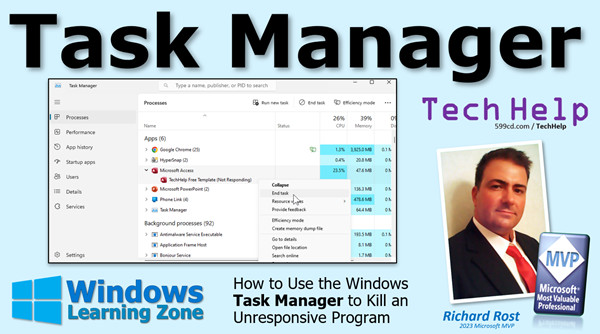
TechHelp Windows 10, windows 11, microsoft windows, ms windows, ms windows tutorial, #windows10, #windows11, #mswindows, #microsoftwindows, #help, #howto, #tutorial, #learn, #lesson, #training, #database, #fasttips, Windows Task Manager tutorial, end process in Task Manager, Task Manager guide, lockup solution, manage processes Windows, Task Manager for beginners, Task Manager shortcut keys, Windows system tools, terminate frozen applications, Access database not responding, Windows Task Manager help, resolve software issues, Task Manager process management, Ctrl Alt Delete functions, system administration Windows, Windows Task Manager tips
 Subscribe to Task Manager
Get notifications when this page is updated
More InformationTranscript Today we are going to talk about how to use the Windows Task Manager to kill an unresponsive program, to take that program that is just not listening to you anymore, and shut it right down.
Most of what I teach is Microsoft Access database design, but this can happen in Access, it can happen in Excel, it can happen with any program. Any program in Windows can occasionally lock up and stop responding.
Today's question is from Alan in Lafayette, Louisiana, one of my Platinum members. He says, "Every now and then my Microsoft Access database locks up and stops responding. Sometimes I am able to close it with the close button, but other times I have no option but to restart Windows. Is there another way that I can shut down Access without having to reboot my system?"
Yes, Alan, Windows has something called the Task Manager, which has been in Windows since I can remember - Windows 7 at least. Windows NT, I think, had something similar, but it has been a while. All you have to do is open up the Task Manager and then kill the program that is misbehaving.
I am going to show you how to do that in just a second, but first, let's make a program misbehave.
Here I am in my Microsoft Access database, and this is a basic database. You have your customer form, you have your order entry, that kind of stuff, but I have a button right here called Hello World. If I take a look at the code in that button, you can see right here, I have X equals zero, and I am saying while X is less than one hundred, do some stuff (does not matter what), and then loop. As you can see, that X variable is never being incremented, so it constantly stays at zero. That is called an endless loop, and this is enough to make my Access database lock up.
Let me close this, and I am going to run this program now basically by clicking on the button. Nothing appears to be happening, but in the background that loop is running, and notice, see, I clicked and it says "Not Responding" because that loop is just going to keep running and running and running, and it is never going to let Access do its thing.
Sometimes with this thing locked up, you could try clicking on the X up here and there you go. Once in a while you will get this message. It says Access is not responding. You can restart it, you can close it, or wait for the program to respond. In this case, closing it should kill the application, but it does not always work.
This is a case when you can open up the Task Manager. As with everything in Windows, there are four different ways to open the Task Manager that I know of. You can either right-click on the task bar and pick Task Manager, you can press Control-Shift-Escape (that is one of those keyboard shortcuts that I never remember), you can do Control-Alt-Delete - that will bring up the Windows Control-Alt-Delete menu and you will see Task Manager on that, or you can click on your start button and just start typing in "task." That is what I usually do because I always forget the other shortcuts. So just start typing in TASK. There it is, Task Manager app. Click on that, and this guy loads up.
This is the Task Manager. Up top here you will see all the apps that are running. There are tons and tons of stuff down here. Do not go digging through this because you do not want to randomly shut some stuff down and then Windows stops responding itself. But right here you will see Microsoft Access. If you open it up right there, you will see there it is "Not Responding." It is on one of my other monitors, and it is still sitting there not responding. To kill this thing, all you do is right-click on it and go to End Task. That should shut it right down, and it did.
Now, I use this thing a lot, so I like to pin it to my task bar so it is always there. Come right down here, right-click, pin to task bar. Now it will always stay right there. So even if you close it, it is right there - you just click on it and it will open right back up again. You do not have to remember any shortcuts or go to your start button or any of that stuff.
As a reminder, when you kill that app, any data that was not saved is going to be lost. So if you were making some modifications to your form, or if you are working with Excel and you are making changes in your sheet and you have not saved, whatever changes you made are most likely going to be lost if you kill that process. Do this only if you are sure there is no way that is coming back.
Sometimes, especially with Access, I see a lot of times where people program something like a loop and they do not realize how long it is going to take to run. So it is maybe a ten-minute process and they think after three or four minutes, it is locked up. That is why I always say if you get a long process like that, program in something so the user sees something happening, like my status box.
It is also important to back up nightly. You should make sure you are backing up all your files on a regular basis, or before you make any big updates. If you are making a huge change, if you are planning on totally replacing some forms or whatever, make a manual backup before you do that, because there is always a possibility that by killing an app like that, you can corrupt the data files.
For Access specifically, once you get back into the database, I always recommend doing a full compact and repair, and do a debug compile once you get back into the VB editor, so that is for Access users.
There are lots of other goodies in here. There is performance and stuff you can check on, app histories, startup apps. You can go in here and stop things from starting up automatically with Windows, like this is my demo label software. I do not always have that starting automatically.
All kinds of different stuff in here, and I cover the Task Manager in detail in my full Windows course.
There you go. That is your TechHelp video for today. I hope you learned something. Live long and prosper, my friends. I will see you next time. Thanks for watching.
If you want me to post more videos about Microsoft Windows, then be sure to like this video, subscribe to my channel, and post a comment down below. Let me know that you want more Windows videos. About 90 percent of what I teach is Microsoft Access database design, but I love teaching Windows, Word, Excel, PowerPoint, and all those other topics too. Of course, the squeaky wheel gets the grease, so if you want more Windows training, make some noise.
You can watch my entire Microsoft Windows Beginner Level 1 course absolutely free on my website and on my YouTube channel. It is over an hour long and covers all the basics. If you like Level 1 and want to learn more about Windows, visit my website at the link shown and you can get Level 2, which is another complete hour-long course for just one dollar.
Level 2 goes into a lot more depth and teaches you how to get the most out of Windows. Visit my website today for more information.
Thanks for watching. To learn more about Windows or any of the other topics I teach, like Microsoft Access, Word, Excel, and more, visit my website at windowslearningzone.com.
Visit my website at windowslearningzone.com Intro In this video, we will talk about how to use the Windows Task Manager to close an unresponsive program, such as when Microsoft Access or Excel locks up and stops responding. I will show you several methods for opening Task Manager, how to identify and end a frozen application, tips for pinning Task Manager to your task bar for quick access, and important reminders about saving your work and backing up data before force-closing a program. We'll also discuss some additional features available in Task Manager, like managing startup apps. Quiz Q1. What is the main use of the Windows Task Manager as discussed in the video?
A. To uninstall programs safely
B. To kill or close unresponsive programs
C. To create new files
D. To update Windows settings
Q2. What is an "endless loop" as described in the video?
A. A loop that repeats a set number of times
B. A loop in which the variable is incremented every time
C. A loop that never stops running because its condition is never met
D. A program that loads multiple times
Q3. Which type of problem commonly prompts the use of Task Manager, according to the video?
A. Screen brightness issues
B. Unresponsive or "locked up" applications
C. Slow internet connection
D. Difficulty printing documents
Q4. What is one way to open the Task Manager in Windows?
A. Press Shift-Tab
B. Click and hold the Refresh button
C. Right-click on the task bar and select Task Manager
D. Open Control Panel and search for Task Manager
Q5. What is another way to open the Task Manager mentioned in the video?
A. Press Control-Shift-Escape
B. Double-click the desktop
C. Press F1
D. Run taskrun.exe from Start
Q6. Why should you be careful when ending processes in Task Manager?
A. Because you might delete important files
B. Because you could close critical Windows processes and make your system unstable
C. Because your monitor might turn off
D. Because your wallpaper will reset
Q7. What happens to unsaved data if you kill an application in Task Manager?
A. It automatically saves your progress
B. Unsaved data will likely be lost
C. Data is sent to the recycle bin
D. Your data is converted into a backup file
Q8. What was recommended to Access users after restarting the database following a crash?
A. Delete all forms and start over
B. Do a full compact and repair, and a debug compile in the VB editor
C. Restart the computer twice
D. Update Windows drivers
Q9. What feature in Task Manager allows you to prevent a program from starting automatically with Windows?
A. App Histories
B. Startup tab
C. Performance tab
D. Services tab
Q10. Why is it important to back up your files, especially before doing major changes?
A. To reduce your computer's speed
B. In case killing an app corrupts your data files
C. To improve network security
D. It is required by Windows updates
Q11. What is the benefit of pinning Task Manager to the task bar as mentioned in the video?
A. It makes it easy to access when needed
B. It increases system speed
C. It automatically closes unresponsive programs
D. It saves battery life
Answers: 1-B; 2-C; 3-B; 4-C; 5-A; 6-B; 7-B; 8-B; 9-B; 10-B; 11-A
DISCLAIMER: Quiz questions are AI generated. If you find any that are wrong, don't make sense, or aren't related to the video topic at hand, then please post a comment and let me know. Thanks. Summary Today's video from Windows Learning Zone is all about how to close an unresponsive program using the Windows Task Manager. This is a common issue that can happen not just in Microsoft Access, but really in any Windows application like Excel, Word, or others. Occasionally, a program may freeze and stop responding to any input.
A question came in from a student who finds that sometimes when Access locks up, he is unable to close it normally and is forced to restart his whole computer. He wanted to know if there is a way to shut down Access without having to reboot the system.
The answer is yes, and the solution is the Windows Task Manager. This tool has been part of Windows for many years, and it gives you a way to force a misbehaving application to close.
To demonstrate how this works, I created a simple scenario in Access where I purposely set up an endless loop inside a button's code. When that loop runs, Access becomes completely unresponsive – you cannot interact with the form, and the program window may say "Not Responding." Sometimes you can try to close the window with the X button, and Windows might offer to let you close or restart the program, but this does not always work.
When the normal methods fail, Task Manager is your best option. There are several ways to open it: you can right-click on the task bar and choose Task Manager, press Control-Shift-Escape, use Control-Alt-Delete and select Task Manager from that menu, or simply start typing "task" from your Start menu and select Task Manager from the search results. Personally, I find typing "task" to be the easiest way since I rarely remember the keyboard shortcuts.
Once in Task Manager, you will see a list of all currently running apps. You just need to look for the application that is frozen (in this example, Microsoft Access), which should show that it is "Not Responding." Right-click on the unresponsive program and select End Task. This action will close the app, effectively killing the frozen process.
For convenience, I recommend pinning Task Manager to your task bar so it's always available. That way you do not have to remember shortcuts or hunt around for it the next time you need it.
Keep in mind, however, that when you end a task this way, any unsaved data will be lost. So if you were making changes to a document or database and had not saved recently, those changes will probably not be recoverable. Make this your last resort, and only use it if you are certain the program is not coming back to life.
Sometimes what looks like a frozen program is actually a process that is just taking a long time to finish, such as a big loop in Access or Excel. For this reason, if you expect something might run for a long time, I recommend programming some kind of visual indicator so the user can see that work is still being done. It is also very important to back up your work regularly, especially before making big changes, since abruptly killing software can sometimes cause data corruption, particularly in databases.
For Access users, after force closing the app, I always advise doing a compact and repair operation once you have reopened your database, followed by a debug compile from the VBA editor. This helps keep your database healthy and free from issues caused by crashes.
Task Manager also offers several other useful features. You can monitor performance, check the history of apps, and control what programs are allowed to start automatically with Windows. I cover all of these features in detail in my comprehensive Windows course.
That covers today's TechHelp video on using Task Manager to end unresponsive programs. If you want to learn more about Windows, I have a complete Beginner Level 1 course available for free on both my website and YouTube channel. It covers the fundamentals of using Windows and runs over an hour in length. If you finish that and are interested in more, Level 2 is available on my website for just one dollar and includes even more advanced tips and techniques.
If you would like me to create more videos about Microsoft Windows, please like the video, subscribe, and leave a comment letting me know which topics interest you. Although most of my tutorials focus on Access, I am always happy to teach about Windows, Word, Excel, PowerPoint, and other related topics. The more interest I see, the more likely I am to release additional content.
You can find a complete video tutorial with step-by-step instructions on everything discussed here on my website at the link below. Live long and prosper, my friends. Topic List Demonstrating a program locked in an endless loop
Identifying when a program is not responding in Windows
Using the X button to attempt to close a frozen program
Understanding Windows error messages for unresponsive apps
Opening Task Manager via the taskbar
Opening Task Manager using keyboard shortcuts
Launching Task Manager from the Start menu
Identifying unresponsive programs in Task Manager
Ending a task using Task Manager
Pinning Task Manager to the Windows taskbar for quick access
Risks of losing unsaved data when killing processes
Precautions for long-running processes in Microsoft Access
Backing up files before major updates or changes
Performing compact and repair after forced closure in Access
Using Task Manager to manage Windows startup apps Primary Topics Windows Task Manager, killing unresponsive programs, detecting not responding apps, recovering from frozen software, Microsoft Access troubleshooting Secondary Topics data loss risks, backup practices, compact and repair in Access, Task Manager shortcuts, Task Manager features |




