Free Lessons
Courses
Seminars
TechHelp
Fast Tips
Templates
Topic Index
Forum
ABCD
 
Home   Courses   TechHelp   Help   Contact   Merch   Join   Order   Logon   Forums   
 
Back to Access Forum    Comments List
Upload Images | @Reply | Bookmark | Link | Email | Next Unseen |
flag when a value changes
Barry Brewer 
    
5 years ago
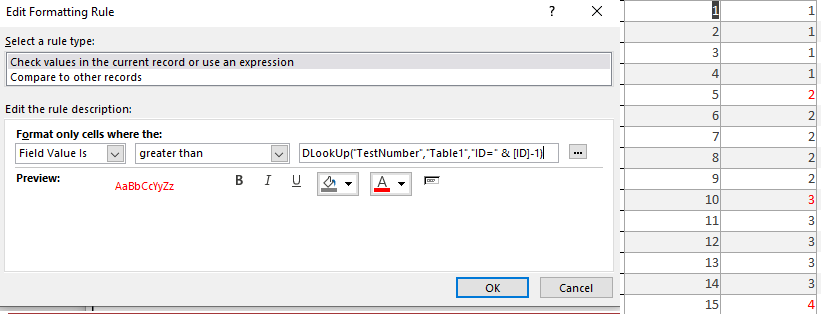
I'm sure what I'm trying to do is simple but I'm not seeing it. I have a report that will show several rows of the same number in a field. What I need to do is conditional format that field to change color when the value changes. In other words, the value may be 1111 for 4 or 5 (the number of times will be different) records but then it will change to 1112 for another 4 to 7 records. I need to first time the number changes to be a different color in the report. This is easy to do in Excel but how do I do it in Access?
Adam Schwanz  @Reply  
           
5 years ago

Adam Schwanz  @Reply  
           
5 years ago
Put your field/table names in as applicable, to the right is how it looks, I think this is what you're asking?
Adam Schwanz  @Reply  
           
5 years ago
Here's the link to it if you want to see how it works. DLookup
Richard Rost  @Reply  
          
5 years ago
Barry, the short answer is that this will NOT be easy to do in Access. Excel has a completely different set of Conditional Formatting tools available to it, and Access is Microsoft's red-headed stepchild, so its CF features are completely different and vastly underpowered. You could probably do this with some hidden query fields - sort them in order and then use DLookup and DMax to see if the previous field was the same, if not set the field to TRUE and then use a CF expression to check for that value, THEN set the CF. So, yes, it's possible, but it's nowhere near as easy as in Excel. This might make a cool TechHelp video. I'll add it to the (very long) list.
Richard Rost  @Reply  
          
5 years ago
And I see what you're trying to do with your CF in the screen shot, but remember, you can't always count on AutoNumber being sequential. So unless you're typing those in yourself, you'll need to use DMax to find the greatest ID that's smaller than the current record. I'd use dates.
Barry Brewer OP  @Reply  
    
5 years ago
Yes, that looks like what I'm trying to do. Thank you!!
Barry Brewer OP  @Reply  
    
5 years ago
Richard, thank you! This is for a production schedule and it flags the operator when he will have to change the tool. In Excell you can check the number to the one above but not so easy in Access.

This thread is now CLOSED. If you wish to comment, start a NEW discussion in Access Forum.
 

Next Unseen


What's This?


The following is a paid advertisement
Computer Learning Zone is not responsible for any content shown or offers made by these ads.
 

Learn
 
Access - index
Excel - index
Word - index
Windows - index
PowerPoint - index
Photoshop - index
Visual Basic - index
ASP - index
Seminars
More...
Customers
 
Login
My Account
My Courses
Lost Password
Memberships
Student Databases
Change Email
Info
 
Latest News
New Releases
User Forums
Topic Glossary
Tips & Tricks
Search The Site
Code Vault
Collapse Menus
Help
 
Customer Support
Web Site Tour
FAQs
TechHelp
Consulting Services
About
 
Background
Testimonials
Jobs
Affiliate Program
Richard Rost
Free Lessons
Mailing List
PCResale.NET
Order
 
Video Tutorials
Handbooks
Memberships
Learning Connection
Idiot's Guide to Excel
Volume Discounts
Payment Info
Shipping
Terms of Sale
Contact
 
Contact Info
Support Policy
Mailing Address
Phone Number
Fax Number
Course Survey
Email Richard
[email protected]
Blog RSS Feed    YouTube Channel

LinkedIn
Copyright 2026 by Computer Learning Zone, Amicron, and Richard Rost. All Rights Reserved. Current Time: 10/15/2026 12:39:44 PM. PLT: 1s