|
||||||
Access Expert 19Conditional Formatting, Export Excel, Word, TextWelcome to Access Expert 19. In this course you will learn how to use conditional formatting in Access to change data appearance based on values and expressions, including advanced formatting rules and field focus settings. We'll discuss methods for exporting data to Excel, Word, and text files, cover mail merge, and review the differences between file formats. Additional topics include related export options, such as exporting to other database formats and text file types. You will also get information on course structure, support forums, and upcoming lessons. Lessons
Resources
Lesson SummaryWelcome! Conditional Formatting & Export - Welcome to Microsoft Access Expert Level 19. In this course we will start by learning about conditional formatting, which lets you change how your data looks based on its values, and discuss some of the advanced rules you can apply. We will then move into exporting data from Access to other formats, including Excel, Word, and text files, as well as various export options. We will also cover related topics such as mail merge, different text file types, and exporting to other database files. Details about additional seminars, support forums, and course structure are also provided.
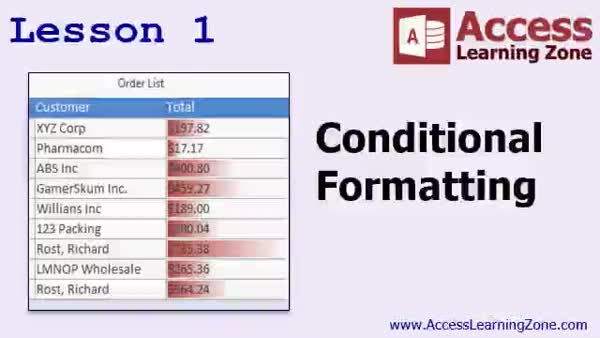
Lesson 1: Conditional Formatting Tips - In Lesson 1, we will walk through the basics of conditional formatting, a feature that lets you adjust the appearance of fields based on their values or related fields. I will show you how to highlight cells using rules such as greater than, less than, and expressions, as well as how to format based on text or dates. We will discuss using expressions for advanced scenarios, compare records using data bars, and explore options like disabling fields and field focus formatting. Additionally, we will look at conditional formatting limitations and best practices for locking fields based on certain conditions.
Lesson 2: Export Tables & Queries to Excel - In Lesson 2, we will learn how to export data from Access to Excel. I will show you different ways to export tables, queries, or selected records, discuss file format options, and explain how to preserve formatting when exporting. We will walk through solutions for selecting specific records, avoiding extra headers when copying to Excel, and using queries for cleaner exports. We will also talk about saving export steps for future use and briefly mention exporting to formats like text and XML files. Exporting to Excel can be useful for sharing data or analyzing it with tools like charts and pivot tables.
Lesson 3: Export Reports, Labels, Tables, Merge - In Lesson 3, we will cover how to export data from Access to Microsoft Word. We will walk through exporting reports and mailing labels as Word-compatible RTF files for easy editing, discuss using Word's Mail Merge feature with Access queries to send personalized letters, and demonstrate how to bring Access table data directly into Word as a formatted table. We will also look at options for further formatting and editing your exported content in Word.
Lesson 4: Export Delimited & Fixed Text Files - In Lesson 4, we will walk through how to export text files from an Access database, discuss the differences between delimited and fixed width formats, and review export options such as character sets, delimiters, and formatting choices. I will show you how to use the Export Text Wizard, set up export specifications for future use, and explain key settings needed when sharing data with recipients who may use older or different systems. By the end, you will know the most universal method for exporting your Access data as a text file.
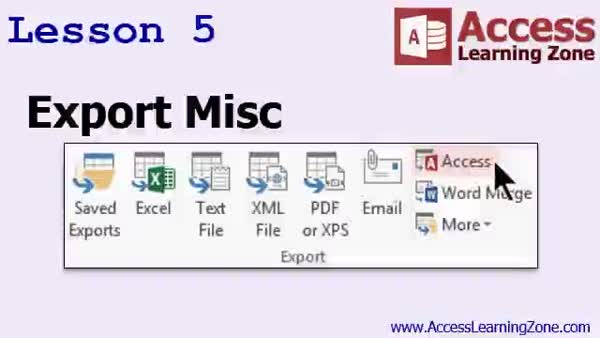
Lesson 5: Export XML, PDF, XPS, HTML, Tables, Lists - In Lesson 5, we will cover a variety of export options in Access that have not been discussed yet. We will talk about exporting to XML, how to open and read XML files, and briefly discuss export formats like PDF, XPS, and HTML documents. I will show you how to export data to another Access database, explain some common issues, and demonstrate dragging and dropping objects between databases. We will also discuss exporting to SharePoint lists and connecting with ODBC databases, such as SQL Server, MySQL, or Oracle. Finally, we will look ahead to future lessons on importing data and linking to data sources.
Lesson 6: Conditional Formatting & Exporting - In this course we learned how to apply conditional formatting to data in Access, and how to export data into various formats, such as Excel, Word mail merge, text files, and other databases. We discussed that upcoming lessons will include importing data from external sources, automating updates with macros, remote data entry projects, linking to other databases, and splitting your Access database. I also explained where to find more lessons, how to get support, and encouraged you to provide feedback on the course.
NavigationKeywordsconditional formatting, export to Excel, export to Word, export text file, delimited text, fixed width text, data bars, save export steps, mail merge, export PDF, export XML, export to HTML, SharePoint list export, ODBC connection, field focus formatting
More InformationTranscriptWelcome to Microsoft Access Expert Level 19, brought to you by AccessLearningZone.com. I am your instructor, Richard Rost. In today's class, we are going to begin by learning conditional formatting, which is changing the format or the appearance of the data in your database based on the values of that data. I saved this for the Expert series because there are some advanced rules you can apply to conditional formatting that really make your databases look good. Conditional formatting is more than just a simple beginner topic. Once we have finished conditional formatting, we will move into exporting data from your database into other formats. We will learn how to export to Excel and to a Word document. We will learn how to perform a mail merge using Microsoft Word. We will also learn how to export to text files and the different types of text file formats, as well as how to export to other database files. This class follows Access Expert Level 18. The topics in this class can really stand alone; you do not have to have taken the previous classes in the series. However, I do strongly recommend you take all of my classes in order and do not jump around a lot. Access Expert 18 covers crosstab queries, find duplicates and unmatched queries, and query properties. Today's class is recorded with Access 2013. If you have Access 2007 or 2010, you should be okay following along with this lesson. There are some minor differences with the menus and with conditional formatting, but you should be able to figure them out. It is not that different. If you have Access 2003 or earlier, I cover exporting in Access 308 and conditional formatting in Access 310. My courses are broken up into beginner, expert, advanced, and developer level classes. Beginner level classes are for novices, and you should understand all the topics covered in them by the time you get to the expert level classes, which you are in now. When you finish all the expert level classes, the advanced classes will cover event programming and macros, and the developer classes will cover Visual Basic for Applications. Each group of classes is broken down into multiple levels: level 1, 2, 3, and so on. In addition to my normal Access classes, I also have seminars designed to teach specific topics. Some of my seminars include building web-based databases, creating forms and reports that look like calendars, securing your database, working with images and attachments, writing work orders and running a service business, tracking accounts payable, learning the SQL programming language, creating loan amortization schedules, and lots more. You can find details on all of these seminars and more on my website at accesslearningzone.com. If you have questions about the topics covered in today's lessons, please feel free to post them in my student forums. If you are watching this course in the online theater on my website, you should see the student forum for each lesson appear in a small window next to the class video. Here you will see all of the questions that other students have asked as well as my responses to them and comments that other students have made. I encourage you to read through these questions and answers as you start each lesson and feel free to join in the discussion. If you are not watching these lessons on my website, you can still visit the student forums later by visiting accesslearningzone.com/forums. To get the most out of this course, I recommend you sit back, relax, and watch each lesson completely through once without trying to do anything on your computer. Then, replay the lesson from the beginning and follow along with my examples. Actually create the same database that I make in the video, step by step. Do not try to apply what you are learning right now to other projects until you master the sample database from class. If you get stuck or do not understand something, watch the video again from the beginning or tell me what is wrong in the student forum and I will do my best to help you. Most importantly, keep an open mind. Access may seem intimidating at first, but once you get the hang of it, you will see that it is really easy to use. I strongly encourage you to build the database that I build in today's class by following along with the videos. However, if you would like to download a sample copy of my finished database file, you can find it on my website at accesslearningzone.com/databases. Sometimes if you get stuck, the easiest way to learn is to tear apart someone else's database. One of the ways that I taught myself Access years ago was by tearing apart the Northwind Traders database that comes with Microsoft Access. You will find there is a sample database for each of my courses on my website. Now, let's take a few minutes and go over exactly what we are going to cover in today's class. In lesson one, we are going to learn about conditional formatting, which is changing the format of a field based on its value or the value of other fields. In the next couple of lessons, we are going to learn how to export data from our database into other formats. In lesson two, we will learn how to export from Access to an Excel file. In lesson three, we are going to learn how to export data from Access into Microsoft Word. In lesson four, we are going to learn how to export text files from our Access database. In lesson five, we are going to talk about a whole bunch of export topics that we have not covered yet. IntroIn lesson 19 you will learn how to use conditional formatting in Microsoft Access to change the appearance of your data based on its values, as well as how to export your Access data to different formats including Excel, Microsoft Word, and text files. I will show you how to perform a mail merge with Word, explain the different types of text file exports, and discuss additional export options available in Access. QuizQ1. What is conditional formatting in Microsoft Access? A. Changing the appearance of data based on its values B. Exporting data to other formats C. Creating database backups D. Importing data from Excel Q2. Why is conditional formatting considered an expert-level topic in Access according to the video? A. It includes advanced rules that enhance database appearance B. It is not possible in beginner versions of Access C. Only developers can use it D. It requires programming in VBA Q3. What is the recommended way to approach the lessons in this course? A. Watch the lesson once completely, then follow along step by step B. Try to memorize the material line by line C. Skip to the lessons you find interesting first D. Apply concepts immediately to your own business projects Q4. Which export formats will you learn about in this class? A. Excel, Word, text files, and other database files B. PowerPoint and PDF only C. Only HTML files D. Only image files Q5. If you have questions during the class, what does the instructor suggest you do? A. Post questions in the student forums B. Only contact the instructor by email C. Do not ask questions until the end of the course D. Try to find answers on your own Q6. What is the instructor's suggestion if you get stuck on a topic in the lesson? A. Watch the video again from the beginning or ask in the forum B. Skip the lesson and move on C. Try to solve it later without asking for help D. Do not worry about understanding every detail Q7. If you want to see example databases related to the course, what should you do? A. Download them from accesslearningzone.com databases B. Buy them from Microsoft C. Request them only by email D. Only use the Northwind Traders database Q8. What is covered in Lesson Two of today's class? A. Exporting data from Access to Excel B. Creating queries in Access C. Designing forms D. Importing data from Word into Access Q9. Which versions of Access are suitable for following along with this lesson? A. Access 2007, 2010, and 2013 B. Only Access 2013 C. Access 2003 and earlier only D. Only Access 365 Q10. What do advanced Access classes (after completing expert levels) typically include? A. Event programming and macros B. Exporting data only C. Only form design D. Importing images Q11. What is the benefit of building the sample database along with the course? A. It helps reinforce learning by practicing step by step B. It uses less time than watching the video C. It is optional and does not improve understanding D. It is only required for advanced students Q12. What does the instructor recommend for reading before each lesson? A. Review questions and answers in the student forum B. Skim the video transcript only C. Skip the forums entirely D. Only read the course outline Answers: 1-A; 2-A; 3-A; 4-A; 5-A; 6-A; 7-A; 8-A; 9-A; 10-A; 11-A; 12-A DISCLAIMER: Quiz questions are AI generated. If you find any that are wrong, don't make sense, or aren't related to the video topic at hand, then please post a comment and let me know. Thanks. SummaryToday's video from the Access Learning Zone covers several key concepts for taking your Access databases to the next level. I will start by teaching you about conditional formatting, which allows you to change how your data appears based on the values it contains. I intentionally saved this topic for the Expert series because there are some advanced conditional formatting techniques that can greatly enhance the look and usability of your databases. This is not just a beginner-level feature. After we have covered conditional formatting, I will show you different ways to export your data from Access into other programs and file formats. This includes exporting to Excel and Word documents. You will learn how to use mail merge with Microsoft Word, export to various types of text files, and even export your data into other databases. This course is the next step after Access Expert Level 18, but the lessons in this video can also stand alone. You do not have to watch the previous classes, but I strongly recommend taking all of the classes in order for the best learning experience. In case you are following in sequence, the previous level covered topics like crosstab queries, finding duplicates and unmatched records, and query properties. I have recorded this class using Access 2013, but if you use Access 2007 or 2010, you should be able to follow along without too much trouble. There are only minor differences, mainly in the menus and the conditional formatting options. For those of you using Access 2003 or earlier, exporting is covered in Access 308 and conditional formatting in Access 310. My course structure is divided into beginner, expert, advanced, and developer levels. Beginners cover the essential foundational skills. By the time you reach expert level, where we are now, you should be comfortable with the core topics. When you complete the expert courses, you will move on to advanced topics like event programming and macros and then to developer concepts focused on Visual Basic for Applications. Each group of classes contains several levels, so you can build your knowledge step by step. Besides the regular lessons, I also offer seminars focused on specific topics. For example, you can learn how to build web-based databases, create calendar-style forms and reports, secure your databases, handle images and attachments, write work orders and manage a service business, track accounts payable, write SQL code, generate loan amortization schedules, and much more. Full details about these seminars can be found on my website. If you have any questions about what we discuss in today's video, I encourage you to post them in the student forums. If you are watching on my website in the online theater, you should see a student forum next to the video where you can read and post questions and join the discussion with other students. Even if you are not watching these lessons on my website, you can join the conversation anytime by heading to the accesslearningzone.com forums. To get the most benefit from this course, I suggest you watch each lesson all the way through once without trying to do anything on your computer. Then, replay the lesson, and this time follow along by building the sample database step by step as I demonstrate. Avoid the urge to immediately use what you are learning on other projects until you have mastered the example database. If you run into any problems or do not understand something, feel free to re-watch the lesson or ask me for help in the student forum. The most important thing is to keep an open mind. Access can seem complex at first, but with a little practice, you will find it is actually quite user-friendly. For those who prefer, I do make a copy of my finished sample database available for download on my website. Sometimes the best way to learn is by examining a completed database and seeing how everything fits together. This is how I learned Access myself, by studying sample databases like Northwind Traders. You will find a sample database for each of my courses on the website. Now, let me give you an overview of today's lessons: In the first lesson, we will focus on conditional formatting. You will learn how to change the appearance of a field based on its value or based on the values in other fields. The next set of lessons will teach you how to export data from your Access database into different formats. In lesson two, I will show you how to export data from Access into an Excel spreadsheet. Lesson three will cover exporting data from Access into a Word document. Lesson four is all about exporting text files from your Access database. Finally, in lesson five, we will discuss several other export topics that have not yet been addressed. You can find a complete video tutorial with step-by-step instructions on everything discussed here on my website at the link below. Live long and prosper, my friends. Topic ListConditional formatting in Access forms and reports Exporting Access data to Excel files Exporting Access data to Microsoft Word Exporting Access data to text files Overview of additional data export options in Access Primary Topicsconditional formatting, exporting to Excel, exporting to Word, mail merge, exporting text files, export to database files Secondary TopicsAccess version differences, sample database use, course structure |
||||||||||||||||||||||||||||||||||||||||||||||||||||||||||||||||||||||||||
|
| |||
| Keywords: conditional formatting, export to Excel, export to Word, export text file, delimited text, fixed width text, data bars, save export steps, mail merge, export PDF, export XML, export to HTML, SharePoint list export, ODBC connection, field focus formatting PermaLink Microsoft Access Expert 19 |