Blank Template
By Richard Rost

 6 years ago
Microsoft Access Blank Database Template
In this Microsoft Access tutorial, I will teach you how to set up a blank database template that you can use for all of your projects. This way you don't have to keep making the same design changes over and over again. We'll make a single form, a continuous form, and main menu form. You will learn how to set your database to overlapping windows instead of tabs. For the menu form we'll disable record selectors, navigation buttons, and scroll bars and set it as the database startup form. We'll turn off alternating background colors in continuous forms. We'll set Allow Deletions to false. Better to "soft" delete records. Then I'll show you how to use all of that by creating a simple customer table, customer form, and customer list form.
Robert from Mexico City (a Gold Member) asks: I see in a lot of your videos you start off with a simple blank template. I, too, build a lot of new databases from scratch. How did you set that up? Any tips?
Free Download
Members
I'll show you which of the Access Options I like to change including setting up a Trusted Location, confirming document deletions and action queries, and more.
Silver Members and up get access to view Extended Cut videos, when available. Gold Members can download the files from class plus get access to the Code Vault. If you're not a member, Join Today!
 Watch These Next... Watch These Next...
I've added more to this template:
Links
 Subscribe to Blank Template
Get notifications when this page is updated
More InformationTranscript Welcome to another TechHelp video brought to you by AccessLearningZone.com. My name is Richard Rost.
In today's video, I'm going to show you how to set up a basic blank database template from scratch. Today's question comes from Robert from Mexico City, one of my gold members.
Robert asks, I see in a lot of your videos you start off with a simple blank template. I too build a lot of new databases from scratch. How did you set that up? Any tips?
Let me show you exactly how I set this up. I have a template already on my website, a customer template you can download. I cover how to set up a basic brand new database in my full Access Beginner Level 1 class. That's also free on my website and on YouTube.
Let me go through the steps to show you exactly what you have to do to set up a blank template that you can then use to build new databases from. This way, you don't have to keep making the same changes over and over again to the same database template.
Let's begin by opening Microsoft Access and selecting a blank database. Let's give our database a name. I'm going to call this my blank template and select where you're going to put it by clicking on this little folder button here. I'm going to pick my desktop over here on the left. I like to put databases that I'm working on on my desktop. Then when they're finished, I'll move them to the server location. Just pick desktop for now and hit OK.
We've got our blank template.accdb. Hit create. That will open us up a blank new database.
One of the things I don't like about the default Access settings is that they start you in tab view. I don't like tab view. I like the classic Windows view, the overlapping windows. That's the first thing I'm going to change.
I'm going to close that tab for Table1. Let's go to file and then options. The Access options window appears. Go to current database. Pick overlapping windows right here. I don't like tab documents. I don't like the way they look and feel. That's the way that Microsoft is promoting it now. I like the old classic overlapping windows. Hit OK. It says you have to close and reopen the database. Sometimes you do, sometimes you don't. In this case, I'm going to close and reopen it.
There's my blank template. Open it back up again. Now for my blank template, I'm going to create three different forms: a single form, a continuous form, and a menu form.
A single form is the Access form we all know and love. It's got one record per page. You can navigate through the different records with the little navigation buttons. A continuous form is like a list form. It shows you a bunch of records on the screen at once and you can scroll up and down it. A menu form is simply a blank form with no data in it and just a bunch of buttons to navigate the different places in the database. That's how I like to get around.
Let's start by making our single form. I'm going to go click on create. If your menu is collapsed like this, just double click and that will stick the ribbon open. So create form design. There's my blank form. They don't usually need to be this big. Access makes them pretty big. I'm going to shrink that up. Maybe make it about yay big. That's about as big as most forms that I build are, right about there. Of course, make it bigger or smaller depending on your needs.
I'm going to give it a little splash color. Go to Format. Click on the background here so you're in the detail section. Go to the background fill color here and pick something like a light blue. That looks good.
Now in this form, I'm going to create two text boxes. There's no data in it, but this gives me a start for when I make text boxes later. Two of them because I usually have an ID, which I make gray because the user can't change it, and then white for all the normal ones. So I'm going to pick one text box, drop it right about there. I'm going to change this guy here so it says label. Make it about as big as you think you're going to need it to be like that.
See how it's not quite on the grid? I like to make sure these are all lined up nicely on the grid like that. That's kind of hard to read, so I'm going to make my default label color black. I like to use the standard colors, not the theme colors. I don't like them changing.
Now I'm going to copy this guy, copy and paste, so I've got two of them. Maybe sneak them up next to each other a little bit more. You can rename this one if you want. Make it say ID. Then take the background color for this guy and make it like a light gray. That just visually tells the user that they can't change that.
Now I'm ready when I want to bind this to a table later on or a query. All I have to do is change the control sources here, and these are already formatted and ready to go.
I'm going to save this guy (Control+S). I'm going to save this as my single F, my single form. Close that.
Let's make a continuous form. I'm just going to copy this guy, copy and paste. Done for me. Make this continuous F. Right click on it, design view. I'm going to change the color a little bit, not a ton, just so I can visually tell them apart. Let's go with the purple on this one for my continuous form.
The point of a continuous form is that I can see a bunch of records on the screen at once. I'm going to right click on the detail section and turn on the form header footer. Not the page header footer - the form header footer. There we go, form header footer.
I'm going to take the labels, cut them out (Control+X), and paste them up here in the form header and slide them next to each other like this. Then we can sneak that up like that. Slide the label over here and put this guy right next to it like that. We can shrink this up like that.
What's going to happen is this will show up in rows and columns going down when we have more records in here. A few things I don't like about continuous forms. First of all, let's make this background color for that the same as this. Open up the properties for the detail section, double click on it. Then under Format, notice there's a back color and an alternate back color. I hate that. It alternates every other row. So I'm going to take this back color here that I selected, copy it, and just paste it over that one so we don't get that annoying alternating colors.
I'm also going to make the form header the same, so just paste over that too. The footer should be the same. There we go. If you want these slightly different, you can. This looks nice.
Sometimes take your header - let me get rid of this here - take your header and make that dark, like a dark purple, and then make these labels white. Sometimes that looks neat too. A little bit of a change. Maybe your footer you can make a darker purple too, like that. That's totally up to you.
Of course you'll change these colors. I like to make things that are related to each other have similar colors. Like, all the customer stuff is blue, all the order stuff is green, all the accounting stuff might be yellow, that kind of stuff. Contacts might be red. Whatever you want to do, this is just to set up your template.
Let's save that. There's my continuous form. If you open these up right now, there's nothing special. There's no data in here yet. You can see you got all the basic parts. Continuous form. This will get bigger when you've got more data in it. You can save the size open like that, but there's no records in here, so you don't see anything yet.
Another thing that I like to do, and this is optional, you may or may not want to do this: I like to go into the form properties and turn allow deletions off under data. Allow deletions, set that to no.
Why? I don't like it when users delete records. I like to make a field in my table that says active or inactive. That way, if the customer is no longer active, you mark it inactive. I just did a video on this. I like to try to keep my users from deleting data whenever possible. You don't want to delete a customer because all of his orders are basically gone.
So that's an option. I like to put allow deletions set to no. I'll put a link to that allow deletions video down in the description below so you can check that out if you want to.
I'm going to make allow deletions set to no for this one, and for the continuous form. In fact, sometimes for the continuous form, I like to set all the stuff off: deletions are no, additions are no, edits are no. That's because this is just for viewing information. Usually you'll see your list of customers here. You get to pick one and open up the customer form, and that's where you do your editing. The continuous form, you can't make changes in. But I think for this database, I'm going to leave additions and edits set to yes, just deletions I'll turn off.
Save changes, yes. Oops, I almost forgot the most important thing about the continuous form: we forgot to make it a continuous form. Go back into form properties, find default view, and change that to continuous forms. That way you get multiple on the screen instead of just the one. Now save it and close it.
The last form I'm going to make is going to be the main menu form. I'm going to copy single F, copy and paste. We'll call this the main menu F. All your other menus can be based off of this one. Sometimes you'll have submenus like an accounting menu and admin menu, but this is the main menu.
Let's open this guy up in design view. Let's change the color. The main menu, usually I make this one darker and put the stuff on top of it as lighter. Let's make this like a - let's go dark blue. We don't need these on here because we don't need fields since there's no data on the main menu.
What I am going to do is go into the form properties under format and turn some stuff off. We don't need navigation buttons - those are little buttons on the bottom to go through the records because there's no records in here. We don't need record selectors because there's nothing to choose. I don't need scroll bars. We'll turn those off. We usually need max min buttons, so we'll disable those.
I'll set the caption to main menu. If you want to, you could drop a label on here. Design labels and put a big label across the top: This is Main Menu. Make the font a little larger, 24 point, or maybe bigger than that. Let's go 36 point, and I'll center it and make it white. Change the font if you want to. Put your company logo on here if you want to. Make it look snazzy. This is your main menu. This is the first thing that your users will see.
Close that. Save changes, yes. Open it back up again. There you go. Now you can put buttons on here to load up the other forms. I'll show you how to do that in just a minute.
I want to make this my startup form for my database so my database opens and goes right to the main menu. Go to file, options. Go to current database where we were a minute ago. Right here, display form. We're going to pick main menu F. Hit OK. Hit OK, and now close the database down.
Now I've got my blank template here. I'm going to copy this. I'm going to right click, drag and copy it over here. We'll just make a copy of it. Because now I'm going to show you how to use it.
Let's make a real simple customer database. So, customers. Customers. There we go.
Leave this blank template alone. Now he's done. Put him off to the side. Any time you make a new database, you can pull him out. For now, we're going to work with the customer database. Open that up.
Now I'm in my customer database. Every good database needs a table, so let's create a basic table, table design. We'll start off with my customer ID. We'll go with a first name and a last name. Real simple, just for class. Obviously, in my full three-hour Access Beginner Level 1 class, I show you all the different types of fields and how to build tables and queries and all that. This is just a real quick database to show you how to use this template.
Check out that class. By the way, it's three hours long. It's absolutely free. It's on my website and here on YouTube too.
Let's save this. This will be my customer T. I like to end all my tables with T's, my forms with F. Primary key defined, yep. That's the auto number right there.
Let's put a couple of records in here. We got Rick, Rost, Joe, Smith, Sue, Jones. Save that.
Now let's make a customer form. Take your single form, copy and paste. This will be my customer F. Open it up.
Now we have to bind the form and the fields inside the form. Go to design view. Open up the properties for the form. Go to all over here on the very top, find record source. That's the table or query you're getting your data from: customer T. That easy. Now this form is bound to that table.
Now we can bind these fields if you want to. Here's a quick trick. Instead of messing with these field properties, watch this. Just go to add existing fields. Grab these guys, all the fields up here. Click on the first one, shift click on the last one, drag and drop them in here.
I know you're thinking, I just formatted these guys. Watch this. Click on this, go to format and use the format painter. Format paint, customer ID. See that? Click on this guy, format paint, double click on the format painter, it'll stick on, then go click, click. I just format painted over them.
Now I don't need these. You can go through the hassle of binding those too, but I just put these in place. There's customer ID, put a little space in there, slide up first name right there, slide up last name. These are labels. You want these to look nice. These are field names. I don't put spaces in my field names. Talk about that in Access Beginner 1 too.
These guys can be a little longer like that. Then you continue on with the rest of your fields. Slide this up because you don't need to be that big. Of course, you'd have all the rest of your fields on here, like address and phone number and all that stuff.
Save it (Control+S), close it down, open it back up again, and there you can see is your basic customer form.
Let's close that. How do we get to the customer form from the main menu? We'll open up your main menu, go to design view, let's drop a button on here. Command buttons right there, drop it. Form operations, open a form, next, open up what? The customer form, next. Open the form and show all records, next. I like to put text on there. Customers, customer form. Next. What do you want to give it as a name? We'll call it customer form button, BTN. Finish. There's my customer form button.
Save that, close it, open up the main menu. There's your customer form. Wherever you move this to, now save it (Control+S). It should open up back in that spot. Access saves the locations of your forms.
Now let's make a customer list form. Copy our continuous form, copy and paste. I'll call this my customer list F. Right click, design view. Same thing, we have to bind it to the customer table. Go to the record source property, customer T. Close that.
Same trick. I'm going to add existing fields. Let's bring them all over. Drop them right here inside the detail section. Chop off these labels, delete. I'm going to slide these guys right up under here just like this. If you want to make sure first name and last name are the same size, just put them one on top of the other for a second and then slide them up like that.
I'm going to format paint this guy, click format paint, drop it on there. These ones are OK. Then I can just delete these two. If you want, let me undo that. If you want to keep these and just change them, all you have to do is open them up and then change the control source property. That's first name, for example. But don't also forget to copy that and paste it over the name. That's another reason why I just like to bring them in from there; you don't have to worry about all that.
Let's delete these two. We'll slide these up right in that spot there. Copy this label, copy and paste, slide it over here on top of last name, then we just change the captions: first name and last name. Shrink that section up, save it, close it. Let's see what it looks like. there we go. There's our continuous form.
I like our continuous forms where everything lines up to the left. I'm going to design this guy, click on that, format and align left. Let's save it, close it, open it back up again, and there we go. Looks a lot better.
Let's put a button on our main menu to open up that customer list. Again, we'll go to command buttons, drop it right here. Form operations, open a form, next, customer list after this time. Show all the records. Text will be customer list. Customer list button is the name of the button itself. We'll put that right there.
Save that, close it, pop it back open, hit the button. There's my customer list. Put that maybe right there. You can move it, you can resize it, set whatever dimensions you like.
How do we get from the customer list over to the customer form? I want to be able to pick a customer like that and hit a button. Watch this. This is bonus material. In the form footer, I'm going to put a button. Button, drop it there. Form operations, open a form. Now we're going to open the customer F, open the form, and find specific data to display. Match up the fields that are the same on both of these forms. First name and last name are all the same too, but our ID is what we want. Click on ID over here, ID over there, join them together with that little button. Next, open customer. Next, open customer button. Finish.
Now we got a little button down here in the footer that will open whatever the currently selected customer is. Close that. Save changes. Open up your customer list. Pick a customer like Sue Jones and then open customer and it goes right to Sue Jones. See that? Close that, click on me, open customer. See?
There are all kinds of cool things you can do. You can filter this, you can sort it, you can make a double click event so you can double click here and open up the customer instead of having to hit a button down here. I cover all this stuff in my more advanced lessons.
Now you've got a basic template to start working with. You can work with this as your template if you like this. I like to use the blank that we created earlier because every form I make is usually different. Sometimes for my classes, I'll start with the basic customer form.
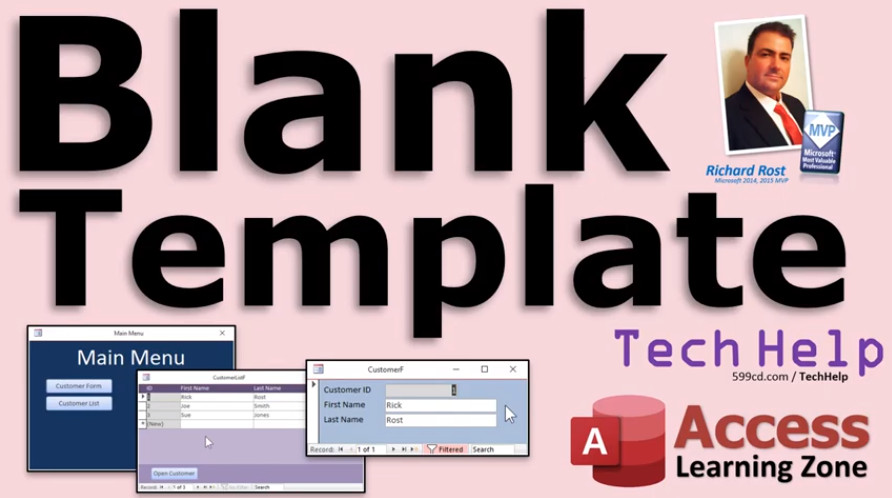
We've got a main menu with a couple buttons on it, a customer list, and then a customer form. In fact, we can move this down here if you want to. Save that. See? That's it. That's your simple, basic blank database template.
If you want to download a copy of my database template instead of building it yourself, go to my templates page at 599c.com/templates. I'll put a link down below the video you can click on to get there. Look on the templates page and find the blank database template. There are a couple of other free ones on there as well as all my other templates that you can check out.
Want to learn more about setting up your blank database template? In the extended cut for members, I cover a few more options that I like to change. We'll go into the Access options again, I'll show you how to set up a trusted location, we'll talk about some of the client settings, and we'll see some of the settings in there like confirm document deletions and action queries, and why I like to change some of these things around.
How do you become a member? Click on the join button below the video. Silver members and up will get access to all of my extended cut TechHelp videos, live video and chat sessions, and other perks. After you click the join button, you'll see a list of all the different membership levels that are available, each with its own special perks.
But don't worry: these TechHelp videos are going to keep coming. As long as you keep watching them, I'll keep making more and they'll always be free. Intro In this video, I will show you how to create a basic blank database template in Microsoft Access from scratch, including setting up essential forms like a main menu, single record form, and continuous list form. We'll walk through customizing form layouts, adjusting Access settings such as the window view, and adding navigation buttons to link your forms together. I'll also demonstrate how to use this template as a starting point for building new databases, saving time by avoiding repetitive setup steps. Quiz Q1. What is the first step when setting up a new blank database template in Microsoft Access?
A. Downloading a template from the internet
B. Creating a table with customer information
C. Selecting and naming a blank database when opening Access
D. Importing data from Excel
Q2. Why does Richard prefer overlapping windows to tabbed documents in Access?
A. Overlapping windows provide automatic color coding
B. Overlapping windows mimic the classic Windows interface with separate moveable windows
C. Tabbed documents are too colorful
D. Tabbed documents do not allow adding forms
Q3. Which forms does Richard create as part of the basic blank database template?
A. Single Form, Continuous Form, and Menu Form
B. Single Form, Report Form, and Search Form
C. Table Form, Query Form, and Chart Form
D. Input Form, Edit Form, and List Form
Q4. What is the primary purpose of the Menu Form in Richard's template?
A. To enter customer data
B. To display report summaries
C. To provide navigation buttons to different parts of the database
D. To edit multiple records at once
Q5. In setting up a single form, why does Richard make one text box gray?
A. For better readability
B. To indicate a field that users cannot change, often the ID field
C. To highlight it for printing
D. For sorting purposes
Q6. What feature does Richard use to quickly apply formatting from one control to another in a form?
A. Format Painter
B. Property Sheet
C. Quick Replace
D. Control Wizard
Q7. When creating a continuous form, what property must be changed to allow multiple records to display in a list format?
A. Caption property
B. Modal property
C. Default View property set to Continuous Forms
D. Color property
Q8. Why does Richard recommend setting "Allow Deletions" to No on forms?
A. To prevent data from being removed by users
B. To speed up database performance
C. It improves database security settings
D. It is required for linking tables
Q9. What is the function of the customer list form in the template?
A. To display all customers in a searchable list format
B. To generate invoices for customers
C. To allow data imports from Excel
D. To send emails to customers
Q10. How can you make the main menu form the startup form for your database?
A. Save the form with a special name
B. Select it in the "Display Form" option under Access "Current Database" settings
C. Set a password on the form
D. Link it from a table
Q11. According to Richard, what is the benefit of copying the blank template for new databases?
A. It prevents database corruption
B. It saves time by avoiding repeated setup steps
C. It automatically links tables from other databases
D. It strengthens database security
Q12. What must you do to bind a form to a table in Access?
A. Change the default view property
B. Set the form's record source property to the desired table
C. Apply a special color theme
D. Make sure the form has only one text box
Q13. What naming convention does Richard recommend for tables and forms?
A. Start with a number
B. Use underscores between words
C. End tables with "T" and forms with "F"
D. Use all lowercase letters
Q14. Which of these is a use of the Format Painter tool in Access forms?
A. Binding forms to tables
B. Copying data between forms
C. Applying the same formatting from one control to others
D. Renaming labels automatically
Q15. In a continuous form, if you want to open a customer's record from the list, what must you do?
A. Double-click on the record
B. Add a button that opens the single form, matching the selected record's ID
C. Edit the record source property
D. Right-click and select "Open"
Answers: 1-C; 2-B; 3-A; 4-C; 5-B; 6-A; 7-C; 8-A; 9-A; 10-B; 11-B; 12-B; 13-C; 14-C; 15-B
DISCLAIMER: Quiz questions are AI generated. If you find any that are wrong, don't make sense, or aren't related to the video topic at hand, then please post a comment and let me know. Thanks. Summary Today's video from Access Learning Zone focuses on setting up a blank Microsoft Access database template from scratch. This is a common starting point for building new databases, and I frequently use a basic template in my tutorials for efficiency. The question for today comes from a student who noticed this pattern and wanted to know how to create such a template and what tips I might have for making the process as streamlined as possible.
I start by launching Microsoft Access and creating a new blank database. I recommend saving the file somewhere convenient, like the desktop, while working on it. You can always move it to a permanent location later once it's finished.
One of the first changes I make to a new Access database is to switch from the default tabbed document view to overlapping windows. I find the classic windowed style much more user-friendly and easier to manage when working with multiple objects. This option can be found in the database's current settings and takes just a moment to adjust, though you may need to reopen the database for the change to take effect.
For my template, I create three primary forms: a single form, a continuous form, and a main menu form. The single form is used for viewing and editing one record at a time, and the continuous form displays multiple records in a list. The menu form serves as a navigation panel for your database, containing buttons that lead users to different parts of the application.
To build the single form, I use the form design tools to set up the layout, adjusting the size and applying some background color for visual distinction. I typically add two text boxes to the design: one for an ID (which I shade gray to indicate it is not user-editable) and another for a standard input field. This gives a consistent starting point for forms I create later on, saving time in formatting and layout.
Once that is saved, I create the continuous form. I duplicate my single form, then modify its settings to allow for the continuous form layout. I also adjust the colors so it stands out from the single form. I include a form header and footer for clarity and move the field labels into the header for better organization. I also tweak the alternating row color settings, as I prefer a consistent background color throughout.
In the continuous form properties, I often turn off the ability for users to delete records. I prefer to manage data by toggling an active or inactive status for records, rather than removing them entirely, which helps preserve related information, such as orders linked to a customer. For some list forms, I may also disable adding or editing records, making the layout view-only. In this template, however, I leave additions and edits enabled, only disabling deletions.
Setting up a main menu form is next. Again, I copy an existing form and customize it, removing data fields since the menu is only for navigation. I apply a distinct color scheme to differentiate it, and I turn off navigation controls since there is no data to move through. I add a large label for branding or instructions and adjust the window's properties so this menu becomes the database's startup form.
With the blank template finished, I save it as a file that I can copy and reuse any time I begin a new project. To demonstrate how to use this template, I create a new customer database by copying the template and setting up a simple customer table with fields like ID, first name, and last name. After entering a few sample records, I build a customer form by copying the single form from the template and linking its record source to the customer table. Pulling fields into the form is straightforward with the add existing fields tool, and the format painter helps transfer preferred formatting.
After setting up the customer form, I update the menu form to include a button that opens the customer form. This connection streamlines navigation for end-users. I follow the same process to create a customer list form by copying the continuous form template, connecting it to the customer table, and laying out the fields appropriately. A button is added to the main menu to access the customer list as well.
To allow selecting a customer from the list and jumping to their detail form, I add a button to the footer of the customer list form. This button is set up to open the customer form for whichever record is selected. This feature is particularly useful for quick navigation between lists and details. There are even more ways to enhance this process, such as setting up double-click actions, adding filters, and more, but those topics are covered in advanced lessons.
At this point, the foundation of a reusable database template is complete. You can continue modifying and expanding on this as needed for your projects. If you want, you can download a copy of my pre-made blank template from my website so you do not have to build it entirely on your own. There, you will also find other free and paid templates for different needs.
If you want to learn more about customizing your blank database template, today's Extended Cut covers several additional Access options. For example, I go further into configuring trusted locations, adjusting client settings, and turning off various confirmation dialogs for deletions and action queries, all of which can make development safer or more streamlined depending on your preference.
You can find a complete video tutorial with step-by-step instructions on everything discussed here on my website at the link below. Live long and prosper, my friends. Topic List Creating a blank Access database template
Changing Access settings to overlapping windows view
Creating and formatting a single form
Adding and customizing text boxes on forms
Setting up color schemes for form elements
Copying and modifying forms for reuse
Creating and formatting a continuous form
Enabling form headers and footers in forms
Adjusting back color and alternate back color in forms
Disabling alternating row colors in continuous forms
Using form properties to disable record deletions
Setting the default view to continuous forms
Creating a main menu form with navigation buttons
Customizing form properties for menu forms
Adding and formatting labels for form titles
Setting the startup form for the database
Duplicating the template for new databases
Creating a simple customer table
Populating a table with sample data
Copying and binding forms to a specific table
Using "add existing fields" to add fields to forms
Applying format painter to form controls
Rearranging and resizing controls on forms
Adding navigation buttons to the main menu
Creating a customer list form using continuous forms
Binding the continuous form to a table
Aligning controls for visual consistency
Adding buttons to open forms from the main menu
Adding command buttons to open related forms
Using the form footer for additional navigation buttons
Configuring a form button to open a specific record
Matching fields for record navigation between forms Primary Topics Microsoft Access, database templates, form design, table creation, navigation menu, form properties, form customization, workflow setup Secondary Topics user interface preferences, disabling record deletions, cosmetic formatting |




