|
||||||

|
|
||||||
|
NavigationBy Richard Rost
 5 years ago
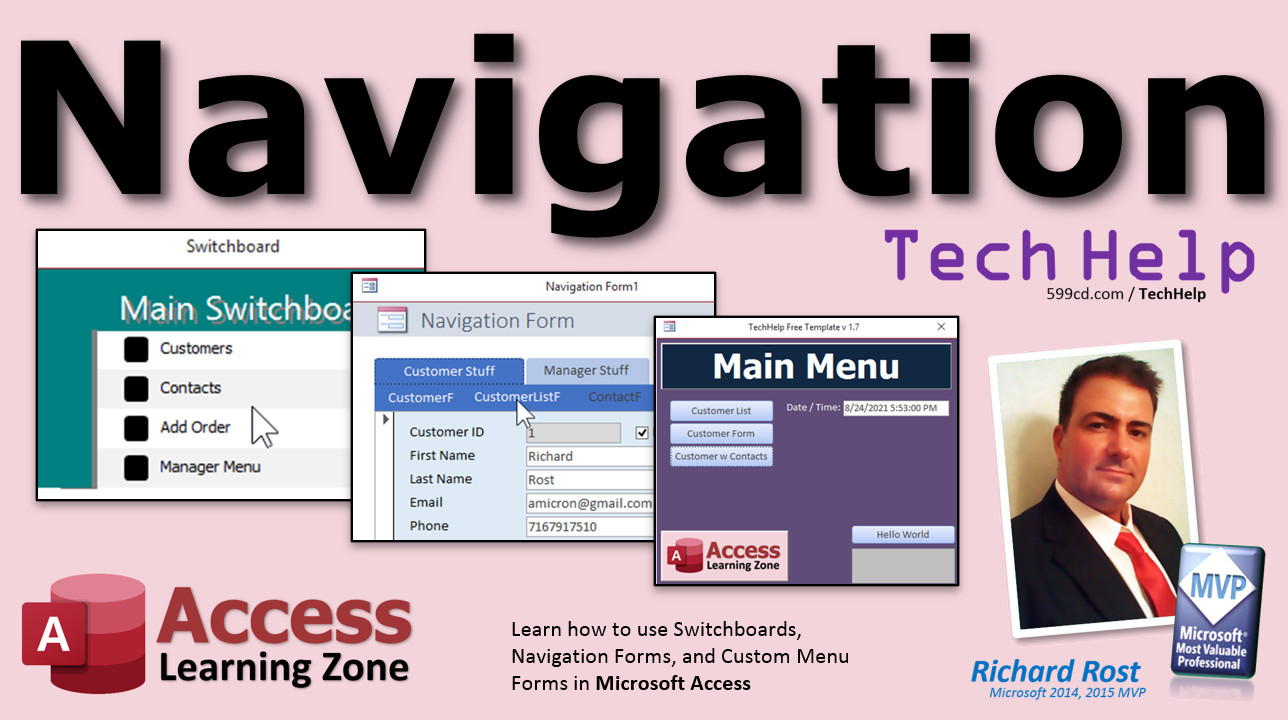
Switchboards, Navigation Forms, Menu Forms In this video, I will show you how to create a Switchboard, a Navigation Form, and my personal favorite method of navigating around a database which is to create custom Menu Forms. Plus, I'll show you a cool special trick for your Menu Form navigation. Charlotte from Auckland, New Zealand (a Platinum Member) asks: What is the best way to create an interface for my users to navigate the different forms and reports in my database? Switchboard? Navigation Forms? Something else? MembersMembers will learn how to open forms directly to the right, or underneath the parent form. This is handy for creating menus where the forms may move around the screen. You can control the form's exact positioning from the calling form.
Member Update
Silver Members and up get access to view Extended Cut videos, when available. Gold Members can download the files from class plus get access to the Code Vault. If you're not a member, Join Today!
Links
Keywordsmicrosoft access, ms access, #msaccess, #microsoftaccess, #help, #howto, #tutorial, #instruction, #learn, #lesson, #training, #database, microsoft access switchboard, create and use a switchboard, What is a switchboard in Access, How do you create a switchboard in Access, alt key command button, movesize, openformright, open form right, form position, Where is the switchboard in Access, Switchboard Manager does not appear in the ribbon, Where's the Switchboard Manager Tool, Access switchboard vs navigation form, navigation form, How do you create a navigation form in Access
More InformationTranscriptWelcome to another TechHelp video brought to you by AccessLearningZone.com. I am your instructor Richard Rost. In today's video, I am going to teach you how to build switch forms, navigation forms, and custom menu forms in your Microsoft Access databases. Today's question comes from Charlotte in Auckland, New Zealand, one of my platinum members. Charlotte says, what is the best way to create an interface when I use your to navigate the different forms and reports in my database? Switchboard navigation forms or something else? Well, Charlotte, I have personally always been preferential to something else. I like to build my own custom menu forms and I am going to show you how to do that a little bit later on. But first, let me show you the switchboard and the navigation forms. Like I had on the opening slide, in old versions of Access we had this thing called a switchboard, which looks like that. Then, later on, I believe around Access 2010, they came out with navigation forms, and those are okay for beginner users. But I like making custom menu forms myself. I think these are the most flexible because you can control exactly the way they look, and when you get into programming and more advanced stuff, you have a lot more control over them. So I am going to show you all three in this video. Now, before we get started, I would like you to go watch my blank database template video. I have a blank template that I use for all my TechHelp videos, and this video shows you how I built that template. You can also download a free copy from my website. There is the address. I'll put a link down below in the description that you can click on. In that video, I show you the basics of how I like to set up my databases. For example, I do not like to use the tab interface. I like to use overlapping windows. I will actually show you how to make a real simple main menu with a custom menu form in that video. Watch that first, then come back here and I'll teach you about switchboards, navigation forms, and we will do something extra with the main menu form. Watch that first and come back. Here I am in the TechHelp free template. I have added a few things since you watched the initial blank video, but it is basically the same stuff. Here is the customer list. You can either click on open customer down here or you can double-click here where it is blue. That will open up the same way. We have an order form here. You can find this in my invoicing template. That is a free video; I will put a link down below. We have our contacts over here. These are all just buttons that open up other forms - the customer form, customers with contacts. That is a subform, and as you can see, I have my own custom menu system here. Now, that is how I like to build a bit. What if you want to go a little simpler? What if you want to just use the built-in navigation that comes with Access? What do you do? There are two things you can do. You can either use the switchboard manager or a navigation form. The switchboard manager goes way back - Access 2000 or 2003, I think, is when it first came out. The switchboard manager lets you simply pick what forms you want to appear on a menu, and you can have multiple levels of nested menus if you want to. The switchboard manager used to be under database tools, but it is not here anymore. They actually hid it, I think, in Access 2010. To get to it, you have to add it to your quick access toolbar up here, which I already did. You can find that by dropping this down, going to more commands, going up to all commands, and then scrolling down until you find the switchboard manager. It is down here somewhere. Add it over here, and you will see it is on my quick access toolbar already. Now once you have that, you can click on this button. It will say the switchboard manager was unable to find a valid switchboard in the database. Would you like to create one? Yes, that is why I clicked. This pops up. Switchboard pages are basically separate menus. You can have multiple pages in the switchboard. Let's say the first switchboard is just your customer form and your contact form. Here we are going to go edit to edit the main switchboard. Items on this switchboard - let's add the customer form. Go new. What text do you want to have in there? How about customers? Then, you pick a command. There is open form in add mode, which means it is opening that form and putting you on a blank new record. Edit mode means you can browse through all of them. There is open a report. "Find application" means you are in this interface to edit the switchboard, "exit application" closes access, and you can run code or run a macro. We are going to open a form in edit mode. What form do you want? Customer F. Hit OK. There you go. Now on the main switchboard, you have the customers. Let's close this and see what we have so far. Close, close. Now you are going to find a switchboard items table, which, nobody told the guys over at Microsoft that they did not follow my naming conventions, because I say no spaces in your table names and they put a space in there. You will also find a switchboard form down here. Now, the switchboard form, if you open it up, looks like that. That is pretty bland. I am no graphic artist, but I think mine looks a little better. That is a little button - you click on it and there is your customer menu. That is not difficult to use. You want to go back in there and make some changes. The main switchboard, you can double-click on it to edit it, add a new button. Let's put the contacts on there. Yes, I realize that my form just put any old form on here. You obviously want to have things that are related to each other on the same page. Open that guy up. Let's open up the contact form. You can add another one, invoices or orders. Let's call it orders. We can make this one open up in add mode. Order instead, like that. Whatever you want to have in here, there is the order F. Close it, close it, and then open it up. Hey, it is not bad. You can come in here and customize this look and feel a little bit. Right-click, design view. You can make this bigger, change the colors, delete that background if you want to, and there is all kinds of stuff you can do in here. You can change this; it is just a picture over here. You can move these things around, change fonts, all that. I am going to close this and not save changes, but you get the point. There is a switchboard items table, too. Members, in the extended cut video, I will take you through this a little more in depth as to what this means. But beginner users, you do not want to modify this by hand. Leave this alone. Use the switchboard manager. If you want to add a second page, go back into here. Add a new page. Let's call this the manager's page or manager menu. Manager menu. OK. On the manager menu, double-click on this one. Now, you will put things on here that only the manager can do. So, new, maybe like edit orders, for example. Go to edit and order F. OK. Then I will close that. Close that. Wait, now we have to put that page - see, it is a little confusing - now we have to put a link to that page on the main menu. So now on the main switchboard, add a new item. We'll call this manager menu, then go to switchboard, and then the manager menu. Then hit OK. You can move things up and move them down, like moving up and down in the order here, if you want that on top or on the bottom. Then close, close. Now when you open this, there you go. There is your manager menu. Click and it opens up the manager menu, and it just replaces the existing menu. You can have another button on here to go back to the other one if you want to. If you want to use this as your startup form, just go into the Access options, like I showed you in the blank database template, and set that as your startup form. So that is the Switchboard Manager, and it is OK. It is real simple, real basic. It gets the job done. Again, these are good for beginner users. They are not bad, but they really have limitations when you start getting into advanced design if you want to become a developer. My method gives you complete control over everything. If you use a switchboard or the navigation forms, which I am going to show you in a moment, I find them harder to work with from a programming point of view than just building my own menu form from scratch. I like to be able to get under the hood and do exactly what I want, and make it look exactly the way I want to make it look. Whereas with these, you are more limited. Let's take a look at navigation forms. Around Access 2010, I think, they introduced something called the navigation form, which is why the switchboard manager is hidden. It is still in there. You can still use it, obviously, but it is old school. Some people still like it though. I still have clients that send me databases every now and then that have switchboards in them. Surprisingly, on my website, switchboard is still a very popular search term. People are looking for it, so that is why I put this video together. People still want to learn how to use it. Navigation forms are found under Create, and then in the Form section, you will see Navigation right here. Navigation forms give you a bunch of different ways to control the interface. I personally like vertical tabs left. That looks like this. Basically, what you have here is a form with the navigation control in it. These are up here in the toolbox. You can add them manually if you want to, and a subform over here. The way this works is you pick something over here and it opens the form as a subform inside of the navigation form. The main reason I do not like this is because, as far as naming your forms go, if you want to have a query that refers to the customer form, now you have to treat it as a subform on the navigation form. It just turns into a pain. I really do not like it. I am not sure how to use it. But I personally do not like these. That is just my opinion. To add something here, just grab it, like customer form, click and drag it right on that "add new." See that? Boom. Customer form. Contact form. Click, drag, drop it there. When you click on these here, you can move them around, click, drag, drop. Just like that. If you want to put something else, put the main menu on there. Now, when you save it, NavigationForm is fine. We are not keeping it. Close it. Open it up. There you go. Customer form. Contact form. Main menu form. That is OK. I just do not like it, because, again from an advanced database standpoint, if you make a query or another form, it is going to refer to these values. Now it has to be forms!NavigationForm!SubformName.Form![Customer], and it just becomes a pain. That is a nightmare. You can do a double-level navigation form, too. That is kind of cool. Go to Create, Navigation. Oh, I hit Form Wizard by accident; I do not want that. Navigation, you could do horizontal tabs, two levels, or you could do horizontal and vertical. That gets really confusing, I think, though. The horizontal tabs, two levels is neat. So, with the two levels, you do groups across the top and then forms on the bottom. Across the top, let's call this "customer stuff." Make it a little wider. Over here, make this "manager stuff." Now, you put your stuff down below. The customer stuff, click, boom. Be careful when you drop it, too. You have to grab it, click it, and drop it right there - do not drop it elsewhere. Maybe add another form by clicking, dragging, and dropping. Now go over to the manager stuff, and you can put order F there, or the detail, or maybe next to it, whatever. Now, when you save this, close it, open it up. Now you have two levels here, customer stuff with this stuff, and manager stuff with these things under here. It is kind of neat. It is OK. It is the naming conventions that it can mess up, but the reason why they added this is because it makes it easy for beginner users and novices to have a way to navigate around the database. But I think this is nice and simple as it is: just put command buttons on a form. For some reason, they try to hide the fact that designing forms in design view is nice and easy. It is not that hard. It takes, what, half an hour of training? I cover a lot of how to do this in my Access Beginner One class. It is easy to do. I think the one major difference between Access and Excel is that with Excel, it is very easy for someone to sit down, just start plugging numbers in, maybe draw some different controls, text boxes, circles, whatever, and you can just be productive and get up and running without knowing much. Obviously, it helps if you learn some functions like SUM and AVERAGE, but that is real simple. Whereas with Access, you will get a lot more out of it if you take the time up front to learn how it works. Just a couple of hours of training to understand the basics of tables, relationships, and form design, and once you get a little bit of training under your belt, Access becomes a whole lot more powerful. It is just not something you can easily sit down and just start plugging away at like Excel or Word. Of course, another problem with using these built-in navigation forms is once you get into developer-level stuff, this becomes notoriously difficult to code for. As you can see, it is easy to set up with the little interface here, but I do not particularly care for it. That is just my opinion. If you like it, great, use it. This brings you to a custom main menu like I developed in the blank video. Mine is really simple. It is a blank form: turn off the scroll bars, turn off the navigation buttons, the record selectors. We covered all this in the blank video. Drop command buttons on here to open up your customer list and all the other things, like the customer form. Pretty straightforward. I promised you that I would show you a cool trick that I have not shown before, with something you can do in the main menu, and I will in just a moment. But first, let me go over a couple of other free TechHelp videos that I have that add to enhancing your main menu. I have done a lot of different stuff that you can do to change your main menu form. First, there is the report list box video, where I show you how to make a list box that has a list of your reports in it, so you can put those on the main menu instead of having to have different buttons for each report. You just put these in a table, and then you have one list box on your main menu and you pick the report you want and click "Print Report." If you have 15 or 20 different reports, you do not have to have 15 or 20 different buttons, you just put them on a list. I will put links to all these other videos down below in the link section. Then, there is my dashboard form, where I show you how to make a dashboard out of your main menu, so you have a sales summary here, for example: the day's, the week's, the month's sales, and a little chart. That is how to make a dashboard out of your menu. There is so much more you can do with custom menus than the navigation form and the switchboard easily lend themselves to. This is kind of related: this is making a splash screen like this thing here that pops up when you start the database before the database actually loads. I just wanted to throw that in because it is kind of neat. This is one of my favorite ones. I use it all the time in my database: my favorite customers list. Again, another list box with your favorite customers, your most recently viewed customers, and the most viewed customers. You can switch between those, and it will show you your top 10 most viewed customers, the ones you viewed recently. That is pretty cool. That is something to put on your main menu. I have a video titled "Form Design Esthetics," where I teach you how to make cool-looking, futuristic forms like this for your main menu or any other kind of form. When you are all done building your menu so it looks good and you are happy with it, watch my simple security video. I will teach you security that is good enough for most trusted work environments. You are not dealing with hackers, and this is not FBI-level security, but it is good enough to keep the average person out. We hide sensitive objects, we hide the navigation pane, we disable the full ribbon, that kind of stuff. For members, I will show you how to password protect stuff. It is pretty cool. That is just some stuff you can do to enhance your main menu, and again, more reasons why you want to build menus like the way I do. Now, it is time for your special feature hidden trick. I did not mention this in any of the texts, so this is pretty cool. I show this in some of my beginner lessons, but a lot of people do not know this trick. Many of you, like me, are keyboard warriors. I hate to stop and have to grab the mouse. Wouldn't it be cool if we could navigate through the forms in our database using just the keyboard? We could tab through. If you are on here, you could tab, tab, but you can barely see which things are focused. But it would be nice if you could make keyboard shortcuts for these buttons. In design view, customer list - let's make the L a keyboard shortcut. So I am going to put a little ampersand right in front of that L. See that? Now it looks like that, customer list, little underscore under there. Customer form - let's make that a C. The customer with contacts, let's use the W. Now save it, close it, open it back up again. Now, to use those buttons, press the Alt key and then that key, so L, right: Alt+L, and there is my customer list. You could make another custom close button over here and make Alt+X for the close. Or just a little training: Ctrl+F4 will shut a form. Alt+F4 shuts down an application, so Alt+F4 will shut down all of Access. Ctrl+F4 will shut down that form. Alt+C, and now you are in here and you can tab around. Do the same thing with these - come in here, make orders Alt+O, contacts Alt+C. If you want to add a close button, let me show you. Let's use the upper right corner, grab a command button, drop it up here. We are going to go for operations - close form. Next. Then we need text so we can use that. Let's make the text "Close" and add an ampersand X like that so it looks like this. Next. What name do I want to give it? Close form. There we go, so there is our close button. Put it right there. You can probably just put the X by itself, but you get the point. Now, Alt+C and then Alt+X. If you are a keyboard freak, Alt+W. If you hit Alt by itself, this is covered in some of my other lessons, you can actually use just the Alt key by itself to navigate through all of the menus up top too. Hit Alt and let it go, it goes up to the ribbon. Then C for create, TN or P for parts or FD for form design. That is designed for people who want to use only the keyboard or people with disabilities. I have a video for how to do that, too - the quick tip shortcut keys to navigate the ribbon. I have videos for everything. There is your super duper shortcut. That is pretty cool. If you want to learn more, in the extended cut I show a cool menuing trick that I use on a lot of my databases. That is how to make another form open up just to the right of the form that calls it. For example, from your main menu, you can click your customer form button and the customer form will automatically always open up to the right of the main menu form, no matter where the main menu form happens to be. If you move it down, it will move down with it. That is all covered in the extended cut. Silver Members and up get access to all of my extended cut videos. How do you become a member? Click the Join button below the video. After you click the Join button, you will see a list of all the different types of membership levels that are available. Silver Members and up get access to all of the extended cut TechHelp videos, live video and chat sessions, and more. Gold Members get access to a download folder containing all the sample databases that I have built in my TechHelp videos, plus my code vault where I keep tons of different functions that I use. Platinum Members get all the previous perks plus access to my full beginner courses and some of my expert courses. These are the full-length courses found on my website, and not just for Access. I also teach Word, Excel, Visual Basic, ASP, and lots more. But do not worry: these free TechHelp videos are going to keep coming. As long as you keep watching them, I will keep making more. If you like this video, please give me a thumbs up and feel free to post any comments that you have. I do read them all. Make sure you subscribe to my channel, which is completely free, and click the bell icon and select "All" to receive notifications when new videos are posted. Click on the "Show More" link below the video to find additional resources and links. You will see a list of other videos, additional information related to the current topic, free lessons, and lots more. YouTube no longer sends out email notifications when new videos are posted, so if you would like to get an email every time I post a new video, click on the link to join my mailing list. If you have not yet tried my free Access Level One course, check it out now. It covers all the basics of building databases with Access. It is over three hours long. You can find it on my website or on my YouTube channel. If you like Level One, Level Two is just one dollar. It is also free for all members of my YouTube channel at any level. Want to have your question answered in a video just like this one? Visit my TechHelp page and you can send me your question there. Click here to watch my free Access Beginner Level One course, more of my TechHelp videos, or to subscribe to my channel. Thanks for watching this video from AccessLearningZone.com. IntroIn this video, I will show you how to create switchboard forms, navigation forms, and custom menu forms for your Microsoft Access databases. I will walk you through using the built-in Switchboard Manager, explore navigation form options, and demonstrate how to build your own flexible custom menu forms. I will also cover tips for keyboard shortcuts to enhance usability. Whether you prefer the built-in tools or want the control of a custom interface, you will see how to effectively design and organize your Access database navigation. QuizQ1. What is the main advantage of creating a custom menu form in Microsoft Access? A. It provides complete control over the layout and functionality B. It automatically updates based on table changes C. It is easier to use than the switchboard for beginners D. It is the only way to open reports Q2. Which Microsoft Access feature was introduced around Access 2010 to help users navigate forms? A. Switchboard Manager B. Navigation Form C. Form Wizard D. Query Builder Q3. Why might advanced users prefer custom menu forms over switchboard or navigation forms? A. Custom menus allow for easier programming and customization B. Switchboards cannot be used at all in new versions of Access C. Navigation forms require VBA code for every button D. Custom menus are built automatically Q4. What happens if you add an ampersand (&) before a letter in a command button's text in Access? A. It adds a new button B. It underlines that letter and sets it as a keyboard shortcut C. It changes the color of the button D. It hides the button from the form Q5. Which type of menu interface allows for multiple levels of nested menus in Access? A. Navigation form B. Custom menu form C. Switchboard manager D. Report selector Q6. What is a primary disadvantage of using the Navigation Form for more advanced databases? A. It cannot hold more than three buttons B. Referring to forms and controls becomes complicated in code and queries C. It cannot display subforms D. It only works with reports Q7. How can you access the Switchboard Manager in recent versions of Access? A. From the Database Tools tab B. By adding it to the Quick Access Toolbar C. By right-clicking the navigation pane D. It is enabled by default Q8. What is a benefit of using a list box for report selection on a main menu form? A. It eliminates the need for multiple command buttons for each report B. It prevents users from opening reports C. It hides report data from the user D. It sorts reports alphabetically only Q9. When should beginner users manually edit the Switchboard Items table? A. Whenever they want to add a form B. Only when using macros C. Never; always use the Switchboard Manager to modify it D. To delete the entire switchboard system Q10. What is the recommended way to set a menu form as the startup form in Access? A. Place it at the top of the navigation pane B. Use the Access options to designate it as the startup form C. Name it "Startup" D. Edit the Switchboard Items table Q11. Which statement best describes why Access requires a bit more upfront learning compared to Excel? A. Access has no templates or wizards B. Access requires understanding of tables, relationships, and form design C. Excel cannot perform calculations D. Access can only store text data Q12. What is one way to improve accessibility for users who prefer keyboards in an Access database? A. Add ampersand shortcuts to buttons for Alt key navigation B. Make all forms read-only C. Hide all toolbars D. Only use macros Q13. What does the "dashboard form" technique add to a main menu? A. An interface for password protection B. A summary display (such as sales summary and charts) C. Extra report printing options D. Automatic email alerts Q14. Which membership level is needed to access both extended cut TechHelp videos and full-length beginner courses? A. Silver B. Gold C. Platinum D. Bronze Q15. What is a potential issue with using navigation forms when writing queries or referring to forms in VBA? A. Forms must be referenced as subforms within the navigation form, which complicates code B. Navigation forms do not support VBA C. Queries are not allowed in databases with navigation forms D. Forms disappear from the navigation pane Answers: 1-A; 2-B; 3-A; 4-B; 5-C; 6-B; 7-B; 8-A; 9-C; 10-B; 11-B; 12-A; 13-B; 14-C; 15-A DISCLAIMER: Quiz questions are AI generated. If you find any that are wrong, don't make sense, or aren't related to the video topic at hand, then please post a comment and let me know. Thanks. SummaryToday's video from Access Learning Zone covers how to build switchboard forms, navigation forms, and custom menu forms in Microsoft Access databases. The topic for this lesson comes from a question about the best way to build an interface that allows users to navigate to different forms and reports in a database. There are several options you can use in Access: the older switchboards, the newer navigation forms, or designing your own custom menu forms. While the built-in options are helpful for beginners, I personally prefer crafting custom menu forms because they offer much more flexibility and control, especially for advanced projects where you need specific behaviors or designs. Before getting started, I recommend familiarizing yourself with the blank database template video available on my website. That video explains my preferred method for setting up a new Access database and why I generally avoid using the default tabbed interface, choosing instead to work with overlapping windows. It also introduces how to create simple custom main menu forms, which is a great foundation for this lesson. In the example database, I have a main menu with buttons that open other forms, such as customer lists, order forms, and contact lists. Each button launches a relevant form, and you can set up these buttons to match your own workflow. If you want to stick with the built-in Access tools, there are two primary options: the switchboard manager and navigation forms. The switchboard manager is a feature from much older versions of Access. It lets you set up menus composed of buttons that open forms, reports, or even other switchboard pages. You can build multiple levels of navigation this way. However, Access has hidden the switchboard manager in newer versions, so you might need to manually add it to your Quick Access Toolbar if you want to use it. The process involves customizing your toolbar to bring back the switchboard manager command and then using its prompts to build out your switchboard. When you create a switchboard, Access automatically generates a table to keep track of your menu items and a default switchboard form. You can edit this form's appearance a bit, like changing colors or moving items, but the built-in appearance is very basic and doesn't offer much room for customization. The structure is simple and great for beginners, but it quickly becomes limiting if you want to go further with your database's design. Advanced users should avoid editing the switchboard items table manually – always stick with the switchboard manager interface to make changes safely. Switchboards can have multiple pages, so you could have a general user menu and a separate managers-only page, linking them together with buttons. If you want this menu to open when the database starts, you just set it as the startup form in the Access options. Now, let's look at navigation forms. Microsoft introduced these forms around Access 2010. They provide a way to set up tabs or groups to organize forms and reports for easy navigation. There are several styles available, such as vertical tabs, horizontal tabs, or even two-level tabs that let you group forms by categories, like "customer stuff" and "manager stuff." You add forms to the navigation control by dragging and dropping them from the list and arranging them however you like. While navigation forms are a step up from switchboards in terms of interface, I find them frustrating to work with as you try to scale up your database. They complicate how forms are referenced in code or queries, since forms opened inside a navigation form are handled as subforms. This makes programming more complex and makes debugging harder for developers. Although navigation forms are fine for beginners and serve their purpose, they lack the flexibility and direct control that come with building your own menu forms. For most applications, especially as you get more advanced, I recommend custom menu forms. With a custom menu form, you have complete control over every aspect of your menu: look, feel, layout, and behavior. You just create a blank form, remove unneeded elements like navigation bars or scroll bars, and add command buttons to launch whatever forms or reports you need. This method is much easier to maintain and upgrade as your database grows. I also want to mention a few free videos on my website that demonstrate enhancements you can make to your custom menus. For example, you can create a list box on your menu that dynamically lists available reports, so instead of having a separate button for each one, you just select from the list and click a single "Print Report" button. Another enhancement is to turn your main menu into a dashboard with sales summaries and charts. You can also add useful features like a splash screen that displays as your database loads or a favorite customers list that highlights your most-viewed or recently viewed records. For style improvements, I have a video on making more visually appealing and modern-looking forms. Security is another aspect to consider. Once your custom menu is complete, you can lock down your database by hiding sensitive objects, securing the navigation pane, and disabling parts of the ribbon. This provides sufficient security for most offices. For members, I offer deeper training on password protection and other security measures. Now, for a helpful technique: making your menu easier to use for keyboard users. Many people prefer not to rely on a mouse. You can assign keyboard shortcuts to your menu buttons by editing their text and adding an ampersand before the desired shortcut letter. For instance, adding "&L" will make Alt+L launch that button's action. This is particularly useful for power users or for improving accessibility. You can also add shortcut keys to close forms or launch specific reports. Microsoft Access also supports built-in navigation with the Alt key, giving you full keyboard control over your databases. In the extended cut of this video, I demonstrate a more advanced menu technique. I show how to make a form open up at a specific position relative to the form that launched it. For example, you can have your customer form always appear to the right of the main menu, and even make it follow the menu if the user moves it. This is a powerful trick for creating professional, dynamic interfaces. This extended training is available to Silver Members and up, who also get access to live sessions, downloads, sample databases, my code vault, and more. Platinum Members unlock access to my full suite of beginner and expert courses. I encourage everyone to check out my free Access Level One course if you have not done so already. It covers all the basic foundations of database design in Access. If you enjoy it, you can access Level Two for just a dollar or for free as a channel member. If you would like your own questions answered in a future video, you can submit them through the TechHelp page on my website. You can find a complete video tutorial with step-by-step instructions on everything discussed here on my website at the link below. Live long and prosper, my friends. Topic ListOverview of switchboard forms in Access Creating switchboards with the Switchboard Manager Adding and editing switchboard items Customizing the look and feel of switchboard forms Creating multiple switchboard pages and navigation links Setting a switchboard or form as the startup form Creating and configuring navigation forms Adding forms to navigation controls via drag and drop Using single and multi-level navigation forms Discussing limitations of navigation forms for advanced users Introduction to building custom main menu forms Adding command buttons to a custom menu form Assigning keyboard shortcuts to menu buttons Creating a custom close button with keyboard access Overview of list box for dynamic report selection Advantages of custom menu forms over built-in navigation Keyboard navigation and accessibility for menu forms Primary TopicsAccess switchboards, navigation forms, custom menu forms, interface design, form navigation, main menu enhancements, keyboard shortcuts Secondary Topicsmenu security, dashboard forms, favorite lists, design aesthetics, accessibility, extended features |
||||||||||||||||||||||||||||||||
|
| |||
| Keywords: TechHelp Access microsoft access switchboard, create and use a switchboard, What is a switchboard in Access, How do you create a switchboard in Access, alt key command button, movesize, openformright, open form right, form position, Where is the switchboa PermaLink Navigation in Microsoft Access |