|
Free Lessons Courses Seminars |
TechHelp Fast Tips Templates |
Topic Index Forum ABCD |
|
||||||
|
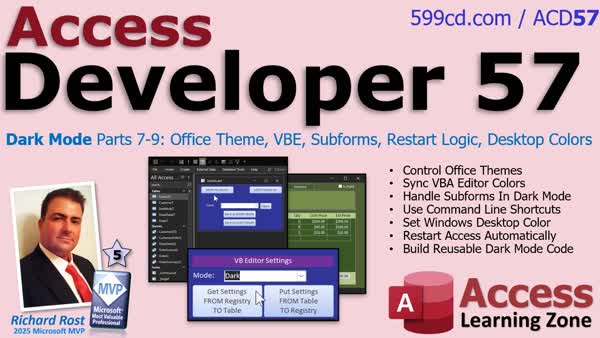
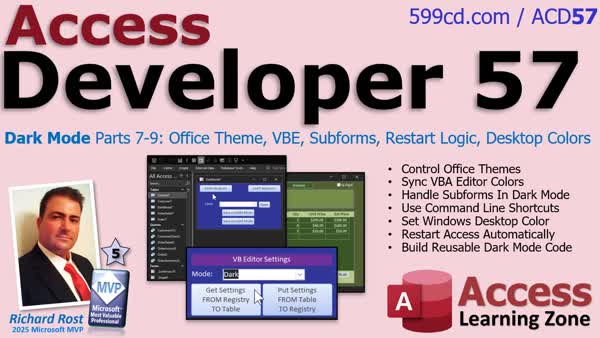
Access Developer 57 Dark Mode 7-9: Office Theme, VBE, Subforms, Colors Welcome to Access Developer 57. In this lesson, we continue building the dark mode system for Microsoft Access applications. We will teach Access to control the Microsoft Office theme so that programs like Word, Excel, and Access can switch between colorful and black mode automatically. We will also bring the VBA editor into the system, handle subforms, desktop colors, command line shortcuts, and show you how to switch your entire setup with one click, creating a comprehensive dark mode experience. Lessons
Lesson SummaryAccess Developer 57: Office Theme, VBE, Subforms - Welcome to Microsoft Access Developer Level 57. We will continue developing the Dark Mode system, turning it into a fully integrated solution. I will show you how to control the Microsoft Office theme, interact with Windows settings, manage the VBA editor, adjust desktop colors, and launch Access from command line shortcuts. Along the way, we will discuss handling multi-monitor taskbars, subform management, automatic restarts, and refactoring code into reusable procedures. By the end, you will have a polished Dark Mode system to easily switch your entire development environment between day and night modes.
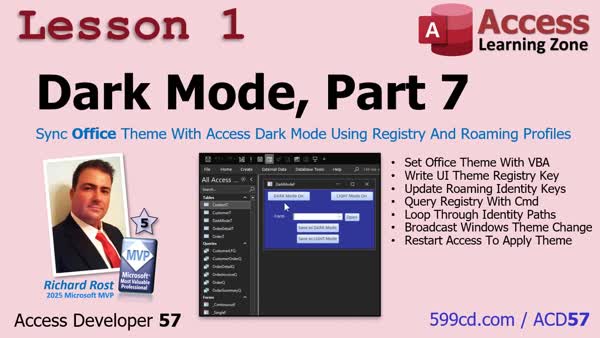
Lesson 1: Sync Office Theme via Registry & Profiles - In lesson one, we will walk through how to control the Microsoft Office theme from inside Access using both the Windows registry and roaming profile settings, ensuring Office applications like Access, Word, and Excel match your dark and light mode preferences. I will show you how to dynamically locate and update the correct registry keys for each user's Microsoft profile, broadcast theme changes across Windows components, and automatically restart Access to apply changes. We will discuss how theme settings sync across devices and how to find your own Office theme values. Next lesson, we will integrate the VB editor for full dark mode support.
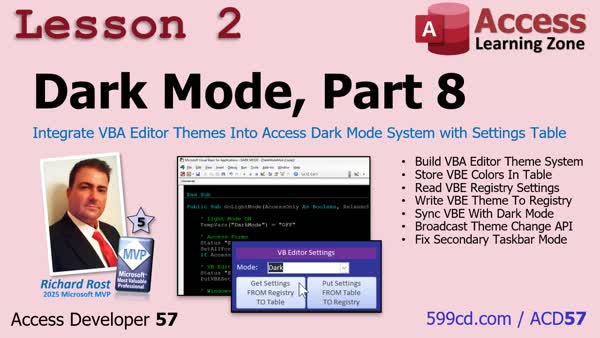
Lesson 2: VBA Editor Themes in Dark Mode - In lesson two, we continue by bringing the VBA editor into our dark mode system, making its theme settings switch automatically using values stored in the registry. I will show you how to handle multiple monitors so all taskbars update correctly, discuss the quirks of getting external apps like Office programs to respond, and demonstrate how to read and write VBA editor color settings from and to the registry using a settings table. We will also refine the interface and clean up button actions, ensuring dark mode changes apply smoothly across your Access environment.
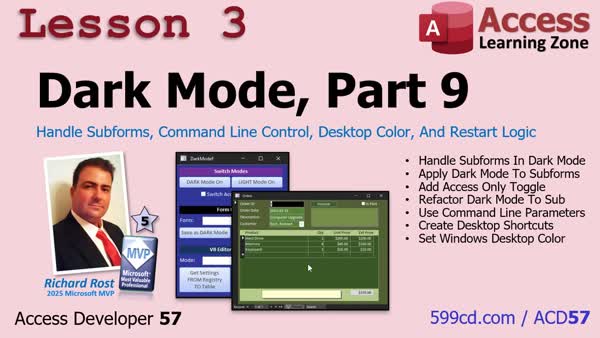
Lesson 3: Subforms, Cmd Line, Win Color, Restart - In lesson 3, we will walk through completing the dark mode system by addressing subforms, adding command line control and shortcuts, setting the Windows desktop color based on mode, and refining the code for reusability. We will also discuss handling Access-only dark mode, demonstrate how to create desktop shortcuts to toggle modes with command line parameters, and explain how to find and adjust Office theme values in the Windows registry or with PowerShell. This lesson wraps up the dark mode system for now, unless further requests are made.
Up Next: Review & Next Steps for Developer 58 - In this lesson, we wrap up Access Developer 57 and the Dark Mode series. We review how to create a complete Dark Mode system in Microsoft Access, covering how to coordinate Office themes, the VBA editor, subforms, command line shortcuts, and desktop colors so you can switch the development environment between day and night modes with ease. I also discuss what is coming next in Access Developer 58, which will focus on building a kanban board system with advanced VBA techniques such as form resizing and drag-and-drop functionality inside Access.
NavigationKeywordsAccess Developer, dark mode system, form color system, light and dark palettes, Windows API calls, Windows registry detection, Office theme control, auto switch colorful black mode, VBA editor dark mode, subforms dark mode, desktop color automation, comma
IntroWelcome to Access <B>Developer 57</B>. In this lesson, we continue building the dark mode system for Microsoft Access applications. We will teach Access to control the Microsoft Office theme so that programs like Word, Excel, and Access can switch between colorful and black mode automatically. We will also bring the VBA editor into the system, handle subforms, desktop colors, command line shortcuts, and show you how to switch your entire setup with one click, creating a comprehensive dark mode experience.TranscriptHi, this is Richard Rost with accesslearningzone.com.I just released Access Developer Level 57, where we are continuing work with my dark mode system. In case you missed Developer 55 and 56, we started building the form color system, saving and applying light and dark palettes for your forms, handling the Access background, and then improving it with Windows API calls and Windows registry detection. Now we are going to teach Access how to control the Microsoft Office theme, so Word, Excel, and Access can switch between colorful and black mode automatically. Then we will bring the VBA editor into the system so your coding environment switches right along with everything else. Finally, we will handle subforms, desktop colors, command line shortcuts, and allow you to switch your whole setup with a single click. If you want a polished dark mode system that controls your Access workspace, Office, Windows, and the VBA editor, this course brings it all together. For more information, visit my website or drop a comment down below if you have any questions. Live long and prosper, my friends. I will see you in class. QuizNo quiz available.SummaryToday's video from Access Learning Zone highlights the release of Access Developer Level 57, where I continue expanding my custom dark mode system for Microsoft Access.If you missed the previous classes, Developer Level 55 and 56 introduced the basics of the form color system. We started by saving and applying both light and dark color palettes to Access forms, as well as customizing the main Access background. I also worked on improving the system by integrating Windows API calls and detecting the Windows registry so the theme could adapt even more smoothly. In this new course, I take things a step further by showing how to let Access control the Microsoft Office theme itself. This means you will be able to make Word, Excel, and Access automatically change between a colorful mode and black (dark) mode, based on user preferences or system settings. After that, I demonstrate how to extend this theme-switching system to include the VBA editor. With this update, your coding environment will stay in sync with your chosen theme, giving you a seamless experience across all your development tools. The course then addresses how to handle subforms, update your desktop background colors, take advantage of command line shortcuts, and configure everything so your entire setup can switch themes with just one click. If your goal is to have a comprehensive dark mode that coordinates Access, Office applications, Windows, and your VBA editor, Access Developer Level 57 shows how to bring all these elements together into a unified, professional system. You can find a complete video tutorial with step-by-step instructions on everything discussed here on my website at the link below. Live long and prosper, my friends. Topic ListControlling Microsoft Office theme with VBAAutomatically switching Word, Excel, and Access themes Integrating the VBA editor with theme switching Handling subforms in dark mode Managing desktop colors in Access Creating command line shortcuts for theme control Implementing one-click setup switching ArticleIn this tutorial, I will walk you through building a comprehensive dark mode system for Microsoft Access that not only changes the appearance of your forms but also synchronizes the look across Office applications like Word and Excel, as well as the VBA editor itself. This allows you to switch between light and dark themes throughout your workspace with just a click.The first step is to set up a system that lets you save and apply color palettes. You need to decide on the colors you want for both light and dark modes and store these settings, perhaps in a table or configuration file. Once you have your palettes, you can use VBA to update the background and controls of your Access forms dynamically. For example, you might have code like this to change your main form's background color: Me.Detail.BackColor = lngDarkBackColor where lngDarkBackColor is a long integer representing your chosen color. Beyond simply updating the form colors, it is important to handle the Access application window itself. Basic VBA cannot directly change the application background or the Office theme, but you can use Windows API calls and modify certain Windows registry settings to detect and respond to the current Windows dark mode status. This helps your Access application match the look of the rest of your system. To take control further, you can use VBA to interact with Microsoft Office's theme settings so that when you turn on dark mode in Access, it also switches Word and Excel to black or colorful themes automatically. This provides a seamless experience as you move between applications. To do this, you would adjust Office-specific registry keys, for example: HKEY_CURRENT_USER\Software\Microsoft\Office\16.0\Common\UI Theme Here, you can set the UI Theme value to 4 for black, 3 for dark gray, 2 for gray, or 1 for colorful. You can use VBA with Windows Script Host or Shell calls to update these registry entries. For example, here is one way in VBA: Shell "reg add HKCU\Software\Microsoft\Office\16.0\Common /v UI Theme /t REG_DWORD /d 4 /f" This line sets the Office 2016 theme to black mode. Adjust the path for your version of Office if needed. Next, you can extend these changes to the VBA editor so your coding environment matches the rest of your setup. This involves modifying registry settings for the VBA editor, which allows you to control the background and font colors in the code window. If your database includes subforms, you should make sure your color-changing code also updates them, so the entire user interface switches mode uniformly. Expand your code to loop through forms and their subforms, applying the selected palette. You might also want to handle the Windows desktop color or provide command line shortcuts, allowing users to open Access directly in dark mode from a shortcut. Finally, bring everything together with a single toggle button on your main switchboard form. When the user clicks it, your code should update all colors, registry keys, and application settings, so the entire workspace follows their choice. Building such a polish dark mode system does require a bit of work and experimentation, but the result is a professional appearance that keeps your workspace comfortable while working late or to match your system preferences. With a little VBA and registry customization, you can control not just Access, but your entire Office and development experience from within your database. If you need more information or help with the code, you are always welcome to reach out or visit our website for detailed lessons and support. |
||||||||||||||
|
| |||
| Keywords: Access Developer, dark mode system, form color system, light and dark palettes, Windows API calls, Windows registry detection, Office theme control, auto switch colorful black mode, VBA editor dark mode, subforms dark mode, desktop color automation, comma Page Tag: whatsnew PermaLink Dark Mode Parts 7-9: Office Theme, VBE, Subforms, Restart Logic, Desktop Colors |