|
||||||

|
|
||||||
|
Export HTMLBy Richard Rost
 5 years ago
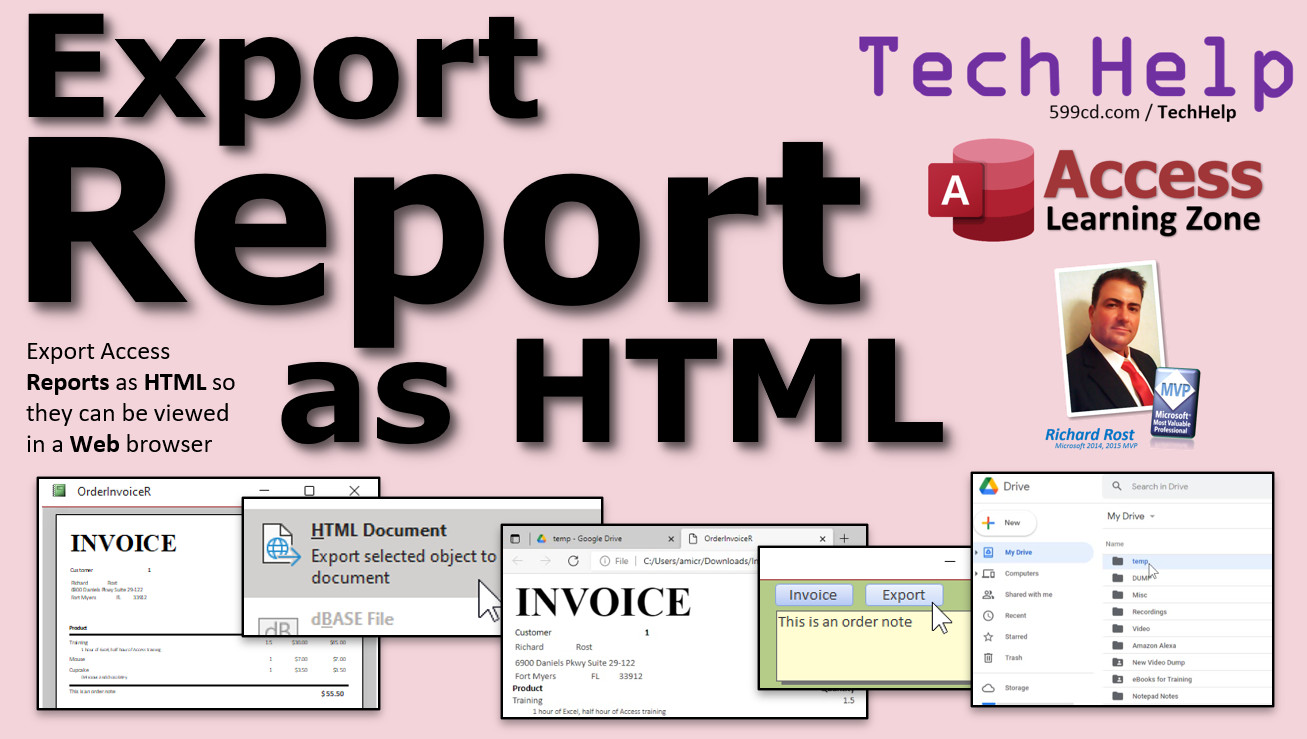
Export Reports as HTML Documents In this video I will show you how to export a Microsoft Access report as an HTML document so it can be viewed in a web browser. Teeka from Shelby, North Carolina (a Platinum Member) asks: I know I have to split the database for my team to use it, and I will go through that video soon. Is there a way for the masses to view the calendar without sending the database to everyone? My team of about 15 people will be using the database but it would be very beneficial if there was a way for a much wider audience to view just the calendar. MembersMembers will learn how to run that export with just one line of VBA code. We will also see how to connect to a Google Drive folder. This way it's a simple click and drag to update your web site, or a public folder, with your report.
Silver Members and up get access to view Extended Cut videos, when available. Gold Members can download the files from class plus get access to the Code Vault. If you're not a member, Join Today!
Links
Auto FTP UploadIf you want to learn how to one-click upload this file to a web server using FTP, I cover that in Access Developer 32.
Keywordsmicrosoft access, ms access, ms access tutorial, #msaccess, #microsoftaccess, #help, #howto, #tutorial, #learn, #lesson, #training, #database, save export steps, run a saved export specification, docmd.outputto, acFormatHTML, export as html, export report, export data as html, Making Microsoft Access Data Available on the Internet
More InformationTranscriptWelcome to another TechHelp video brought to you by AccessLearningZone.com. I am your instructor Richard Rost. In today's video, I am going to show you how to export an Access report as an HTML document so it can be viewed in a web browser by anybody. This is a great way to share your data from your Access database with anybody anywhere in the world. Today's question comes from Tika in Shelby, North Carolina, one of my Platinum members. Tika says, I know I have to split the database for my team to use it and I will go through that video soon. Is there a way for the masses to view the calendar without sending the database to everyone? My team of about 15 people will be using the database but it would be very beneficial if there was a way for a much wider audience to view just the calendar. Yes, Tika, we have a couple of options. Let me go over them for you. Basically, as far as I see it, you have three options for sharing your Access data with a wide audience, and these are people that may or may not have Access. First, you can migrate your database up to SQL Server online. This way, your data resides on the web. You and your team can still work with it as usual in Microsoft Access. You just connect to it. Then, you can make a public-facing page on your website using something like ASP where people can view whatever data you let them view, such as your calendar. The pros of this are that the data is available in real time 24-7 as soon as changes are made. So you update something, boom, and it automatically appears online. The cons are, this is a significant amount of work to set up. However, once you get it up and running, you do not have anything more to do. This is how my whole website is set up. My website is built in ASP (Active Server Pages) on Microsoft technology and it has SQL Server in the background. All I do is type something new in and boom, it appears right on my website on the home page. I have nothing more to do. That is the best solution for me. Now, the second solution would be to use SharePoint. Again, it is from Microsoft. Your data will be moved up to a SharePoint list on a web server. You can make a public-facing page for people to view, although I personally do not recommend SharePoint unless you are dealing with just a small team of people. It is good for small teams. It is not good for public stuff. You can do it, but it has some issues. The third option would be to export your calendar report as an HTML document. Then, it can be viewed right inside a web browser. You can do this inside of Access with just a few clicks and I will show you how in just a minute. You can either upload that document to your website using FTP or whatever web program you are using, or you can put it in a public folder on something like Google Drive, Dropbox, OneDrive, or one of those services, and then people can view it there. The pro is that this is by far the easiest solution to set up. The downside is that the document is only as up to date as you make it. So if you want it updated daily, then you have to update it every day. If you want it updated hourly, someone is going to update it every hour. If that is good enough for you and your team, for example, if you are just looking at a weekly schedule, then this would be a good solution for you. If you need up to the minute changes visible on your website immediately, then I would go with SQL Server. Let me show you how to do the export to HTML and you can decide if that is a good enough solution for you. Here I am inside my TechHelp free template. It is a free download from my website. I do not have a calendar set up in this database. I do have a calendar database available on my website. It is called the Microsoft Access Calendar Seminar and it makes cool reports like this. It actually looks like monthly calendars and you can see it is from 2009, but it is still good today. So if you want to be able to print stuff that looks like an actual calendar, check this seminar out. I will put a link to it down below in the links section. You can export any report as an HTML document. Since I have an invoice set up, we will just export that. Go into the customer form, open up his orders, and bring up his invoice. You will do the same thing with whatever your calendar is. Your schedule - just put it into a report. If you do not know how to make reports, go watch my Access Beginner Level 1 classes, which spend some time building reports. Right up here in the data section, you will see you can send it to Excel, a text file, PDF, or whatever. You can export it as a PDF if you want to as well. But if you want it visible easily in a web browser, drop down More, and then go HTML document. Where do you want to export it to? It is going to drop in your Documents folder. That is fine. I will hit OK. It is going to ask if you want to select an HTML template. Do not worry about that. Just leave that off and leave default encoding on, then hit OK. Access will ask if you want to save these export steps. Do not bother with this. Just hit Close. Now let us go see what Access created. Here I am in my Documents folder. This is where Access dropped this HTML document. Let us double-click to open that up. There we are. There is my HTML document, and you can use this on a web page or do whatever you want with it. It is not perfect. It does not look exactly like your report. If you want it to look exactly like your report and you can be putting it online, you can make it a PDF document too. PDFs sometimes look better and are more true to the original layout of the report than an HTML document. Most people today have browsers that can by default display PDFs. So you can use either HTML or PDF, either one - or even a text file if you want. Let us go ahead and close this. Now all you have to do is just click and drag and copy this over to your website or to your Dropbox folder or your OneDrive or Google Drive. You can install Google Drive for Desktop, which is relatively new, and you can just click and drag and drop it there, and then create a public folder where you can send the link to anybody and they can just view it from there. As I said, the downside is it is only as up to date as you make it, but it is relatively easy to update. Once a day, at the end of the day, click Update, drop it, and there you go. If you want to learn more in the extended cut for members, I will show you how to do a one-click export with one line of VBA code. Again, I tell everybody this: VBA is not scary. It should not intimidate you. It is really easy. I will show you exactly how to do it. One click, it will export the file. Then I will show you how to use Google Drive to make a folder on your system where you can just drop that file right in there, and then you can make that folder public so you can link to it from your website or send the link out to your team members, your customers, or whoever has to get this information. I will cover it in the extended cut for members. Silver members and up get access to all of my extended cut videos. Gold members can download the TechHelp video templates. How do you become a member? Click the Join button below the video. After you click the Join button, you will see a list of all the different types of membership levels that are available. Silver members and up will get access to all of the extended cut TechHelp videos, live video and chat sessions, and more. Gold members get access to a download folder containing all the sample databases that I build in my TechHelp videos, plus my Code Vault where I keep tons of different functions that I use. Platinum members get all of the previous perks plus access to my full beginner courses and some of my expert courses. These are the full-length courses found on my website and not just for Access. I also teach Word, Excel, Visual Basic, ASP, and lots more. Do not worry, these free TechHelp videos are going to keep coming. As long as you keep watching them, I will keep making more. If you liked this video, please give me a thumbs up and feel free to post any comments that you have. I do read them all. Make sure you subscribe to my channel, which is completely free, and click the bell icon and select All to receive notifications when new videos are posted. Click on the Show More link below the video to find additional resources and links. You will see a list of other videos, additional information related to the current topic, free lessons, and lots more. YouTube no longer sends out email notifications when new videos are posted, so if you would like to get an email every time I post a new video, click on the link to join my mailing list. If you have not yet tried my free Access Level 1 course, check it out now. It covers all the basics of building databases with Access. It is over three hours long. You can find it on my website or on my YouTube channel. If you like Level 1, Level 2 is just one dollar. It is also free for all members of my YouTube channel at any level. Want to have your question answered in a video just like this one? Visit my TechHelp page and you can send me your question there. Click here to watch my free Access Beginner Level 1 course, more of my TechHelp videos, or to subscribe to my channel. Thanks for watching this video from AccessLearningZone.com. IntroIn this video, I will show you how to export a report from Microsoft Access as an HTML document so it can be viewed in any web browser. We will talk about different options for sharing your Access data with a larger audience, including exporting reports, using SQL Server, and SharePoint. I will walk you through exporting a report to HTML, explain where to save the file, and offer tips for sharing it online using services like Google Drive or Dropbox. This process is easy and lets you share your Access calendar or other reports with anyone, even if they do not have Access. QuizQ1. What is the main topic of this TechHelp video? A. Exporting an Access report as an HTML document B. Importing data into Access from Excel C. Automating Access reports using macros D. Setting user-level security in Access Q2. Which of the following is NOT mentioned as a method to share Access data with a wider audience? A. Migrating the database to SQL Server online B. Using SharePoint lists C. Exporting reports as HTML documents D. Emailing the original Access database file Q3. What is a significant advantage of using SQL Server online to share Access data? A. It is the easiest method to set up B. Data is available in real time 24-7 as soon as changes are made C. It requires no setup work at all D. Only a small team can access the data Q4. Why does the instructor NOT recommend SharePoint for public access to data? A. It is not compatible with Access B. It is only suitable for small teams and has issues with public access C. It is too expensive for most users D. It can only store text data Q5. What is the main drawback of exporting a report as an HTML document for sharing? A. The document can only be viewed by Access users B. The report can be accidentally deleted from Access C. The document is only as up to date as when it was last exported D. Only one person can view the document at a time Q6. Where does Access default to saving exported HTML documents? A. Downloads folder B. Documents folder C. Desktop D. C:\\ root directory Q7. How can you share the exported HTML file with others? A. Upload it to a website using FTP B. Put it in a public folder on Google Drive C. Place it in a Dropbox or OneDrive public folder D. All of the above Q8. What is one alternative file type you could use for sharing reports that might look more like the original layout? A. Word document (.docx) B. PDF file (.pdf) C. CSV file (.csv) D. XML file (.xml) Q9. What is a benefit of using PDFs over HTML when exporting Access reports? A. PDFs can only be viewed with Microsoft Edge B. PDFs are more true to the original report layout C. PDFs require special software to view D. HTML files are always larger than PDFs Q10. In the extended cut for members, what additional feature does the instructor demonstrate? A. How to create a custom HTML template B. How to do a one-click export with VBA code C. How to animate Access reports D. How to password-protect the exported file Q11. What is recommended if you need your shared calendar to reflect changes immediately? A. Export as an HTML document daily B. Use SQL Server online for real-time updates C. Only export to PDF weekly D. Only use SharePoint Q12. How can you make a folder public with Google Drive? A. By sharing it with everyone via email B. By setting folder permissions to public and sharing the link C. By making it a hidden folder D. By copying the folder to the Desktop Q13. What benefit do Gold and Platinum members receive, respectively? A. Gold: Access to Q&A sessions; Platinum: Access to PDF exports B. Gold: Download video templates and code; Platinum: Full courses including Word, Excel, and more C. Gold: Access to mailing list only; Platinum: Channel comments D. Gold: Receive the HTML exports; Platinum: SharePoint online access Q14. What should you do after exporting an Access report as an HTML document, according to the video? A. Edit the HTML manually for better formatting B. Copy the file to your website, Google Drive, Dropbox, or OneDrive C. Print out the HTML file for distribution D. Compress it to a ZIP file before use Q15. What is encouraged if the viewer still needs help or has questions? A. Contact Microsoft support only B. Post comments and questions below the video or visit the TechHelp page C. Try searching on Google instead D. Wait for a paid support email Answers: 1-A; 2-D; 3-B; 4-B; 5-C; 6-B; 7-D; 8-B; 9-B; 10-B; 11-B; 12-B; 13-B; 14-B; 15-B DISCLAIMER: Quiz questions are AI generated. If you find any that are wrong, don't make sense, or aren't related to the video topic at hand, then please post a comment and let me know. Thanks. SummaryToday's video from Access Learning Zone focuses on how to export an Access report as an HTML document so it can be viewed in a web browser. This is a useful way to share your Access database information with a wide audience, even if they do not have Access installed on their systems. Tika raised a great question about sharing an Access calendar with a large group. She has a team of about 15 people who will use the database, but she is looking for a solution to allow a broader audience to simply view the calendar without distributing the actual database to everyone. There are several options available for this situation. First, you can move your database to SQL Server online. Once your data is on the web, your team can continue working in Access by connecting to the online database. You can then create a public webpage with ASP or a similar technology to let others view selected data, such as your calendar. The advantage is that this method gives you real-time updates. As soon as your team changes something, it instantly appears online. However, setting this up does require a fair amount of initial work. On the plus side, once it is up and running, maintenance is minimal. My own website runs this way, using ASP and SQL Server in the background. I simply update the content, and it is immediately available for all to see. The next option is SharePoint, Microsoft's web-based platform. Here, your data is stored in a SharePoint list, and you can make a public page for viewing information. In my experience, SharePoint is better suited for small teams rather than public-facing content. It can be used for wider sharing, but it does come with some limitations and is less ideal for large public audiences. The simplest method is to export your calendar report from Access as an HTML document. Once you have exported the report, it can be opened in any web browser, making it widely accessible. You can upload this document to your website or place it in a shared public folder on services such as Google Drive, Dropbox, or OneDrive, allowing easy viewing by anyone with the link. This approach is by far the easiest to set up, but keep in mind that you have to create and upload a new file each time you want to update the data. For example, if you want your calendar updated each day, you need to generate and post a new export daily. This works well if your updates are not extremely time-sensitive and a once-daily update meets your needs. If you require your viewers to see live, up-to-the-minute data, then the SQL Server approach is better. I will now walk you through how to export an Access report as an HTML file. You do not need a calendar specifically for this process; you can export any report, like an invoice. Just make sure your data is organized in a report. If you aren't familiar with working with reports, I recommend you check out my Access Beginner Level 1 courses, where I teach the basics of building reports. Once your report is ready, you can choose the export option in Access, and select HTML document. Then save the file to your desired location, such as your Documents folder. You can ignore the prompts for an HTML template or export steps, and stick with the default options. After exporting, you will have an HTML file that you can double-click to open in your web browser. The resulting file may not look exactly like your Access report, but it gets the data into a shareable format. If a more precise layout is required, exporting to PDF is another good choice, as PDFs tend to preserve the original appearance better. PDF files are also easily viewable in all modern browsers. Once your export is complete, simply copy or drag the file to your web folder, Dropbox, OneDrive, or Google Drive. If you are using Google Drive for Desktop, you can quickly drop the file into your public folder and share the link as needed. The main drawback is the manual nature of the update process, but for routine updates, it is an easy solution. For those interested in automating this process, in the Extended Cut for members, I show how to export a report with a single click using a short VBA code. VBA is quite approachable and not something to be afraid of, and I will walk you through each step. I also demonstrate how to use Google Drive to set up a shared public folder, so you can simply drop your updated file in and make it available to everyone who needs access. Silver members and up have access to all my Extended Cut videos. Gold members can also download sample databases used in these videos, along with the Code Vault full of reusable functions. Platinum members get everything previously mentioned, plus access to my complete beginner and many expert courses on Access, as well as courses on Word, Excel, Visual Basic, ASP, and more. These TechHelp videos will continue to be available for free, so if you find them helpful, please give them a thumbs up and leave your comments. I read every one. Make sure you subscribe to my channel and select notifications so you know when new content is posted. For additional links, resources, and related courses, you'll find more information on my website. If you want to receive an email whenever I post a new video, there is an option to join my mailing list. Also, be sure to check out my free Access Level 1 course, which covers the basics of building databases. It is available on both my website and YouTube channel. Level 2 is only one dollar and is included free for all YouTube channel members. If you have a question you want answered in a video, visit my TechHelp page and submit your question. A complete video tutorial with step-by-step instructions on everything discussed here is available on my website at the link below. Live long and prosper, my friends. Topic ListOptions for sharing Access database data with a wide audience Overview of SQL Server migration for Access data sharing Discussion of using SharePoint for Access data sharing Exporting Access reports as HTML documents Demonstration of exporting an Access report to HTML Locating and opening the exported HTML document Advantages and limitations of HTML export Alternative export formats: PDF and text file Uploading exported HTML to a website or cloud services Sharing Access reports via Google Drive, Dropbox, or OneDrive Considerations for keeping exported data up to date Primary Topicsexporting Access reports, sharing Access data, HTML reports, online database access, SQL Server, SharePoint, uploading reports, data sharing solutions Secondary TopicsPDF export, Google Drive, Dropbox, OneDrive, difference between live vs static data sharing, report design recommendations |
||||||||||||||||||||
|
| |||
| Keywords: TechHelp Access save export steps, run a saved export specification, docmd.outputto, acFormatHTML, export as html, export report, export data as html, Making Microsoft Access Data Available on the Internet PermaLink Export HTML in Microsoft Access |