|
||||||
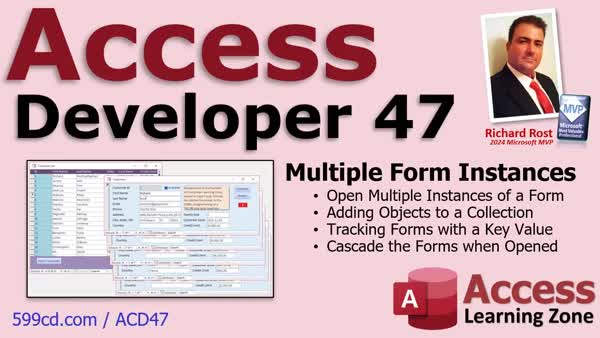
Access Developer 47Multiple Form Instances, Collections, KeysWelcome to Access Developer 47. In this course you will learn how to open and manage multiple instances of the same form in Microsoft Access using collections. We'll discuss tracking form instances with key values, handling initialization and closing, preventing duplicate forms, giving specific forms focus, and cascading windows. You will also see how to review code with ChatGPT for improvements and manage memory by resetting collections, while receiving suggestions for even better form management in your Access applications. Lessons
Database FilesLinksResources
Lesson SummaryWelcome! Open Multiple Instances of a Form - Welcome to Microsoft Access Developer Level 47. In this course we will learn how to open multiple instances of the same form, such as viewing several customers or products at once. We will discuss using collections to manage these form instances, track them with key values, handle initialization and closing, prevent duplicate forms, give specific forms focus, and cascade their windows. The course also covers reviewing code with ChatGPT for improvements and suggestions. This material is based on Access 365 but should work with versions back to Access 2007.
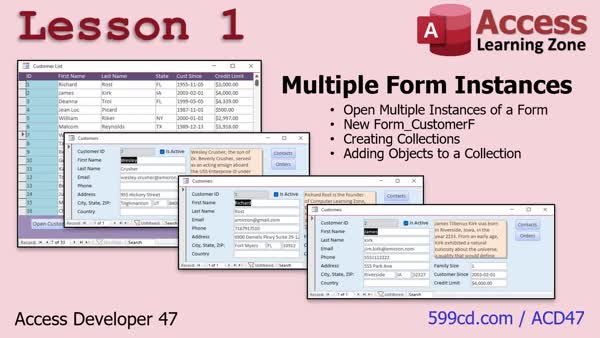
Lesson 1: Open Multiple Form Instances - In Lesson 1, we will walk through how to create multiple form instances in Microsoft Access, allowing you to open several copies of the same form with different data, such as multiple customer records at once. We will cover the basics of collections, how to declare and use them to manage multiple form objects, how variable scope affects form persistence, and the steps required to keep multiple forms open simultaneously. We will also discuss best practices for initializing collections and considerations for making collections public so forms remain open after the original list form is closed.
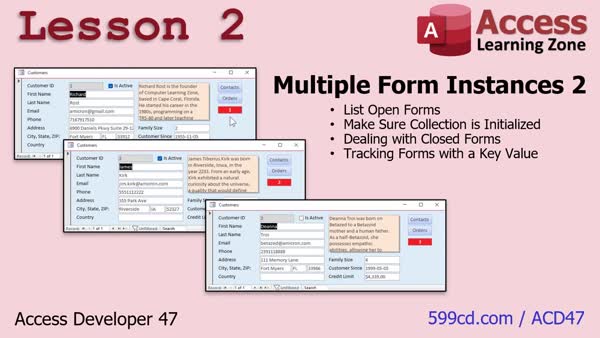
Lesson 2: Track & Manage Multiple Forms - In Lesson 2, we continue working with multiple form instances by exploring how to list all open forms, ensure the collection is properly initialized, and handle closed forms. I will show you how to count items in the collection, loop through open forms using both For Each and counter loops, and manage errors when accessing closed forms. We will discuss why the built-in key property for collections is not ideal and instead create our own key value to uniquely track each open form, storing it directly in the form itself for easier identification and management.
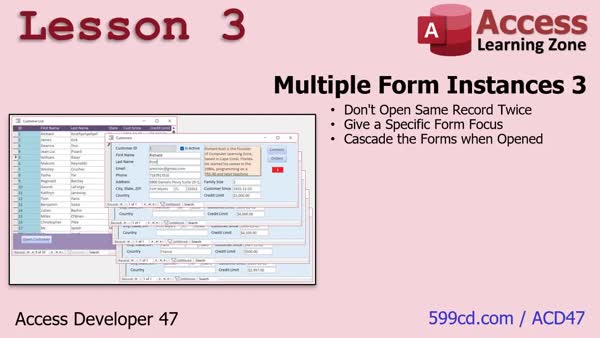
Lesson 3: Prevent Duplicate Forms & Cascade - In Lesson 3, we will walk through how to prevent opening multiple instances of the same customer form in Access, which could otherwise cause write errors. I will show you how to give a specific form focus, loop through open forms to find a particular one, and cascade multiple form instances so they display neatly. We will also discuss error handling when checking for existing forms and address how to properly reset form collections and use a "kill switch" to close all open forms quickly. The steps ensure better management of multiple form instances in your application.
Lesson 4: Reset Multiple Form Collections - In Lesson 4, we finish working with multiple form instances by refining how we manage collections in memory. I will show you how to reset the collection when all forms are closed to keep memory usage efficient, and we will review and test the process with open and closed forms. We will discuss suggestions for improving collection management, including better error handling, key tracking, and alternatives for rebuilding collections. We will also touch on feedback from Chat GPT for possible improvements and mention related resources and next steps for working with collections and form management.
Lesson 5: Next Steps & Finding Help - In this lesson we will discuss what is coming up next after Access Developer 47. I talk about possible topics for Access Developer 48, including class modules and a tricky SQL example for deleting duplicate messages in a forms database. I also mention my goal to release new lessons more regularly, encourage feedback through the core survey, and provide resources like the Access Index, search box, and AI chatbot for finding information.
NavigationKeywordsopen multiple form instances, collections, prevent duplicate forms, form focus, cascade windows, track open forms, initialize collections, manage form memory, reset form collections, key value form tracking, close all open forms
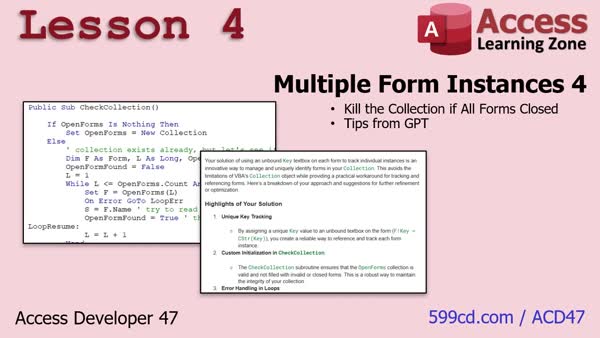
More InformationTranscriptToday we're going to learn about opening multiple instances of the same form. For example, you might want to open four customers at the same time. Or, if you're working on orders, you may want to open five different products so you can see all their information at the same time. We will be using the same form, copies, or instances of the same form. To do this, we'll learn how to create our own collections, which is an object type in Access. We'll learn how to track the individual forms with a key value so we can tell which one is which. We'll learn how to cascade them when they open so they open layered. All kinds of cool stuff like this in today's class. Today's class follows Access Developer 46. It's not a hard prerequisite, but I do cover a lot of topics that I've covered in previous developer courses. As always, my classes are designed to be followed one after the other, so I recommend you start at Beginner Level 1 and work your way all the way up. Lots of developer-level VBA material is covered today. That's why I generally advise against skipping levels. It is currently December 2024. The closest retail version of Access to this one is going to be Access 2024. I'm currently using an Access 365 subscription, which is what I recommend. That way, you always have the latest and greatest version and you don't have to worry about upgrading. The material covered in today's class, however, should apply to at least Access 2007, maybe earlier, but that's probably the earliest version I would say it would work with. If you have questions regarding the material covered in today's class, just scroll down to the bottom of the page that you're watching the lessons on and you can post your questions there. Also, take a minute to read through any other questions that may have been posted, as your question may have already been answered. Make sure you subscribe to this page to get notified of any other questions or comments posted for this class. Also, make sure to visit my Access forum where you can post questions about anything else related to Access. You can join in conversations with me, the moderators, and other Access students. Now let's take a closer look at exactly what's covered in Access Developer 47. In lesson one, we're going to learn how to create multiple instances of the same form. For example, on your customer list form, you can open up multiple copies of the customer form with different customers in each. Or, you can open up multiple products or multiple orders or multiple whatever you want. We'll learn about collections, how to create collections, and how to add objects to a collection. In lesson two, we're continuing with multiple form instances. I'm going to show you how to list all of the open forms. We'll make sure the collection is initialized to avoid errors. We'll deal with closed forms, and I'll show you how to track forms with a key value. We're going to make our own key value; we're not going to use the built-in one. It's better. In lesson three, I'm going to show you how to not open the same customer form twice, which could cause write errors. For example, if you open up Richard Rost twice, edit one, then edit the second one, it could cause issues, so we'll prevent that. Then we'll see how to give a specific form focus, so if you want to loop through the forms and find a specific one, you can. I'll show you how to cascade the forms when you open them, so if you open four in a row, they cascade nicely, just like pretty little windows should. In lesson four, we're going to finish up working with collections and multiple form instances. We're going to start by killing the collection and resetting it if we detect that the user has closed all the forms. We want to keep our memory nice and tight. Then we're going to take all our code and drop it into ChatGPT to see what it has to think about it. Maybe it can make some suggestions, things to do better, or things I might have missed. We'll see what that's all about in just a minute. IntroIn this lesson, you will learn how to open and manage multiple instances of the same form in Microsoft Access, allowing you to work with several records side by side, such as multiple customers or products. We will cover how to use collections to keep track of each form instance, assign and use unique key values, prevent duplicate forms from opening, and cascade form windows for easy viewing. You will also learn how to handle closing forms, manage memory by resetting collections, and review code for improvements in Access Developer 47 Lessons. QuizLESSON 1: Q1. What command should NOT be used to create multiple instances of the same form? A. DoCmd.OpenForm B. Form.Visible = True C. Set F = New Form D. DoCmd.Close Q2. What is the scope of a variable declared inside a subroutine? A. Global-level scope B. Procedural-level scope C. Module-level scope D. Form-level scope Q3. How can you ensure that multiple instances of the same form can be opened simultaneously? A. Use a different form variable for each instance B. Use a global variable for all instances C. Use a collection to store form objects D. Set the form's Visible property to False Q4. What does setting a variable to Nothing accomplish? A. It assigns a global value to the variable B. It saves the current value of the object to the database C. It releases the memory allocated to the object D. It makes the form visible on the screen Q5. When do you need to set an object variable after declaring it? A. Before exiting the module B. After using the object in a procedure C. Immediately after declaring the variable D. Only when the object variable is public Q6. What must be done to prevent all form instances from closing when the main form closes? A. Use a module-level scope for the collection B. Use a form's Unload event to close forms C. Declare the collection as Public in a global module D. Set the form instances to Read-Only Q7. Why is it necessary to initialize the OpenForms collection in the form load event? A. To ensure compatibility with the main menu B. To prevent runtime errors in the application C. To guarantee that the collection variable has been set before use D. To automatically close forms when the form loads Q8. What application behavior should be considered when using public variables in a developer environment? A. They can simplify code readability in subroutines B. They enhance security by restricting access to forms C. Compile or runtime errors can erase public variables D. They automatically destroy after each form use Answers: 1-A; 2-B; 3-C; 4-C; 5-C; 6-C; 7-C; 8-C DISCLAIMER: Quiz questions are AI generated. If you find any that are wrong, don't make sense, or aren't related to the video topic at hand, then please post a comment and let me know. Thanks. ---- LESSON 2: Q1. What is the purpose of listing all open forms in the tutorial? A. To count the total memory usage B. To help debug the application efficiently C. To manage multiple instances and track them effectively D. To close all forms simultaneously Q2. How do you initialize the collection for open forms to avoid errors? A. Set the collection to null upon form load B. Use a check collection subroutine in the form load event C. Assign the forms directly to an array D. Restart the application Q3. Which loop is preferred in the tutorial for listing forms and why? A. For Each loop; because it is easier to write B. While loop; because it automatically handles errors C. Itemized counter loop; because it provides index-based access D. Do Until loop; because it reduces complexity Q4. What happens when errors occur in VBA regarding form collection? A. The error is automatically fixed and proceeds B. All public variables including the collection are cleared C. The application crashes and restarts automatically D. The forms automatically close to prevent errors Q5. Why does the tutorial advise against using built-in keys for identifying forms? A. Keys are not supported in the VBA environment B. Built-in keys are unreliable and difficult to manage C. They don't offer uniqueness among different forms D. Built-in keys consume too much memory Q6. How is a custom key recommended to be stored in the tutorial for identifying forms? A. In a temporary variable B. In the form tag property C. In an unbound textbox on the form D. In a separate database table Q7. What problem might arise if the same customer form is opened twice according to the tutorial? A. The database duplicates the customer data B. The application crashes due to multiple instances C. You may encounter write conflicts when saving changes D. The forms overwrite each other's visual settings Q8. What ensures that the open forms collection is available when the form loads? A. Adding a new form event to trigger during form load B. Manually entering form details in a global array C. Checking if the open forms collection is null and initializing it D. Persistently storing form data externally Q9. What does the tutorial suggest doing in case of errors to maintain the functionality of the form collection? A. Throwing all errors and restarting the application B. Implementing error handling to manage error responses C. Logging errors and manually fixing them post-runtime D. Disabling error throwing in the form collection module Answers: 1-C; 2-B; 3-C; 4-B; 5-B; 6-C; 7-C; 8-C; 9-B DISCLAIMER: Quiz questions are AI generated. If you find any that are wrong, don't make sense, or aren't related to the video topic at hand, then please post a comment and let me know. Thanks. ---- LESSON 3: Q1. What is the primary purpose of resetting the collection when all forms are closed in the lesson? A. To save changes made to the open forms B. To enhance the user interface design of the application C. To keep memory usage efficient and release unused resources D. To improve the application's loading speed Q2. Which method is suggested for checking if a form in the collection is open or closed? A. Access a random property of the form B. Use a built-in function to check form status C. Use a property from the form that displays a status message D. Check if the form can be minimized Q3. What type of loop is suggested for traversing the forms in the open forms collection? A. For each loop to specifically manage the form count B. Counter-based loop for ease of exiting when conditions are met C. Recursive loop to manage nested collections D. Infinite loop to ensure all forms are processed Q4. How does the lesson suggest handling errors when checking if a form is open? A. Log the error and skip the form B. Change the form's properties to indicate it's closed C. Use "On Error" to redirect to a specific part of the code for closed forms D. Restart the check with a new form collection Q5. What is the instructor's opinion on Microsoft's documentation about keys in the context of collections? A. It provides an excellent resource for all developers B. It is often incomplete and not very useful C. It is comprehensive but hard to understand D. It is outdated and needs an update Q6. What does the instructor do with their lesson content to seek improvement suggestions? A. Shares it on online forums for public feedback B. Sends it to other developers in the field C. Uploads it to chat GPT for analysis and feedback D. Publishes it in a programming magazine Q7. What is one suggestion given by the analysis for optimizing the collection reset? A. Always clear the entire collection without checks B. Preserve all valid forms and only remove closed ones C. Use system default methods for resetting the collection D. Avoid unnecessary checks to increase speed Q8. What is the purpose of using a Boolean flag in the open forms checking loop? A. To monitor the number of open forms B. To indicate if at least one form is found open C. To track if the loop starts correctly D. To signal when to restart the collection analysis Q9. What alternative method is mentioned for managing form properties instead of visibly tracking them? A. Utilizing the title property of the form B. Utilizing the tag property of the form C. Using the form's tooltip property D. Applying the border color property Q10. Why does the instructor mention they prefer Google Docs over Word during certain phases? A. Google Docs is the industry standard for document preparation B. Google Docs allows easier online access and collaboration C. Word processing capabilities in Google Docs are superior D. Google Docs provides better offline storage Answers: 1-C; 2-A; 3-B; 4-C; 5-B; 6-C; 7-B; 8-B; 9-B; 10-B DISCLAIMER: Quiz questions are AI generated. If you find any that are wrong, don't make sense, or aren't related to the video topic at hand, then please post a comment and let me know. Thanks. ---- LESSON 4: Q1. What is the purpose of checking the collection before creating a new form? A. To verify if a specific customer ID is available for creation B. To ensure the collection has enough memory for new forms C. To check if the form is already open and avoid creating duplicates D. To log which forms are open for debugging purposes Q2. Why is 'On Error Resume Next' used in the code? A. To stop the program from running after an error B. To continue executing the code even after errors occur C. To manually handle specific errors with a custom message D. To alert the user about possible syntax errors Q3. What does the statement 'F.setfocus' accomplish in the code? A. Closes the form if it is already open B. Changes the form's layout to focus mode C. Sets the input focus to an already open form D. Highlights a specific section of the form Q4. How can you restart the collection of open forms? A. By clicking a "Refresh" button B. By setting 'OpenForms' to an empty array C. By setting 'OpenForms' to nothing D. By restarting the application Q5. Why is repositioning code added after making the form visible in 'open forms.add'? A. To ensure that forms appear in predefined positions B. To maximize form size before repositioning C. To prevent the form from closing accidentally D. To load specific content in the form based on position Q6. Which language does not use short-circuit evaluation that can optimize condition checks? A. Python B. Java C. VBA D. C++ Q7. What is a possible issue caused by not turning off error handling after use? A. Errors remain unhandled, causing program crashes B. The program exits successfully with a log C. Prevents multiple forms from opening simultaneously D. Future code errors are ignored, leading to unresolved issues Q8. Why might you want to clear and reset the collection in an application running all day? A. To add new, unopened forms easily B. To reduce the size and memory usage of the application C. To make debugging easier and more efficient D. To ensure all forms open at the same location Answers: 1-C; 2-B; 3-C; 4-C; 5-A; 6-C; 7-D; 8-B. DISCLAIMER: Quiz questions are AI generated. If you find any that are wrong, don't make sense, or aren't related to the video topic at hand, then please post a comment and let me know. Thanks. SummaryToday's video from Access Learning Zone is all about working with multiple instances of the same form in Microsoft Access. There are situations in Access where it can be really useful to have several copies of the same form open at the same time. For example, you might want to view information on four different customers simultaneously, or compare five separate products side by side. This approach allows you to work more efficiently with your data by keeping the details you need right in front of you, each in its own independent window. To accomplish this, I'll guide you through the process of creating your own collections in VBA. Collections are object types that let you track multiple form instances. You'll learn how to manage these collections using a key value for each form, so you can easily tell which form is displaying which record. This method also allows you to perform actions like cascading the forms as they open, so they appear offset rather than stacked directly on top of each other. These skills are especially helpful when working with multiple records of the same table, such as different orders, products, or customers. This class builds directly on topics covered in Access Developer 46. While it is not a strict prerequisite, much of the background material comes from earlier developer-level courses. My suggestion is to work through my courses in order, beginning with Beginner Level 1 and progressing upward, as I introduce important VBA concepts throughout the series. At the time of recording, it's December 2024, and I'm working with Access 365, which I strongly recommend since it always gives you the latest updates and features. However, the techniques I present today should work with any version of Access going back to 2007, though I cannot guarantee compatibility with versions older than that. If you have questions about the topics discussed in this lesson, you can post them at the bottom of the lesson page. I encourage you to browse through existing questions and answers, since someone else may have already addressed your question. Consider subscribing to the class page to receive notifications when new comments or answers are posted. For questions beyond this lesson, remember there is an Access forum on my website where you can join discussions with me, the site moderators, and other Access users. It's a great place to ask for help or share your experiences. Let me break down what we'll be covering in Access Developer 47. In the first lesson, I'll introduce the technique for creating multiple instances of the same form. For instance, on your customer list form, you'll be able to open several copies of the customer form, each loaded with a different customer. The same method applies to other tables like products or orders. We'll cover how to use collections to keep track of each open form and how to add those form objects to your custom collection. Lesson two goes deeper into managing multiple form instances. We'll go through listing every open form, ensuring your collection is properly initialized to prevent errors, and handling situations when forms are closed. You'll also learn how to assign and use your own key value for each form instance, rather than relying on the built-in key. This offers greater control and flexibility. Lesson three focuses on preventing the same record from being opened in multiple form instances simultaneously, which could lead to data conflicts. For example, if you accidentally open the same customer in two forms and edit both, it can cause issues when saving. I'll show you how to avoid this problem. Additionally, you'll see how to programmatically give focus to a particular open form, and how to position each new form so that when several are opened in a row, they cascade across the screen instead of stacking on top of each other. In the fourth lesson, we'll wrap up by looking at housekeeping tasks. You will learn how to reset and clear your collection if all the forms are closed, which helps keep your database running smoothly and avoids wasting memory. Finally, we'll take all the code we've written, paste it into ChatGPT, and see what suggestions or improvements it might offer. This is a chance to get some feedback and maybe even spot a detail we've missed. You can find a complete video tutorial with step-by-step instructions on everything discussed here on my website at the link below. Live long and prosper, my friends. Topic ListCreating multiple instances of the same form in Access Opening multiple customer, product, or order forms simultaneously Creating and working with custom collections in VBA Adding objects to a VBA collection Listing all open form instances Initializing collections to prevent errors Handling closed forms in collections Tracking individual form instances with custom key values Preventing duplicate form instances for the same record Giving focus to a specific form instance Cascading multiple open forms for better window arrangement Resetting and clearing collections when all forms are closed Reviewing VBA code with ChatGPT for optimization suggestions Primary Topics
multiple form instances, Access VBA, collections, custom form tracking, unique key values, preventing duplicate forms, cascading forms, memory management Secondary Topics
form focus, version compatibility, using ChatGPT for code review |
||||||||||||||||||
|
| |||
| Keywords: open multiple form instances, collections, prevent duplicate forms, form focus, cascade windows, track open forms, initialize collections, manage form memory, reset form collections, key value form tracking, close all open forms PermaLink How To Open Multiple Form Instances Track With Collections Cascade Layered Windows in Microsoft Access |