|
||||||
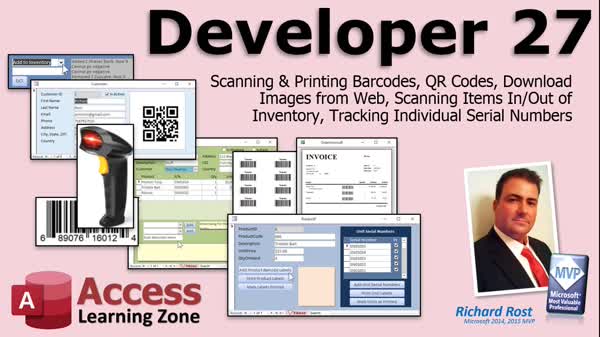
Access Developer 27Barcode Scanning, Label Printing, QR CodesWelcome to Access Developer 27. In this course you will learn how to use barcode scanners with Microsoft Access to track inventory, manage product codes, and scan items in and out. We'll discuss different types of barcodes and barcode scanners, how to print barcode labels using a free font, and how to generate QR codes with the Google Charts API. You will see how to synchronize forms, adjust inventory, integrate barcode functionality for inventory control and order management, and handle tasks like printing labels and tracking serial numbers. Lessons
Database Files
Links
Resources
Lesson SummaryWelcome! Barcode Scanning & Labeling - Welcome to Access Developer Level 27. In this course we will cover using barcodes with Microsoft Access, including scanning items in and out of inventory, tracking unit serial numbers, and managing product codes. We will discuss different types of barcode scanners and barcodes, creating and printing barcode labels using a free font, integrating QR codes with the Google Charts API and web browser control, and downloading and saving QR code images. Additional topics include synchronizing forms, adjusting inventory, tracking and printing serial numbers, and integrating barcode features into your developer database for inventory control and order management.
Lesson 1: Scan & Lookup Barcodes Easily - In Lesson 1, we will discuss the basics of barcode scanning, including the types of barcode scanners available, differences between 1D and 2D barcode symbologies, and using your cell phone as a barcode reader. We will walk through creating a product table with a barcode field in Microsoft Access, building a form to scan barcodes, and setting up a simple lookup feature to retrieve product details by scanning a barcode. We will also briefly mention available resources for product information lookup and touch on recommendations for barcode scanners and cell phone apps.
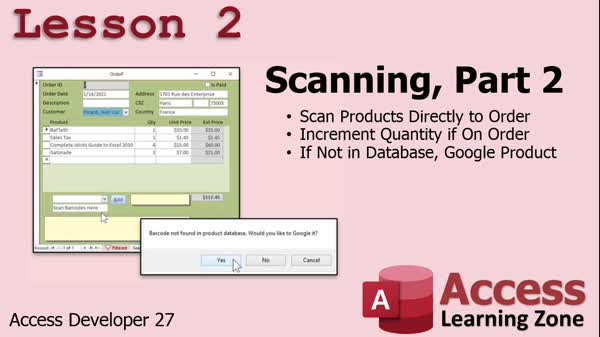
Lesson 2: Scan Barcodes & Auto-Add to Invoices - In Lesson 2, we will learn how to enhance barcode scanning in Microsoft Access by automatically adding scanned products to an invoice, checking if a product is already on the order and incrementing its quantity if needed, and performing a Google search for products not found in the database. We will walk through setting up a barcode scanning field on the order form, managing product lookups, handling duplicate scans, and using VBA to open a web browser for searching product details. This lesson builds on previous barcode scanning techniques to streamline order entry.
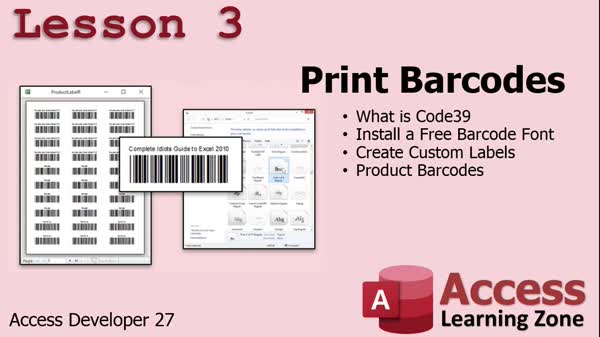
Lesson 3: Print Code 39 Barcodes Free Fonts - In Lesson 3, we will walk through how to print barcode labels using Microsoft Access. We will talk about the Code 39 barcode, why it is suitable for Access databases, and how to install a free Code 39 barcode font. I will show you step by step how to set up barcode labels for your products, including adding the necessary formatting so that your barcodes scan correctly. We will also discuss key points about barcode formats and tips for designing your labels to work with common label printers.
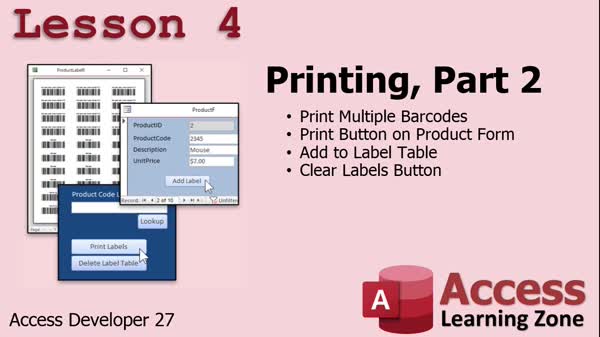
Lesson 4: Print Multiple Barcode Labels - In Lesson 4, we will learn how to print multiple barcode labels for the same product using Microsoft Access. I will show you how to set up a label table, create buttons to add products to the label list, clear the label table, and adjust your report's record source to print the desired labels. We will walk through adding functions to your product form and main menu, using VBA to automate the process, and discuss handling cases when no labels are present. We will also briefly discuss options for more advanced label printing and the potential for adding QR codes.
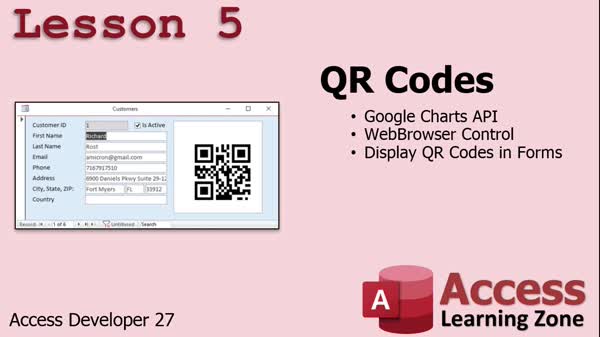
Lesson 5: Show QR Codes with Google Charts - In Lesson 5, we will walk through how to display QR codes in your Microsoft Access forms using the Google Charts API and the Web Browser control. We will discuss the differences between 1D and 2D barcodes, look at the limitations of QR code support in Access, and explore why built-in or third-party add-ins are not ideal. I will show you how to use the Google Charts API to create QR codes from your data and configure the Web Browser control in your form to display them, as well as mention some practical considerations and limitations of this approach.
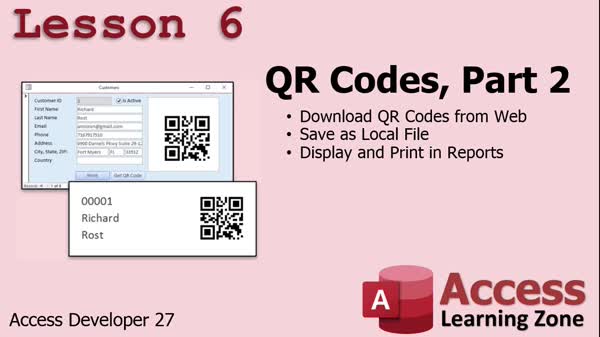
Lesson 6: Download & Print QR Name Badges - In Lesson 6, we will walk through how to download a QR code from the web and save it as a local file under your database folder, reducing repeated use of the Google API and enabling offline access. You will learn how to display these local QR code images within a form, set up error handling and directories, and use the image files in a report to create printable items such as employee name badges. We will also discuss creating a manual update button, managing changes, and handling issues that arise during the process of generating and displaying QR codes in your Access database.
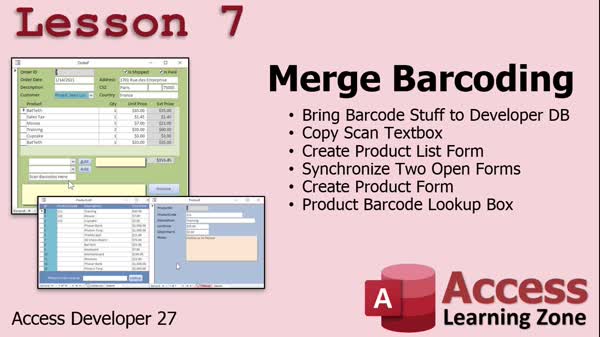
Lesson 7: Barcode Scanning & Form Sync - In Lesson 7, we will merge the barcoding features into the developer database, including adding a barcode scanning text box to the order form and building a product list form. I will show you how to synchronize two different open forms so that selecting an item in the product list automatically opens the corresponding product form. We will also configure the product code lookup scan box on the product list form, set up event handling for barcoding, and discuss indexing product codes to avoid duplicates. This lesson focuses on integrating and refining merge barcoding capabilities within the Access developer template.
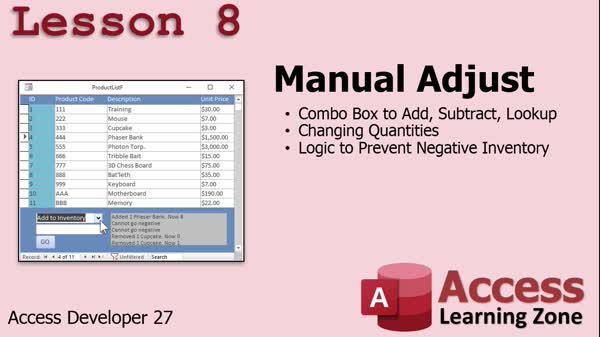
Lesson 8: Add or Remove Inventory by Combo Box - In Lesson 8, we will add the ability to manually add or remove inventory from the product list form using a combo box to select the desired action: lookup, add to inventory, or subtract from inventory. I will show you how to update the quantity on hand, ensure the values do not go negative, and add a status box to track changes. We will also discuss logic for preventing accidental changes, handling security, and briefly touch on related topics like purchase orders and auditing user actions. This lesson will cover the steps to add and remove manual inventory efficiently.
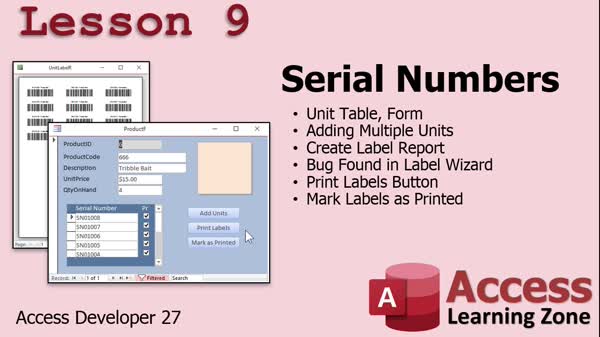
Lesson 9: Track & Print Unique Barcode Labels - In Lesson 9, we will start tracking serial numbers for individual units within your inventory system. I will show you how to create a units table and subform, generate unique serial number barcodes for each unit, and link these to specific products. We will also walk through adding multiple units, handling label printing using reports, and marking labels as printed. Throughout the lesson, I will discuss considerations for updating inventory, avoiding duplicate or mismatched serials, and practical tips for barcode design. Finally, we will see how this helps identify which serial numbers were sold to which customers.
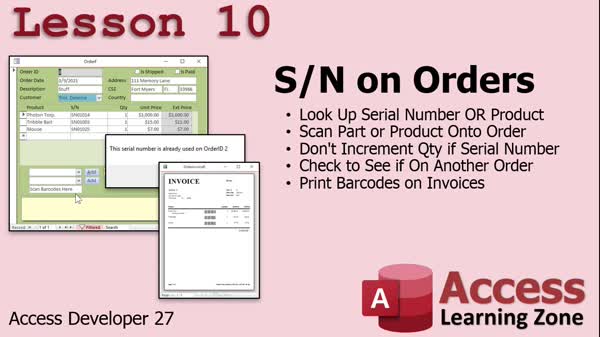
Lesson 10: Track Serials & Prevent Duplicates - In Lesson 10, we will cover how to scan serial number barcodes into orders and properly handle them in the database. We will program the barcode scanning field to distinguish between serial numbers and product codes, look them up, and ensure each serial number is treated as a unique line item on an order. We will also check if a serial number has already been used on a different order, preventing duplicates, and include the serial numbers and their barcodes on printed invoices. We'll discuss handling empty strings vs. nulls in the table, and talk about database design related to storing serial number data.
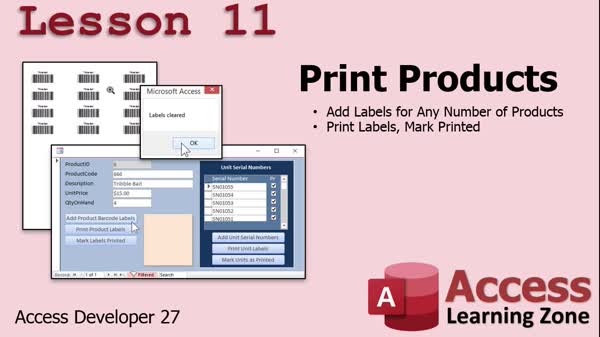
Lesson 11: Print Multiple Barcode Labels - In Lesson 11, we will integrate merge barcode printing for products within our developer database. I will show you how to modify the interface to clearly separate unit serial number labels and product barcode labels, add new buttons to print and mark labels as printed, and adjust the layout for clarity. We will walk through coding changes to allow printing multiple barcode labels at once and discuss ensuring status tracking is included. Finally, we will review how to organize everything visually for ease of use and wrap up our barcode printing functionality.
Lesson 12: Barcode Printing & Scanning Update - In this course we learned how to work with barcodes in Access, including printing barcode labels and scanning them based on requests from users. I explained why there was a delay between lessons, shared some updates about future plans, and mentioned upcoming topics like purchase orders and order entry. We will be revisiting and updating material from Access 300, and I encouraged everyone to send in feedback and use the topic index for questions.
NavigationKeywordsbarcode scanner, barcode labels, inventory tracking, serial numbers, barcode printing, QR codes, Google Charts API, Code 39 barcode, label printing, web browser control, product lookup, order management, merge barcode, inventory adjustment
More InformationTranscriptWelcome to Microsoft Access Developer Level 27 brought to you by AccessLearningZone.com. I am your instructor, Richard Rost. In today's lesson, we are going to cover pretty much everything there is to know about using barcodes with Microsoft Access. Even if you are not planning on scanning and printing barcodes yourself, you will find these lessons useful. I will be talking about scanning items into and out of inventory, including tracking unit serial numbers. You can skip the lessons on printing barcodes if you are never going to print, but if you are ever going to do any kind of inventory control, the rest of the lessons will be great as far as tracking product codes, unit serial numbers, and so on. There is also some extra cool stuff in here, like using the web browser control and downloading images from the web, so there is extra material for everyone. This class follows Access Developer 26. A lot of the database that we use in this class is the database that we have been building over the last couple of classes. If you have not taken 26 and the previous lessons, you might be a little lost, so take 26 first. I also expect that you have a solid foundation in all my Beginner, Expert, Advanced, and other Developer lessons, especially from 16 onward when we cover recordsets. I am using Access 365, which is roughly equivalent to 2016 or 2019. If you have any questions regarding the material covered in today's class, scroll down to the bottom of the page that you are on right now and post them there. Take a minute to read through any other questions that have been posted, as your question may have already been answered. That happens a lot. Also, make sure you click on the subscribe button for this page to make sure you get notified if any other questions, comments, or addendums are posted. As always, if you have Access questions that are not related to today's class, go ahead and post them in my Access forum. Now let's take a closer look at what is covered in Access Developer 27. In lesson one, we will discuss the types of barcode scanners, the different types of barcodes, 1D and 2D barcode symbologies, using your cell phone as a barcode reader, creating a product table with a barcode field, and creating a form to scan a barcode and look up a product. In lesson two, we will learn how to scan a product in and have it automatically added to an invoice. We will also check to see if the product is already on the order and, if so, we will increment the value by one instead of adding lots of line items. We will also learn how to scan a product and perform a Google search on it to display details. This is great for books or any product with a UPC barcode. In lesson three, we are going to learn how to print barcode labels. We will talk about the code 39 barcode and why I prefer it for Access databases. I will show you how to install a free code 39 barcode font. Then we will see how to create custom barcode labels for our products and print them out. In lesson four, you will learn how to print multiple labels for the same product. If you want to print out 10 copies of the same label, it is easy to do. We will create a button on our product form to create individual labels and then a button to clear the table once we have printed. In lesson five, we are going to learn how to use the Google Charts API and the web browser control to display QR codes, which are 2D barcodes, in your Microsoft Access forms. QR codes are great for detailed product info, employee name badges, whole web page URLs, or any time you want to display an image for someone to scan with their phone to get detailed information. In lesson six, you will learn how to download a QR code from the web and save it as a local file on your hard drive in a folder under the current database folder. Then you will learn how to display that file as an image in a report, and in this way we can print employee name badges. In lesson seven, we are going to merge the barcoding elements that we have created into the developer database. We will take the barcode scanning text box that is on the order form and add it over here. We will build a product list form. I will show you how to synchronize two different open forms, so if you click on something in the product list, it will automatically jump to the product form as well. Then we will put the product code lookup scan box on the product list form. In lesson eight, we are going to add the ability to manually adjust our inventory from the product list form. We will make that scan box so we can pick from a combo box whether we are going to just look up, add to inventory, or subtract inventory. This way, when we scan a product, if I have add to inventory selected, it will add a unit, add a unit, add a unit. If I choose subtract from inventory, it will take units out of inventory by subtracting a unit. We will put logic in there to prevent them from going negative. In lesson nine, we are going to start tracking serial numbers. We have made a product code that tracks unique products, like this particular hard drive, this particular stool, or whatever you are selling. Now we are going to track serial numbers for individual units. So if you are selling hard drives, and you have 10 of the same hard drive, this is unit one, unit two, unit three, unit four, and so on. We will print out serial number barcodes for each one of them and track that in your database. We will make a table as part of it, and a subform underneath the product form where we can add units. When you click on the button to add units, and you are going to add 10 of these, it will add 10 labels to your system and print them out. We will mark them as printed so we know those ones are good. Then we will get ready to scan them in the next lesson. In lesson ten, we are going to scan those serial number barcodes onto our orders. We will program the barcode scanning field so it will know whether you scan a serial number or a product number. It will look it up appropriately in the database and add it to the order. It will not use that increment trick where it just adds one to the quantity. If it sees it is a serial number, that is to be a separate line item. We will check to see if that serial number has been used on a different order. We do not want to scan the same barcode twice. Then we will print the barcodes on that person's invoice so they have them, and then we are all set with that. In lesson eleven, we are going to integrate the printing of the barcodes from the product table that we did in one of the earlier lessons. We are just going to add them into the developer database so everything is nice and together. We will make it so we can print any number of barcode labels. Remember in the first lesson, we just did one at a time. This one will again ask the user how many they want. We will make a button to print them and then a button to mark those labels as printed. IntroIn lesson 27 of the Microsoft Access Developer series, you will learn everything you need to know about working with barcodes in Microsoft Access. I will show you how to scan barcodes for inventory management, track products and unit serial numbers, create barcode fields and forms, automatically add scanned products to invoices, print barcode and serial number labels using free fonts, generate and display QR codes with the Google Charts API, use the web browser control to download images, and integrate barcode features into your ongoing developer database. This lesson also covers manual inventory adjustments, building synchronized forms, and preventing inventory errors. QuizQ1. What is the primary topic covered in Access Developer Level 27? A. Advanced SQL queries for Access databases B. Barcode usage with Microsoft Access C. Security features for Access applications D. Integrating Access with Excel Q2. Which of the following is NOT mentioned as a use for barcodes in the course? A. Tracking unit serial numbers B. Performing inventory control C. Sending mass emails D. Looking up product codes Q3. What should a student do if they have not completed Developer Level 26 or previous relevant lessons? A. Skip to lesson three of this course B. Continue with this course without concern C. Take Developer Level 26 first D. Only watch lessons five and beyond Q4. Which barcode symbology is discussed as being preferred by the instructor for use in Access databases? A. QR codes B. Code 128 C. EAN-13 D. Code 39 Q5. What is used to perform a Google search on a scanned product in lesson two? A. Access SQL Query B. Manual search bar C. Built-in Access Search tool D. Barcode scanning integration Q6. What is the purpose of printing multiple labels for the same product, as taught in lesson four? A. To label parts from different suppliers B. To provide additional pricing information C. To create backup labels for each location D. To easily print out several identical labels if needed Q7. Which lesson introduces using the Google Charts API and the web browser control to display QR codes in Access? A. Lesson two B. Lesson three C. Lesson five D. Lesson seven Q8. In lesson six, what are students taught to do after downloading a QR code? A. Edit the QR code with Photoshop B. Store it in a cloud folder C. Save it locally and display it in an Access report D. Email it to customers automatically Q9. What feature is added to the product list form in lesson eight? A. Automatic email reminders for low stock B. Ability to manually adjust inventory C. Sending data directly to a shipping provider D. Importing barcodes from Excel Q10. How does the system handle scanning serial number barcodes in lesson ten? A. It adds them as a generic product B. It ignores serial numbers during order processing C. It treats each serial number as a separate line item D. It merges them into a single order entry Q11. What logic is implemented to ensure inventory units do not go negative? A. Disabling the subtract button B. Preventing users from scanning barcodes C. Adding logic to the scan box to restrict subtraction D. Printing a warning message randomly Q12. Why do students mark barcode labels as printed? A. To delete them from the database B. To ensure those labels are tracked and not reprinted unnecessarily C. To send notification emails to suppliers D. To update the Access application version Answers: 1-B; 2-C; 3-C; 4-D; 5-D; 6-D; 7-C; 8-C; 9-B; 10-C; 11-C; 12-B DISCLAIMER: Quiz questions are AI generated. If you find any that are wrong, don't make sense, or aren't related to the video topic at hand, then please post a comment and let me know. Thanks. SummaryToday's video from Access Learning Zone covers everything you need to know about working with barcodes in Microsoft Access. Even if you do not plan to scan or print barcodes yourself, these lessons are very useful. I discuss how to scan items in and out of inventory, including tracking serial numbers for individual units. If you are not printing barcodes, you can skip those sections, but the rest of the tutorials will help you manage product codes, unit tracking, and similar tasks. There are also interesting additions in this class, such as learning how to use the web browser control and download images from the web, so there is something for everyone. This course picks up where Access Developer 26 left off. The database used in this class continues from what we built in the past few Developer levels. For those who have not yet completed lesson 26 and the earlier material, I highly recommend doing so first, otherwise you may be confused. You should also have a solid background in my Beginner, Expert, Advanced, and the other Developer courses, especially from level 16 onward, since we start using recordsets in those lessons. I am currently using Access 365, which works about the same as Access 2016 or 2019. If you have questions related to this class, you can submit them at the bottom of this website page. It helps to read through the other questions first, since yours might have already been answered. Also, you can subscribe to this page so you are notified of any new questions, comments, or updates. If you have general Microsoft Access questions that do not relate directly to this class, make sure to ask those in my Access forum. Let me explain what is covered in Access Developer 27: Lesson one starts by reviewing different types of barcode scanners and the main barcode formats, including 1D and 2D symbologies. I show how to use your phone as a barcode reader, set up a product table with a barcode field, and create a form that scans a barcode and looks up the relevant product. In lesson two, we learn to scan products directly into an invoice. If you scan a product that is already part of the order, the quantity increases instead of adding multiple line items. I also explain how to scan a product and instantly perform a Google search to display its details which is useful for books or anything with a UPC barcode. Lesson three focuses on printing barcode labels. I highlight the Code 39 barcode and explain why it is the best choice for Access databases. I show you how to install a free Code 39 font and demonstrate how to generate custom barcode labels for products and print them. Lesson four covers printing multiple copies of a label for the same product. For example, if you need 10 copies of one label, you will have a button to generate labels and another to clear them from the table when printing is finished. Lesson five explores how to use the Google Charts API and the web browser control to show QR codes (2D barcodes) in your Access forms. QR codes are especially useful for detailed product information, employee badges, web addresses, or whenever you want to let someone scan an image with their phone for more details. In lesson six, you will see how to download a QR code from the web, save it locally inside a folder under your database directory, and display the image in a report. This is a good solution for printing things like employee badges. Lesson seven demonstrates how to merge barcode functionality into your developer database. I show you how to take the barcode scanning text box from the order form and add it where needed. We create a product list form and synchronize different open forms, so that selecting something in the product list automatically updates the product form. The product code scan box is also placed on the product list form. Lesson eight adds the ability to manually adjust inventory from the product list form. You will be able to choose, from a combo box, whether you want to just look up a product, add to inventory, or subtract from inventory. When you scan a product, it will follow the correct operation depending on which mode is selected, and it will not allow the inventory to go below zero. Lesson nine introduces tracking of unit serial numbers. While product codes track product types, serial numbers track individual items such as separate hard drives or units sold. For each individual item, a unique barcode with its serial number is printed and stored in the database. We set up a subform under the product form to add these units, and you will be able to print and track each serial number label as you add them. Lesson ten explains how to scan these serial number barcodes onto your orders. The barcode scanning field will be set up to distinguish between scanning a serial number and a product number, then handle them correctly in the database. Serial numbers are always separate line items, and we ensure the same serial number is not used twice. We will also print the appropriate barcodes on invoices. Lesson eleven wraps everything up by integrating barcode label printing from the product table into the main developer database. I will show you how to print any number of barcode labels, ask the user for the quantity, generate them, and then mark those labels as printed once done. If you want to see a complete video tutorial with step-by-step instructions for everything I discussed here, you can find it on my website at the link below. Live long and prosper, my friends. Topic ListTypes of barcode scanners explained 1D vs 2D barcode symbologies Using a cell phone as a barcode reader Creating a product table with barcode fields Building a form to scan and look up products Automatically adding scanned products to invoices Incrementing quantities for duplicate scanned products Scanning barcodes to perform Google searches Printing barcode labels for products Installing a free Code 39 barcode font Creating custom barcode label reports Printing multiple labels for the same product Adding form buttons for label creation and clearing Displaying QR codes in forms using Google Charts API Using the web browser control to display QR codes Downloading QR codes and saving as images Displaying QR code images in reports Printing employee name badges with QR codes Merging barcode features into your developer database Synchronizing two Access forms for product lookup Placing barcode scan boxes on product list forms Manually adjusting inventory through scan actions Combo box selection for inventory operations Validation to prevent negative inventory Tracking unique serial numbers for units Printing serial number barcodes for each item Creating a serial numbers subform under products Adding multiple units and generating serial labels Marking serial number labels as printed Scanning serial number barcodes onto orders Differentiating serial vs product number scanning Validating unique serial number usage in orders Printing barcodes on invoices Integrating barcode label printing fully in database Prompting user for number of barcode labels to print Buttons to print and mark barcode labels as printed Primary Topicsbarcode scanners, barcode symbologies, inventory management, serial number tracking, barcode label printing, Google Charts API, QR code display, Access forms integration, product lookup, inventory adjustment Secondary Topicsform synchronization, Google search integration, UI enhancements, combo box actions, preventing negative inventory |
||||||||||||||||||||||||||||||||||||||||||||||||||
|
| |||
| Keywords: barcode scanner, barcode labels, inventory tracking, serial numbers, barcode printing, QR codes, Google Charts API, Code 39 barcode, label printing, web browser control, product lookup, order management, merge barcode, inventory adjustment PermaLink How To Scan, Print, and Track Barcodes, QR Codes, and Serial Numbers for Inventory in Microsoft Access |