|
||||||
Access Beginner 6Address Queries, Employee Table, Photos, BadgesWelcome to Access Beginner 6. In this course you will learn how to create and use address completeness queries to identify customers with full or missing address information, design mailing label and secretary reports, and build an employee table with custom fields. We will also walk through creating an employee form with pictures, inserting and resizing employee images, and generating printable name badges that include employee photos and a company logo. We'll discuss report design tips, input masking, and best practices for managing employee and image data within your Access database. Lessons
Resources
A Note About ImagesWhen this course was recorded in 2012, it was common practice to store small images directly inside your database. Over the years, however, best practices have changed. Today, for large numbers of photos, high-resolution images, or files that change frequently, I recommend storing the image files in a folder (or subfolder) and saving only the file path in your database instead. That said, this lesson is absolutely not a waste of time. There are still plenty of situations where storing images inside your database makes sense. Small, static images such as a company logo, a handful of employee photos, icons, or other graphics that rarely change can work just fine. The key is moderation. You generally don't want to store hundreds or thousands of large, high-resolution images directly in your database anymore. I still recommend watching these lessons so you can understand how image storage in Access works and appreciate how techniques have evolved over the years. I've also recorded a newer video explaining the modern approach, which you can watch here: Images. If you want to learn even more about working with images in Access, check out my Imaging Seminar. I'll also be revising Access Beginner 6 in the future to spend less time on OLE objects and focus more on current image management techniques. Stay tuned. Lesson SummaryWelcome! Address Queries & Employee Tables - Welcome to Access Beginner Level 6. In this course we will build on previous lessons by working with queries to identify customers with complete or missing address information, create reports and mailing labels based on those queries, add employee data by creating a new table, and design an employee form with pictures. We will also cover making printable name badges for employees and discuss the structure and progression of the Access course series, as well as how to get help and make the most of these lessons.
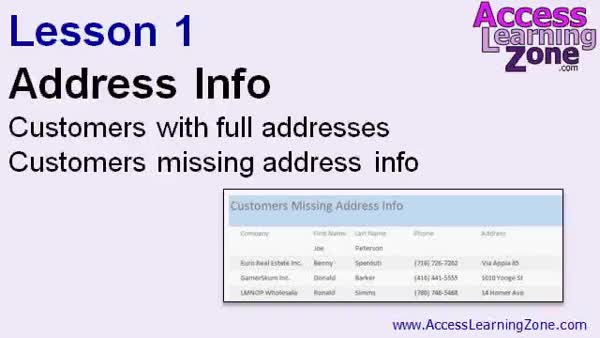
Lesson 1: Find Customers Missing Address - In Lesson 1, we will focus on customer address info by creating two queries: one to find customers who have full addresses and another to identify those missing any address details such as street, city, state, or postal code. We will walk through building mailing label and secretary reports using these queries, adjusting query criteria with IS NOT NULL and OR conditions, and updating the mailing label report to use the new full address query. We will also discuss troubleshooting report design and briefly cover tips for adjusting print layouts and working in report layout mode.
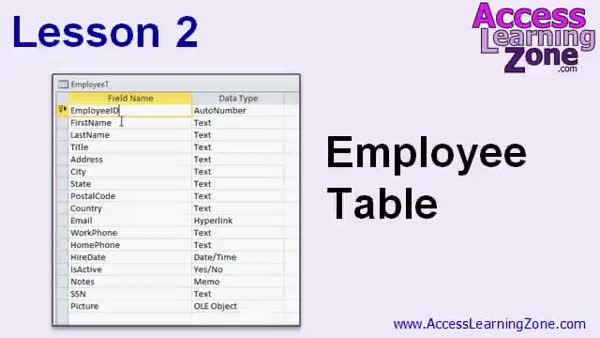
Lesson 2: Create Employee Table & Fields - In Lesson 2, we will build an employee table in our database, similar to the customer table but with different fields suited for storing employee information. I will show you how to create the table, copy and adjust relevant fields from the customer table, and add fields unique to employees, such as title, social security number, work and home phone numbers, and a picture. We will discuss input masks for sensitive fields and best practices for retaining past employee data, and I will show you how to edit hyperlinks. At the end, we will enter some sample data into the employee table.
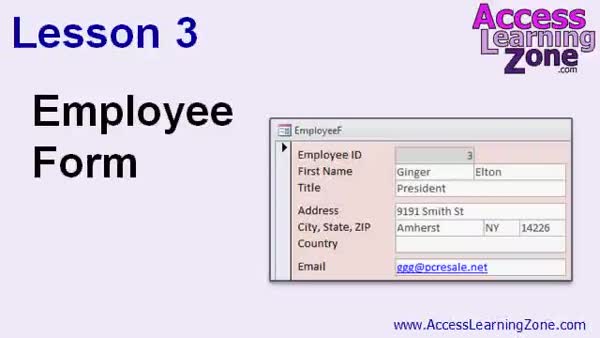
Lesson 3: Build & Format Employee Form - In Lesson 3 we will walk through constructing our employee form in Access. We will add fields from the Employee table, arrange and align them neatly, copy address and notes blocks from the customer form for consistency, and use tools like the grid alignment, resizing, and format painter to improve the form's appearance. We will also make the Employee ID field read-only and adjust field label formatting. Finally, we will save and review our employee form, making minor adjustments to alignment and appearance for a clean and professional layout.
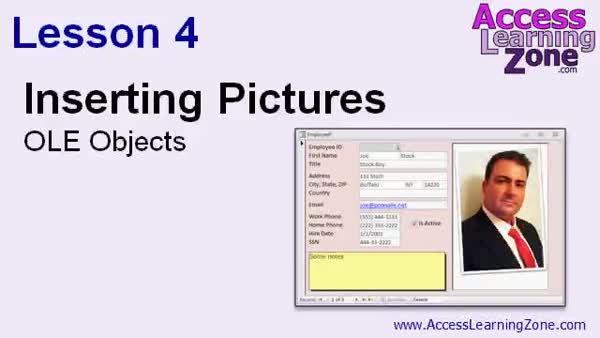
Lesson 4: Insert, Show, Resize Photos - In Lesson 4, we will learn how to insert pictures into an employee record using the employee form in Access. I will show you how to acquire, save, and format employee pictures, and walk through the process of dragging and dropping images into an OLE object field. We will discuss the formats that display best, such as Windows Bitmap files, and look at how to adjust picture display settings, including size modes. You will also see how to resize the picture area on your form and use the Insert Object menu for adding or linking images.
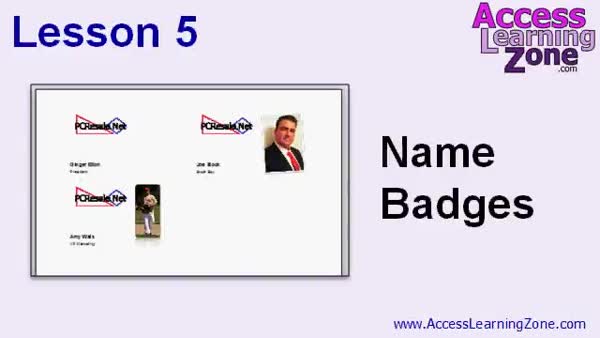
Lesson 5: Employee Name Badges w/ Photos - In Lesson 5, we will walk through how to create an employee ID report in the form of printable name badges that include the employee's picture, name, title, and a company logo. I will show you how to select label sizes, adjust layout and font, add employee photos using a bound object frame, and insert a static company logo image. We will also discuss resizing images and the differences between bound and unbound object frames, as well as basic tips for managing images in your Access database.
Lesson 6: Address Queries, Tables & Forms - In this course we learned how to create address queries to organize customer mailing labels and identify missing information, worked with the IsNull and IsNotNull keywords, and explored table design by copying fields and adding OLE objects for storing pictures. We also built an employee form, practiced adding and aligning images, and discussed image properties like stretch, clip, and zoom. Additionally, we created a name badge report, added a static company logo, and reviewed resources for additional support, course upgrades, and ways to interact with the Access learning community.
NavigationKeywordsaddress queries, employee table, employee form pictures, mailing labels, missing address info, IsNull, IsNotNull, employee name badges, OLE object, image resizing, input masks, report layout, company logo, bound object frame, hyperlink field
More InformationTranscriptWelcome to Microsoft Access 2010 Beginner Level 6, brought to you by AccessLearningZone.com. I am your instructor, Richard Rost. We are going to start today by doing some more query work. We are going to begin by making some address queries. The first query will be to see which customers are not missing any address information. They have an address, city, state, and zip code. That way, we can correct our mailing label report to only send mailings to customers where we have the complete address. Then we will make a second query to show any customers who are missing any bit of address information. So if someone is missing a zip code, for example, I can print out a list to hand to the secretary and say, please call this customer and get their zip code. Then we are going to add employee data to our database. We will start with an employee table. It will be pretty similar to the customer table we built before, but you will see some new data types on there. We will build an employee form. I will show you how to put pictures in your forms so you can display them on the form and on a printable report. We will make a name badge report where we can make name badges for all of our employees with their picture, name, title, and a company logo. This class follows Access Beginner Level 5, which is very important, especially for lesson 1 in today's class, where we make the address queries. Level 5 covers query criteria, null values - very important for today - and parameter queries. Today's class will be using Access 2010. 2007 is almost identical. If you are using 2003 or earlier, you should still be able to follow along, but you would be better off getting my Access 2003 lessons from my website. You are encouraged to build the database that I build in class yourself, follow along with the videos and make the database yourself, but if you are lazy like me and you want to just download a copy, go to accesslearningzone.com/databases, and you can grab a copy of the database from this class and from the previous class if you want to start off from that spot. My courses are broken up into four groups: Beginner, Expert, Advanced, and Developer. My Beginner courses are for novice users who have little or no experience with Microsoft Access. They are designed to give you an overview of the basic features of Access and cover just what you need to know to be productive. The Expert classes are designed for more experienced users who are already comfortable with Access. Expert classes go into a lot more depth about each topic than the Beginner classes do, and will cover more functions, features, tips, and techniques for power users. Once you have mastered the Expert classes, move up to the Advanced lessons. You will learn how to work with macros, automation, and many more advanced features that really add enhanced functionality and professionalism to your databases. Finally, my Developer Level courses are designed to teach you how to program in Visual Basic for Microsoft Access. This will allow you to create the most advanced databases possible and unlock the true potential of Microsoft Access. Each series is broken down into different numbered levels starting with Level One. Each subsequent level teaches you new and different topics in Microsoft Access, building on the lessons learned in the previous classes. Once you have finished all the Beginner classes, move up to the Expert series, then the Advanced, and finally the Developer lessons. In addition to my normal Access classes, I also have seminars designed to teach specific topics. Some of my seminars include building web-based databases, creating forms and reports that look like calendars, securing your database, working with images and attachments, writing work orders, tracking accounts payable, learning the SQL programming language, and lots more. You can find complete details on all these seminars and more on my website at AccessLearningZone.com. If you have questions about the topics covered in today's lessons, please feel free to post them in my student forums. If you are watching this course using my custom video player software or the online theater on my website, you should see the student forum for each lesson appear in a small window next to the class videos as long as you have an active internet connection. Here you will see all of the questions that other students have asked as well as my responses to them and comments that other students may have made. I encourage you to read through these questions and answers as you start each lesson and feel free to post your own questions and comments as well. If you are not watching the lessons online, you can still visit the student forums later by visiting AccessLearningZone.com/forums. To get the most out of this course, I recommend that you sit back, relax, and watch each lesson completely through once without trying to do anything on your computer. Then, replay the lesson from the beginning and follow along with my examples. Actually create the same database that I make in the video, step by step. Do not try to apply what you are learning right now to other projects until you master the sample database from this class. If you get stuck or do not understand something, watch the video again from the beginning or tell me what is wrong in the student forum. Most importantly, keep an open mind. Access might seem intimidating at first, but once you get the hang of it, you will see that it is really easy to use. Now let us take a closer look at exactly what is covered in today's class. In Lesson One, we are going to make queries that are interested in customer address information. The first query will show us only customers who have full addresses. The second query will show us customers who are missing any bit of address information, whether it is the street address, the city, state, postal code, and so on. Then we will make a new set of mailing labels and a report for our secretary to check on customers who are missing address information. In Lesson Two, we are going to build an employee table, which will be similar to our customer table, but will have some different fields. In Lesson Three, we will construct our employee form. In Lesson Four, we will learn how to insert the employee's picture into the record on the employee form. In Lesson Five, we will make printable name badges with the employee's picture, name, title, and a company logo. IntroIn lesson 6, you will learn how to create queries in Microsoft Access 2010 to find customers with complete or missing address information, update your mailing labels, and generate reports to help track incomplete addresses. We will also cover how to add employee data to your database, including designing an employee table, building an employee form, adding pictures to records, and creating printable name badges with photos, names, titles, and a company logo. QuizQ1. What is the purpose of the first address query discussed in the lesson? A. To find customers who have complete address information B. To delete customers with incomplete addresses C. To update customer phone numbers D. To find duplicate customer entries Q2. What does the second address query focus on? A. Customers with complete phone number information B. Customers who have purchased products C. Customers who are missing any part of their address D. Customers with recent order activity Q3. Why is it important to only send mailings to customers with complete address information? A. To reduce printing costs B. To ensure mailings are delivered successfully C. To promote new products D. To identify VIP customers Q4. What tool will be created to help the secretary obtain missing address information? A. A list to hand to the secretary B. A phone call script C. An email marketing campaign D. A customer satisfaction survey Q5. What new database element will be introduced in this lesson? A. Inventory table B. Employee table C. Sales order table D. Vendor table Q6. What feature will the employee form include that is new compared to previous forms? A. Custom macros for automation B. Displaying employee pictures C. Barcode scanning D. Email automation Q7. What is the purpose of the name badge report? A. To print address labels for customers B. To generate sales reports C. To create name badges for employees with picture, name, title, and company logo D. To summarize annual employee performance reviews Q8. What Access topics were covered in Level 5 and are important for today's lesson? A. Action queries and joins B. Query criteria, null values, and parameter queries C. Macros and automation D. VBA programming Q9. Which Access versions are almost identical to what is shown in this course? A. 2013 and 2016 B. 2007 and 2010 C. 2003 and earlier D. 2019 and Office 365 Q10. What is recommended before trying to apply lessons to a personal project? A. Memorize all Access functions B. Build the sample database step by step as shown in the video C. Jump to Developer lessons first D. Only watch the video once Q11. What should a student do if they have questions about the lessons? A. Contact Microsoft support directly B. Post in the student forums on AccessLearningZone.com C. Wait for the next class D. Read the user manual Q12. What is the progression of Access courses as suggested in the video? A. Beginner, Developer, Expert, Advanced B. Expert, Beginner, Advanced, Developer C. Beginner, Expert, Advanced, Developer D. Developer, Beginner, Expert, Advanced Q13. What are the Expert classes designed for? A. Novice users B. Users comfortable with Access who want more depth and tips C. Only database administrators D. Developers working with VBA Q14. What types of seminars are offered in addition to regular classes? A. Web-based databases, forms as calendars, database security, SQL language, and more B. Only customer service skills C. Management and leadership seminars D. Graphic design classes Q15. What is suggested as the best approach for learning from the video lessons? A. Read the transcript only B. Watch each lesson fully first, then replay while following along and creating the same database C. Try to customize everything as you go along D. Only listen to the audio Answers: 1-A; 2-C; 3-B; 4-A; 5-B; 6-B; 7-C; 8-B; 9-B; 10-B; 11-B; 12-C; 13-B; 14-A; 15-B DISCLAIMER: Quiz questions are AI generated. If you find any that are wrong, don't make sense, or aren't related to the video topic at hand, then please post a comment and let me know. Thanks. SummaryToday's video from Access Learning Zone is Microsoft Access 2010 Beginner Level 6. I am your instructor, Richard Rost. In this lesson, we begin by working further with queries, specifically focusing on address information for our customers. The first task is to create a query that helps us identify customers who have complete address details - meaning each customer record should have an address, city, state, and zip code. This is essential for generating accurate mailing labels and ensuring that we only send mailings to those with full address information. Next, we develop another query that finds customers who are missing any part of their address. For example, if a customer does not have a zip code on file, they will appear in this query. This allows us to generate a list that can be given to a secretary or staff member, so they can contact these customers and gather the missing information. After tackling these address queries, we shift our focus to adding employee information to our database. We start by building a table for employee data. While this table will be similar to the customer table we built earlier, there will be some new data types to explore. Following that, we will create a form for employee records, including the ability to display pictures for each employee, both on the form and within a printable report. Then, we will create a report specifically for producing employee name badges. These badges will feature the employee's photo, name, job title, and a company logo, making them suitable for practical use as identification within your organization. Today's class builds directly on concepts from Access Beginner Level 5, especially regarding query criteria, handling null values, and parameter queries. If you have not yet completed Level 5, I recommend reviewing it first, as these topics are crucial for successfully working through the address queries in this session. This course uses Microsoft Access 2010. Users of Access 2007 should find the instructions nearly identical. If you are working with Access 2003 or earlier, most of the material still applies, but you may want to consider reviewing my Access 2003 tutorials, which are available on my website. You are encouraged to build the sample database alongside me as you watch the lessons. However, if you prefer not to, or want to save time, you can download a copy of the completed database from this class - as well as from previous classes - straight from my website at accesslearningzone.com/databases. My course offerings are structured into four levels: Beginner, Expert, Advanced, and Developer. The Beginner series is intended for those new to Microsoft Access, providing a solid introduction to all the essential features you need to become productive quickly. If you are more comfortable with Access already, the Expert series takes a deeper look at each topic, introducing more advanced features, functions, and techniques for more power and flexibility. Once you have completed the Expert series, you can progress to the Advanced series. These classes introduce macros, automation tools, and more robust features to enhance the professionalism and functionality of your databases. Finally, the Developer level focuses on programming with Visual Basic for Access, enabling you to create complex and powerful databases that harness the full capabilities of Microsoft Access. Each series is divided into levels, starting at Level One, with each subsequent level building on the knowledge from previous lessons. The goal is to provide a logical path from beginner to developer, making it easier to become proficient over time. Alongside the standard courses, I offer seminars that address specific topics in depth, such as building web-based databases, designing calendar-like forms and reports, database security, working with images and attachments, creating work order systems, handling accounts payable, learning SQL, and more. Comprehensive details for all seminars are available on my website at AccessLearningZone.com. If you have questions as you go through today's lessons, you are welcome to post them in the student forums. If you are using my video player software or website, the forum for each lesson is visible in a panel next to the video, so long as you have an internet connection. There, you can read past questions and my responses, as well as comments from other students. I highly recommend engaging with these discussions and posting your own questions as they come up. If you are watching offline, you can still access the forums directly from the Access Learning Zone website. To get the most out of the course, I suggest you watch each lesson all the way through first, without trying to follow along on your computer. After the initial viewing, watch the lesson again and build the database step by step, just as shown in the video. Focus on mastering the techniques in the sample database before trying to apply them to your own, unrelated projects. If you get confused or stuck, rewatch the lesson or reach out to me in the student forum. Approach the lessons with an open mind. Access might look overwhelming at first, but as you spend some time learning, you'll discover it is much easier to use than it appears. Here's a closer look at what today's class covers: Lesson One: We design queries focused on customer address data. The first query identifies only those customers with complete address records. The second query highlights customers missing part of their address information, such as street, city, state, or postal code. We then use these queries to print mailing labels and generate reports to help staff follow up with customers missing information. Lesson Two: We create a new employee table. This is similar to the customer table but with fields relevant to employee data. Lesson Three: We build an employee form for easier entry and management of employee records. Lesson Four: We add employee photos to the records in the employee form. Lesson Five: We design a printable employee name badge report, including the employee's picture, name, title, and a company logo. You can find a complete video tutorial with step-by-step instructions on everything discussed here on my website at the link below. Live long and prosper, my friends. Topic ListCreating a query to show customers with complete addresses Creating a query to show customers with missing address info Generating a mailing label report for customers with full addresses Creating a report listing customers missing address information Building an employee table with new field types Constructing an employee data entry form Inserting employee pictures into forms Displaying employee pictures on printable reports Creating employee name badge reports with photos and logos Primary Topicscustomer address queries, identifying missing data, mailing label reports, employee table creation, employee form design, inserting images in forms, name badge reports Secondary Topicscourse structure, recommended learning process, student forums |
||||||||||||||||||||||||||||||||||||||||||||||||||||||||||||||||||||||||||||||||||||||||||
|
| |||
| Keywords: address queries, employee table, employee form pictures, mailing labels, missing address info, IsNull, IsNotNull, employee name badges, OLE object, image resizing, input masks, report layout, company logo, bound object frame, hyperlink field PermaLink Microsoft Access Beginner 6 |